
NAZARETH. – City of Galilee where Jesus, with Mary Most Holy and St. Joseph, led the hidden life. The name is written and interpreted in various ways. Ναζαρεθ or Ναζαρετ, corresponding to the Syriac Nāsrat and the Hebr. Nāsreth, seems to mean “watchtower, guard.” St. Jerome interprets it from nēser as “flower, shoot.” The form Ναζαρα (Lk. 4:15; Mt. 4:13) seems to be a Hellenization, like Ναζωραῖος, the name given to Christians, not without contempt. In the time of Our Lord the city was of no importance (Jn. 1:46), but it subsequently acquired significance through the events of Jesus’ life (Mt. 4:13; Lk. 1:26; 2:4, 39, 51; 4:16) and through the appellation “prophet of N.” given to him (Mt. 21:11; Acts 10:38). In the 2nd century A.D. the city was inhabited by Jews, among whom Count Joseph of Tiberias built a church for Christians. The Jews remained there at least until the 6th century, despite the Christianization.
In 634 N. was occupied by the Arabs, who a century later made life very difficult for the Christians. In the 12th century the Crusaders raised N. to the status of an episcopal see, transferring it from Bejsān; but the city, having fallen again into Muslim hands, suffered greatly, especially under the ferocious Bejbars in 1263. In 1291 the translation from N. Loreto (v.) is placed. In 1390 the Franciscans were able to open a convent there, but it lasted only a short time because of the Arabs’ harassment; they re-established themselves in N., and definitively, in 1620. In modern times many other religious communities have gone to settle in N., forming an active center of Christian life. In 1948 it was occupied by Jewish forces, which still hold it today. The inhabitants, as a result of the war, number approximately 19,000, including residents and refugees, the majority of whom are Christians.
The location of ancient N. must be placed, contrary to Kopp’s opinion, on the hill where there are
The principal monuments of N. are: 1) the sanctuary of the Annunciation (Lk. 1:26–38), of Piacenza (v.) says in 570 that « domus s. Mariae basilica est ». Excavations carried out in 1899 and 1909 brought to light a Byzantine pavement near the sacred grotto, traditionally regarded as the house of Mary; they also revealed the remains of a large three-aisled church erected by the Crusaders, in which the grotto remains in the northern aisle. The present church was reconstructed above these remains in 1730, so that the grotto would remain beneath the high altar. 2) The sanctuary of the Nourishment, or house of St. Joseph, reconstructed in 1914 along the Crusader foundations. Inside it are the remains of an olive press with a mosaic floor and a grotto on two levels. It is believed to be identifiable with the church « super duos fundata cancros » Arculf (v.) in 670. 3) The church of St. Gabriel, reconstructed in the 17th century on what seems to have been a Crusader foundation; it is connected with the account of the apparition at the fountain narrated in the Protoevangelium of James (11:1). 4) Later the fountain was diverted farther south and is today in a rudimentary building near the road leading to Tiberias. 5) The Precipice (Lk. 4:30), identified by the Commemoratorium de casis Dei of 808 as one mile from N., specifically at the present-day Gebel el-Qafzeh, where the remains of an apse can be seen. 6) The Tremor, a sanctuary connected with the preceding one and dedicated to the Virgin, whose existence Poggibonsi attests in 1347. 7) The synagogue, now a Melkite church, built, it seems, on the site of the ancient one mentioned by the apocrypha.
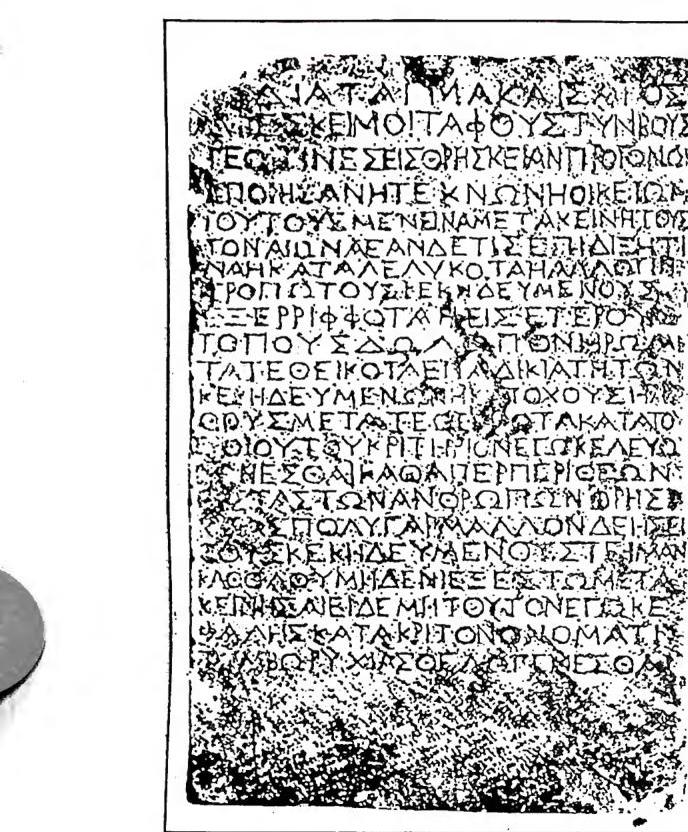
EDICT (RESCRIPT) of N. – Greek inscription bearing the title Διάταγμα Καίσαρος, carved on stone (0.60 × 0.375), sent from N. to Paris in 1878, preserved since 1925 in the Froener collection at the Musée des Médailles, interpreted and published in 1930 by F. Cumont.
The imperial Edict concerns the violatio sepulchri and prescribes that all tombs remain untouched and that no one dare to tamper with, exhume, or remove « through wicked deceit » bodies or inscriptions. It concludes: « absolutely no one shall be permitted to carry out transfers; otherwise I wish that such a person be condemned to capital punishment ».
F. Cumont proposed the hypothesis that the Edict was a response to the report sent by Pilate concerning the trial of Jesus and the disappearance of the body, which, according to the calumny spread by the members of the Sanhedrin, had been stolen by the disciples (Mt. 28:11–15). The procurator of Judea, having received the order, would have had it transcribed in Greek and displayed in N., the homeland of Jesus. The following observations have been made against Cumont’s explanation: there is no positive evidence of an official report by Pilate to Tiberius concerning the trial of Jesus; the name « Caesar » in the inscription may refer to Augustus, Tiberius, or Gaius (Caligula); the occasion of the decree may have been, rather than a concrete and specific case, the general practice of profaning tombs; its provenance from N. does not establish its original destination; the Greek language presupposes a Hellenistic city.
Although the form of the carved letters may date the inscription to the 1st century, it contains no positive elements in itself for a secure dating.