
TIBERIADE. – City of Palestine, situated almost at the center of the western shore of the lake of the same name, founded near ancient Reccath (Ios. 19:36) between the years 18 and 22 Herod Antipas (v.), tetrarch of Galilee, who named it T. in honor of the emperor Tiberius.
At first the more observant Jews decided not to live there, because T. was considered an impure place, having been built partly over the necropolis of the neighboring city; Herod therefore summoned outcasts and convicts, who formed its first urban nucleus. Raised to the capital of Galilee, and with the government offices and banks transferred there from Sepphoris, the Jews, once the rabbis had lifted the interdict, flocked there in large numbers, forming the majority of the city, which became the most populous in Galilee.
The city’s constitution was Hellenistic, with a senate of 600 members presided over by an archon; with a strategos for internal affairs and an agoranomos for the supervision of the markets. The royal palace was decorated with figures of animals, a cause of scandal to the Jews, who razed it to the ground in 66; there were a stadium, a forum, a temple for the pagans, and numerous synagogues for the Jews. Favored by Claudius, the city inscribed on its coins the title Tiberias Claudiopolis Syriae Palestinae. In A.D. 55 it was assigned by Nero to Agrippa II, a friend of the Romans, and in 66, as the legions approached, although defended and fortified by Flavius Josephus, it surrendered to Vespasian. After the fall of Jerusalem, it became the religious center of the nation: the Sanhedrin resided there; a celebrated rabbinic school arose there, which around the Mishnah compiled the “Jerusalem” Talmud in the fourth century and in the seventh century elaborated the Masorah (v.), to which it added a vocalic pointing known as that of T.
Constantine authorized the converted Jew Joseph of T. to open a church there, and in the fifth century the Christian community had its own bishop, suffragan of the bishop of Scythopolis. Justinian erected other churches, among them one dedicated to S. Peter, which survived even after the Muslim occupation of 637, when T. became the capital of the “province of the Jordan.” Conquered by the Crusaders in 1099, it became the capital of the Principality of Galilee, entrusted to Tancred, who surrounded it with walls, built churches and monasteries there, and founded a Latin bishopric. Taken in 1187 by Saladin, and returned for a brief period to the Christians in 1240, it declined under Arab and Turkish rule into a miserable fishing village. In the eighteenth century the sheikh 'Omar
eş-Zâhir, known by the name of Dâhir, promoted its urban development, renewed the circuit of its walls, and erected a citadel there, still visible today, although shattered by the earthquake of 1837. The city presents no elements of archaeological interest; medieval and Arab material has been used in recent constructions. Columns, capitals, and remains of the walls of a synagogue with a mosaic floor indicate the prosperity of the Roman city.
Jewish immigration, the founding of flourishing colonies in the vicinity,
and, after the flood of 1934, reconstruction according to a new plan with the creation of villas and new neighborhoods, have made T. an important center in the State of Israel, as a seaside resort.
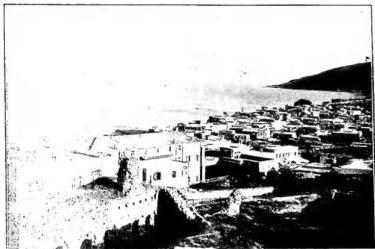
(photograph by Laboratorio Zincografico Terra Santa)
TIBERIADE – Panorama of the modern city and the lake.
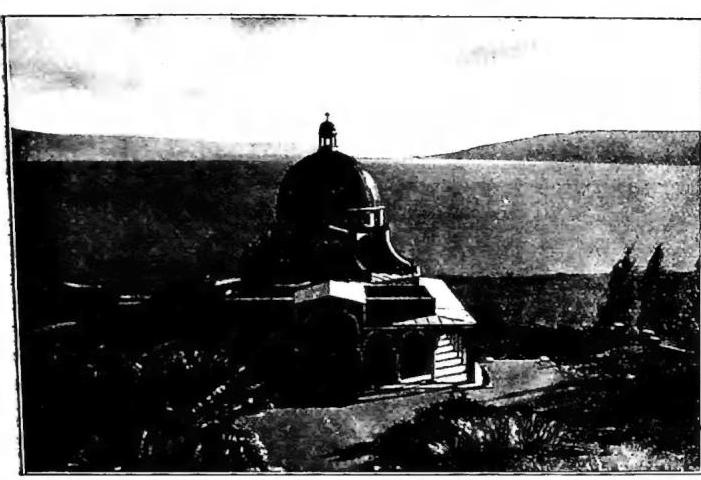
The region was different in the time of Jesus, who chose the shores of the lake as the centre of his apostolate, Cafarnao (v.). There he gathered the crowds and spoke to them, seated in fishing boats (Mt. 13, 1-3); from among the fishermen of the lake he chose his Apostles (ibid. 4, 18-22); in Peter’s boat he crossed it several times from one shore to the other, calming a violent storm (ibid. 8, 23-27). There occurred the miraculous catch of fish (Lc. 5, 1-11), the coin found by Peter to pay the tribute (Mt. 17, 20), the appearances of Jesus upon the waters (ibid. 14, 31), and finally, after the Resurrection, the confirmation of the primacy to s. Pietro (Io. 21). The towns and surrounding hills recall his apostolate, the preaching of the beatitudes and of the parables. Of the cities mentioned in history, situated on the shore or on the surrounding hills and fallen into ruin, the following have been identified through archaeological excavations: Tarichea or Magdala (= the village of el-Megdel); Cafarnao (= Tell Hüm); Corozain (= Hirbet Kerāzeh); Filateria, south of T. (Hirbet Bejt Jerah), where the most important archaeological excavation is in progress. On the eastern shore are Bethsaida Giulia, identified with et-Tell, and Gergesa, at el-Kursi; excavations in recent times have brought to light, in the bay of et-Tābīgah, a church from the 4th century commemorating the multiplication of the loaves, a chapel from the 4th century on the hill called of the Beatitudes, and, on the shore of the lake, another chapel dedicated to the primacy of s. Pietro.