
GENESARETH (Hebr. Kinnereth). — A Canaanite city (Kinnereth in the list of Tuthmosis III) assigned by Joshua to the tribe of Nephthali (Ios. 19, 35), which from ancient times gave its name to the lake (Jäm Kinnereth: Num. 34, 11; Ios. 15, 27). It is identified with Tell el-'Orejmeh, 11 km north of Tiberias, on the northwestern shore of the lake.
The archaeological exploration of 1929–30 revealed its occupation from 1600 to 800 B.C., the small Roman military harbor of the first century, and the strategic importance it had from the earliest times in defending the Via maris. A fragment of a stele and a scarab of Tuthmosis III, another scarab of Queen Teje, wife of Amenophis III, and a fragment of a cultic vessel from the time of Ramses II were found there.
After the exile, the plain, so highly praised by Fl. Josephus (Bell. Ind., III, 10, 7) for its fertility, extending from Tell el-'Orejmeh to Megdel (= Magdala), was called Genesar (gan haš-šar “garden of the prince”), and the lake also bore this name (I Mach. 11, 67).
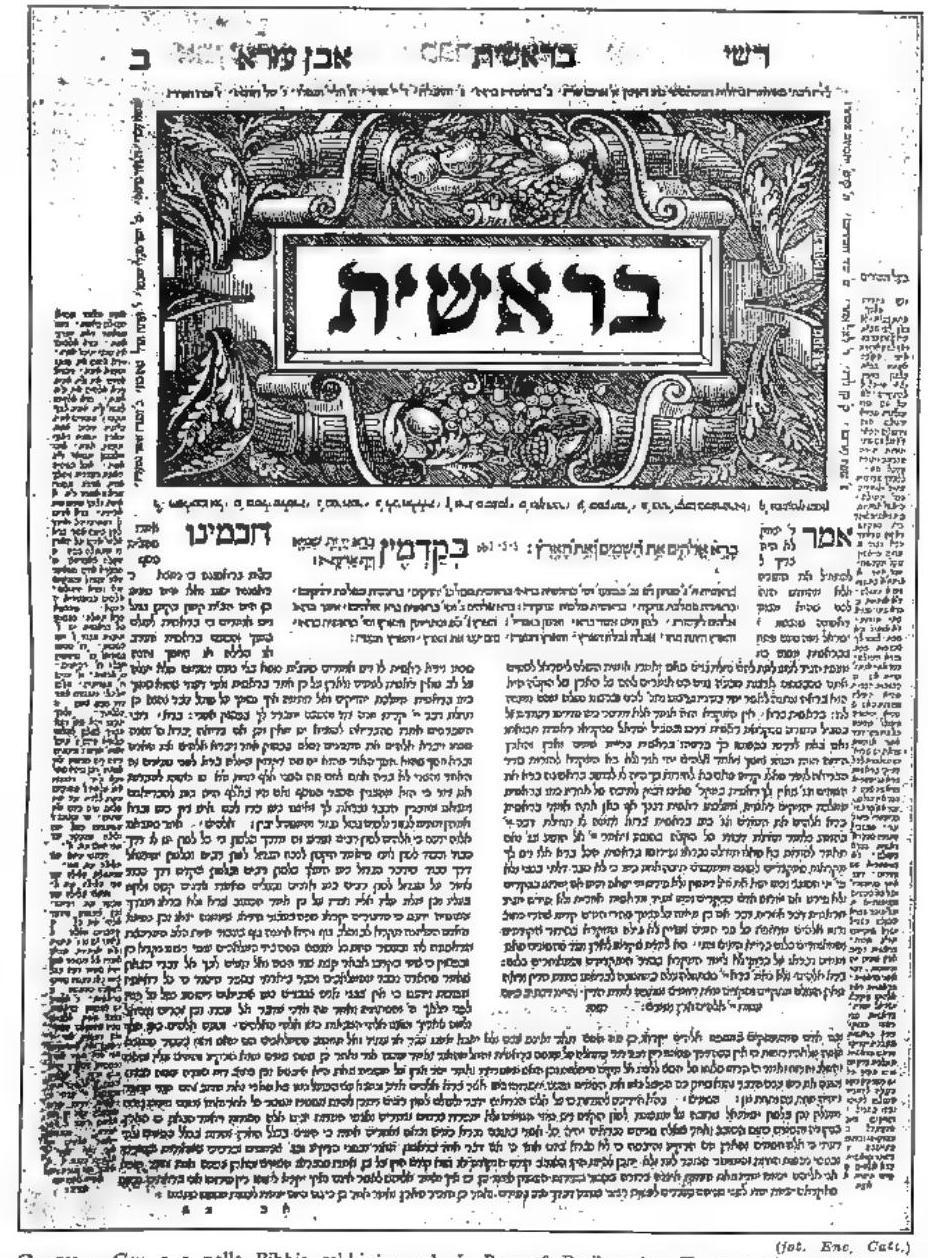
“in the beginning.” The Germans often call it the first book of Moses, in relation to the other books of the Pentateuch.
The questions raised by the book of Gen. are exceedingly difficult and serious.
SUMMARY: I.
II. Contents
II. The author and the literary question
III. Particular problems
IV. Theological teaching.I. CONTENT
The general idea of the book is well expressed by its very name, Gen. It deals with the origin of the universe and, in particular, of the human race, both according to nature and according to the supernatural economy. The natural origin of man is described in chaps. 1–2, whereas the supernatural plan has a more complex development. There is an elevation to the supernatural order, as is understood in the light of the New Testament, immediately in the account of the first events, followed by the collapse of everything through sin. At this precise point the divine plan of restoration is manifested. In chap. 3:15 we find the primitive promise; thereafter this plan is carried out from the moment when God, choosing Abraham and making the messianic promises to him, repeating them to his descendants Isaac and Jacob, brings into being the chosen people from whom the Messiah will be born. From this point of view, the book may be divided into two great parts: the his-GENESI — Gen. 1:1 in the Rabbinic Bible, ed. J. Buxtorf, Basel 1620. Hebrew text and Targum of 'Chuséba. Beneath the two texts: concordance. On the right: commentary by Rall (v.). On the left: commentary by 'Abhrábam Ibn 'Ezra' (v.). Frames on the right and left: commentary by the decisor (v. DECISION), the 'aqābah ben 'Ašet ba'el hat-tārīm (1209–1343) — Rome, copy of the Pont. Biblical Institute.
to the lake, as later occurred with the creation of Tiberiaide (v.).
BIBLI: A. Mader, Die biblische Stadt Kimereth und römische Überreste auf dem 'Orémeberge, in Biblica, 15 (1932), p. 297; P. Knoppel, Der Teil 'Oréme und die ebene Genesareth, ibid., p. 298. Donato Baldi