
GENEROSA, CEMETERY of. – It is located at the sixth milestone of the Via Portuense, in the area formerly called « ad sextum Philippi », near the grove of the Fratres Arvales. It originated, in the praesidium of a matron named Generosa, with the burial of the martyrs Simplicio, Faustino, and Viatrice in a private hypogeum, which subsequently developed into a cemetery for the rural Christian community of the area. The cemetery is mentioned only in the Liber de locis sanctis Martyrum: « Iuxta viam vero Portuensem, quae et ipsa in occidentali parte civitatis est... s. Simplicius, s. Faustinus, s. Beatrix dormiunt »; the Hieronymian Martyrology adds the detail of its distance from Rome, « miliario VI ». According to the Acts, the martyrs Simplicio and Faustino belong to the persecution of Diocletian. Their bodies remained in the cemetery until the time of Leone II (682–83), who transferred them to S. Bibiana in a rough
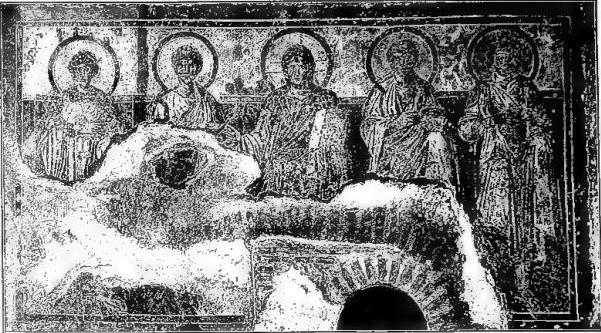
(from Wilpert, Pitture, ch. 83)
The cemetery, forgotten for many centuries, came to light again when discoveries were made in the years 1858–64 near the grove of the Fratres Arvales and the temple of Dea Dia; the same excavations also brought to light the Basilica erected by Pope Damaso (366–84) near the martyrs’ tomb. The cemetery galleries excavated in the hill are not extensive; and, because of their rather crude workmanship, they display the characteristics of a rural cemetery. Several loculi are still found there, some with consular dates; one bears a graffito dated 372. The Basilica built by Damaso is at the same level as the galleries; it is 15 m long, 6.30 m wide in the central nave, and 2.75 m in the right-hand aisle. No traces remain of the left-hand aisle, which has disappeared, along with the roof and much of the perimeter walls. The excavation of the building was carried out by the Pontifical Commission of Sacred Archaeology in 1868; restoration work begun in 1901 and resumed in 1936 was left unfinished. A fragment of an epistyle in Philocalian lettering, bearing the words (Faustino) Viatrici, belongs to the Basilica. The historical crypt of the martyrs is reached by a passage opened to the right of the apse, in which, above the cathedra, a small window permits a view of the interior of the sanctuary. In the 6th century, a fresco was executed on the wall raised to reinforce the crypt itself. It depicts the Savior at the center, with a cruciform nimbus, in the act of speaking and supporting the book of the law; on the left are ss. Viatrice and Simplicio, and on the right ss. Faustiniano (Faustino) and Rufiniano, identified by their names. The last figure seems to have been added for reasons of symmetry and perhaps out of the patron’s devotion. Almost adjoining the apse is an arcosolium, the only one in the cemetery, constructed in masonry and later than the year 384, as can be inferred from the date of that year in the inscription placed above a form, partly covered by the wall of the arcosolium. In the lunette of the arcosolium is an almost entirely vanished figure of an orans; on the right-hand walls are the sacrifice of Abraham, the Good Shepherd, and, below, a sheep; on the left-hand wall is a representation of the flock, which remained concealed by a wall added later. De Rossi wished to identify this arcosolium as the tomb of the martyr Viatrice.
BIBLI: A. Nibby, Dintorni di Roma, II, Roma 1848, pp. 607–608; G. B. De Rossi, in Bulletino di arch. crist., 1st series, 7 (1869), p. 1 ff.; id., Roma sotterranea, III, Roma 1877, pp. 647–67, pls. 46–52; Chr. Huelsen, Di una iscrizione monumentale appartenente al cimitero di G. nella Via Portuense, in Nuovo bulletino di archeol. crist., 6 (1900), pp. 121–126, pl. 2; O. Marucchi, Le catacombe romane, Roma 1933, pp. 87–93; G. P. Kirsch, Le catacombe romane, ibid. 1933, pp. 230 ff., 247, no. 27; E. Josi, Cimitero di G.; 1) Sterro della Basilica cimiteriale dedicata ai martiri Simplicio, Faustino, Viatrice, 2) Pitture con la rappresentazione del gregge sul fianco sinistro di un arcosolio, in Riv. di arch. crist., 16 (1939), pp. 323–30; Wilpert, Pitture, pp. 221, 320, pls. 112, 262; H. Leclercq, s. V. in DACL, VI, 1, cols. 866–903. Carlo Carletti