
DIOCLEZIANO (Imp. Caesar M. Aurelius Valerius Diocletianus Augustus), ROMAN EMPEROR. — Born into a humble family in Dalmatia around 243, perhaps not far from Salona, he made his way, like many of his fellow countrymen from the Illyrian provinces, into the army. Having distinguished himself in the arduous wars conducted by Aureliano and Probo, he took part in the expedition of the emperor Caro against the Persians (283), holding the high rank of comes domesticorum, that is, commander of the imperial guard. The expedition was cut short by Caro’s sudden death, and the Roman army turned back under the leadership of Caro’s young son, already appointed his imperial colleague: Numeriano. During the long march Numeriano was killed; the soldiers’ voice accused the praetorian prefect Arrio of the crime, and D., accepting this version of the affair, with barbarous dispatch killed Arrio with his own hand, whereupon the army hailed him as emperor (17 September 284). The resistance being prepared against him by Caro’s other son, who had remained in Rome, Carino, failed because Carino was killed by one of his own officers, and D. was universally recognized as emperor. To the arduous task imposed upon him, D. brought neither a cultural education nor extensive administrative experience, but rather peasant common sense, tenacity in his convictions, soldierly promptness in carrying out decisions, a highly developed sense of duty, and complete devotion to II. The two gravest evils from which the Empire suffered were the incessant attempts of barbarians to break through the frontiers and the absence of any rule for imperial succession, so that there were repeated, likewise incessant, usurpations by emperors elected in every possible anarchic manner, who wore down the Empire’s inadequate forces in sterile and ruinous internal struggles. D. undertook to remedy both ills. The vastness of the frontiers made it difficult to guard them all effectively; moreover, in such troubled times even a victory was dangerous, since it had very often happened that victorious soldiers hailed their commander as emperor, forcing him to assume the purple and perhaps murdering him some time later. D. began by appointing a colleague, choosing a man of his own stature, of humble family, an Illyrian, a soldier, rougher than himself, endowed with personal courage and absolute loyalty: Massimiano.
Having found this expedient effective, a few years later (293) he proceeded to a more radical reform, intended to eliminate uncertainty regarding the succession. He appointed two Caesars attached to the two Augusti, invested with authority superior to that of any other magistrate or general and destined to become Augusti when the latter were gone. Succession was thus automatic, and the risks of usurpation ought, in theory, to have disappeared. A single criterion was to govern the choice:
the appointment of the person best suited, without regard to bonds of kinship. Conversely, a kind of fictitious kinship was established among the four sovereigns: the two Augusti were called brothers, and the two Caesars their sons. The division was purely administrative, nor was it to undermine the unity of the Empire, since the authority of the elder of the Augusti was to prevail over all.
The Empire therefore ceased to be a kind of extraordinary magistracy and became a sort of college entered by co-optation. The two great electors, the senate and the army, were eliminated altogether; and since they had hitherto acted as representatives of the Roman people, the Roman people was no longer the master of that state which nevertheless continued to call itself the res publica Romanorum.
Once the concept and function of imperial dignity had been so radically altered, there was no longer any reason not to assume fully the character and outward manifestations of the absolute sovereign, with a ceremonial borrowed from that of the eastern courts.
An ingenious and sound construction, but one marked by a certain naïve schematic quality that could not withstand the complicated and selfish psychology of human beings. In any event, the initial results were good: victories on all the frontiers, internal security, and some twenty years of tranquillity. The one to suffer was Rome, which ceased to be the seat of the Empire. All four sovereigns established themselves in residences closer to the frontiers: D. at Nicomedia, in Bithynia; Massimiano at Milan; and still farther forward the two Caesars: Galerio at Sirmio on the Danube, Costanzo Cloro at Treviri on the Rhine. The four cities had to be equipped so that they could serve as capitals, and the multiplication of courts and bureaucracy, together with the increase in the army, came to weigh rather heavily upon the state budget. An attempt was made to remedy this through radical reforms of the tax system. Wealth consists in landed property and in the productive capacity of human and animal labor: these two sources of wealth are obliged to surrender part of their product to the state through the two taxes of the ingatio (land tax) and the capitatio (personal tax). Connected with the reorganization of taxation was also a Diocletianic attempt to secure stability and reasonableness in the prices of goods and services, an attempt that was not new in the ancient world, but had never until then been undertaken on so meticulous and extensive a scale. The relevant edict is preserved in many epigraphic copies found in several cities of the eastern provinces (only one in Italy), none of them complete.
As regards religious policy, D., a sincerely religious man, sought to restore the ancient Roman faith and worship, upon which the loyal obedience of the subjects to the dual imperial dynasty was also to rest: D.’s dynasty was called Jovian, and Massimiano’s Herculean, reproducing in a certain manner on earth the supreme celestial hierarchy: Jupiter, divine intelligence and will; Hercules, executor of that will. Religions other than the official one were tolerated in accordance with the longstanding practice of the Roman government, but were watched and also suppressed if they were judged too far removed from the prescriptions of the state religion. Christianity could find itself in such a position; and although it was not molested during the first years of D.’s reign, the time of persecution eventually arrived. According to Christian writers, the persistent and insistent advocate of rigorous measures was Caesar Galerio, a rough, superstitious soldier and the son of a fanatical priestess of barbarian cults.
The actual persecution was reached by degrees. At first, measures were begun against Christians serving in the army, probably prompted by the refusal of Christian soldiers to obey orders that, rightly or wrongly, they considered contrary to their conscience. The soldiers were ordered to pay homage to the national deities, under penalty, in the contrary case, of missio ignominiosa, expulsion from the army. Capital sentences appear to have been rare.
The same provisions were subsequently adopted for civilian officials; there was not yet a bloody persecution, which D. did not wish to undertake, both by temperament and because he had seen its uselessness. But owing to Galerio’s insistence and to a response from the oracle of Apollo Dalymaios at Miletus, the provisions of Valeriano were brought back into force: destruction of the sacred books and churches, confiscation of their property, and arrest of the Christian hierarchy.
It happened that the destruction of the church of Nicomedia was followed by a fire in the imperial palace, and the fire was deemed intentional and the work of the Christians. And so the order was issued that all the inhabitants of the Empire should perform a public act of worship to the official divinities of the State, and that refusal to obey should be punished (503). The corresponding edict, obligatory, as was always the case, for all four rulers, was enforced with greater or lesser severity in the various regions: very mildly by Costanzo Cloro, most harshly by Galerio, and also by D., who always took seriously whatever he had resolved to do. The failures of the preceding persecutions now made it necessary to be more radical and more ruthless. And many among the most illustrious martyrs known to us were victims of this final persecution.
But D. was not a persecutor for long. Desiring to witness during his lifetime the orderly functioning of the system he had devised for the succession, he wished at a certain point to renounce the Empire and to compel his colleague Massimiano to make the same renunciation. On 1 May 305 the two Augusti abdicated, and the two Caesars took their place. Two new Caesars were appointed, chosen from outside the families of the rulers. D. withdrew into private life in the great palace he had built near Salona, within which the oldest part of the city of Spalato lies nestled; from there he emerged once to attempt to restore order among successors and usurpers (the conference of Carnunto). M. is not known precisely in what year or how.
Roberto Paribeni
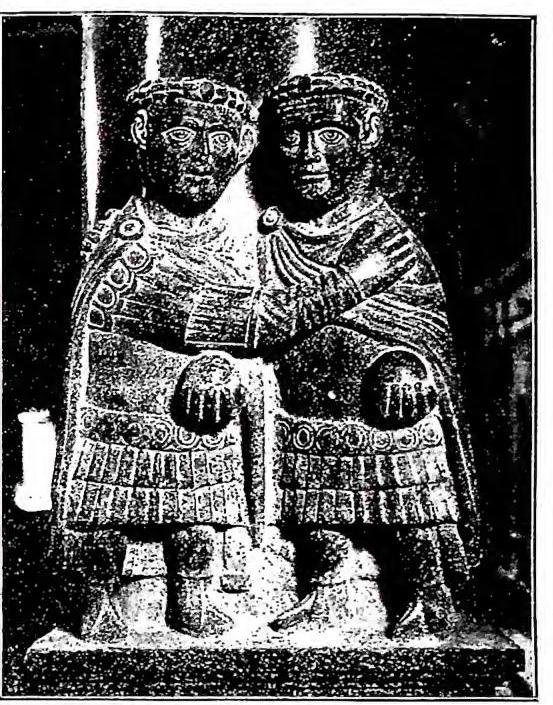
ICONOGRAPHY. — G. Malalas (12, p. 306) describes D. as tall, with gray hair and beard, white skin, blue eyes, and a prominent nose. The various coin types agree in their fundamental physiognomic features: square head, short nose forming an angle with the forehead, projecting chin, full neck, and robust nape (J. J. Bernoulli, Römische Ikonographie, II, III, Stoccarda 1894, p. 193 ff.). Of the sculpted portraits, only the following can be considered certain: a togate statue (Rome, Villa Doria Pamphili) with a corresponding head (later detached, reworked, and passed into the antiquities market); a double herm, with Saturn, formerly in the Jerichau collection, Rome; a colossal head with a civic crown, from Nicomedia (K. Dörner, Ein neuer Porträtkopf des Kaisers Diohletien, in Die Antike, 17 [1941], p. 142); two porphyry reliefs, in the Vatican Library (R. Delbrück, Antike Porphyryerke, Berlino-Lipsia 1932, p. 35) and at S. Marco, Venezia (ibid., p. 36); the clipeate image on the frieze inside the Mausoleum of Spalato (ibid., p. 61). — Vedi tav. XCVIII.