
ELENA (Flavia Iulia Helena Augusta), saint. -
I. LIFE
Mother of the emperor Constantine, venerated as a saint in the Latin Church (18 Aug.) and in the Greek Church (21 May). She seems to have been of very humble origin ("stabularia" St. Ambrose calls her, De obitu Theod., 42) and was taken as a concubine by Constantius Chlorus, then a Roman officer of the army garrisoning the Danube.In all likelihood in 288 Constantine was born of her at Naissus in Moesia (modern Niš). When, five years later, Constantius Chlorus was raised by Diocletian to the dignity of Caesar, he had to send her away in order to marry Theodora, stepdaughter of the emperor Maximian, and thus to establish that bond of kinship which was held useful to the stability of the Diocletianic tetrarchic system. Her son, however, always held his mother in great honor, conferred on her the title of Augusta, placed her effigy on coins, and gave her name to a city of Bithynia; Eusebius (Vita Constantini, III, 47, a) affirms that it was the son who converted the mother to Christianity, which may perhaps correspond to the writer's desire to accumulate merits on the head of Constantine.
E. showed her piety with abundant alms and with the construction of new churches at Rome (S. Croce in Gerusalemme, or the Sessorian Basilica), at Constantinople (together with her son, the great Basilica of the Apostles), at Bethlehem (Basilica of the Nativity) and on the Mount of Olives (Basilica of Gethsemane). In her late years she went on pilgrimage to Palestine, where she is said to have sought for and found the true Cross (v.). A part of the holy wood she is said to have brought to Rome and placed in her Basilica of S. Croce. She died, it seems, in 335, at Constantinople, but, according to Eusebius, the body was said to have been transported to Rome and buried in the round-plan mausoleum, known under the name of Tor Pignattara on the via Prenestina, in the grandiose porphyry sarcophagus found there and now in the Vatican Museum.
BIBL.: sources
Roberto Paribeni
II. ICONOGRAPHY
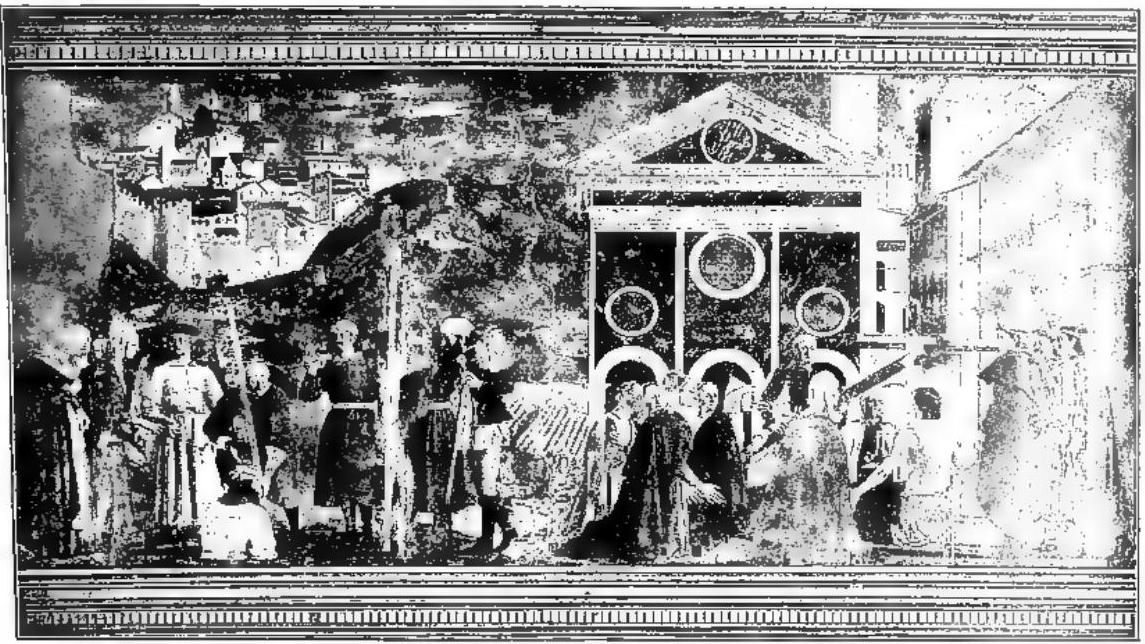
Already from the most ancient times adorned with a diadem or a crown and dressed as an empress, St. Helena bears as her individual attribute the Cross whose discovery stands at the center of her legend and her cult. The prototype of the Eastern depictions brought the Saint together with Constantine at the sides of the Holy Wood: created probably in connection with the feast of the Exaltation of the Cross and handed down in a Syriac homiliary of the 8th century and in the Byzantine reliquaries of Gran and of Nonantola (11th century), it survived still in the late frescoes of Athos and of Wallachia (16th century) as well as in Russian icons. In Western art the images of St. Helena are equally widespread to the south and to the north of theAlps: the German examples range from a Salzburg miniature of the 12th century to two Romanesque frescoes in Cologne (St. Gereon) to the paintings of L. Cranach the Elder and of B. Bruyn, the Italian ones from certain fourteenth-century miniatures to the paintings of the Chiodarolo, of Cima da Conegliano, of the Moretto and of Palma Vecchio, from the marble group of A. Rizzo (Venice, S. Apollinare) to the statue of Bolgi
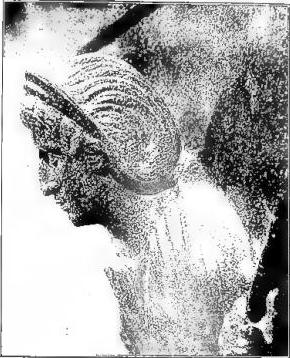
(from F. Gurecki, I verdagioni romani, I, Milan 1911, pl. 6, no. 1)
HELENA, saint - Gold coin.
BIBL.: sources
Kurt Rathe
III. MAUSOLEUM OF ST. HELENA. - After her death, which occurred around 335 (O. Seeck, Hélène, in Pauly-Wissowa, VII, II, col. 2820), E. Augusta was transported to the "royal city" (εἰς τὴν βασιλεύουσαν πόλιν) to be laid in the imperial tombs (ἐρῶσις βασιλικοῖς ἀπετίθετο); Eusebius, Vita Const., III, 47. The "royal city" according to St. John Chrysostom is Rome (St. John Chrysostom, Contra Iudaeos et gentiles, 9: PG 48, 825) and the imperial tombs are without doubt the mausoleum "ad duas lauros" on the via Labicana, whose ruins are known under the name of Tor Pignattara.
The Liber Pontificalis (6th century) mentions this mausoleum in connection with the construction of the Constantinian Basilica in honor of the martyrs Peter and Marcellinus on the via Labicana ("... fecit ... Constantinus... et mysileum ubi mater eius sepulta est Helena Augusta, via Lavicana miliario III": Lib. Pont., I, p. 182); the "Notitia ecclesiarum" of the 7th century describes it as a rotunda ("... et s. Helena in sua rotonda": G. B. De Rossi, Roma sotterranea, I, Rome 1864, p. 178), the "Liber de locis" (7th century) calls it a church ("... ecclesia est s. Helenae ubi ipsa corpore iacet": G. B. De Rossi, ibid., p. 178) and in the 8th century it receives the title "basilica" ("... coemeterium... iuxta basilicaam beatae Helenae": Lib. Pont., I, p. 500), probably because, after the demolition of the Basilica of the two martyrs, it itself had to serve as a church.
The mausoleum was built at the third mile of the via Labicana, that is, "in the center of the immense imperial Labican latifundium of the 4th century called Subaugusta, which extended from the church of S. Croce (Sessorianum) as far as Centocelle, including all the villas and gardens" (G. Tomasetti, La campagna romana, III, Rome 1913, p. 388). At first it was to be the tomb of the Emperor and of the imperial family. But after the construction of a new mausoleum at Constantinople for the burial of Constantine, the mausoleum on the via Labicana remained solely for the imperial family. Constantine had his mother buried in his own sarcophagus ad "duas lauros". This sarcophagus with horsemen in relief later served as the tomb of Anastasius IV (1153-54) in the Lateran Basilica. At present it is found in the Greek-cross hall of the Vatican Museum.
The construction of the mausoleum was begun after the victory over Maxentius (312). Indeed, in the foundations of the structure, funerary cippi of the "equites singulares", the Emperor's bodyguard, were found to have been used, a guard disbanded by Constantine, who also destroyed the free burial place granted to them in the imperial Subaugusta (P. Crostarosa, Nuovo Bull. arch. crist., 3 (1897), pp. 117-22). This dating is confirmed by means of the brick material coming from the "Officina S.R.F. Domitiana", which flourished until 320.
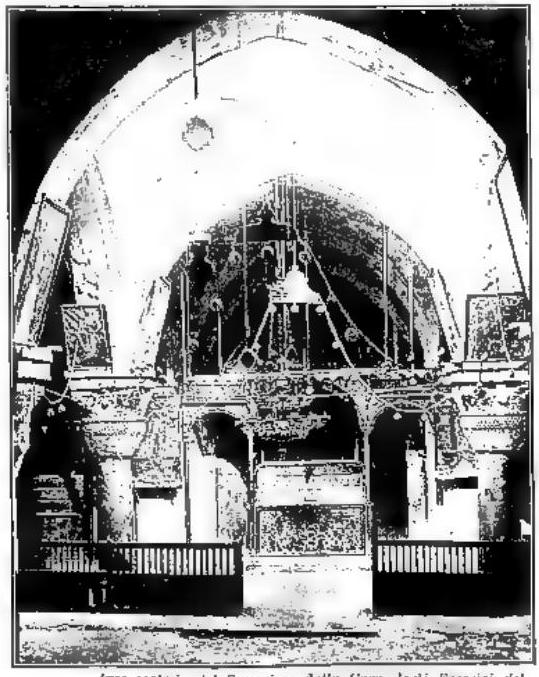
The mausoleum presents itself as a building with a central plan consisting of a rotunda preceded by a very vast atrium, surrounded on three sides by a wall with porticoes leaning against it, while on the western side a portico of greater width served as the entrance (A. Bosio, Roma sotterranea, Rome 1634, p. 323). The rotunda has an internal diameter of 20.18 m, a wall thickness of 3.78 m and a wall height of 15.12 m. Inside, the cylindrical wall of the rotunda appears articulated in its architectural lines: it shows in fact four curvilinear niches on the diagonals and three rectilinear niches on the axes. The fourth rectilinear niche on the west was used as the entrance. Above this zone of niches, the wall diminishes in thickness, which is noted on the inside but is clearly visible from the outside by the recessing of the cylindrical wall. Moreover, on this wall there always open to the outside eight niches with arched windows corresponding to the lower internal niches. The wall of the rotunda is crowned by a frieze with corbels and surmounted by a dome built by means of pignatte (amphorae [pignatte, from which came the popular name of Tor Pignattara]). The brick masonry was plastered on the outside, while on the inside it was faced with marble.
Excavations carried out in 1941 on the western side of the mausoleum brought to light remains of masonry, with marble incrustations and mosaics, which seem to have belonged to a building or to a courtyard corresponding with the rotunda of the mausoleum (Cf. Deichmann, op. cit. in bibl.).
From the architectural point of view the mausoleum of St. Helena presents itself as a masterpiece of the late imperial age and can be compared to the other famous one of Romulus on the via Appia. As such it closes the series of pagan round buildings and inaugurates the history of Christian central-plan buildings, being the prototype of the imperial mausoleum at Constantinople. - See pl. XVI.
BIBL.: sources