
WOOD. — From the earliest manifestations of Mediterranean civilization, fine-quality wood was employed in the applied arts. During the early Christian and Byzantine periods, mention should be made of the doors of S. Ambrogio in Milan and, above all, of the splendid one at S. Sabina in Rome (5th century), made of cypress wood, with panels depicting biblical scenes and frames decorated with vegetal motifs.
At the height of the Romanesque period, there appeared expressions of authentic polychrome statuary, such as the Madonna in trono of S. Maria Maggiore at Alatri, that of the parish church of Acuto, now in the Museo del Palazzo Venezia,
and the moving, popular-style Deposizioni of the cathedral of Tivoli and of the cathedral of Volterra. In the German lands, too, wood sculpture was cultivated successfully even before the supreme flowering of the Gothic style, as demonstrated by the Madonna del Tesoro in Essen Cathedral, the Crocifisso in Brunswick Cathedral, and the door of S. Maria in Campidoglio in Cologne. But it was the 14th century that was to foster an extraordinarily fertile and multifaceted development of the art of woodwork, with beamed and coffered ceilings, choir stalls and lecterns, pulpits, altars, cathedrae, altarpieces, and furniture of every kind and purpose. In Italy, the Pisan sculptors predominated, with their tender Annunciazioni, as did the makers of carved choir stalls, such as those in Orvieto Cathedral (designed by the Sienese Vanni di Tura), Siena Cathedral (made by Francesco del Tonchio), and S. Domenico in Ferrara, in which the exquisite skill of Giovanni da Baiso, a master of ecclesiastical cabinetmaking in the Po Valley, shines forth. Toward the end of the 14th century, the Flemish artist Jacques de Baerze was in vogue in Burgundy, with his carved altarpieces.
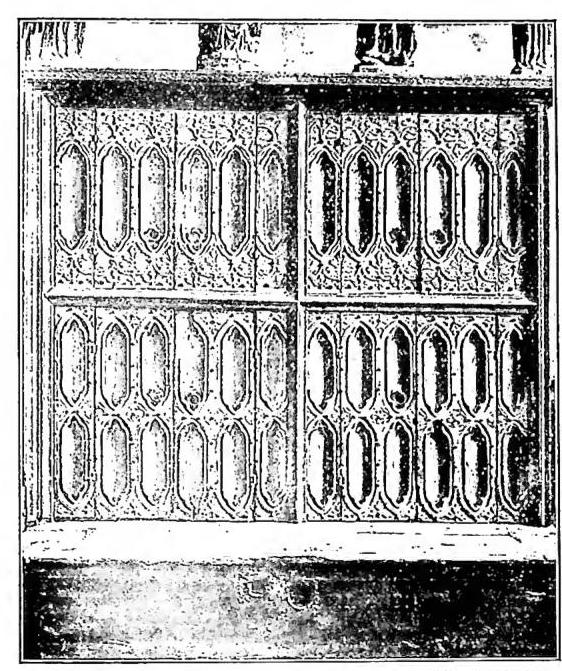
LEGNO — Cabinet from the early 14th century, probably designed by Giotto — Padua, Scrovegni Chapel, Sacristy.
of Monteoliveto, and Fra' Damiano da Bergamo, with the doors of S. Pietro in Perugia and the choir stalls of S. Domenico in Bologna. During this same period, sculptors flourished in Germany, displaying pronounced national characteristics: Lucas Moser, Grasser, Michele Pacher, Hans Leimberger, and then, in Nuremberg, the school’s leading master, Veit Stoss. Meanwhile, the flourishing of cabinetmaking skill, especially in the sphere of sacred art, is attested by the fifteenth-century choir stalls of Ulm Cathedral and the altars of Bamberg and Heilbronn. No less worthy of appreciation, in France, are the choir stalls in the cathedrals of Rouen and Amiens. Spanish art, after the Burgundian and Flemish influences, underwent those of the Italian Renaissance, especially through the work of Alonso Berruguete, who resided in Italy.
The general characteristics of the Baroque age are also reflected in wood sculpture and carving, which display a great variety of stylistic motifs and technical devices, extending the achievements of the late sixteenth century. In our peninsula, taking precedence over those of the other regions, the seventeenth-century masters of the Veneto and Lombardy emerge, chiefly: Francesco Planta the Younger and Giacomo Piazzetta (father of the celebrated painter Giambattista) in Venice, with the figurative backs of the school of S. Rocco and of the sacristy of SS. Giovanni e Paolo; G. B. Salmoiraghi, active in Milan and Valtellina; Giacomo Bertesi and Domenico Capra in Cremona; Giuseppe Bulgarini in Brescia; and the highly productive Fantoni dynasty (with Andrea pre-eminent among them), together with the inlayers Caniana in the Bergamo area. In Genoa, Filippo Parodi and Antonio Maria Maragliano are noteworthy; in Rome, the craftsmen responsible for the still classical decorations in the canons’ choir at S. Pietro and in the sacristy cupboards of S. Francesco a Ripa make their mark; in Lucca, the gilded splendour of the alcove in Palazzo Mansi is astonishing. No less prestigious, and toward the end of the century more elegant and restrained, were the activities of the eighteenth century. In Venice, the Bellunese Andrea Brustolon, a fanatic of Bernini, achieved worldwide renown and formed Giovanni Marchiori in his eminently sculptural taste; in Piedmont, G. L. Bosso, Pietro Piffetti, and Giuseppe Maria Bonzanigo worked with consummate diligence; in Liguria, G. B. Girolamo Pittaluga; in Rome, D. Antonio Colicci, author of the sumptuous choir of Montecassino, and the craftsmen responsible for the organ and other furnishings in the characteristic church of the Maddalena, for the ceiling of S. Clemente, and for the organ of S. Maria in Vallicella; in Abruzzo, Bernardino Mosca, to whom the graceful ceiling of S. Bernardino in Aquila is attributed; and in Naples, the carvers of the tribunes and choir lofts of S. Chiara and of the spectacular Bourbon berlins. Throughout the entire eighteenth century, furniture makers displayed the most varied skills, partly under French influence, especially in Venice, with polychrome lacquerwork imitated in the Far East, in Piedmont, Liguria, and Bologna. During the second half of the century, the Lombard Giuseppe Maggiolini established a distinctive type of floral and landscape marquetry, fitting amiably into the excessively austere linearity of Neoclassical taste. The art of furniture making found its finest exemplars above all in France, from the period of Henry IV through that of Louis XVI, including such distinguished cabinetmakers as Andrea Carlo Boulle and Carlo Cressent. — Vedi tav. LXX.