
ROCCO, saint. – Young pilgrim, born in Montpellier and died at Angleria (Angera, on the eastern shore of Lago Maggiore) in the 14th century; invoked from the 15th century together with s. Sebastiano, whose fame as a thaumaturge he gradually eclipsed, as a protector against the plague. Feast on 16 August.
I. BIOGRAPHICAL DATA
Despite the Acta breviora and the Vita s. Rochi by Francesco Diedo (v. BIBLICA), the chronology and part of the Saint’s biography remain obscure, to such an extent that some have gone so far as absurdly to deny his historical existence. The dates 1295 and 1327 for his birth and death, supplied by Diedo, no one knows on what basis, do not accord with the events narrated in the Vita. In 1921, P. Guerrini indicated ca. 1355 as the probable date of his death; recently, after a careful analysis of the Acta breviora, A. Maurino and A. Fliche proposed, for his birth and death, respectively, 1345 and 1377 in the former case, and 1350 and 1378–79 in the latter. It has also been said that the name R. was a transformation of the surname of the ancient Montpellier family of Rochch or Rog (Rubeus), to which R. supposedly belonged; yet the name R. is by no means unknown in medieval onomastics. A bishop of Autun at the beginning of the 7th century was called «Racho», or «Rocco», and his feast was celebrated on 28 Jan. (cf. L. Duchesne, Faites épisc. de l'ancien. Gaule, II, Paris 1910, p. 179; V. JALABERT, LOUIS, Les brévinires, V, index, p. 261); a Psalter from Treviso dating from approximately the middle of the 13th century records on 1 July the feast «s. Rochi conf.» (cf. V. JALABERT, LOUIS, Les psautiers, II, p. 99); the recent edition (Rome 1936) of the Passio b. Petri Parentii from the beginning of the 13th century speaks of a young man«nomine Rochus» (cf. P. Paschini, Notarella su s. R., in Riv. di storia della Chiesa in Italia, 4 [1950], p. 248).
In the Acta, once duly separated from the commonplaces of hagiography, the following biographical details appear genuinely reliable. Orphaned at a young age, R., after distributing his paternal inheritance in alms, left Montpellier on a pilgrimage to Rome; when he reached Acquapendente, he placed himself at the service of the plague-stricken, who were the first to experience his thaumaturgical power; from there he went to Cesena to perform the same charitable service. From Cesena he resumed his journey to Rome, where he cured a cardinal who subsequently introduced him to the Pope. In the Urbe R. remained for three years, devoting himself to the poor and those afflicted by the plague; he then went, for the same charitable purposes, to Rimini, Novara and then Piacenza, where, having contracted the same disease, he left the city and lived for some time in a wooded place; once recovered, he resumed his journey toward his homeland, but at Angera he was arrested on suspicion of espionage and died in prison after five years of confinement. His identity having been recognized after his death, he was honorably buried. The site of the tomb is not indicated.
(fot. Enc. Catt.)
ROCCO, santo - Wooden painted statue (15th century), from the lazaretto - Acquapendente, church of S. Caterina.
Contra Pettem Epidonic Apud vimi bigalli mi interefficio Chiaci cuiidem Offico.
(fot. Enc. Catt.)
II. CULT
The biographer Jean Pin speaks of a canonization, but to this day there is no confirmation of it; if it did take place, one must suppose that this canonization was carried out by the antipopes Clement VII or, rather, Benedict XIII; it is certain that in 1590 Sixtus V had in mind canonizing him « overo di levarlo dal numero delli Santi », as attested by a dispatch of the Venetian ambassador Alberto Badoer (cf. P. Paschini, art. cit., p. 249). In 1629 the Sacred Congregation of Rites granted an Office and Mass of s. R. for the churches erected in his honor.At Montpellier, R. was not the object of cult before 1410, since in that year, on the occasion of an epidemic, only s. Sebastian was invoked; yet in 1421 there is information concerning a chapel in honor of R. existing there, and around 1440 concerning the celebration of his feast on 16 August. In Avignon in 1437 the painter Pierre de la Barre was to paint an altarpiece in which the « ymago s. Roqui » was also to appear. In France, fifteenth-century Missals and Psalters (the oldest is a Psalter-hymnal from Maguelone, from the beginning or first half of the fifteenth century: the Calendar records, in the original hand, on 16 August « sancte Roc [sic] »: V. JALABERT, LOUIS, Les psautiers, I, p. 278) record, at first as an addition and later inserted into the text, the feast of R., whose name also appears in Books of Hours; it does not appear in Breviaries. In Germany, wooden statues of R. from the fifteenth century are preserved, including that of Obersimonswald in the Black Forest, dating from around 1450 (cf. K. Künstle, op. cit. in bibl., II, p. 515). In Italy the cult
of R. underwent extraordinary development in the second half of the fifteenth century, precisely on the occasion of violent epidemics: 1476 at Gemona (cf. G. Marchetti, op. cit. in bibl., p. 5); 1477 at Venice; 1478–79 at Brescia. In 1485 the mysterious translation of the relics to Venice took place; from that moment the city of St. Mark, with its church of S. R. and the sumptuous scuola of S. R. (sixteenth century), an artistic and charitable center in keeping with the spirit of the Saint, became the hearth from which devotion to the great thaumaturge radiated, spreading wherever Venetian power made itself felt. Numerous confraternities, hospitals, chapels, and churches arose in his honor throughout Europe, and 16 August became in more than one place a votive feast, celebrated with solemn popular festivities. In Rome, the church of S. R., near the port of Ripetta, dates from the dawn of the sixteenth century. As for the procession in honor of R. which, according to Diedo, took place at Constance in 1414 on the occasion of the Council, for historical reasons it seems that it should be referred to the Council of Ferrara (January 1439). The feast of R. on 16 August appears in various editions of the Missale Romanum preceding the reform of s. Pius V, beginning with the Venetian edition of 1505 (cf. R. Lippe, Missale Romanum Mediolani 1474, II, London 1907 [H. Bradshaw Society, 33], pp. 225–26; A. Ebner, Iter Italicum, Freiburg im Breisgau 1896, p. 231, mentions only one manuscript missal [sixteenth century] containing the feast of the Saint).
III. ICONOGRAPHY
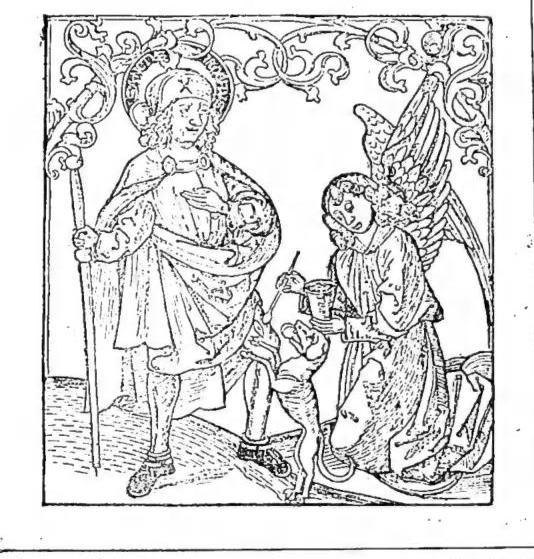
Another testimony to the popular cult of R. is the rich iconographic material concerning him. R. is depicted as a pilgrim, youthful in appearance, with his left leg (less frequently the right) uncovered, bearing a swollen bubo and also a suppurating sore, which the Saint points to with his right hand. Beside him stands the dog with a loaf of bread in its mouth, an allusion to the bread which, according to the Acta, the dog of the noble Gottardo brought him daily while he lay ill near Piacenza. He is often accompanied by an angel who, according to the Acta, appeared to the Saint to announce his recovery and then his death, and by other saints, among them s. Sebastiano, protector of those stricken by plague from the seventh century onward, and one of the quinque famosiores sancti contra pestem titulares together with s. R., s. Antonio, s. Adriano, and s. Cristoforo (cf. Anal. Boll., 60 [1942], p. 239). Besides the statues preserved in the Museum of Grenoble (beginning of the fifteenth century), at Acquapendente (fifteenth century), and at Obersimonswald (ca. 1450), among the very numerous works that could be cited, listed by Künstle, Ceroni (S. R., Roma 1927), Fliche (St-R., Parigi 1930), and Bessodes (S. R., Torino 1931), only the paintings or sculptures by the following artists may be mentioned: for the fifteenth century: Crivelli (Venezia), Ghirlandaio (Pisa), Bergognone (Milano), the Rodari brothers (Como); for the sixteenth century: Pordenone, Tiziano, Tintoretto (Venezia); for the seventeenth century: Van Dyck (Senlis), Guido Reni (Bologna), Rubens (Alost), Preti, Baciccia (Roma); for the eighteenth century: Tiepolo, Marchiori (Venezia); for the nineteenth century: Mariani (Roma), Baussan, Marsal (Montpellier). - Vedi tav. LVII.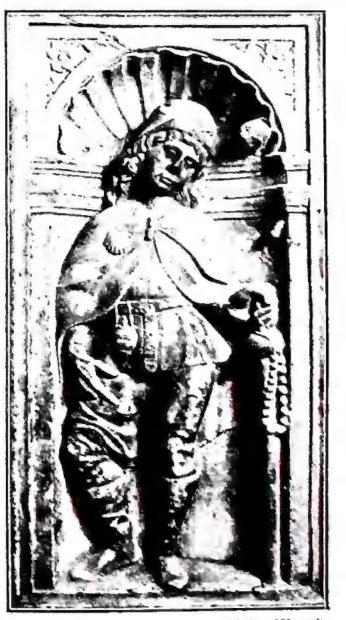
(photo Alinari)