
MOST PRECIOUS BLOOD OF OUR LORD JESUS CHRIST. — Feast having as its object the “Most Precious Blood” that Christ shed for the salvation of the human race (v. REDEMPTION; HYPOSTATIC UNION); it stands in close relation to the feasts of Corpus Domini and of the Sacred Heart.
The salvific virtue of this M. P. has been exalted by all Christian literature from antiquity to the present day; it is therefore not surprising that, beginning in the late Middle Ages, this M. P. became the object of particular devotion, which was moreover the natural consequence of devotion to the humanity of Christ, spread by s. Bernardo di Clairvaux, s. Bonaventura, s. Gertrude la Grande, and others. Testifying to it are: 1) the hymns, proses, sequences, and prayers catalogued by U. Chevalier (Repertorium hymnologicum, VI, Bruxelles 1920, p. 86 [index]), among which the cantilena by an anonymous author, but sometimes attributed to s. Bernardo or s. Bonaventura, should be recalled: Salve caput cruentatum (Chevalier, op. cit., n. 17846); 2) the miniatures, paintings, stained-glass windows, and sculptures depicting angels collecting in chalices the Blood flowing from the side, hands, and feet of Christ Crucified; the mystical “bath” in the Blood of Christ; the fons salutis; the mystical “mills” and “presses.”
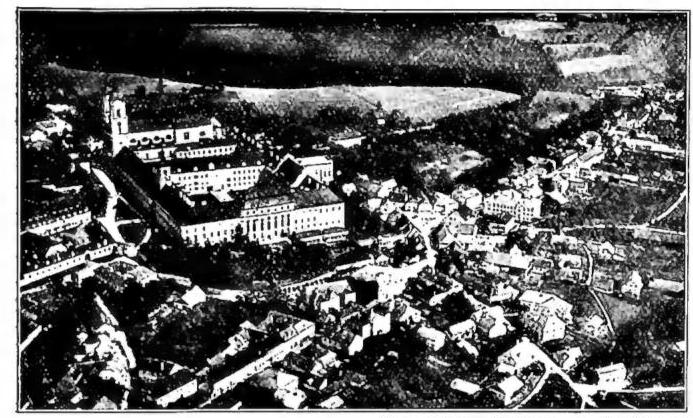
SANGUE PREZ.MO DI N. S. GESÙ CRISTO - SANKT FLORIAN
Later, a proper liturgical feast of the Precious Blood was established, celebrated on different dates. One of the earliest concessions by the Holy See of an office De Sanguine Christi was that granted in 1582 to the diocese of Valencia (Spain). In the 18th century, concessions of a Mass and Office for the feast of the Precious Blood multiplied; for example, it was granted to the diocese of Sarzana (16 Dec. 1747) for the day after the Most Holy Trinity; to the Passionists, to various dioceses, and to the whole of Portugal (1794) for the Friday after the Fourth Sunday of Lent; to the diocese of Breslau (1778) for the third Friday of March; and to various other dioceses or religious congregations, which obtained permission to celebrate it during the month of March or in Lent. In Rome, devotion to the Precious Blood was particularly practiced in the church of S. Nicola in carcere, seat of the archconfraternity of the “Precious Blood,” established in the 18th century. But the most zealous apostle of devotion to the Precious Blood and, consequently, the promoter of its feast, during the first thirty years of the 19th century, was b. del Bufalo (v.), who obtained permission for it to be celebrated in the houses of his Congregation with the rite of a double feast of the second class on the first Sunday of July, with an octave (26 March 1822; the concession was renewed in subsequent years at the request of various dioceses and religious families). It was then don Giovanni Merlini, third superior general of the Missionaries of the Precious Blood after b. Gaspare, who suggested to Pius IX, exiled at Gaeta, that he vow to extend it to the whole Church if he were able to return to Rome. His prayer answered, Pius IX, by the decree Redempti sumus of 10 Aug. 1849 (Archive of the Sacred Congregation of Rites: Decreta ann. 1848–49, fol. 209), established that it should be celebrated on the first Sunday of July with the rite of a double feast of the second class. In 1914, Pius X assigned it the same rite on 1 July, and Pius XI, in commemoration of the Nineteenth Centenary of the Redemption, assigned it the rite of a double feast of the first class, slightly revising its office (25 Apr. 1934: AAS, 26 [1934], pp. 559–60; cf. also 27 [1935], pp. 81–89). As for the Sermon of s. Giovanni Crisostomo, which is read at the Second Nocturn, although considered of doubtful authenticity by certain critics, there are excellent arguments for holding that it is genuinely his. Finally, it should be noted that the Mass and Office of the Precious Blood, still in use, were composed at the order of Benedict XIV
and are the same as those granted with the rite of a double feast of the first class in 1747 to the diocese of Sarzana (Archive of the Sacred Congregation of Rites: Decreta ann. 1745–47, fol. 335).