Machine translation of the 1948–1954 Italian original. The original text is authoritative.
GAETA, ARCHDIOCESE OF. - The archdiocese of Gaeta, immediately subject to the Holy See, is part of the province of Latina and comprises the territories that once belonged to the dioceses of Formia, Minturno and Fondi, covering an area of 774 sq. km.; a population of 109,400, of whom 109,300 are Catholic, 43 parishes, 81 secular priests, 18 regular priests, and a minor seminary (1949). The cathedral is dedicated to the Assumption.
In Roman times Gaeta was a small settlement around the port of Formia, which in the early Middle Ages was part of the Western Empire and in 681 served as a refuge from pirates for the bishop and inhabitants of Formia. After becoming the capital of a duchy ruled by an ipato, Gaeta passed in 1140 to Norman rule, becoming an important maritime stronghold from which Marcantonio Colonna set sail for Lepanto in 1571; on his return he deposited in the cathedral the banner given him by Pius V. On 25 November 1848, after being joined by the court, the king of Naples and the grand duke of Tuscany, Pius IX took refuge there and on 11 February 1849 ordered prayers for the definition of the dogma of the Immaculate Conception (Pius IX, Acta, I, Rome 1854, pp. 162-66). As the last Bourbon stronghold, Gaeta was besieged in 1860-61 and captured by Cialdini. Among its native sons were Giovanni Crescenzi-Caetani, later Gelasius II (1118-19); Tommaso de Vio, called Cajetan (1469-1534), a most learned commentator on the Summa of St Thomas, papal legate in Germany and later cardinal; the painters Scipione Pulzone, called Gaetano (1550-88) and Sebastiano Conca (q.v.); and the historians Erasmo and Sebastiano Gattola (18th cent.).
The see of Gaeta, formed by the union of the older sees of Formia (q.v.) and Minturno (q.v.), is not recorded before the 8th century. Among its bishops the writer Francesco Patrizi (1460), a friend of Pius II, is renowned. In 1818 the suppressed diocese of Fondi (q.v.) was annexed to Gaeta, which Pius IX also honoured in 1849 by raising it to an archdiocese, the bishop at the time being Ludovico Parisi.
In the diocese stood the monastery of S. Angelo di Balenzano, suppressed in 1788 (Cod. dipl. Caietan., II, p. 107), whose church is already noted in a charter of 839.
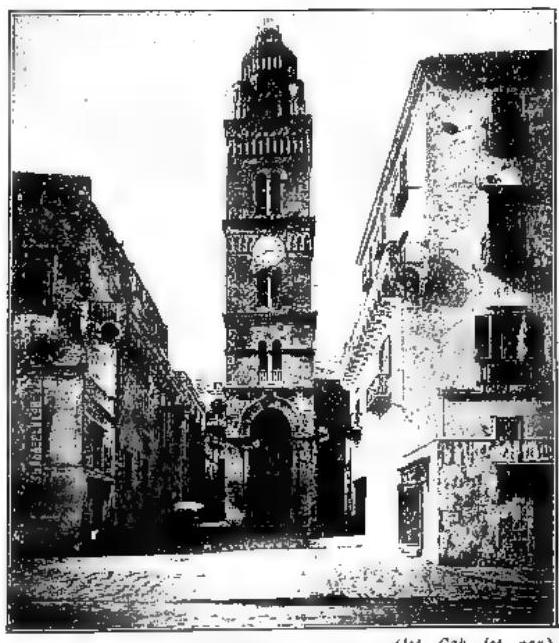
MONUMENTS. — In addition to the Roman remains and the castle, which originally belonged to the town and was enlarged by Charles V, the following are noteworthy: the church of S. Giovanni a mare, also known as S. Giuseppe, built in the 12th century; the Cathedral, consecrated on 22 January 1106 by Paschal II and rebuilt in 1792, which, with its valuable paintings and sculptures from various periods, preserves the column of the Paschal candle (13th century) and the bell tower from the second half of the 12th century; the churches of S. Lucia, with remains from the 13th and 15th centuries, of S. Domenico, with remnants from the 9th century, and of the Annunziata, erected in 1321 and rebuilt in 1621. In the cleft of the split mountain lies the sanctuary of the Crucifix from the 15th century.
BIBL.: B. Scalese, De ecclesia Caietana eiusque sacrosanti episcopi, Naples 1785; Cappellotti, XXI, pp. 334-45; B. Gama, Series episcop., Rathbone 1873, pp. 880-81 and Suppl., pp. 14-15; Codex diplom. Caietan. Tabularum Castineum, 2 vols., Montecassino 1887-91; L. Salome, G., Milan n.d.; P. Fedele, Il ducato di G. all’inizio della conquista normanna, in Arch. stat. napolet., 29 (1904), p. 50 ff.; id., Le stendardo di M. A. Colonna a Lepanto, Perugia 1904; G. Ferrero, La colonna del cero pasquale di G., Naples 1905; P. Fantasia, Su i monumenti medievali di G., ibid. 1920; P. Fr. Kehr, Italia Pontificia, VIII, Berlin 1923, pp. 80-98; Cottineau, I, col. 1238; M. Inguanez, L. Mattei Cerasoli, P. Sella, Rationes decimarum Italiae nei secc. XIII-XIV, Vatican City 1940, pp. 7-12. Alberto Galleti
Cite this article
“GAETA, ARCIDIOCESI DI.” Enciclopedia Cattolica, vol. V (1950), p. 1102. Azione Romana digital edition, https://azioneromana.com/article/gaeta-arcidiocesi-di.