Machine translation of the 1948–1954 Italian original. The original text is authoritative.
ERASMO, saint. — Martyrdom of S. Erasmo. Detail of the fresco in room 4ª, beneath the church of S. Maria in Via Lata (8th century) — Rome.
Schleiermacher, H. der Dunkle, in Werke, part 3ª, II, Berlino 1838, pp. 1–146; F. Lassalle, Die Phil. H. von Ephes., 2 vols., Berlino 1858; M. Konh, Alte sprach H., Amburgo 1907; Br. Pressler, Die Naturphilos. Anschauungen H., Magdeburg 1908; N. Cuppini, Esposizione del sistema di E., Roma 1912; B. Donati, Il valore della guerra e la filosofia di E., Genova 1913. Extensive bibliography on E. in Überweg, I, pp. 42–43*; C. Massantini, E., Torino 1945. Andrea Ferro
ERASMO, saint. — He is commemorated in the Hieronymian Martyrology on 2 June. In a letter of October 500, S. Gregorio Magno attests that his body rested at Formia (Reg. Epist., 1, 8). His cult was widespread in antiquity, and he was numbered among the Holy Helpers (v.).
The accounts of his life and martyrdom are reported in a fairly legendary Passio, composed between the 6th and 9th centuries, according to which E., a native of Antioch, took refuge in the mountains of Lebanon at the beginning of Diocletian’s persecution. Returning to the city, he was seized, scourged, flayed, and imprisoned. Miraculously freed, he passed through Sirmio, where he suffered at the hands of Massimiano, and reached Formia, where he died shortly afterward. The designation attributed to him by later documents as the city’s first bishop is uncertain.
BIBL.: Acta SS. Iunii, I, Parigi 1867, pp. 206–14; Lanzoni, p. 163 ff.; Martyr. Hieronymianum, p. 296 ff.; H. Delahaye, Les origines du culte des martyrs, Bruxelles 1933, p. 307 ff.; D. Mallardo, Il caltradorio marmoreo di Napoli, Roma 1947, p. 1946. Agostino Amore
ICONOGRAPHY. — The oldest representation of his martyrdom is found in an eighth-century fresco in the underground church of S. Maria in via Lata in Rome, where E. stands before the consul, with two henchmen nearby. Beside it, in another fragmentary fresco, the Saint is carried into heaven by two angels.
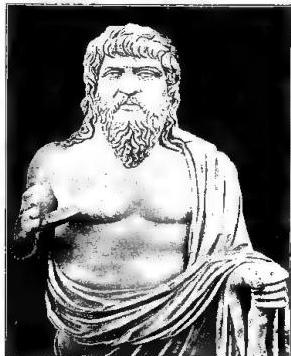
(from H. Delbrück, Antike Patriote, Bonn 1918, p. 21, pl. 14) ERACLITO — Statue of E. (2nd century A.D.) — Candia (Crete), Museum.In the thirteenth century, scenes of his martyrdom appear on the candle-holder for the Easter candle in the cathedral of Gaeta. Later he is depicted in episcopal robes and, as protector of sailors, with a winch around which a rope is wound; this is the case in certain German sculptures and paintings of the fifteenth and sixteenth centuries, such as a wooden statue in the church of S. Severino at Passau and a painting by Michele Fischer at Grier. At times, following the popular interpretation given to the representation, the Saint’s intestines are wound around the winch in place of the rope, as in the painting by M. Grünewald in the Munich Pinakothek. Also worthy of particular mention is the large painting by Nicola Poussin in the Vatican Pinakothek depicting the martyrdom of E., reproduced in mosaic on the altar dedicated to the Saint in the Basilica Petriana.
BIBL.: K. Künste, Iconographie der Heiligen, II, Friburgo in Br. 1926, pp. 210–13. Emilio Lavagnino
Cite this article
“ERASMO, SANTO.” Enciclopedia Cattolica, vol. V (1950), p. 303. Azione Romana digital edition, https://azioneromana.com/article/erasmo-santo.