ERACLA, SANTO

Image from page 300
Image from page 300

ERACLUS, Saint. — Born around the 2nd century, he studied philosophy alongside Origen, who converted him to Christianity and later associated him as an assistant in catechetical teaching at the Didascalium of Alexandria. When Origen was forced to abandon teaching in 231, E. succeeded him. He was ordained priest by Bishop Demetrius, whom he later succeeded in the Alexandrian see. Despite his old friendship with Origen, as bishop he maintained the measures already taken against him by his predecessor, refusing to allow his return to Alexandria.

Article illustration
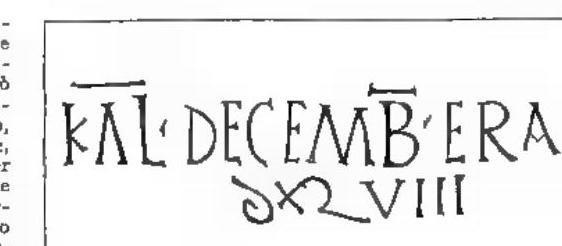
(from V. FEDERICI, GIACOMO, *La scrittura delle cancellerie italiane*. Rome 1931, tav. 3)
Act of donation by Ordoño I, King of Castile and León, to Bishop Fronimus, dated the era of Spain 918 (A.D. 850).

IV. ERA OF SPAIN

Its starting point is 38 B.C.; it was adopted not only in the Iberian Peninsula but also in the provinces occupied by the Visigoths in Gaul and Africa. Christian inscriptions show its use in Cantabria in the 3rd century, in Mérida by the end of the 4th, then in Lusitania, Baetica, and Galicia in the second half of the 5th century. It became general use during the Visigothic period; in the eastern zone, it did not appear before the Mozarabic period. To obtain the exact date, 38 must be subtracted. (J. Vives, *Inscriptiones christianae de la España Romana y Visigoda*, I, Barcelona 1941, p. 7). Inscriptions use the words *era*, *aera*, *in era*, *suo era*, or the abbreviations *er.* or *e.* It disappeared only in 1180 in Catalonia, in 1349 in Aragon, in 1358 in Valencia, in 1383 in Castile and León, and in 1422 in Portugal.

V. ERA OF DIOCLETIAN OR ERA OF THE MARTYRS

Dating from the year 284, the year Diocletian ascended the throne (the exact day varies between August 1 and 29), another era was established, named after this emperor and later called by Christians, from the 7th century onward, the Era of the Martyrs, in memory of the great persecutions he ordered. Of Egyptian origin, it spread to Europe; it was used by St. Cyril of Alexandria for his Paschal tables, by Evagrius, and by St. Bede. Today it is still in use among the Copts of Upper Egypt. At Milan, St. Ambrose also employed it, dating his Epistle 23 (*Episcopis per Aemilianus constituti*) to the 80th year and 9th day from Diocletian’s accession.

VI. BYZANTINE ERA

This is the most widespread of the complete eras that date from the hypothetical creation of the world, fixed by this era at 5508 B.C., so that the year 5309 corresponded to the first year of the Christian era. Introduced around the 7th century, it spread throughout the Orthodox East and was abolished in Russia only by Peter the Great on January 1, 1700. In Italy, it was used in the southern regions, particularly for dating documents in Greek. The year began on September 1 under this era.

VII. CHRISTIAN ERA

Introduced by the Scythian monk Dionysius Exiguus (d. 556), who spread in the West the Paschal table compiled by Cyril of Alexandria, covering the years 437–537, and continued it from the following year onward. However, unlike Cyril, who calculated years using the Era of Diocletian, Dionysius wished to eliminate the name of the persecutor from his cycles. Considering that no historical event equaled in importance the coming of the Redeemer, he took this as the starting point for counting years. Thus, though erroneously, he fixed the birth of Jesus Christ to December 25 of the year 753 *ab urbe condita* according to the Varronian calculation, so that the year 754 *ab urbe condita* corresponded to the first year of the new era. It was first used only by chroniclers; it entered public documents in England and France in the 7th century, in Germany in the 9th, and in Spain in the 14th. In Italy, the oldest examples are

E. IN ROME. — According to Roman myth, Hercules (Latin *Hercules*), returning from the slaughter of Geryon, crossed Italian territory; passing through the site of future Rome, he was robbed of his herd by the monstrous thief Cacus. After recovering the cattle, Hercules killed Cacus and in gratitude erected an altar to Jupiter *Inventor*. The Arcadian Evander, who then dwelt on the Palatine, recognizing the hero’s divinity, gave him an altar. Thus the Roman cult of Hercules was traced back to times before the founding of Rome, specifically to the two sanctuaries of the Porta Trigemina and the Ara Maxima.

Historically, the cult is also of considerable antiquity: the Ara Maxima in the Forum Boarium stood in an open enclosure within the *pomerium* of the city. The annual sacrifice was performed according to Greek rite. Women were excluded; it was said that dogs and flies could not enter the enclosure. Originally, the cult was exercised by the two Roman *gentes*, the Potitii and the Pinarii; but Appius Claudius Caecus, in 312 B.C., incorporated it into the public cults of the state. Not far from the Ara Maxima was the perhaps even older sanctuary of the Porta Trigemina. During the centuries of the Republic, Hercules had other important sanctuaries near the Porta Collina, the Circus Flaminius, and the Circus Maximus.

The god’s figure was transmitted to the Romans from the Greek colonies of southern Italy; it was widespread in Etruria and also in Latium, where, for example, at Lanuvium and Tivoli, he appeared as one of the principal city deities. Outside Rome, he is often associated with Jupiter.

Article illustration
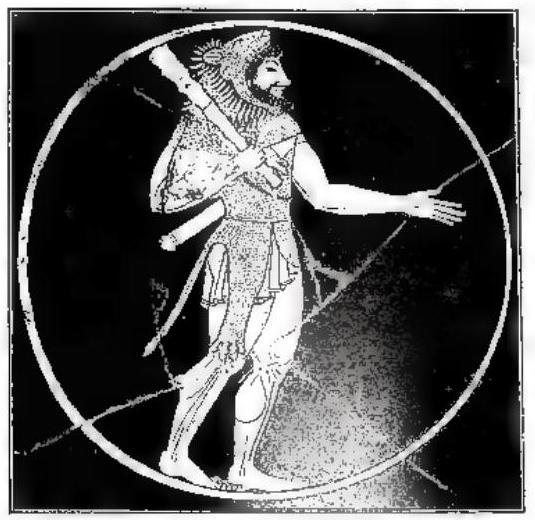
HERACLES — Hercules with a club. Greek red-figure *kylix* (late 6th century B.C.) — Vatican, Gregorian Etruscan Museum.

Heracles (Ἡρακλῆς). — Hero of ancient Greece, son of Alcmena and Zeus, who appeared to her in the guise of her husband. Some scholars see in him an essentially Greek hero, while others consider him a pre-Hellenic or Eastern deity who entered Greece.

In later ages, his cult became very widespread, and he was venerated under numerous epithets; both royal houses of Sparta claimed descent from him. Festivals with athletic contests were celebrated in his honor; animals, including those that had worked, fruits, and natural products were sacrificed. He was the protector of athletes (many of his sanctuaries were near gymnasia, where he was worshipped alongside Hermes), of springs and baths, a healer, musician, and astrologer.

In the archaic age he seems especially to have been renowned for his countless myths, among which the best known are: 1) the hatred of Hera, who delayed his birth, forced him to serve Eurystheus and sent two serpents against him which Heracles strangled; 2) the twelve labours imposed by Eurystheus at Hera’s instigation: the slaying of the Nemean lion, whose skin he thereafter habitually wore; the slaughter of the Lernaean hydra, a many-headed monster; the capture of the Erymanthian boar, a favourite subject of vase-painting; the capture, according to Euripides the slaying, of the Ceryneian hind; the killing of the Stymphalian birds; the cleansing of the Augean stables; the capture of the Cretan bull; the capture of Diomedes’ man-eating mares; the conquest of Hippolyte’s girdle, queen of the Amazons, a girdle which in historical times was hung in the Heraeum of Argos; the driving off of Geryon’s cattle, for which he sailed across Ocean in the golden cup of the Sun; the capture of Cerberus, the three-headed guardian of the Underworld; and the theft of the apples of the Hesperides. Interwoven with these are numerous martial exploits. Heracles was aided by his nephew Iolaus and protected by Athena; 3) the hero’s death and final apotheosis: torn by a shirt soaked in the blood of the centaur Nessus, which his wife Deianira had made him wear, Heracles mounted the pyre, from which he was conveyed to Olympus and, reconciled with Hera, received immortality as his reward.

Bibl.: U. V. Wilamowitz, Euripides Herakles, 2nd ed., Berlin 1908, introduction; Zwicker, s.V. in Pauly-Wissowa.