
HERACLES ('Ἡρακλῆς). — Hero of ancient Greece, son of Alcmena and Zeus, who had appeared to her in the guise of her husband. Some scholars see in him an essentially Greek hero; for others, he is pre-Hellenic, or an Eastern divinity who passed into Greece.
In later times he had an exceedingly widespread cult, and the epithets under which he was worshipped were numerous; both reigning houses of Sparta boasted of descending from him. Festivals were celebrated in his honour with contests and competitions; animals were sacrificed, including those that had already worked, as well as fruits and natural products. He was the protector of athletes (a large part of his sanctuaries were situated near the gymnasia, where he was worshipped together with Hermes), the protector of springs and thermal baths, a physician, musician, and astrologer.
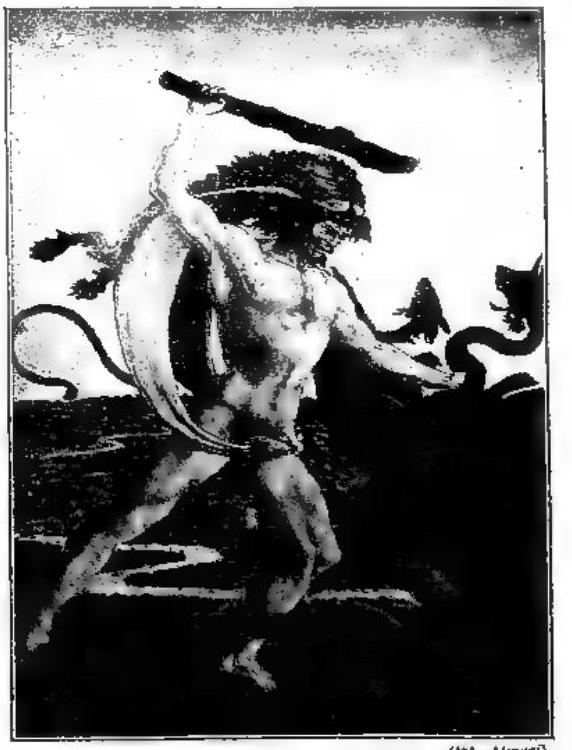
In the archaic period he seems above all to have been famous for his numerous myths, among which the best known are: 1) the hatred of Hera, which delayed his birth, obliged him to serve Eurystheus, and sent two serpents against him, which H. strangled; 2) the twelve labours, imposed by Eurystheus at Hera’s instigation: the killing of the lion of Nemea, whose skin he habitually wore; the killing of the Hydra of Lerna, a many-headed monster; the capture of the boar of Erymanthus, a favourite subject of vase painting; the capture—or, according to Euripides, the killing—of the Cerynitian hind; the killing of the birds of the Stymphalian marsh; the cleaning of the stables of Augeas; the capture of the Cretan bull; the capture of the mares of Diomedes; the acquisition of the girdle of Hippolyta, queen of the Amazons, a girdle which in historical times was hung in the Heraion of Argos; the capture of the herd of Geryon, for which he sailed across the Ocean in the Sun’s golden cup; the capture of Cerberus, the three-headed dog guarding the Underworld; and the acquisition of the apples of the Hesperides. Numerous warlike exploits are interwoven with or inserted among these. H. was assisted by his nephew Iolaus and protected by Athena; 3) the hero’s death and final apotheosis: torn apart by a shirt soaked in the blood of the centaur Nessus, which his wife Deianira had made him put on, H. climbed onto the pyre, from which he was transported to Olympus and, reconciled with Hera, received immortality as his reward.
BRUL.: U. V. Wilamovitz, Euripides Herakles, 2ª ed., Berlino 1900, introduzione; Zwicker, s. V. in Pauly-Wissowa.
VIII, 1, coll. 526-68; Gruppe, s. V. ibid., suppl. III, coll. 910-1120; L. R. Farnell, Greek Hero-cults and ideas of immortality, Oxford 1921, p. 95 seg.; N. Turchi, Ercole, in Enc. Ital., XIV (1932), p. 191 seg.; G. R. Levy, The Oriental origin of Herakles, in Journal of Hellenic Studies, 34 (1934), p. 49 seg.
Luisa Banti
E. IN ROME. — According to Roman myth, E. (in Latin Hercules), returning from the killing of Geryon, crossed the territory of Italy; as he passed through the places where Rome would later arise, his herd was robbed by the notorious thief Cacus; having recovered the oxen, E. killed Cacus and, in gratitude, raised an altar to Iuppiter Inventor. The Arcadian Evander, who then lived on the Palatine, recognizing the hero’s divinity, dedicated an altar to him. Thus the Roman worship of E., ■ specifically the two sanctuaries at the Porta Trigemina and the Ara Maxima, was traced back to times preceding the foundation of Rome.
Historically, too, the cult is of considerable antiquity: the Ara Maxima in the Forum Boarium stood in an open-air enclosure, included within the pomerium of the City. But the annual sacrifice ■ was performed according to the Greek rite. Women were excluded; dogs and flies were said to be unable to enter the enclosure. ■ The cult was originally conducted by the two Roman gentes, the Potitii and the Pinarii; but Appius Claudius Caecus, in 312 B.C., incorporated it into the public cults of the State. Not far from the Ara Maxima stood the sanctuary, perhaps even more ancient, of the Porta Trigemina. During the centuries of the Republic, E. had other important sanctuaries near the Porta Collina, the Circus Flaminius ■ and the Circus Maximus.
The figure of the god was transmitted to the Romans by the Greek colonies of southern Italy: it was widespread in Etruria and also in Latium, where, for example, at Lanuvium ■ or Tibur, he appeared as one of the city’s principal divinities. While outside Rome he appears chiefly associated with Giu-
His character as a victor, documented as early as his most ancient cultic epithets (Invictus, Victor), subsequently determined his popularity, both in private worship, in which this character was interpreted philosophically as triumph over the passions and death (E. in funerary representations), and in public worship, in which he was connected with the aspirations of the Roman Empire: the emperor Commodus already had himself called Romanus Hercules, while alongside Diocletian Ionius, the emperor Maximian would assume the epithet Hercules.