
GRECIA. - The kingdom that includes the southern, most indented part of the Balkan region,
SUMMARY:
I. Geography
II. Prehistory and History up to Christianity
III. Religion
IV. Civil History from Christianity to the Present
V. Ecclesiastical History
VI. The xxxvi
VII. The Greek Versions of the Bible
VIII. Literature
IX. Archaeology and Art
X. School System.I. GEOGRAPHY.
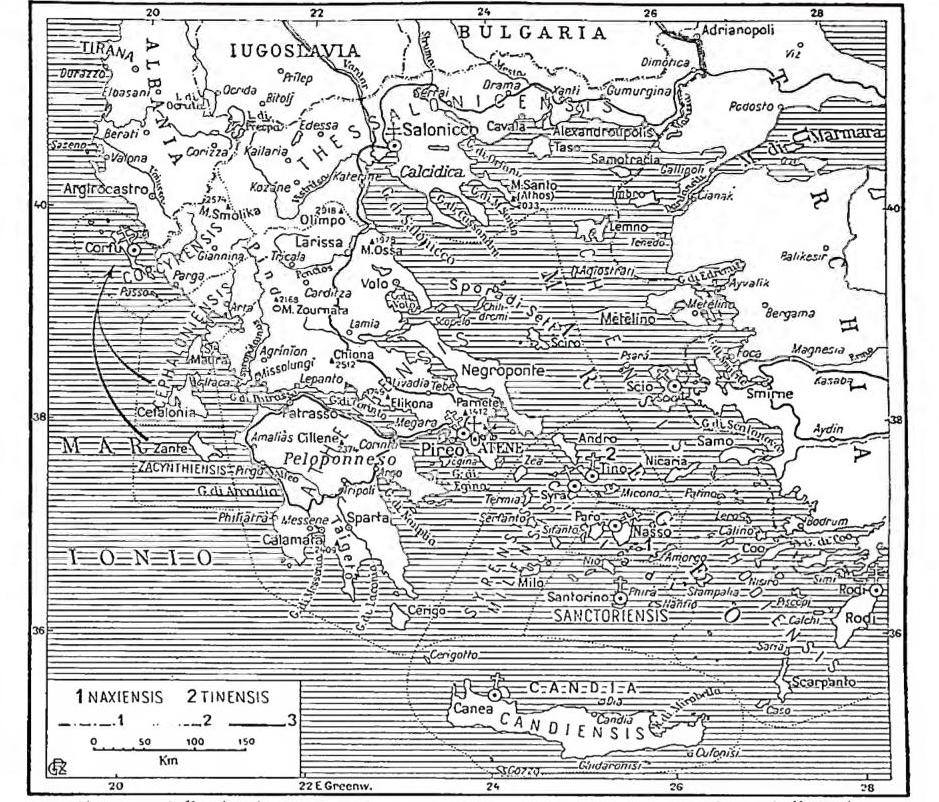
It is the southernmost and most insular State in Europe: 132,562 sq. km., of which 108,707 (82%) are on the mainland.
The country is almost entirely covered by mountains (Mount Olympus 2,985 m., Mount Pindus 2,575 m.), among which open a few small plains, most often in the form of closed basins, which difficult communications isolate from one another. The climate is Mediterranean or sub-littoral, with mild, rainy winters and hot, dry summers, whose pronounced relief, nearby sea, and frequent breezes impart a less excessive character. Rather than woods, the limestone mountains are covered with scrub and meager pastures: arable land accounts for barely 10% and tree crops for 3% of the territorial surface. Agriculture nevertheless remains the basis of the Greek economy; cereals are insufficient for domestic consumption, while the most important products are tobacco (first place in Europe), the olive, and above all the vine (Corinthian raisins and Cretan sultanas). Goats and sheep predominate in livestock farming. Fishing is of modest importance. Mineral resources are not lacking (iron, lead, silver, zinc, etc.), but their industrial exploitation is hindered both by a lack of capital and by insufficient motive power (little lignite, modest hydroelectric capacity). The imbalance in the trade balance is mitigated by the proceeds of maritime trade, favored by a good merchant navy (1.3 million gross tonnage), which is very active especially in the eastern Mediterranean.
| Regions (and provinces, or nómai) | Area in sq. km. | Population (Oct. 1940 census) | Density per sq. km. | Most important settlements (and population in thousands) |
|---|---|---|---|---|
| MAINLAND . . . . . | 108,707 | 7,347,002 | 67 | |
| Epirus (Arta, Ioannina, Thesprotia, Preveza) . . . . . | 9,552 | 367,695 | 38 | Ioannina (20) |
| Macedonia (Chalcidice, Kavala, Drama, Florina, Kilkis, Kozani, Pella, Thessaloniki, Serres, Mount Athos) . . . . . | 34,603 | 1,731,889 | 50 | Thessaloniki (225) |
| Thrace (Evros, Rhodope) . . . . . | 8,586 | 354,816 | 41 | Komotini (33) |
| Thessaly (Larissa, Trikala) . . . . . | 13,488 | 577,247 | 43 | Larissa (30) |
| Mainland Greece (Attica-Boeotia, Aetolia-Acarnania, Phthiotis-Phocis) . . . . . | 20,835 | 1,853,085 | 89 | Athens (487) |
| Peloponnese (Achaea, Arcadia, Argolis-Corinthia, Elis, Laconia, Messenia) . . . . . | 21,643 | 1,173,541 | 54 | Patras (79) |
| INSULAR . . . . . | 23,855 | 1,288,729 | 54 | |
| Euboea . . . . . | 4,297 | 179,533 | 42 | Chalcis (22) |
| Ionian Islands (Cephalonia, Corfu, Zante) . . . . . | 1,947 | 223,452 | 115 | Corfu (34) |
| Asian Islands of the Aegean (Chios, Lesbos, Samos) . . . . . | 3,901 | 311,751 | 79 | Mytilene (20) |
| Aegean Islands, formerly Italian . . . . . | 2,682 | 115,913 | 43 | Rhodes (55) |
| Cyclades . . . . . | 2,649 | 141,654 | 53 | Hermoupolis (18) |
| Crete (Heraklion, Chania, Lasithi, Rethymno) . . . . . | 8,379 | 442,339 | 53 | Heraklion or Candia (42) |
| Kingdom of Greece . . . . . | 132,562 | 7,780,000 | 55 | |
| 1949 (estimate) . . . . . |
Following World War II, the Italian islands of the Aegean were assigned (Sept. 15, 1947) to Greece, incorporated into the Kingdom and divided into four provinces (Rhodes, Kalymnos, Karpathos, and Kos).
The population (7.8 million inhabitants) consists of 87% Greeks, with Turkish, Albanian, Slavic, and Armenian minorities. One-third of it is considered urban; but of the settlements, only two exceed 100,000 inhabitants (Thessaloniki and Piraeus) and two exceed 50,000 (Patras and Volos), while the capital has now surpassed one million (when considered together with its port, Piraeus).
Greece has been established as an independent Kingdom since 1830 (with a republican interlude in 1923-24); the 1911 Constitution is currently undergoing revision.
II. PREHISTORY AND HISTORY UP TO CHRISTIANITY.
FROM THE ORIGINS TO THE ROMAN CONQUEST. - With the Paleolithic period almost entirely absent, Greek prehistory begins with the Neolithic (from about the middle of the 4th millennium), the deposits of which are located in the eastern part of the mainland, the northeastern part of the Peloponnese, and in Crete. Cretan civilization is notably different from that of the mainland (v. EGERIA, RELIGIONE) and the latter (whose principal monuments are ceramics) can be divided with relative approximation into two epochs: the first, named after Sesklo in Thessaly, appears to stem from immigration; the second, named after Dimini, also in Thessaly, rather from an evolution of the first, without excluding a new influx of peoples. The homeland of the Neolithic peoples (Thracians, Pelasgians) is to be sought, for the first wave, in Asia Minor (and the itinerary would have followed the routes of Thrace and Macedonia), and for the second, in Mesopotamia (entry into G. would in any case have taken place from the north).Neolithic culture disappears with the Metal Age (from about the middle of the 3rd millennium): new invaders now come from the southern and eastern seas (Carians, Leleges, Cyclopes of later Greek mythology), and subsequently from the north. These latter are the Indo-Europeans (or Aryo-Europeans), who from about the 12th century formed the Mycenaean civilization, under the cultural and, for at least three centuries, also political influence of Crete. Having risen to great power, the Mycenaeans (Achaeans), starting from about the middle of the 15th century, conquered the islands of the Aegean Sea and Crete itself, and came to settle on the coasts of Asia Minor (Trojan War of the beginning of about the 12th century).
With the Iron Age (from about the 12th century), perhaps following new migrations ("Dorian invasion"), Mycenaean civilization disappears (not abruptly) and a dark period begins (the Greek Middle Ages, between about 1000 and 800) in which the political configuration and civilization of historical G. take shape. The first political unit was that of the villages which, grouped by region, formed a State of which the region itself was the eponym. Very soon, first in the eastern portion of the mainland, in the islands, and on the coasts of Asia Minor, the villages united within fortified walls, and thus the polis, the city-state, was established. Patriarchal monarchy, which was the first form of government, quickly and smoothly gave way, due to the evolution of economic and social conditions, to aristocratic government, which in turn, owing to the territorial expansion of the States and the development assumed by commerce and industry—with new social classes formed alongside that of the landowners—ended up transforming into a democracy. One of the most important determining causes of this change is the codification of law (legislation of Draco, Solon, Phaedon, Philolaus, etc.), whereby, since all are equal before the law, every citizen has the right to participate in the administration of public affairs. Sometimes democracy was in crisis, due to the relaxation that follows every bitter political struggle, and for more or less long periods there was the rule of a single man (tyranny): such was Pisistratus in Athens. All the city-states passed through this political-social development, SPARTANI (v.).
While the Hellenic territory was troubled by the formation of the poleis, which governed themselves and the surrounding region, the process of diaspora in the Aegean basin—begun some centuries earlier by the first Indo-European invaders—and throughout the Mediterranean did not stop: between the 8th and 6th centuries the coasts of Asia Minor, Sicily, and southern Italy became populated with Greek colonies which, independent of the mother country, nevertheless maintained an almost filial relationship with II. The independence of those of Asia Minor (Ionia, due to the large number of Ionic colonies) was in danger from about the middle of the 6th century: Croesus (561-46) imposed a tribute in exchange for independence. But once Croesus was defeated by the Persians and the Lydian empire disappeared, the domination became actual and harsh. An attempt at revolt, led
by Polycrates of Samos and ending miserably, offered Darius the opportunity for an expedition to the mainland, an expedition that ended with Persian control over the Hellespont, Thrace, and perhaps Macedonia. A new revolt, more substantial due to the participation of the cities of Aeolis and the Hellespont, Caria and Cyprus, led by Aristagoras of Miletus and suppressed after the naval battle of Miletus, advised Darius to attempt the outright conquest of G. But the attempt failed with the defeat of the Persians by the Athenians and Plateans led by Miltiades on the plain of Marathon (590). The subsequent expedition of Darius's son and successor, Xerxes, met the same fate. This time he had to clash with a league formed by Spartans, Athenians, Corinthians, and others. After the success at Thermopylae which opened the way for the Persians to capture and destroy Athens, Xerxes suffered a severe naval defeat at Salamis, a defeat that forced him to retreat. General Mardonius remained in Greece, but he too was defeated and killed by the Spartans at Platea (479), while at the same time the Greek fleet once again dispersed the Persian fleet near the promontory of Mycale. The victory was perfected with the conquest of the islands and Greek cities of Asia Minor (Cimon's victory at the Eurymedon, c. 469), and sanctioned by the Peace of Callias (c. 448), whereby Xerxes's successor, Artaxerxes, recognized the independence of the Asian colonies. Concurrently, Greek rule was consolidated in Sicily and southern Italy at the expense of the Carthaginians and Etruscans.
Meanwhile Athens, to which the command of the war had been entrusted shortly after the battles of Plataea and Mycale by the Delian-Attic League (478)—in which the Peloponnesians participated and in which the individual cities held the position of autonomous confederates, providers of ships and financial contributions—through this very pre-eminence within the League, was moving toward becoming a great power. After the battle of the Eurymedon, the League, formed by Euboea, the Ionian Cyclades, the Ionian and Aeolian cities of Asia Minor, those of the Hellespont, the Propontis, the Thracian and Macedonian coast, Lydia, and Caria, slowly transformed into the Athenian Empire, and Athens, now conscious of its dominant position, entered into conflict with Sparta. United with those of Thebes, the Spartans defeated the Athenians at Tanagra (457). Athens hastened to conclude an armistice with Sparta, in order to dedicate itself to the subjugation of Boeotia and other countries of central G. But with Boeotia rebelling once again and the Athenians defeated at Coronea (447), central G. regained its independence. Having subsequently subdued a revolt led by Euboea, Athens concluded a thirty-year peace with Sparta (446-45), by which the statu quo between the two adversaries was recognized. Hostilities resumed in 431: on one side Athens with a few allies, on the other Sparta, with the Peloponnese, Megara, Boeotia, Phocis, Locris, and the Corinthian colonies of the Ionian Sea—a very large following that Sparta had managed to secure by setting itself up as the champion of the oppressed. The war had alternating fortunes, and concluded in 421 (Peace of Nicias) with a new recognition of the pre-war statu quo. This was once again disturbed by the outbreak of a conflict between the Athenian colonies of Magna Graecia and Syracuse. Athens and Sparta intervened against one another, and the campaign ended disastrously for the Athenians (413), also providing the opportunity for the Ionian cities subject to Athens to rebel with the help of Darius II of Persia and the Spartans. The fortunes of war were initially favorable to the Athenians (naval battle of Cyzicus, 410), but soon the Spartans recovered at Notium (407), and, although defeated at the Arginusae (406), were able to decisively defeat the Athenians at Aegospotami (405). The war ended (404) sanctioning the clear predominance of Sparta in the Greek world. It was a change of master, not liberation from
the Athenian tyranny, as the cities that had turned to Sparta for help had hoped. Hence new discontent, which Sparta did not bother to quell, actually spoiling its relations with Persia, and breaking them off altogether in order to bring aid to the Ionian cities threatened by Tissaphernes. The Persians were defeated at Sardis (395). Meanwhile in G. an anti-Spartan League was forming, favored by the Persians, in which Boeotia, Athens, Corinth, and Argos participated, in addition to Sparta's former allies in central and northern G. Although the League was defeated at Coronea (394), the Spartan victory was vitiated by the naval defeat suffered shortly before at Cnidus at the hands of the Persians. Everyone then abandoned Sparta, and Athens was able, precisely with the help of the Persians, to reconstitute part of its Empire. But two powers evidently could not coexist in G., and a new clash was therefore looming between Sparta and Athens. This time the Persians entered the conflict as moderators, obtaining through the Peace of Antalcidas dominion over the Greek cities of Asia Minor, the dissolution of all leagues with the exception of the Peloponnesian one, and reconfirming the autonomy of the individual Greek States. Sparta, profiting from this situation, sought in the following years to extend its power to the detriment of Thebes. Once the project initially succeeded, a war subsequently arose between the Spartans and Thebans, the latter supported by a league in which the Athenians also participated. With the Spartan fleet defeated at Naxos (376), Athenian power began to flourish alongside Theban power, and jealous of the former, the Athenians sought to draw closer to the Spartans. But when the latter were defeated in 371 at Leuctra by the Theban Epaminondas, the Athenians too were soon weakened as a result. To complete the work of conquest, Epaminondas attempted an expedition in 362 but fell at the head of his men. Thus ended the Theban hegemony, and a general peace was then concluded from which "Sparta and Athens remained weakened, the Peloponnesian League broken, G. disorganized."
While the peninsula was troubled by continuous conflicts, the Macedonian state was forming in the north. Having ascended the throne, Philip II (360) turned his attention to the conquest of G. Philip began hostilities in 357 by occupying Amphipolis in Thrace and continued his campaign for several years, bringing it toward a conclusion when, in 349, he turned against Athens. The Macedonians initially succeeded in becoming an official part of the Greek world (346), then in defeating a Boeotian League at Chaeronea (338), and finally in concluding the Peace of Demades with the Athenians, whereby Philip remained the effective ruler of the peninsula. He was then preparing to begin an expedition against Persia when he was struck down and killed (336). He was succeeded by his son Alexander the Great. The stages of the
In 272 the latter was once again master of Macedonia and of G., but his position was by now weakened by the formation of new leagues: among these, the Aetolian and the Achaean. A series of wars took place between the successors of Antigonus Gonatas and the two leagues. Finally Dosone, having defeated the confederates at Sellasia (222), reunited under himself a large part of G. into a new Hellenic league, in which the Achaeans also participated, while the Aetolians and Athenians kept out of II.
At the end of the 3rd century Philip V, successor to Dosone, in agreement with the Seleucid Kingdom, turned against the Ptolemies of Egypt. This fact provoked Roman intervention. Defeated at Cynoscephalae, Philip II [sic, meaning Philip V] (197), Macedonia became a vassal State of the Romans and in G. a system of independent leagues was organized. Having subdued a rebellion that broke out in G., at the head of which Antiochus had placed himself, and having defeated Perseus, son of Philip, at Pydna (168), Macedonia was divided into 4 vassal States of Rome, and twenty years later (148-47) reduced to a province, while the Achaeans, taking advantage of the murky situation in Macedonia, roused G. Intervening to put down the revolt, the Romans made G. first a part of the province of Macedonia (146), later a province in its own right under the name of Achaea. Hellenic political independence thus came to an end in the Roman Empire. But Greek culture did not set; indeed, it animated with itself the entire Mediterranean world that had become Roman (v. ELLENISMO).
Mario Camozzini
### III. RELIGION.
Greek religion arises from the fusion of the culture of the Indo-European invaders with the autochthonous one, which, according to a current but conventional expression today, is called Mediterranean (for the Cretan territories, Minoan). Beyond its literal meaning, however, this classification has no deeper ones, and does not resolve any of the problems that an attempt to penetrate the inner core of Greek religion poses to the scholar.
If it is true that Indo-European civilization was of the patriarchal type and Mediterranean civilization of the matriarchal type, it is equally true that the terms "patriarchy" and "matriarchy", unless applied to a culture known in its elements and in its development, simply indicate a category with very broad limits within which there can be, and are, remarkable differences, which are realized in the process of individuation of those cultures that, in a very broad sense, can be said to be encompassed within the aforementioned categories. Thus Indo-European culture was evidently a well-defined type of patriarchal culture, to which—knowing absolutely nothing about it for the pre-diaspora period, that is, for the entire age in which only a "pure" Indo-European existed—it is impossible to apply a priori the categories of a patriarchy constructed for the most part on the elements offered by current so-called "primitives". The same applies to Minoan culture, and this observation is intended to highlight the difficulty of a "historical" understanding of Greek religion—a religion that becomes appreciable only in the historical age, when G. is born, and yet does not present itself as a complex of "primitive" beliefs and norms, but as a whole already fixed by a very long and unknown travail. To this difficulty of a historical order is added another, equally preoccupying and common to the study of many ancient religions, of a psychological order. Accustomed (and one might even say conditioned) for about 2000 years to a religion that, although revealed, is rich in rational elements and even possesses its own philosophy, it is very difficult for moderns to approach an entirely arazional religion and understand it in its inner essence without distorting it and without assuming, at least in terms of understanding, an attitude of more or less condescending criticism, justified by the conviction that that type of religiosity is "surpassed".
A third and final difficulty of a preliminary order presents itself to the scholar: there is no trace in G. of sacred books or of a markedly religious or canonical literature. "There is not even, not even in the philosophical schools, any doctrinal speculation that has taken as its object a formulary of beliefs, more or less official and fixed; finally, there is not, in Hellas, the balance sheet of the constructive activity of prophets and religious reformers" (Picard, V. BIBLICA., p. 10). Theology was for the Greeks the doctrine of the persons and works of the various gods, a doctrine that was fixed only once (by Cornutus), and which the only personality who could have systematized it (Plato) disdained.
Nevertheless, the sources for the knowledge of Greek religion are not lacking: in literature there are historical-religious references in every author, references that find confirmation in archaeology, epigraphy, and numismatics, which, taken together, constitute the extremely abundant material for research and study.
The first author of significance in the history of Greek religion is Homer. In his orbit lives Hesiod, who moreover, and perhaps by reaction, repudiates Homeric ideals out of a preoccupation with systematizing religious data in the light of his personal tendencies. The elegiac poets, the lyric poets, and the tragic poets give abundant news of myths and rites, and the specific contribution of the latter is of particular importance for the knowledge of the religiosity and morality of ancient Attica (Aeschylus above all). A markedly ethical motif is detectable in Pindar, while the mythical material already found in Aeschylus and Sophocles finds in Euripides an excessively subjective interpreter. A rationalistic preoccupation is discernible in Herodotus's attempt to systematize religion according to a preconceived historicism, by which even Hecataeus had allowed himself to be guided. But historians, especially after history became truly critical from Thucydides onwards, are a source of great value.
Among the mythographers, who prove to be the most worthy collaborators of poets and exegetes, in addition to the aforementioned Hesiod, mention must be made of Pherecydes, Hellanicus, and, in the 5th century—when mythology became in a sense specialized—Herodorus, Socrates, and Stesimbrotus. Occasional mythographers include philosophers, especially the rationalist critics of the mythical system; grammarians, who use historical-religious material as a means to explain ancient authors; and historians, polygraphs, etc., of the Hellenistic age. Figurative tradition, in turn, retains the most notable documentary value; indeed, the most ancient sources on gods, heroes, and cults consist precisely of the material provided by archaeological discoveries, which are continually enriched by new results. The excavations of Athens, Eleusis, Olympia, Delphi, Epidauros, Pergamon, etc., have brought to light documents of fundamental importance comparable to those offered by numismatics (divine types, Olympian and heroic legends, festivals and ceremonies). Finally, epigraphy also provides a rich material for investigation: "acts of consecration, accounts of the construction of buildings of worship—temples, treasuries, altars, etc.—sacred laws, temple chronicles, official decrees of city foundations, or those of pious associations, both in the domain of private cult and in others close to religion; to these are added rituals, oracles, catalogues of priestly personnel, calendars, minutes, etc." (Picard, V. BIBLICA., p. 19). In this material, which essentially represents the entire Hellenic cultural heritage, Greek religion is enclosed. While it does not seem to have been subject to an evolution, given that the main beliefs found in Homer remain valid for the citizen of the 5th or 4th century B.C. (it is the individual's attitude toward religion, if anything, that changes, not the religion), it is composed, like most religions, of a mythology and a cult. The subject matter of mythology, which is "a manner of expression for which no other could be chosen because it is the only matter of expression suited to the times" (thus according to K. Kerényi), consists of the deeds of the divinities, through which the divine figures realize and assume their personality. Zeus (v.), the sky god of the Indo-European koine, king of gods and men. Inhabiting Olympus with his divine court, he is the protector of society, the family, the clan, the city, and the State.
Hera (v.), sister and spouse, probably a pre-Hellenic divinity, as attested by her function as protectress of Argos, the localization of her most famous temple at Mycenae, and the setting of her most important myths in the Argolid. Her function is exhausted in protecting marriages and married women. Athena (v. J. van Windekens, Éléments d'origine pélasgique dans la religion grecque, in Le muséon, 63 [1950], p. 97 seqq) would also be of pre-Hellenic origin, the daughter of Zeus (already in the Mycenaean age there is the representation of an armed goddess, covered by a shield), who, for the Hellenic world, is the goddess of active force but not exclusively a warrior: protectress of cities, artisans, women wishing to adorn themselves, and many other activities in which wisdom is necessary.
Brother of Zeus is Poseidon (v.), god of the sea and of all waters (springs, rivers, lakes), but also, at one time, lord of the earth (he was, according to a very ancient tradition, the husband of Demeter), a divinity who derives all his importance from the natural world; a fact that deprives him of the moral value proper to the other gods of Greece. Alongside Zeus, the Apollo (v.), also perhaps of non-Greek origin, the "pure" and the "holy" par excellence; he who oversees the norms that rightly regulate coexistence among men, the musician, the inspirer of singers, and also the revealer of the future and the unknown, brother of Artemis (v.), the goddess who is the symbol of li-
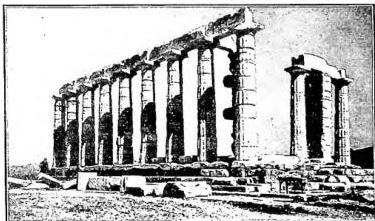
Aphrodite (v.), whose homeland is perhaps Mesopotamia, the goddess of love, of the peace of the sea—from whose foam she is born—and of calm navigation. All are slaves to her arts, men and gods, with the exception of Artemis, Athena, and Hestia.
Distant, but not for this reason extraneous to the world of the Olympians, Hermes (v.), a most ancient divinity whose name is perhaps connected with the heap of stones (erma): dispenser of gifts to men, whose earnings he protects—especially unexpected ones, but also calculated ones or those achieved by means not entirely lawful. He is a thief from birth, and it was he who placed in woman's heart "lies, flattering words, and malice." But he is also the protector of herds and shepherds: a dual spirit that generates in men restlessness and a sense of protection at the same time.
Personification of brute force, god of war as an end in itself, Ares (v.): of scant spiritual content, whose minor importance is matched by that of Hephaestus (v.), the god of fire and at the same time the artisan god, who dwells in volcanoes (Etna above all), and by that of Hestia, daughter of Rhea and Cronus, the personification of the hearth, a divinity "represented in an imperfect manner in her human figure, so much so that it is always evident that respect and veneration go to the hearth itself and its fire, not to the goddess" (Nilsson).
In addition to these (Olympian) divinities, Demeter (v.) and Dionysus (v.) attained great importance, though initially extraneous to official religion.
Better than in mythology, the beliefs of the complex of the Greek nation can be discerned in cult, which is the expression of the social side of religion: all the more so in G. where religious practice is under the control of the State. Indeed, from the viewpoint of cult, the increasingly defined connection between the foundation of official religion and the foundation of the State comes to light, so much so that Greek religion ends with the end of the polis. Its long maintenance was facilitated by the paradoxical position assumed by the critics of religious tradition—critics who flourished even in the period of full splendor of the Greek nation—a position of detractors who do not cease to pay their homage to those very divinities against whom they direct their arrows.
There is no trace in G. of the existence of a priestly class: the exception is perhaps formed by the priests of Dodonaean Zeus (v. DONNA, oracle of), and those practicing in mystery cults, where religious brotherhoods extraneous to the official religion also appear. At Eleusis (v. MISTERIO) the high priest and other subordinates were provided exclusively by a determined γένος. But nothing of the kind existed in civic religion, in which religious authority was exercised by the people, who—having elected or drawn lots for priests, mostly for a limited time—delegated them to execute the resolutions of the assemblies or of the magistrates. Naturally, this did not entail any incompatibility between the function of priest and any other activity: it was sufficient that during the celebrations the officiant devoted himself solely to the sacred activity. Some cults were presided over by priests, others by priestesses, and still others by both together. But on certain occasions it was the civil and military authorities themselves who directed the rite. The place of worship is naturally subject to a certain evolutionary process: originally every altar is the seat of the divinity when invoked, and the primitive altar is nothing other than a rough square, round, or elliptical stone. Subsequently, two types of altars are distinguished: the βωμός and the ἐσχάρα, while a third type, the βόθρος, served in practices for chthonic divinities. These altars are then placed in the center of a sacred enclosure (τέμενος) surrounded in turn by a wall (περίβολος), and enclosed within the interior of the temple, which thus becomes the true and proper residence of the divinity. The image, which has a table for offerings before it, is placed in a cell (ναός) sometimes enclosing within itself an ἄδυτον, which could be entered only by the priest and under certain circumstances, whereas the influx of the faithful into the sacred enclosure is subject, according to the rites and divinities, to precise rules: access limited to certain occasions, sometimes only annual, although, as a rule, entry is permitted daily. The temple is usually dedicated to a single divinity, and the most important sanctuary was originally on the acropolis, but this probably only in the era when the acropolitan seat was the only closed temple, while open-air sacred places are preserved: in woods, near springs, rivers, mountain tops, etc.
Cult practices did not differ much from one another: among them were included sacrifices and offerings, hymns and prayers, expiation and purification ceremonies. Usually one implored the god first of all to make himself present with an ὕμνος κλητικός, and then the sacrifice was performed. This could be bloody or bloodless, sacramental—if the divinity was incorporated by the faithful through a meal—or sacrificial, if the offering was left to the divinity. Different animals were sacrificed according to the different divinities; white animals were offered to the Olympians, black ones to the chthonic gods. The rite was usually performed to obtain something (this was also the case with purifications), under certain circumstances. This was also true of processions, which were practiced especially in connection with "agrarian" divinities. The intensity with which the rite in honor of a god is carried out is testified to by the fact that, in the act of worship, the individual divinity sums up in itself the whole θεῖον, a realization that is at least henotheistic.
To complete the schematic picture of Greek cult, it should be noted that the rites, the calendar, and the very types of cult never transcended the circle of the city walls. The extremely particularistic spirit of the Greek people meant that, while roughly beliefs were the same for everyone, the specification of faith and reverence in this rather than that divinity depended exclusively upon the arbitrariness of the citizens. Perhaps only a certain type of cultic organization assumed pan-Hellenic value, namely the oracle. In the most ancient times that of Dodona, which, situated in the northern part of G., "might have guided the migrations of the Dorians"; in more recent times that of Delphi (v.). Here Apollo was venerated, having probably replaced an autochthonous divinity, and he constituted, at a certain moment, a common place of gathering for all Greeks. From Delphic Apollo stem the traditions relating to the Seven Sages and the collection of Delphic precepts, the poetry of Pindar, and all that radiance of wisdom that emanates from the spiritual equilibrium of Apollo: here Socrates finds his γνώθι σεαυτόν.
Among the official festivals of the Athenian fasti, we should recall the Dipolia (v.) in honor of Zeus, the Pyanopsia (v.) in honor of Athena, the Thargelia (v.), the Munichia (v.), Brauronia (v.), Tauropolia (v.) in honor of Artemis, and still others.
Alongside the official religion, of which poets, philosophers, historians, and polygraphs are the spokesmen, a "popular religiosity" can be found in Greece, which, without ceasing to exist alongside the civic religion, would rise to remarkable sublimation. Leaving aside the mysteries (v.), the endpoint of popular religiosity despite their extremely ancient origin, remains of beliefs and practices of a less precise nature can be ascertained above all through Pausanias. In his Periegesis he speaks of stones (ἱεροὶ λίθοι), perhaps originally believed to be endowed with magical virtue and subsequently connected with some divinity; of the veneration of trees (the olive tree on the Acropolis of Athens, for example) and their connection to certain divinities (Zeus, Dionysus, Artemis, etc.); of original theriomorphism, documented both by the epithets borne by certain gods in the historical era and in myths in which divinities transform into animals or in cults in which the priest bears an animal name. More conspicuous elements of popular religiosity are rituals of a clearly magical character: those to summon rain; annual sacrifices to the Winds, Clouds, and Thunders; rituals intended to ensure the fertilization of the earth and of humans, etc.
To the magical sphere also belongs a series of beliefs involving eliminatory rites against a kind of malevolent fluid (μίασμα) that would emanate under certain circumstances from persons and things—an idea that gives rise to the formation of a concept of the pure and the impure, concepts separated, however, by a fairly fluctuating boundary line. It is certain that whoever has approached certain persons or things, or has performed certain acts, is invested by the fluid emanating from them and must be purified from II. Particularly in precise circumstances: sacrifices, for example, must be offered ἄγνως καὶ καθαρῶς. And one must remove the μίασμα that emanates from having shed or having been touched by blood; from a woman of childbearing age having attended a funeral ceremony; from having approached a pregnant or menstruating woman; from the entirely physical defilement that comes from carnal conjunction; from having committed a crime or approached the culprit, etc. The practices for ridding oneself of the μίασμα were varied: lustrations with water, fire, and fumigations serve this purpose, which is also attested by the presence of a water krater placed at the entrance of temples, so that one may purify oneself before entering, given that one may have been struck by the μίασμα even without knowing it; and, on the other hand, the μίασμα can be transferred to an animal, a human, or an object.
The characteristic of all these rites has led some to speak of a certain "pre-deism" of theirs, not wishing to assert by this that they belong to a stage of Greek religion in which gods do not appear, but rather that they do not imply any god, since implication is not essential to the rite. Instead, it is the idea of tabu that is manifested in the belief "in supernatural forces, useful or harmful, acting by contact or contagion; one seeks to capture good forces directly just as one seeks to repel or destroy bad ones."
In the primitive religious environment, the cult of ancestors (v. ANTENATI, culto degli; DEFUNTI, venerazione dei) must also have flourished, from hero (v.) derives, as revealed by the mystery cults which, perhaps originally "agrarian" rituals, trace their foundation back to the earliest times, maintain themselves alongside the civic religion, and later blossom into the great Orphic and Eleusinian manifestations. A continuity of relations between the deceased and the living is attested by the annual festival celebrated in honor of the dead: on that day the deceased visited the living and stayed with them, returning at evening to their sad dwelling. Here arises the idea of the soul surviving death, often represented in material form in the guise of an animal, such as a snake or a bird. But the cult of the deceased was paid as if he continued to maintain a bodily figure, even when the practice of cremating the corpse was introduced—a practice that should have led to a more spiritual conception.
Greek religion, as already noted, dissolves with the dissolution of the political unity of the country. The dispersion of Hellenic culture throughout the Mediterranean world and the ease with which the Greeks identified their divinities with those of foreign countries led to the loss of the genuine character of the divinities themselves and of the cults connected to them. Not only that: with Alexander's expedition, new cults were imported, and to these the now-skeptical populace turned, as well as to the mystery cults—Greek indeed, the latter, but placed outside the official religion, which was increasingly neglected to their advantage (v. ELLENISMO).
IV. STORIA CIVILE DAL CRISTIANESIMO AD OGGI.
I. IMPERIAL ERA
From the beginning of the imperial era, Greece—whose territory had been devastated by the final battles of the Republic (Pharsalus, Philippi, Actium), whose population had been decimated, and whose wealth had been impoverished (Strabo, in book VIII of his Geography, gives a pitiful description of it)—was able to welcome its restoration with the accession of Augustus to the Empire. In 27 B.C., the latter detached the Peloponnese from Macedonia, reconstituted local administrations—especially those of pan-Hellenic significance, such as the Amphictyonic League of Delphi—established new ones, such as that belonging to the populations of Achaea, based in Argos and headed by an "Hellasarch" as a sort of symbolic resurrection of the ancient Achaean League; and he revived the court of the Areopagus, though replacing selection by lot with election.It was Rome's policy to be generous with local autonomies while centralizing the general government of the country—whose holder was of senatorial appointment—in imperial hands. Athens, Sparta, and Rhodes enjoyed the privilege of free cities, meaning they were exempt from the control of the Roman governor.
During the first two centuries of the Empire, the history of Greece presents no noteworthy events. The life of the country was entirely taken up with administrative affairs and ambitious municipal rivalries, enclosed within the memory of its glorious past, and disinclined to participate with its men in the government of the Empire, even when the Edict of Caracalla granted Roman citizenship to the Greeks as well. Greek identity was felt above all in the celebration of the Olympic Games, the traditional symbol of pan-Hellenism, which had been celebrated continuously ever since 776 B.C. (serving also, from the 4th century onward, to establish the calculation of time) until 393 A.D., when Theodosius I prohibited their further celebration.
Nor from a religious point of view, except for Corinth—destroyed by Sulla and rebuilt by Caesar through the influx of foreign colonists—was there any interpenetration between the Latin and Greek elements, despite the sympathy the emperors showed toward Greece. Claudius (d. 54), imbued with Hellenism, did not withhold his sympathy; Nero (d. 68) gathered easy laurels there; Hadrian (d. 138) stayed in Athens for a long time, and in 131 consecrated the new Olympion and founded a common assembly (synedrion) of the Greeks in the city around the temple he built to Zeus Panhellenios, with an annexed imperial cult, priestly college, festivals, and games.
Yet in the 3rd century, during the crisis of the Empire, the tranquility of the region began to be disturbed. Under Decius (d. 245) the Goths threatened its borders, so much so that under Valerian (d. 245 [260]) the walls of Athens had to be raised, and in 267, under Gallienus (d. 268), the city was occupied by Goths and Heruli, who were driven back by the Greek general Dexippus. In 396 Alaric appeared once again before Athens—which he did not attack because he was terrified by the statue of Athena Prômachos overlooking the Acropolis—but he destroyed the sanctuary of Eleusis (395) and devastated the Peloponnese, from which Stilicho drove him back.
The provincial organization established by Augustus lasted until the reform of Diocletian, who assigned Greece, under the name of Achaea, to the praetorian prefect of Illyricum. The only surviving relic of classicism remained the University of Athens, faithful to traditional Platonism—which remained vibrant even in its Neoplatonic interpretation—and hostile to Christianity. Its closure, ordered by Justinian in 529, marked the death of cultural paganism in Greece.
II. MIDDLE AGES
Under the dominion of Byzantium, which, beginning with the foundation of Constantinople (330), assumed its specific character under Justinian (527-65), the position of G. became secondary. By virtue of the division into themi—which translated into practice in the various provinces of the Empire the situation already established by him for the exarchates of Ravenna and Africa, whereby the civil and military administration that Diocletian had entrusted to two different officials was once again united in the hands of a single governor (strategos)—the province of Achaea was abolished and replaced by two districts: I. Hellas, which included Attica, Boeotia, the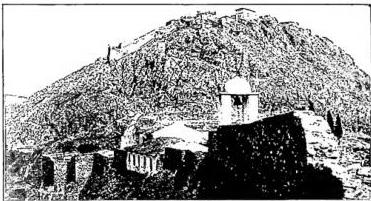
The northern invasions of the Vandals (467-77) and the Slavs (549, 588) into the Peloponnesus—where the latter ended up settling permanently—altered the ethnic composition of the population, although the Greeks, with their superior culture, managed to absorb the preponderant Slavic element. The ancient cities were reduced to villages, and the latifundium expanded over previously cultivated lands. These dismal conditions of the Greek people eventually erupted into an open, though soon quelled, rebellion that broke out in Athens in 1727, when Leo III the Isaurian initiated the Iconoclast struggle. Nor did the tribulations of G. cease here, for in 746-47 a severe plague depopulated Athens; the country had to sustain continuous struggles to stem the progressive invasion of the Slavs into the territory; the incursions that Muslim Arabs, who had settled in Crete from 823, made on the islands and coasts of G.; the invasion of the Bulgarians whom Basil II, hence called the Bulgaroctonus, defeated in 1018 near Athens; and the looting that Roger II of Sicily in 1147-49 carried out in Acarnania and Aetolia, occupying the two commercial centers of Corinth and Thebes.
The capture of Constantinople by the Fourth Crusade (1204) brought a profound upheaval to the situation of G., where the Latin leaders, especially from France, occupied it and applied the feudal system. Thus arose the Principality of Achaea ruled by the dynasty of Geoffrey of Villehardouin, and the Duchy of Athens, which passed from Boniface III of Montferrat to Otto de la Roche, to Walter of Brienne, and finally to the Acciaiuoli of Florence. Nor should we forget the relations, both commercial and political, that Southern Italy—due to the importance of the Adriatic coast—always maintained with G.; hence it can well be said that the catastrophe of Constantinople in 1453 was a catastrophe not only for the Greeks, but also for Latinity, ousted from the region along with its Western culture.
The Ottoman Turks under Mehmed II conquered Constantinople in 1453 and in 1456 seized Athens. G. was divided into six militarily organized districts: Morea, Boeotia and Attica, Thessaly, Aetolia and Acarnania, Epirus, Euboea. Thus its territorial unity was reconstituted, and under the Turkish regime the country was able to enjoy a wretched but effective peace. This, however, brought no civil improvement because the Ottoman government, modeled on that of nomadic hordes, was as if encamped in the occupied territories, ruling with the law of the desert, oblivious to civic administration. During these long centuries of Ottoman rule, there are no internal political events to record, except for the progressive occupation by the Turks, to the detriment of the Venetians, of Euboea (1470), Lepanto, Coron, Modon, and Navarino (1499-1501), that is, of almost all of G.
Hostilities between Venetians and Turks, despite the peaces of 1503 and 1573, continued constantly until, in the long war from 1645 to 1669, the Venetians lost the island of Candia after a heroic resistance, and in the war from 1685 to 1689 they lost the Peloponnesus. It was during this war that the Parthenon, used by the Muslims as a powder magazine, was almost destroyed by a bomb thrown by the Venetians under Francesco Morosini (Sept. 27, 1687). With the help of Emperor Leopold I, Morosini was able to recapture the Peloponnesus, possession of which was confirmed to him by the Peace of Karlowitz (1699), but only for a few years, because in 1718, by the Peace of Passarowitz, it passed back to the Turks—much to the indifference of the Greeks, who declared they preferred the Sultan to the Venetians and the Greek Patriarch of Constantinople to the Latin Pope of Rome.
III. NATIONAL INDEPENDENCE
The French Revolution, everywhere provoking the rise of nationalisms—alongside those of the Serbs, Bulgarians, and Romanians of the Balkan Peninsula subject to the Turk—also awakened that of Greece, encouraged (here as among the other aforementioned populations) by Russia, which from Peter the Great onward had always considered itself the natural protector of the Orthodox populations.Opposition to this liberation movement came from Metternich's Austria, which—in the name of the principles of the Holy Alliance—was opposed to any spirit of nationalism that, had it prevailed, would have ended up shattering the Austrian State itself, as indeed later happened; but it was platonically encouraged by Russia, which supported secret associations (eterie) and welcomed Greek refugees from Turkey into the ranks of its army and civil offices, and more effectively by England, which, once the insurrection broke out, sent its fleet in support. The revolution broke out in Jassy at the initiative of Alexander Ypsilantis, aide-de-camp to Tsar Alexander I, and developed in Achaea under the leadership of P. Mauromichalis and T. Kolokotronis, with the blessing of the Archbishop of Patras, who raised the banner of the insurrection on the walls of Kalavryta, and with the effective action of M. Botzaris and admirals Kanaris and Miaoulis.
The first effect of the insurrection was the gathering at Epidaurus on Jan. 1, 1822, of an assembly of the insurgents which proclaimed the independence of Greece and elected a five-member council and a 59-member senate presided over by Demetrios Ypsilantis, brother of Alexander. While the powers coldly received the insurgents' appeal, illustrious European liberals rushed as volunteers to the call: suffice it to remember Lord G. Byron, who later fell at Missolonghi, and Santorre di Santarosa, who fell at Sphacteria. Meanwhile, to quell internal discord, Greece had established a dictatorial regime under the Corfiot Count Ioannis Kapodistrias (1827), formerly a minister at the court of Tsar Alexander I, who was soon assassinated (1831) for his authoritarian demeanor.
The Viceroy of Egypt, Mehmet Ali—appointed Pasha of Morea for the occasion—sided in defense of the Sultan, sending his son Ibrahim to occupy Navarino, Tripolitsa, and Missolonghi (1827). The three powers interested in the events (France, England, and Russia) interposed their mediation, but Ibrahim, after accepting it, refused to comply with the armistice conditions; whereupon the English fleet went into action and annihilated the Egyptian one, thus achieving the liberation of Greece from the Turks. The Treaty of Adrianople (Sept. 1829), confirmed by the London Conference (1830), recognized the independence of Greece within the limits of Hellas, the Peloponnese, Euboea, and some islands of the archipelago, setting the northern border along a line from the Gulf of Volo to the Gulf of Arta, which excluded the populous provinces of Epirus, Thessaly, and Macedonia, as well as the large islands of Crete, Rhodes, Samos, and Chios.
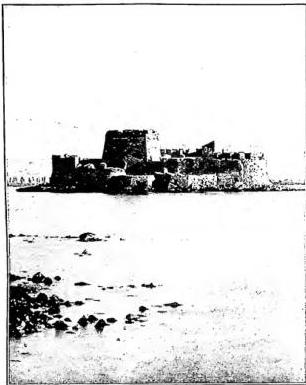
The crown of the new Kingdom was offered to Prince Leopold of Saxe-Coburg, and upon his refusal, it was offered to Otto, second son of Louis of Bavaria, who made his solemn entry into Nauplia, the provisional capital, in 1833 and fixed the capital of the Kingdom at Athens. Because of his excessively centralizing, German-style system of government, a revolution broke out in 1862 that persuaded Otto to return to Bavaria. He was succeeded by Prince George of Denmark, favored by England, which for the occasion ceded the Ionian Islands (1864)—held by it since 1815—to Greece.
The new Constitution, which gave the monarchy a democratic character inasmuch as popular sovereignty was recognized through the parliamentary system, came into force in 1864.
Under the reign of George I, Greece improved its internal condition; thanks to the two Balkan Wars, it increased its territory with the conquest of Thessaloniki by the Diadoch Constantine, who ascended the throne (as the twelfth of that name, to reconnect with the last of the Palaiologoi who fell beneath the walls of Byzantium in 1453) following the assassination of his father in Thessaloniki (1913). But the prosperity achieved was nullified by the events of the First World War, which the Cretan Venizelos wanted Greece to join, against the advice of the King who desired neutrality, and who had to go into exile (1917), from which he was recalled following a plebiscite in 1920. But the defeat inflicted upon them by the Turks in Asia Minor (1922) forced Constantine XII into definitive abdication in 1922. He was succeeded—since Alexander I (who reigned from 1917 to 1920) had predeceased him—by his other son, George II, who, following the republican revolution led by Plastiras, had to abdicate in 1924.
The republican regime lasted until 1935, when the National Assembly, by an overwhelming plebiscite, recalled George to the throne. The unstable balance of the parties persuaded the new Prime Minister Metaxas to assume a dictatorial posture. Meanwhile, events drew the country into the Second World War: the attack on Greece, moving from Albania, by inadequate Italian forces which were defeated by the skillful defense of General Papagos (1940-41); the German intervention in Greece (1941); the landing of the Anglo-American allies (1944); the withdrawal of King George to England; the regency of Archbishop Damaskinos (1945); the bloody guerrilla warfare between the national front (ELAM) and the Soviet-compliant popular liberation army (ELAS) under the leadership of Markos; the institutional plebiscite (1946) which voted for the return of the King. The latter died in 1947 and was succeeded by his brother Paul II. After the cession of the Dodecanese islands to Greece (1946), a treaty of friendship between Italy and Greece was signed in San Remo on Nov. 5, 1948.
V. ORANTE, IMPERO ROMANO DI, Storia
For modern Greece: Fr. Ch. Pouqueville, Hist. de la régénération de la Grèce, Paris 1826; G. G. Gervinus, Risorgimento della G., 3 vols., Milan 1863-64; G. F. Hertzberg, Gesch. Griechenlands seit dem Absterben das antiken Lebens bis zur Gegenwart, Gotha 1876-78; F. Gregorovius, Gesch. der Stadt Athen im Mittelalter, 2 vols., Stuttgart 1889; W. Miller, Greece, London 1928; J. Ancel, Peuples et nations des Balkans, Paris 1930, pp. 15, 98, 109, 157, 183; G. Zoras, Nel primo centenario della costituzione del Regno ellenico, in L'Europa orientale, 13 (1933), p. 106 ff.; id., La restaurazione monarchica in G., ibid., 16 (1936), p. 177 f.; M. Vasmer, Die Slaven in Griechenland, Berlin 1941. Nicola TurchiV. STORIA ECCLESIASTICA.
I. FROM THE BEGINNINGS OF CHRISTIANITY UNTIL THE 20TH CENTURY
1. Apostolic Age
The Hebrew Bible calls the Greeks Jāwān ("Ionians"). Jāwān was a descendant of Japheth; the Septuagint (Ἰωάν) and the Vulgate (Iavan) transcribe his name in the genealogies (Gen. 10, 2, 4; I Chron. 1, 5, 7); elsewhere they translate it as Ἕλληνας and Graeci, or Ἑλλάς and Graecia. In Assyrian, it was said Jāmn, Jāman, Jāvan ("Ionians"). In Is. 66, 19 Yahweh promises that he will cause the Israelites to reach the Greeks and the "islands." Ezek. 27, 13, 19 and Joel 3, 6 (Heb. 4, 6) speak of the trade in slaves, vessels, and metals that the Tyrians conducted with the Greeks. Dan. 8, 21 ff. and 11, 2 describe the power of the ram or Alexander "king of the Greeks" ("first king of the Greeks": I Macc. 1, 1; 6, 2). The Seleucids are also "kings of the Greeks" (Dan. 10, 20; Zech. 9, 13; I Macc. 1, 11; 8, 18: against them the Jews ask the Romans for help to free them from the "yoke of the Greeks").The first political relations between Jews and the inhabitants of G. properly speaking took place (I Macc. 12, 20-23) under the king of Sparta Areios I (309-265 B.C.) and the high priest Onias I (325-300) or II (c. 265). Jonathan Maccabeus (168-142 B.C.) appealed to a very ancient kinship between Spartans and Jews (I Macc. 12, 6, 21; 14, 20; cf. II Macc. 5, 9, and Fl. Josephus, Antiq. Iud., XIV, 10, 22); Simon (142-134) renewed the alliance at the desire of Sparta (I Macc. 14, 16-23).
In the "Greek" or "Hellenistic" period, which began after the conquest of Alexander the Great (d. 323 B.C.), Palestine, after a brief period of Ptolemaic rule, was under the "Greek" Empire of the Seleucids, kings of Syria. There then spread
among the Jews, IV (v.), the pagan customs of the "Greeks," despite the resistance of faithful groups (II Macc. 4, 15; 9, 24); the Hellenistic language and Greek coins came into use (v. BIDRAMMA; DIDRAMMA). But Hellenism (v.) took place principally in Alexandria (v.), and subsequently had other centers in Antioch, Cyrene, Smyrna. For the Jews called "Hellenists," because they were Greek-speaking, diaspora (v.), the Greek versions of the Bible were made, the oldest and most important of which is called the Septuagint; moreover, an important Judeo-Hellenistic literature developed, Philo (v.). At the time of the apostolic preaching, G. properly speaking was the Roman province of Achaea. Conquered in 146 B.C., it was at first attached to Macedonia; it was elevated to a senatorial province by Augustus in 27 B.C., with Corinth (v.) as its capital, "totius Graeciae lumen" (Cicero, Pro lege Man., 5). Gallio (v. Acts 18, 12) was proconsul of Achaea, which was distinct from Macedonia (Acts 20, 2), when St. Paul arrived, a fugitive from
The New Testament books mention numerous Hellenistic Jews in Jerusalem (Act. 6, 1; 9, 29): ἑλληνιστῆς (from ἐλληνίζειν "to live like the Greeks" or "to speak Greek"), translated incorrectly by the Vulgate as Graecus, is the Jew who speaks Greek (Act. 21, 37-39) because he was born or domiciled in the world of Hellenic language and culture. The term Ἕλλην (Vulg. Graecus) is equivalent in the New Testament to "pagans" (Io. 7, 35; Act. 11, 19; 14, 1; 18, 4; Rom. 1, 14, 16; 2, 9 ff.; 3, 9; Gal. 3, 28) in opposition to Ἰουδαῖος; οἱ Ἕλληνες is equivalent to τὰ ἔθνη (cf. Act. 13, 47), with explicit reference to the Greco-Roman cultural world. Greco-Roman civilization and power were in fact identified with paganism (I Cor. 1, 22-24). But in Christianity, with every distinction removed other than faith in Christ, there is no longer any distinction between Jews and Greeks (Rom. 10, 12; Gal. 3, 28), nor between Greeks and barbarians (Rom. 1, 14; Col. 3, 11). G. was the cradle from which civilization spread throughout the ancient world ("oikoumène"). Its philosophical and religious thought contributed indirectly, and most often negatively, to preparing humanity for the universal and personal Christian message. A.-J. Festugière sets forth, in a rich synthesis, the profound, not infrequently esoteric currents that reveal the labor underlying the restless Greek inquiry into God, the soul, and the cosmos at the time of the emergence of Christianity.
The faith brought by s. Paolo to G. developed rapidly there. S. Clemente Romano (1st cent.) presupposes numerous communities there. Many bishops were already present there in the first three centuries. Athens regained its status as a center of learning for the West; the pagan Academy was closed there only in 529. From the time of Constantine, the greater part of ancient G. passed to the prefecture of Illyricum; under Valentinian I, G. was united to the prefecture of Italy; in 379 it passed once again to the Eastern Roman Empire.
14. On the Greek religious mentality in relation to the Christian message: A
J. Festugière, L'idéal religieux des Grecs et l'Évangile, Paris 1933; id., La révélation d'Hermès trismégiste, I, L'astrologie et les sciences occultes, ivi 1948; II, Le Dieu cosmique, ivi 1949, followed by III, Les doctrines de l'âme, and IV, Le Dieu inconnu et la gnose; cf. M. P. Nilsson, Religiosità greca, trad. it., Florence 1949.Antonino Romeo
15. Subapostolic Age
The subsequent external development of the Greek Church is manifested in the participation of its bishops in ecumenical councils. Already at the Council of Nicaea (325) there are present 4 or 5 bishops from Macedonia and Thessaly, 3 from Achaea, and 4 from the islands. At the Council of Ephesus (431) one notes the presence of 5 bishops from Macedonia and Thessaly, one of whom also represented the bishop (papal vicar) of Thessalonica, the metropolitan of Corinth with 6 suffragans, the metropolitan of Old Epirus with 2 suffragans, and the metropolitan of Rhodes with 4 suffragans. At the VII Ecumenical Council (787) there are the synodals of G., namely, the metropolitan of Thessalonica, that of Gortyn with 9 suffragans, the 5 bishops of the islands of Corfu, Zante, Cephalonia, Aegina, Lemnos, the metropolitan of Nicopolis (Epirus), and another 3 bishops from the Peloponnese and other Greek regions.The entire ecclesiastical organization of Eastern Illyricum to which the dioceses of G. were incorporated, with the exception however of the bishoprics of the metropolis of Rhodes, comprised at the end of the 9th century and even later some sixty dioceses. This development was due at least in very large part to harmony with the Roman See, to which those dioceses belonged both de jure and de facto until 732; to the sacrifices made in the early persecutions by martyrs such as Dionysius, Publius, Leonidas, Cyril of Crete, Demetrius, Isidore, the Ten of Crete; to the apologetic and dogmatic theology taught by the apologists Aristides and Athenagoras, by the teacher Theodore, the future archbishop of Canterbury, by Andrew of Crete, by Joseph of Thessalonica, brother of s. Teodoro Studita, and by the future apostles of the Slavs, ss. Cyril and Methodius originating from Thessalonica; to the zeal and good example of Nicon Metanoeites (d. 998) and of the founders of famous monasteries, Luke (d. 946), Athanasius the Athonite (d. 1000; V. PATMOS), and Christodoulos of Patmos (d. 1093). The separation of Byzantium from the Catholic Church (v. COSTANTINOPOLI, I, Il patriarcato) dragged the Greek Church into the same sad fate. The two Ecumenical Councils of Lyons (1274) and Florence and numerous other attempts by the popes met with only temporary success. Indeed, after the rejection of the unionist attempts, hatred against the Catholic Church often grew, as demonstrated by the many writings of Greek controversialists. Furthermore, in the 14th century, the new heresy of Palamism, propagated by Gregory Palamas, metropolitan of Thessalonica, and by his followers and successors Nilus and Nicholas Cabasilas, added a grave obstacle to Union. The Latin domination that from the 13th century encompassed many parts of modern G. did little to aid Union; indeed, due to the methods used by the governments, it often resulted to the advantage of the dissidents, even though their bishops were not officially admitted to their sees. When Latin rule ceased, the grave damages suffered by the Catholic Church—especially on account of mixed marriages—could be better observed. A characteristic example is offered by Crete, occupied by the Venetians from the 13th century until the year 1669; there originated the patriarchs most hostile to the Catholic Church, such as Meletius Pegas and Cyril Lukaris. Under Turkish rule, the Greek hierarchy was able to reorganize itself once again. Nevertheless, its culture and influence were certainly not flourishing, principally on account of the sad situation of their patriarchs. Precisely in those times, as will be seen below, the dissident Greek Church readily asked for and accepted the services of Catholic missionaries and the Roman See. It is not denied, however, that even in those times, particularly through the help of "Orthodox" benefactors from abroad, schools were established, for example, at Mount Athos, Athens, Chios, Patmos, Ioannina, Missolonghi, in the Ionian Islands, etc.
After liberation from the Turks, the Greek government promoted primary and secondary schools and in 1837 founded the University of Athens with a faculty of theology. Certainly the Greek Church derived several advantages from these state institutions, but also disadvantages on account of the liberal statolatry of the rulers of that time. The Greek Church itself underwent a transformation, inasmuch as the liberal government, with the consent of an assembly of bishops, proclaimed in 1833 the independence of the Greek Church from the Byzantine patriarchate. Other events of capital importance followed, such as the suppression of many bishoprics and of many male and female monasteries. On these and other difficulties V. ATENE, ARCUDIOCESI di.
Gregory XVI, in strenuously defending religious principles in the internal struggles of G. (first half of the 19th century), certainly rendered services to the cause of holy liberty against statolatry. He established the apostolic delegation. In the second half of the 19th century, the influence of Protestants—which had already begun earlier—continued; the fact that many professors of theology had been trained in German universities, particularly under Protestant masters, also had unwholesome effects. The encyclical letters of Pius IX and Leo XIII inviting dissidents to Union met with strong opposition in G., including in the press. However, even in sad days, there was no lack of trust from "Orthodox" parents who entrusted their children to Catholic institutions run by religious men and women.
II. THE CATHOLIC CHURCH, FROM THE 13TH TO THE 20TH CENTURY
Pope Innocent III created the Latin archbishopric of Athens in 1209, with 11 suffragan sees. Other Latin bishoprics were created around the same time in Crete and elsewhere. Indeed, Greece at that time presented a vast ecclesiastical organization. Those few bishops who took the oath of obedience to the Pope and his representatives were left in office. Western religious also hurried to the aid of souls.Thus the monastery of Daphni came into the hands of the Cistercians. Dominicans, Franciscans, and other religious founded residences in Greece, especially in Crete. But the conversions of Greeks were not numerous. Latin domination did not lead the indigenous inhabitants to the Catholic faith of their masters. It was not the fault of the Church that several of the lords and even some ecclesiastics were not of exemplary conduct. A fortunate initiative, especially after the Council of Florence, was promoted to gently attract dissidents to the Catholic Church through the agency of Catholic priests of the Greek rite; indeed, perhaps the principal cause of the meager results of the Catholic apostolate in preceding centuries was precisely Latinism. In Crete, Methone, and Corone, strong groups of Catholics were formed under priests of the Greek rite. The Catholic bishop of the Greek rite Joseph, who previously bore the name of Giovanni Piusideno, was an able writer and exemplary prelate, who died beside his flock during the capture of Methone in 1500. Cardinals Bessarion and Isidore of Kiev supported the Catholics of the Byzantine rite with their authoritative influence. In the 17th century, many dissident prelates of Greece addressed letters to the Roman Curia asking for help; the Greek monasteries of Athos, Nea Mone (Chios), and Patmos did the same. The Holy See was benign and charitable toward such petitions, although at times it showed reluctance as a consequence of some unfortunate experiences with Orientals. Conversions of dissident prelates were also obtained; some nevertheless did not persevere. In any case, the apostolate of Catholic missionaries in Greece often found trust among the "orthodox." The schools of the Jesuits, Capuchins, and Lazarists were attended by not a few children of dissident parents. When in the 19th century a flourishing of charitable and educational foundations with all modern equipment began in Athens, Piraeus, Thessaloniki, Crete, Chios, Naxos, Syros, Santorini, Tinos, Corfu, and elsewhere, "orthodox" parents showed very great confidence in these schools and other institutions of the kind. Thus it has remained down to the present day, although attacks against Catholic works have not been lacking over the course of time. For the cultural contribution of Greek Catholics in the West, V. COLLEGI ECCLESIASTICI (IX. Greco, Pontificio).
III. IN THE 20TH CENTURY
The Greek "Orthodox" Church received a new Constitution in 1940. Until 1923 it had been governed by a permanent Synod of 5 members presided over by the Archbishop of Athens. The Statute of 1923 replaced this Synod with another composed of all the bishops, leaving the dispatch of ordinary business to the Archbishop of Athens. This arrangement lasted until 1925. A new Statute in 1931 established a General Assembly of all bishops to meet at least every 3 years and a permanent Synod of 8 members. The Statute of 1940 retained these two bodies, merely reducing the members of the Synod to 6, and entrusted them with the task of electing new bishops, to be done by presenting 3 candidates to the government, which would then choose one of them. Certain dioceses were suppressed and others merged together, resulting in 65 dioceses and the Archdiocese of Athens, subject to the Synod of Greece, while the province of Crete, subject to the Byzantine Patriarch, numbers one metropolitan and 7 suffragan bishops.In 1938 Archbishop Chrysostomos Papadopoulos was succeeded upon his death by Chrysanthos Filippidis, who in turn had as his successor, in 1941, Damaskinós, who later became regent of the Kingdom until the king's return; he died in 1949 and was succeeded by Spyridon.
Over the last 20 years the "Orthodox" Church has had tense relations with the Catholic Church and, conversely, very friendly ones with Protestant churches. The tension, the cause of which was the arrival in Greece of numerous Catholics of the Greek rite together with their bishop after the war against Turkey (1921), has manifested itself in numerous legislative acts against "proselytism," in the constant refusal to recognize the Latin Archbishop of Athens, in the clergy's opposition to the establishment of civil marriage (the law recognizes only the "Orthodox" marriage of "orthodox" persons, so that a "mixed marriage" performed in the Catholic Church is considered invalid), in the new law of 1938 which elaborates on the constitutional clauses concerning religion, and finally in the effective opposition to the establishment of diplomatic relations with the Holy See.
The Greek Church has had itself represented at all the major Pan-Christian conferences (Lausanne 1927; Edinburgh 1937; Amsterdam 1948). Relations with the Anglicans are particularly close. Upon invitation, delegates were sent to the Lambeth Conferences of 1920, 1930, and 1948. In 1931 there were official discussions on doctrine and the possibility of intercommunion with the Anglicans and Old Catholics. But it was only in 1938 that the Greek Church recognized Anglican ordinations, a move later imitated by other "Orthodox" Churches.
The level of clergy education in the Greek Church is, due to its extreme poverty, rather low. The majority of students in the theological faculty of Athens do not aspire to the priesthood but merely to some career connected with the Church (e.g., chancery work in dioceses, theology chairs almost all held by laymen). The adoption of the new calendar in 1924 gave rise to local dissensions that still persist.
In 1907 an association called Ζωή (Life) was founded, mostly by laymen, with a monastic-type rule for the training of catechists and the promotion of Sunday schools. It publishes a weekly magazine of the same name. In 1938 the Christian Union of Graduates arose to elevate the level of religious life; it publishes Ἀκτίνες (Rays). After World War I other movements came into being, especially on the initiative of laymen, for religious renewal.
The situation of Latin Catholics in Greece during the 20th century has not undergone any noteworthy changes. Catholic Action has been organized according to modern guidelines. In 1947 the diocese of Chios was placed under the administration of the Archbishop of Naxos, and that of Santorini under that of Syros.
Giuseppe Gill
IV. THE GREEK RITE
Until a few years ago, this term was always used to designate the rite of the Byzantine Church observed in various regions. To distinguish the languages and countries of this rite, people said Greek-Russian, Greek-Bulgarian, Greek-Georgian, Greek-Melkite (Arabic), etc. Now the expression Byzantine rite has come into use; V. BIZANTINA, ARTE, LITURGIA.Placido de Meester
VI. THE κοινή.
The κοινή ("common [language]") or ἑλληνική διάλεκτος designates the Greek language from the time of Alexander (ca. 330 B.C.) down to the Byzantine period; it is the post-classical Hellenism that spread from Alexandria (v.) throughout the Roman world. The language of conversation and commercial relations, it lasted until 500 A.D., when the Neo-Greek phase begins; it is also called "Hellenistic," since ἑλληνισμός referred to the grouping of the entire Greek people, beyond the barriers of individual States, into a common cultural world (400-200 B.C.). The κοινή extends to the various forms of Hellenistic literary production (inscriptions, private letters, historical and biblical works); it remains a compromise between the spoken language and the tradition of classicism.
This international language, convenient for transactions, breaks up the existence of the Greek dialects. The literary language, which differed significantly from the spoken language and remained under the influence and imitation of classical Greek, from the 1st century B.C. strives to draw closer once again to the ancient classical models (Atticism); whereas the spoken language develops on its own account, and has modern Greek as its endpoint. The Atticizing tendency did not affect the manuscript tradition of the New Testament, although a sporadic Atticization of the Synoptics can be detected in individual manuscripts or groups of manuscripts (Michaelis).
The κοινή was formed on the basis of Attic, of which it mostly preserves phonology and inflection; Doric influence is minimal or nil, while the contribution of Ionic is abundant. The choice of α or η, the vocalism of certain words, cases of aspiration, laws of contraction, declension and conjugation adhere, with few exceptions, to the rules of Attic; whereas Ionic, which penetrated only accidentally