
Ephesus ("Ephesos"). - A city on the Ionian coast of Asia Minor, of Mycenaean origin as attested by archaeological findings, situated almost at the mouth of the Caÿster and endowed with an excellent port for trade, which it always sustained from the sea to the mountains of the Taurus. Successively occupied by Croesus, king of Lydia, by the Persians (545), by the Macedonians (334), in 133, by testament of King Attalus III, it passed to the Romans, under whom it became the richest and most commercial city in Anatolia.
Ephesus was the birthplace of Heraclitus, the iambic poet Hipponax, the elegiac poet Callinus, and the painter Parrhasius. The principal deity worshipped in Ephesus was the Great Mother, depicted standing with hands clasped at her sides, endowed with many breasts to signify her inexhaustible fertility. The Greeks assimilated her to Artemis, who in turn was assimilated to the Italic Diana. Her Ionic dipteral temple burned in 356 at the hands of Herostratus but was rebuilt more splendidly (Strabo, XIV, 1, 22; Pausanias, IV, 31, 8; VII, 2, 6). Within the temple precinct was built a sanctuary to Augustus, symbolizing the union of provincial and imperial cult (cf. V. Chapot, La province romaine proconsulaire d'Asie, Paris 1904). From the Ephesian sanctuary derive the Ephesia grammata, formulas endowed with magical power for the benefit of those who pronounced or carried them.
The Ground Truth image shows a single, solid horizontal line. According to Rule 2 (UNDERSCORE & LINE RULES), this is a stylistic or background line, not a placeholder underscore. Therefore, the OCR result must ignore it and output nothing or only meaningful text. The provided OCR output is "____," consisting of four underscores. This is an incorrect interpretation of the line as a placeholder, violating the rule that stylistic lines must be ignored. The OCR has hallucinated placeholder underscores where none exist in the GT. Thus, the OCR result is inconsistent with the Ground Truth.
The Ground Truth image shows a single, solid horizontal line. According to Rule 2 (UNDERSCORE & LINE RULES), this is a stylistic or background line, not a placeholder underscore. Therefore, the OCR result must ignore it and output nothing or only meaningful text. The provided OCR output is "____," consisting of four underscores. This is an incorrect interpretation of the line as a placeholder, violating the rule that stylistic lines must be ignored. The OCR has hallucinated placeholder underscores where none exist in the GT. Thus, the OCR result is inconsistent with the Ground Truth.
---
EFESO
City on the Ionian coast of Asia Minor, of Mycenaean origin. Its name appears in Hittite sources as Apasa, and in Greek tradition, it was founded by the Amazons or by Androclo, son of Codro, king of Athens. The city was renowned for its temple of Artemis (v. Tempio di), one of the Seven Wonders of the ancient world, and for its commercial and cultural importance. In the New Testament, it is mentioned as the site of the preaching of S. Paolo (v. S) and as the residence of S. Giovanni Evangelista (v. S).
The city was part of the Roman province of Asia and became an important center of early Christianity. The Third Ecumenical Council (431) was held there, which condemned Nestorianism (v. EFESO, Concilio di). In the Byzantine era, it remained a significant ecclesiastical and administrative center until its decline following Arab raids and the silting of its port.
BIBL.:
J. Keil, Ephesos. Ein Führer durch die Ruinenstätte und ihre Geschichte, Vienna 1930; G. Jacopi, Efeso, Rome 1932; F. Miltner, Ephesos. Stadt der Artemis und des Johannes, Vienna 1958; V. ARTEMIDE, Tempio di; PAOLO, S.; GIOVANNI EVANGELISTA, S.; EFESO, Concilio di.
A. M. Schneider
The Ground Truth image shows a single, solid horizontal line. According to Rule 2 (UNDERSCORE & LINE RULES), this is a stylistic or background line, not a placeholder underscore. Therefore, the OCR result must ignore it and output nothing or only meaningful text. The provided OCR output is "____," consisting of four underscores. This is an incorrect interpretation of the line as a placeholder, violating the rule that stylistic lines must be ignored. The OCR has hallucinated placeholder underscores where none exist in the Ground Truth. Thus, the OCR result is inconsistent with the Ground Truth.
The Ground Truth image shows a single, solid horizontal line. According to Rule 2 (UNDERSCORE & LINE RULES), this is a stylistic or background line, not a placeholder underscore. Therefore, the OCR result must ignore it and output nothing or only meaningful text. The provided OCR output is "____," consisting of four underscores. This is an incorrect interpretation of the line as a placeholder, violating the rule that stylistic lines must be ignored. The OCR has hallucinated placeholder underscores where none exist in the Ground Truth. Thus, the OCR result is inconsistent with the Ground Truth.
The Ground Truth image shows a single, solid horizontal line. According to Rule 2 (UNDERSCORE & LINE RULES), this is a stylistic or background line, not a placeholder underscore. It must therefore be ignored in the OCR output, which should contain no characters or only meaningful text. The OCR result "____" (four underscores) incorrectly interprets the line as a placeholder, violating the rule that stylistic lines must be disregarded. The OCR has thus introduced placeholder underscores where none exist in the Ground Truth, making the output inconsistent with the original.
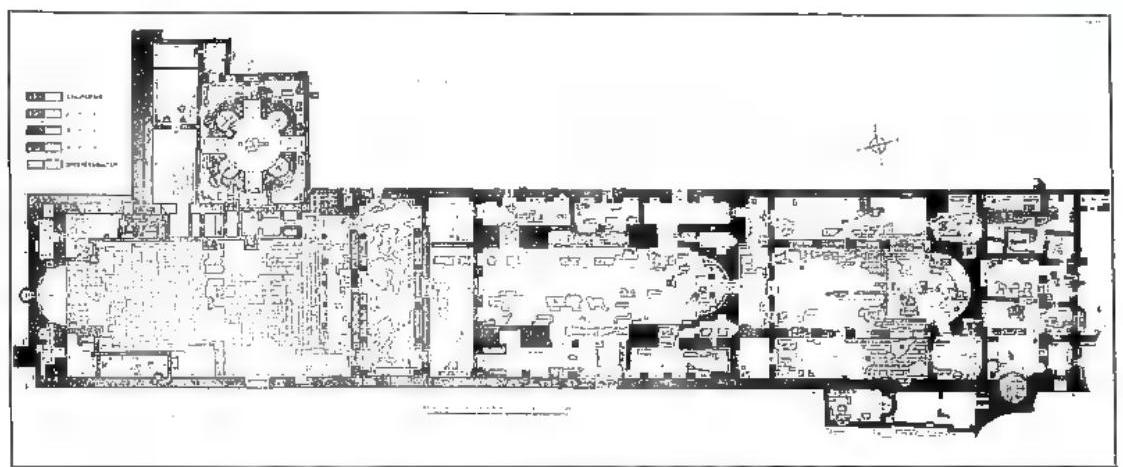
(from E. Rusch, F. Knoll, J. Kell, Die Marienkirche in Ephesus, in Forschungen in Ephesus IV, 1. 1911, pl. 1)
EFESO - Plan of the church of St. Mary.
as amulets. The port of E. that was destroyed in the Byzantine era by the Seljuk Turks (1116) corresponds to the present-day Turkish village of Ayasoluk, a corruption of ἄγιος Θεολόγος, referring to the apostle St. John, who carried out his mission in E. and there had a basilica, now in ruins, around which Christian devotion developed among the people, and markets took place in which Italian merchants took an active part.
BIBL.:
Nicola Turchi
I. EPHESUS IN THE NEW TESTAMENT
Ephesus was the setting of the activities of St. Paul and later of St. John.St. Paul visited Ephesus for a few days at the end of his second missionary journey (52-53). The warm reception in the synagogue compelled him to return. Meanwhile, Aquila and Priscilla remained to prepare the Christian conquest of Ephesus (Acts 18:18-21). During this time, the Alexandrian Apollos (v. APOLLO) arrived, a soul burning with apostolic zeal but imperfectly initiated into Christianity, whom the couple fully instructed and baptized. In a similar condition to Apollos were about a dozen "disciples" when Paul returned to Ephesus in 54 (third journey): he instructed and baptized them, and they joined the nascent community (Acts 19:1-7). The break with the synagogue occurred after three months of disputes over the "kingdom of God." Paul then moved to the school of a certain Tyrannus, one of the many rhetors who abounded in the major cities of the East. It is unclear whether the hall, which, according to a variant of codex D in Acts 19:9, was at Paul’s disposal from the fifth to the tenth hour (11 AM–4 PM), was lent to him free of charge. Two years of fruitful apostolic labor, which, due to the influx of foreigners and the likely dispatch of disciples to other cities of proconsular Asia (Col. 1:7; 4:13), extended far beyond the borders of Ephesus (Acts 19:26), aroused the jealousy of the Jews (Acts 19:13-17) and the concern of those economically interested in maintaining the cult of Ephesian Artemis (v. DIANA). Indeed, as Paul prepared to leave Asia, Demetrius and the guild of silversmiths incited a riot, during which some of Paul’s Asian friends also intervened on his behalf (Acts 19:31). Regarding the question of whether Paul endured a prolonged imprisonment in Ephesus, followed by a sentence to the beasts (cf. 1 Cor. 15:32), and whether he wrote the Prison Epistles from this city, V. PRIGIONIA, EPISTOLE della.
On his return from Achaia to Jerusalem, Paul summoned the Ephesian presbyters to Miletus, to whom, in a farewell discourse, he defended his conduct (Acts 20:17-35) and announced that this would be their last meeting (Acts 20:25, 38). Instead, he returned to Ephesus between his first and second Roman imprisonments, leaving Timothy there as bishop (1 Tim. 1:3). Paul’s final concerns for the faithful of Ephesus and the sorrows they caused him are mentioned in 2 Tim. 1:15-18. From his second Roman imprisonment, Paul (2 Tim. 4:12), likely to facilitate Timothy’s journey to Rome, sent Tychicus to Ephesus, who had already undertaken other missions there (Eph. 6:21-22).
Of the monuments of Ephesus brought to light by excavations conducted at the end of the 19th century and the early years of the 20th, the Acts mention only the theater, where the crowd incited by Demetrius’ speech rushed. The so-called "prison of St. Paul" may, at most, represent a confused memory of an imprisonment.
The only passage in the New Testament that implies a connection between Ephesus and the apostle St. John is the first of the seven letters of the Apocalypse (2:1-7), addressed to the angel of the church of Ephesus. From this, one may infer a directive and supervisory role exercised by the Evangelist over this and the other Asian communities. It is clearer that, toward the end of the apostolic age, the Ephesian church was troubled by the erroneous propaganda of false apostles and, while resisting these attacks well on the whole, had nevertheless grown cold in its original charity. A trace of St. John’s residence and activity in Ephesus is also found in the name of the aforementioned village of Ayasoluk (ἄγιος Θεολόγος).
II. COUNCIL OF EPHESUS
This was the third Ecumenical Council, held in 431.1. Occasion and preliminaries
The Council of Ephesus originated from the controversy stirred, at the end of 428, by Nestorius, patriarch of Constantinople, regarding the legitimacy of calling the Blessed Virgin Θεοτόκος, Mother of God—a title with which, moreover, she had long been honored, especially in Egypt and Cappadocia.Nestorius deemed this term harmful, as it could lead one to believe that Mary had given birth to divinity. In his view, it would have been better to use the term χριστοτόκος, Mother of Christ, since such a specification evoked the two natures, divine and human, of the Incarnate Word.
The reason for Nestorius’ strong aversion to the adjective Θεοτόκος lies in the fact that he was imbued with the heterodox concept of the union of the two natures in Christ, recently elaborated by Theodore of Mopsuestia to combat the heresy of Apollinaris. According to Theodore, "Mary gave birth to Jesus, but not to the Word, the Logos; the Logos has always existed, has never had a beginning, though He dwelt in Jesus in a wholly special manner. Mary, therefore, is the mother of Christ and not the mother of God. She may be called so in a figurative sense and because God was in Christ in a wholly particular way" (PC 66, 993).
These words essentially express the whole of Nestorius’ (v.) Christological doctrine and constitute his heresy. He splits Jesus Christ into two subjects of attribution, two persons, undoubtedly closely united but at the same time distinctly coexisting in the union. One may well speak of a single personality, a single πρόσωπον of the Word and the man Jesus, of divinity and humanity: but this unique personality is of a moral and juridical order and does not suppress the duality in physical persons; in Christ, there are two beings who say: I, me, on different planes. Nestorius aptly conveyed his thought when he said that the "Word was not born twice."
Already sufficiently evident in the homilies he delivered at the beginning of the controversy, this conception becomes clearer in his work, recently rediscovered in a Syriac version, titled The Book of Heraclides of Damascus (published in the original text by P. Bedjan and in French translation by F. Nau, Paris 1910).
Nestorius’ preaching against the theotokos caused a great stir and provoked protests from all sides, with its echo soon reaching Rome and Alexandria.
Alerted by his representatives in Constantinople, Cyril of Alexandria promptly unmasked the new heresy, initially without alluding to its author, then addressing him directly (v. CIRILLO d'ALESSANDRIA, santo). Pope Celestine, amply informed by the African Marius Mercator, resident in Constantinople, as well as by Cyril and Nestorius himself, ruled against the innovator at the Roman Council of 11 August 430, ordering him, under pain of excommunication and deposition, to retract within the ten days following notification of the Roman sentence by the Bishop of Alexandria. Cyril did not hasten to execute the delicate mission entrusted to him and greatly complicated the entire situation by submitting to Nestorius for signature a series of twelve anathemas, which contained expressions never heard before and fully clashing with the terminology used by the School of Antioch. The bearers of the Roman sentence and the letter of anathemas arrived in Constantinople only on 7 December 430. Meanwhile, Nestorius, foreseeing the blow that threatened him, had skillfully averted it by obtaining from Emperors Theodosius II and Valentinian III the convocation of an ecumenical council to examine his case. The edict of convocation, addressed to all metropolitans of the empire, was issued on 19 November 430. The Council was to open at E. on Pentecost of 431, which fell on 7 June. The Pontiff, for the sake of peace, accepted the convocation of the Council, while writing to Cyril on 7 May 431 that the execution of the Roman sentence against the innovator was delayed. Furthermore, he appointed three legates, the two bishops Arcadius and Projectus and the deacon Philip, to represent him at the future assembly, giving them very precise instructions on the conduct to be held. This did not revoke Cyril’s earlier delegation; however, the Pope exhorted him to make every effort to settle the controversy peacefully, with the cooperation of the other prelates (Mansi, IV, 1292). Indeed, the assembly promised to be stormy, as Cyril’s anathemas had unleashed a veritable storm among the Orientals of the Patriarchate of Antioch.
Cyril’s second letter to Nestorius (the one beginning with Καταφλυαροῦ) was declared conforming to the Symbol of Nicaea and solemnly approved, while Nestorius’s reply to it was condemned as heretical. Cyril’s third letter to the innovator, which concluded with the twelve anathemas, was also read; though these must certainly have been read, nothing in the acts indicates that they received special approval from the Council, as had the letter Καταφλυαροῦ. This was followed by a lengthy patristic florilegium on the union of the two natures in Christ, which included some citations from pseudo-epigraphic writings of Apollinarian origin. Finally, the sentence of deposition and excommunication was pronounced: “Necessarily compelled by the canons and the letters of our holy Father and colleague Celestine, bishop of the Church of the Romans, we have come with tears to pronounce this sorrowful sentence against Nestorius: Our Lord Jesus Christ, whom he has blasphemed, decrees through this most holy Council that he is excluded from the episcopal dignity and from the entire priestly college” (Mansi, IV, 1212). The people of E., most devoted to the Virgin Mary, welcomed with enthusiasm the condemnation of the opponent of the Theotokos: the city was illuminated, and the bishops were escorted to their lodgings with torches and censers (cf. the epistle by Cyrilli ad clerum populumque alexandrinum: PC 77, 138).
Thus, the triumph of orthodoxy was achieved in a single day. But the formalities had not been observed. The haste could only provoke a schism among the bishops. On 26 June, John of Antioch arrived with his followers. Informed of what had occurred and invited to subscribe to the deposition of Nestorius, the Orientals refused. Instead, they convened a synod, deposed Cyril and Memnon, bishop of E., as guilty of Arian and Apollinarian heresy, and excommunicated their partisans.
Meanwhile, the Roman legates also arrived and presented to the Cyrillian Council a letter from Pope Celestine, while requesting communication of the acts of the first session. With them, four sessions were held (10, 11, 16 or 17 July), and in the last of 17 July, which was the fifth in the series, John of Antioch and his followers, who had refused to appear and explain themselves, were excommunicated. Thus, two opposing groups emerged, mutually anathematizing each other. Each diligently informed the emperor to win him over. Displeased, he ordered each party to send delegates to Constantinople to discuss the matter before him, who would then decide accordingly. This was done. The two delegations met not in Constantinople but in Chalcedon without reaching an agreement, while Theodosius II, disgruntled, declared the Council dissolved (end of October 431). Far from restoring concord, it had matured a schism, and unity could only be re-established two years later through long and tedious negotiations. In August 433, a compromise formula, known as the Act of Union, was finally subscribed by both parties.
In conclusion, the decisions of the first session remained acquired: the proclamation of the divine maternity of Mary and the deposition of Nestorius, that is, what Pope Celestine had already decided before the Council, which might have been dispensed with.
3. Principal Decisions. - The principal decision of the Council of E. was evidently the proclamation of the divine maternity of Mary, the canonization, that is, of the Theotokos, which undermined at its foundation what was called the Nestorian heresy.
Another decision, destined to become famous in the history of the controversy over the Filioque between Greeks and Latins, and which also had importance in the Monophysite controversy, is that presented at the sixth session (22 July 431) regarding the composition of formulas of faith different from the Symbol of Nicaea: “The holy Council has decreed that no one shall be permitted to present, write, or compose a formula of faith different (ἑτέραν πίστιν) from that which was established by the holy Fathers, assembled with the Holy Spirit at Nicaea...” (Mansi, IV, 1361 ff.). On this decree and its importance in the history of theological controversies, cf. M. Jugie, Le décret d'Éphèse sur les formules de foi et la polémique anticatholique en Orient in Echos d'Orient, 30 (1931), pp. 257-70.
From the complex and tumultuous history of this Council, the Roman primacy, the superiority of the Pope over the ecumenical council, and rather the impotence of the entire Council without the participation and presidency of the Pope, are vividly illuminated.
BIBL.:
H. du Manoir, Dogme et spiritualité chez S. Cyrille d'Alexandrie, Parigi 1944; E. Schwartz, Acta conciliorum oecumenicorum, I, Berlino 1927-29; G. Bardy, Saint Cyrille d'Alexandrie, Parigi 1914; L. Duchesne, Histoire ancienne de l'Église, III, Parigi 1910; M. Jugie, Nestorius et la controverse nestorienne, Parigi 1912; J. Tixeront, Histoire des dogmes, I, Parigi 1905; F. Loofs, Nestorius and his place in the history of Christian doctrine, Cambridge 1914; A. d'Alès, Nestorius. Le livre d'Héraclide de Damas, Parigi 1910; P. Galtier, Saint Cyrille d'Alexandrie et saint Léon le Grand à Chalcédoine, Roma 1951.
A. M.
Ultimately, the Council was the executor of Roman decisions. For everything it did outside the program outlined by the Pope—even with the approval of his legates—proved ephemeral in the end, as neither Celestine nor his successor Sixtus III ratified the anathemas that the two opposing factions hurled at one another.
“Driven by Celestine’s letter,” the Fathers pronounced the deposition of Nestorius during the first session; likewise, as recorded in the acts, at the beginning of each session, Cyril of Alexandria “held the place of the bishop of the Church of the Romans.” The Roman legates, who arrived late, demanded that the first session be repeated before them, and they were obeyed. And when all was concluded, one of them, the deacon Philip, made the following solemn declaration, which the assembly accepted with its probative silence: «Nemo dubitat, immo per omnia saecula notum est, beatum Petrum apostolorum principem, piscatorem, columnam fidei, fundamentum Ecclesiae catholicae, a Domino nostro Iesu Christo, Salvatore et Redemptore generis humani, claves regni accepisse et potestatem ligandi atque solvendi peccata consecutum esse; qui usque adhuc et semper in suis successoribus vivit et iudicat» (Mansi, IV, 1296). The Vatican Council, as is well known, made its own the words of the legate of Ephesus, incorporating them verbatim into the fabric of chapter 2 of the constitution Pastor aeternus.
Among the Council’s decisions, the following should also be noted: the condemnation of Pelagianism and, in particular, of Celestius, whose name is paired with that of Nestorius in canons I and IV, presented at the seventh session on August 30 (Mansi, IV, 1471; however, the acts provide no details on this condemnation; cf. M. Th. Disdier, Le pélagianisme au Concile d'Éphèse in Echos d'Orient, 30 [1931], pp. 314-33); the declaration of the autonomy of the Church of Cyprus from the Patriarchate of Antioch, ratified in the same seventh and final session (Mansi, IV, 1465-70).
The memory of the Council of Ephesus is perpetuated in Rome by the great basilica of Santa Maria Maggiore, which Pope Sixtus III (432) had built after the Council and dedicated to the Mother of God, adorning it with precious mosaics that have recently been restored; and also by the inscription that one of Celestine’s legates, the deacon Philip, had engraved in the church of San Pietro in Vincoli (cf. G. B. De Rossi, Inscriptiones Christianae, II, Rome 1887, p. 110).
Ancient sources: Socrates, Hist. eccl., VII, 20-34; Evagrius, Hist. eccl., I, 2-7; Theodoret, Haereticarum fabularum compendium, IV, 12; Liberatus, Breviarium causae Nestorianorum et Eutychianorum, 2-9. Other recently edited and supplemented sources: F. Loofs, Nestoriana. Die Fragmente des Nestorius gesammelt, untersucht und herausgegeben, Halle 1905; Nestorius, Le livre d’Héraclide de Damas, edited by P. Bedjan with a French translation by F. Nau, Paris 1910. On the number of members of the Council: E. Gerland and V. Laurent, Corpus notitiarum episcopatuum Ecclesiae orientalis graecae, I: Les listes conciliaires, fasc. 2, Chalcis-Kition 1936; Barhadadabbâ (Nestorian bishop of the early 7th century), Histoire des saints Pères persécutés pour la vérité: PO 9, 439-531.
Among the numerous studies and monographs on the Nestorian question and the Council of Ephesus, cf. for the older works: Hefele-Leclercq, II, pp. 234-48, 295, 379. For the more recent: M. Jugie, La primauté romaine au Concile d'Éphèse, in Echos d'Orient, 14 (1911), pp. 130-46; id., Nestorius et la controverse nestorienne, Paris 1912; F. Loofs, Nestorius and his place in the history of christian doctrine, Cambridge 1914; R. Draguet, Les actes du Concile d'Éphèse, in Revue de sciences philosophiques et théologiques, 18 (1920), pp. 233-42, 408-31; id., Après le Concile d'Éphèse: Le retour des Orientaux à l'unité, in Echos d'Orient, 30 (1931), pp. 271-92; E. Amann, Nestorius, in DThC, XI, cols. 76-157; A. d'Alès, Le dogme d'Éphèse, Paris 1931; V. Grumel, Le Concile d'Éphèse: le Pape et le Concile, in Echos d'Orient, 30 (1931), pp. 293-313; M. Th. Disdier, Le pélagianisme au Concile d'Éphèse, ibid., pp. 314-33; H. du Manoir, Le Symbole de Nicée au Concile d'Éphèse, in Gregorianum, 12 (1931), pp. 104-37; P. Galtier, Le centenaire d'Éphèse: Rome et le Concile, in Recherches de science religieuse, 21 (1931), pp. 160-190; J. Lebon, Autour de la définition de foi du Concile d'Éphèse, in Ephemerides theologicae Lovanienses, 8 (1931), pp. 393-412; A. Bernareggi, S. Ambrogio davanti al Concilio di E., in Scuola cattolica, 2 (1931), pp. 42-57; E. Stephenson, L'Église orthodoxe et la primauté romaine à Ephèse, in Echos d'Orient, 32 (1933), pp. 57-78, 203-217; Fliche-Martin-Prates, IV, pp. 175-201.
Martino Jugie
III. THE ROBBERY OF EPHESUS
Pope St. Leo I applied this name to the Council held at Ephesus from August 8 to 22, 449, presided over by Dioscorus, bishop of Alexandria. The assembly had been convened by Theodosius II on March 30, 449, to re-examine the trial of Eutyches, archimandrite of a monastery in Constantinople, condemned as a heretic in the Permanent Synod of Constantinople (November 448), presided over by Flavian, bishop of the city. According to the Emperor's intention, this Council was to be ecumenical. Pope St. Leo, although he had already approved the sentence of the Council of Constantinople, after reviewing the acts and the letter of convocation sent by Eutyches himself, agreed to be represented at the future council by three legates: Julius, bishop of Pozzuoli, the priest Renatus, who died en route, and the deacon Hilary. Among the letters entrusted to the legates was the one addressed to Bishop Flavian, which later became famous under the title of Tome of Leo or Letter to Flavian. In it, the Catholic doctrine on the Incarnation was masterfully expounded, setting aside the Eastern terminologies concerning the mystery. The legates were ordered to read it in the plenary session.For the court, dominated by the eunuch Chrysaphius, a favorite of Theodosius II and a great protector of Eutyches (his godfather), the primary aim was to obtain the rehabilitation of the condemned archimandrite. Dioscorus of Alexandria was to preside over the Council. The prelates who had condemned Eutyches would participate as mere spectators, without the right to vote. The great theologian of the Antiochene school, Theodoret of Cyrrhus, was not to appear unless summoned by the Fathers. This exclusivism is explained by the fact that Eutyches was a fervent supporter of the Monophysite formulas preferred by St. Cyril of Alexandria, even after his reconciliation with the Easterners of Antioch in 432. The elderly archimandrite had been unable to correctly explain these formulas at the Constantinopolitan Council of 448, so that anyone who spoke of two natures (δύο φύσεις) in Jesus Christ after their union was deemed Nestorian. He had then used his influence with Chrysaphius to depose or suspect many bishops who favored Dyophysite formulas. Dioscorus of Alexandria desired nothing more than to work for the triumph of the Cyrillian formulas; for this reason, he had been chosen by the Emperor to preside over the Council. He would exercise this office as a true tyrant. On August 8, 449, Dioscorus assembled at Ephesus, in the church of St. Mary (the very place where Cyril had opened the first Council of Ephesus in 431), the 130 bishops present, most of whom were chosen from among Eutyches' friends. The proceedings began with the reading of the imperial letters convening the Council. The reading of the Pope's letters was to follow, but Dioscorus opposed it and kept them for himself. Eutyches was then summoned, who presented a vague profession of faith in which he anathematized all heresies, especially those of Valentinus and Apollinaris, of which he was accused, and declared that he adhered to the Nicene Creed, according to the decree issued at Ephesus in 431. After the reading of the acts of the Council of 448, which had condemned him, 114 bishops declared him orthodox. Some rare protests were drowned out by the cry: "If anyone says two natures (δύο φύσεις), let him be anathema." Dioscorus voted last. After this, he put to a vote the condemnation of Flavian of Constantinople and Eusebius of Dorylaeum, guilty of having excommunicated Eutyches and of having affirmed two natures after the union, thereby somewhat altering the Nicene Creed.
Dioscorus, feigning threats, called for the help of the two imperial magistrates assigned to the Council's police, who had soldiers, parabolani, Egyptian sailors, and the monks of Barsauma enter, and these fell upon the recalcitrants. Flavian was particularly brutalized and died three days later on the road to exile. Eusebius of Dorylaeum managed to flee and took refuge in Rome, where he delivered to Pope St. Leo the appeal of Flavian and his own. Following this scene of violence, the doors of the Basilica were closed. Flavian and Eusebius were deposed by the 135 bishops present, and even Domnus of Antioch subscribed to II.
This last act clearly reveals Dioscorus' purpose: to make the special terminology adopted by St. Cyril since 430 to refute Nestorius triumph, and to absolutely ban the Dyophysite terminology that Cyril himself had accepted for the sake of peace by signing the Symbol of Union in 433—the terminology of the Latin West and the Easterners of the patriarchate of Antioch. Here, it is primarily a matter of terminology rather than doctrine proper. It concerns the meaning of the term physis (φύσεις) in the theology of the Incarnation, which the Alexandrians and their followers understood in the sense of a concrete subject, a nature-person, a hypostasis, whereas the Latins, the Antiochene Easterners, Flavian, and Eusebius understood it in the sense of nature proper, considered as distinct from the person. With the Robbery of Ephesus begins the long Monophysite logomachy, which later swept Egypt, Ethiopia, Syria, and Armenia into schism and heresy.
BIBL. The acts of the Robbery of Ephesus have come down to us incomplete. The minutes of the August session were preserved in those of the first session of the Council of Chalcedon. An incomplete Syriac version of the session of August 22 remains, the best edition of which is that by J. Flemming, together with a German translation: Akten d. ephesinischen Synode vom Jahre 449. mit Georg Hoffmann deutscher Übersetzungen und seinen Anmerkungen (in Abhandlungen of the Göttingen Academy of Sciences, philological section, 15), Berlin 1917. Cf. also: F. Martin, Le pseudo-synode connu dans l'histoire sous le nom de brigandage d'Éphèse, étudié d'après ses actes retrouvés, en syriaque, Paris 1873; A. Larcou, Le brigandage d'Éphèse et le Concile de Chalcédoine, in Revue des questions historiques, 27 (1880), pp. 83-150; G. Krüger, Monophysitische Streitigkeiten im Zusammenhang mit der Reichspolitik, Jena 1884; F. Nau, Histoire de Dioscore, patriarche d'Alexandrie, écrite par son disciple Théopiste, in Journal asiatique, 10ᵉ série, 1 (1903); F. Haase, Patriarch Dioskur I von Alexandria nach monophysitischen Quellen, Breslau 1908.
For a more extensive bibliography V. CHALCEDON, COUNCIL of; DIOSCORUS; EUTYCHES. Martino Jugie
IV. CHRISTIAN MONUMENTS OF EPHESUS
The excavations conducted over many years, beginning in 1895, by the Austrian Archaeological Institute, while uncovering a large part of the Hellenistic-Roman city with monuments notable for their architectural beauty and decorative richness (among them the theater, the agora, the library, the baths and the portico of Verulanus, the gymnasium of Vedius Antoninus, the great street called the Arcadiane, the sculptures of a large honorary monument to Marcus Aurelius, etc.), have also brought to light the two principal Christian buildings mentioned in literary sources, specifically in the letter of the Council of Ephesus to the clergy and people: the church of the Virgin, which was the very seat of that Council, and that of St. John the Evangelist.The first, also known as the "double church," is located in the flat part of the city, between the hills and the port, north of the baths and the portico of Verulanus. The church was built upon a previous structure from the classical era (early 2nd century A.D.), of a very elongated rectangular shape (865 x 30 m), consisting of a large, possibly open space surrounded by columns. At its center, on the two sides, there were, to the east, an apsidal hall, and to the west, another similar hall, but divided into three naves. This building is known as the monasion, though its exact use remains uncertain: it has been suggested that it was a kind of market, with the two halls at the ends serving as annexes— the western one possibly functioning as a basilica, the other for transactions.
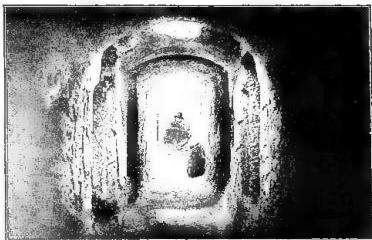
(From J. Krill, Vortschau's Bericht über die Arbeiten in Ephesus, Berlin 1925, fig. 6) EFESO - Gallery of the underground cemetery (3rd century).
A fire, perhaps the one caused by the Gothic sack of 263 A.D., severely damaged the building, which was never restored: the decline of the city and its economy may have rendered it superfluous. Instead, around the mid-4th century, a church was established within it, the first of those that would succeed one another here through various modifications. It occupied only the western part of the previous building, for a length of about 150 m, while the rest of the structure was used as an atrium. Given its layout, only minimal modifications were necessary for this purpose. The church,
with three naves divided by columns, had a length of 74.50 m (excluding the apse) and a width of 25.70 m. A peculiarity was that, since the colonnades of the naves were not parallel to each other, the naves themselves were not of equal length throughout their development. The capitals of the columns were largely those of the previous building. The apse, with a diameter of 11.90 m, was flanked by two rooms or chapels, the prothesis and the diaconicon, which were not perfectly symmetrical to each other.
The church was preceded by a narthex (28 x 9.63 m) paved with mosaic, and in front of the narthex was the atrium. From this, one could also access, to the north, the baptistery, built entirely between the 6th and 10th centuries. It consisted of a centrally planned building, circular on the inside and dodecagonal on the outside, enclosed in turn by a quadrangular structure. The inner hall had four entrances and niches in the spaces between them. The font was circular, with two opposing staircases at the ends of one of its diameters. In elevation, the baptistery must have featured a row of windows beneath a brick dome. The walls were covered with marble slabs adorned with carved crosses, and the vaults of the niches with stucco.
At a certain point, this columned church was modified, not so much in the atrium and baptistery as in the main body. In its western part, a second church was built, about 46 m long, also with three naves, an apse to the east, and a narthex to the west. The original narthex thus became an esonarthex. The new church, instead of being roofed like the first, was domed. The dome was supported by four large pillars built in the middle of the central nave. By inserting smaller pillars between these larger ones, triple-arched openings were created on either side of the main nave to allow communication between it and the side naves. This second church also repeated the peculiarity noted in the first, namely the differing widths of the side naves. The old narthex was modified by adding four pairs of columns and two pairs of pillars in front of the walls. Columns, capitals, and marble floor slabs were taken from earlier buildings. An important element for establishing the chronology of the monument is the sculpted architrave placed over a new door opened between the old narthex (now esonarthex) and the atrium: it bears the name of a bishop Giovanni, who should be assigned to the second half of the 5th century.
At an even later time, after the domed and pillared church described above (the second) was destroyed for unknown reasons, a new church (the third) was created in the part of the original columned church that remained to the east of the pillared church. The latter became the atrium of the new building, with which it communicated through a door opened at the center of the apse. The new church also had a narthex, three naves divided by pillars, and an apse, the latter corresponding to the apse of the original church. In the middle of the nave, the presbytery was built, with a protruding ambo, and at the center of the apse, a memoria was installed on a quadrangular base and adorned with eight columns. Matronea ran above the side naves and above the narthex. Adjoining the basilica on the south side was a small apsidal chapel, possibly funerary. The apse of the chapel, as well as the walls of the church, were decorated with paintings.
To the east of the place of worship, civil structures were attached (a large hall with columns and a basin, smaller rooms, etc.), in which, in all likelihood, the bishop's residence should be recognized.
When the entire grand monumental complex fell into ruin and ceased to serve for worship, profane constructions were first adapted within it, and later, tombs were superimposed over everything.
As seen, all the described churches follow the original basilical type with a longitudinal development and naves divided by columns.
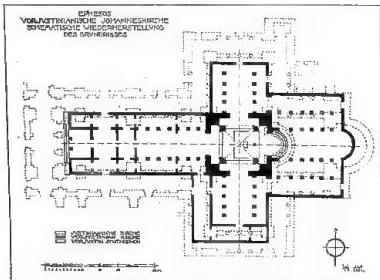
Greater elements of originality are instead presented by the second great Christian building of E.: the church of S. Giovanni Evangelista on the hill of Ayasoluk (a corruption of Ἄγιος Θεολόγος).
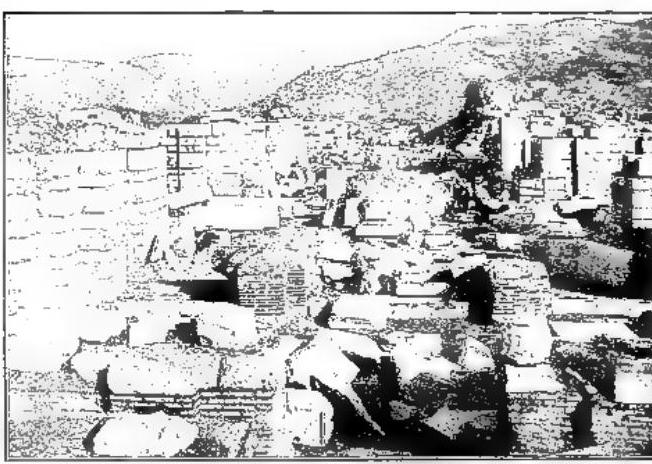
Excavations began in 1921-22 during the Greek occupation of Anatolia by G.A. Sotiriou and were then thoroughly explored between 1927 and 1930 by J. Keil, Fr. Miltner, and H. Hörmann. However, only the plans and summary reports of the building and excavation have been published so far in the brief accounts of the Beiblatt of the Jahreshefte of the Austrian Archaeological Institute.
In the 4th, if not already in the 2th century A.D., above a group of underground chambers—where tradition evidently venerated the Apostle’s burial site (a well almost at their centre must have served to reach his hand, and a large terracotta pithos nearby to contain the water rendered sacred by the tomb’s proximity)—a square memoria (18 m per side) was built, covered by a cross vault supported on four columns and with four doors on its sides. In a second phase, the door on the eastern side was replaced by an apse. The construction’s type still perfectly follows the classical tradition: that a pyramidal crown rose above the vault is merely a hypothesis suggested by analogy with classical-era mausolea. At the beginning of the 5th century, the memoria was enclosed within a large cruciform basilica, of which it formed the centre and, one might say, the very raison d’être. The basilica, oriented east-west with its façade to the west, had an anterior body of three naves, preceded by a narthex, an exonarthex, and a deep portico marked at the entrance by two columns. The lateral arms of the cross were likewise three-naved; the eastern wing of the memoria, which could be called the presbytery, had five naves and naturally terminated in an apse. The building’s form connects it to others known in Syria and Palestine, constructed like this one around a monument that, for one reason or another, enjoyed particular veneration. Of considerably larger dimensions and a far more complex plan, with elements constituting a transitional link between the Early Christian basilica and the Byzantine church of Hagia Sophia, was the edifice built by Justinian above the 5th-century church. Maintaining the same orientation, the new church also took the form of a Latin cross, with the Saint’s memoria at the crossing of the arms, but no longer enclosed within its original walls; instead, it was completely open and thus in direct relation with the rest of the building. This was preceded by a quadrangular atrium surrounded by columns on three sides, the church’s façade opening freely onto the fourth. Later, an exonarthex was added in front of II. Before this construction, three doors led into the narthex, covered by barrel vaults or perhaps even small domes (tradition attributed eleven domes to the church), and from the narthex five doors—three corresponding to the central nave and two to the lateral ones—gave access to the church. Other doors were opened in the southern and northern long walls. The nave was over 93 m long, with a maximum width (at the arms of the cross) of over 62 m. In the anterior part, on six piers (the two central ones larger), rested two elliptical domes, corresponding to two wide bays of the central nave. Four columns on each side of these bays divided the central nave from the lateral ones. Some of the recovered capitals of these columns still bear traces of gilding and colour and display the monograms of Justinian and Theodora. A similar system recurred in the two arms of the cross and in the space east of the central crossing toward the apse, with the sole difference that the domes covering these were perfectly circular rather than elliptical. Another analogous dome covered the central crossing above the bema and the Saint’s memoria. The arms of the cross and the presbytery were thus also three-naved. On either side of the presbytery, enclosed by the apse, were two quadrangular chambers (later modified by additions), behind which stairs led up to the matronea. The walls were clad in marble below and mosaics above, as were the vaults. Decorative elements were found during the excavation, though in rather limited quantities, which may be explained by considering that the building, though no longer used for worship, did not immediately fall into ruin but was gradually stripped of its ornaments.
Other minor Christian monuments of the city include: a small apsed chapel, hardly earlier than the 5th century, adapted within a private house located on the terrace above the theatre; a Byzantine fountain with sculpted plutei (6th century); and a group of four columns, perhaps originally supporting statues, on the Arcadian Way, resting on polygonal bases adorned with shell niches, following the scheme known from the ambo of Thessaloniki, also probably from the 6th century.
Of Christian cemeteries, the one extensively explored lies on the eastern slope of Panayır Dağ, near the grotto where tradition located the legend of the Seven Sleepers. The cemetery developed above and around a kind of catacomb consisting of a series of ten vaulted chambers distributed along the sides of a curridio, which were evidently believed to be the resting places of the seven martyrs. However, if these served from the outset as burial sites, the interments must have been without coffins or biers, that is, using embalmed bodies, for no traces of coffins appear except in later depositions, when tombs in masonry were built above the floor and against the original walls of many of these chambers. One of the rooms, however, seems to have remained as a chapel: its walls were adorned with paintings, probably representing the martyrs. A niche on the side of the staircase descending to the catacomb, also decorated with paintings, perhaps contained the tomb venerated as that of Mary Magdalene. Above the catacomb, likely around the mid-5th century—when the legend of the Seven Sleepers took shape—the cemetery’s first nucleus arose, consisting of a partly constructed, partly rock-cut building, with rubble masonry and brickwork. It comprised a quadrangular space flanked on the east and west by two smaller rooms of the same shape, the eastern one terminating in an apse and particularly intended for worship. All the spaces, including this one, were occupied by tombs in coffins and niches, built into the floor, excavated beneath it, or carved into the walls. A large quadrangular room to the west served almost as an atrium and was likewise filled with tombs, as were the two large, irregular niches opened on the southern side.
Adjacent to the north was instead a sort of quadrangular mausoleum with a central plan, featuring three niches in the walls. Subsequently, the cemetery gradually expanded onto the terraces surrounding the original nucleus, ultimately containing approximately seven hundred tombs. The final part of it is represented by the so-called mausoleum of Abradze, so named after the inscription on an architrave bearing the name of this individual, who is called ἀργυροφόλῳ and who is said to have commissioned II. This mausoleum, like all other elements of the necropolis—partly built in masonry and partly carved into the rock—differs from the earlier ones because, while those were inspired by the concept of an elongated building covered by a vault, this one instead presents a central-plan scheme. The possibility that the adoption of such a scheme was inspired by the Justinian Basilica of St. John would suggest dating this mausoleum to around the mid-6th century or the following decades. All the buildings generally had marble slab flooring and plastered walls and vaults, sometimes decorated with paintings and mosaics. The excavation of the cemetery yielded coarse terracotta vessels and, above all, a very large number of lamps; relatively few funerary inscriptions were found. From the descriptions of travelers and the inscriptions left by visitors on the walls, it can be established that the cemetery remained visible until the 15th century. Some paintings at the entrance of the catacomb can still be attributed to the 13th century: on the vault, Christ the Benefactor within an almond-shaped medallion supported by two Angels, and on the western wall, the Virgin and Saints.
The name "Tomb of St. Luke," given by the first excavator of Ephesus, J. T. Wood, to a monument located southeast of the odeon, is entirely arbitrary: it is a classical-era monument, circular in shape, which in the Christian era was adapted into a church.
A ruined Byzantine chapel is located approximately 15 km from the city on Ala Dağ, at the site called Panagia Kapuli: a local tradition, lacking historical foundation and based on the visions of Caterina Emmerich, would have it that this is the site of the Virgin's house and the place of her death.