
PERGAMENA. – P. or parchment (in Latin membrana) is animal skin tanned according to a process which, according to Pliny the Elder (Nat. hist., XIII, 11), who cites Varro, was discovered by Eumenes II, king of Pergamum, when, at the beginning of the second century B.C., Ptolemy, king of Egypt, prohibited the export of papyrus in order to prevent the Library of Pergamum from developing and eclipsing that of Alexandria. In reality, from the earliest times leather had been used to receive writing among the Egyptians themselves, the Hebrews, the Assyrians, the Persians, and the Greeks, who subsequently designated by the name diphtherai other materials used for writing as well. But the technique adopted at Pergamum and the industry that arose from it were undoubtedly those that thereafter gave p. its name (pergamemum).
Sheep, ox, or goat skin was generally used; after being thoroughly scraped, it was immersed in hot water to remove the grease, then laid out to dry and rubbed, without any further tanning, with powdered clay, and finally cleaned with pumice stone or some substitute. The material thus obtained was wonderfully suited to receive writing: it had a smooth and sufficiently solid surface and could be used equally on both sides; moreover, it was preserved much better than papyrus, responding excellently to the effects of external agents and, unlike papyrus, easily withstanding erasure, which contributed to its diffusion. Indeed, among the manuscripts on p., especially during the Middle Ages, numerous palimpsests (v.) are found, that is, manuscripts on which the original writing had been scraped away in order to write a new text.
P. was first used for writing letters, documents, and brief notes; later it was employed in the production of books. Nevertheless, its manufacture became widespread only slowly, and it had to await three centuries before completely triumphing over papyrus, whose use gradually disappeared beginning in the fourth century. Undoubtedly, around the eleventh century, rolls and sheets of papyrus from the Papal Chancery were still known, but they must be regarded as exceptions, owing their existence only to a sentimental attachment to a material that had by then become scarce and exceedingly rare.
It is now established that the first books on p. were prepared in roll form, although no classical example of them has survived (it is well known that rolls were much used by the Hebrews, who employed them for their sacred book, the Tóráh). Their length was generally that of the skin used, but where necessary longer rolls were sewn together and made. Purple-dyed p. was also used in the early period to cover papyrus rolls, and this was certainly the first appearance of binding. However, the roll form must have been difficult to handle and rather inconvenient, since as early as the second century A.D. people thought of giving books the same form as the ancient wax tablets (from which they also took the name codices or caudices). The oldest surviving codices on p. date from the fourth or third century A.D.; as for parchment documents, the oldest that have come down to us date from the seventh century. Among the codices, some were written in letters of gold or silver and have survived in part to the present day, beginning as early as the sixth century, such as the famous Codice argenteo of Ulfila’s Greek Gospels, in Uppsala, and, in Italy, the Codice purpureo of the cathedral of Rossano Calabro. Many other purple codices from the eighth, ninth, and tenth centuries are also preserved, especially from the Carolingian period, during which entire volumes were written in inks of several colors—blue, green, violet, and yellow—the first used particularly for coloring initials, together with red, which, in the oldest parchment codices, is found especially in the opening lines, titles, and subscriptions (colophon). Red subsequently remained in use for initials, titles, and the headings of chapters and paragraphs (hence rubrica and rubricare), and sometimes for marginal annotations, signatures, cross-references, more extensively in liturgical books.
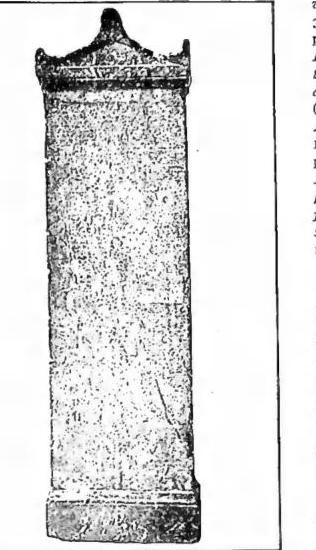
PERGAMO — Stele with pediment, on which are inscribed three letters from Antiochus I to Meleager, governor of the satrapy of the Hellespont, concerning the concessions granted to Aristodice of Assos (ca. 275 B.C.), discovered at P. — Berlin, Museum für Völkerkunde.
through the spontaneous zeal of converts during his Ephesian preaching (54–57).
Foreigners from all Asia gathered at Ephesus for the Artemisia (v. DIANA); this made the city suited to becoming a center of Christian expansion. An indication of the rapid progress of the Gospel in the province is provided by the greetings from the “Churches of Asia” already found in I Cor. 16:19. Paul’s practice of targeting the principal centers of the regions to be evangelized, and his having sent Epaphras (v.) to the Phrygian cities of Colossae (v.), Laodicea (v.), and Hierapolis (Col. 1:7; 4:12 ff.), lead one to believe that he did not neglect the famous city of Misis. At that time, however, the splendor of P. was being eclipsed by its rival Ephesus (v.), which had effectively become the most important city of the province and the seat of the proconsul. Perhaps for this reason Ephesus is named first among the seven Churches (Apoc. 1:11), whereas P. is third, after Smyrna.
The first Christian conquests at P. may have taken place, as elsewhere, among the Jews (a Jewish community at P. is attested by Flavius Josephus, Antiq. Iud., XIV, 10, 22); but the ethnic-Christian element must soon have become predominant, as may also be inferred from the characteristics of those Nicolaitans (v.), who were a scandal to the community, comparable to that caused by Balaam to the detriment of Israel: idolatry and fornication (Apoc. 2:14 ff.).
The entire letter addressed to the Church of P. fits well within this setting. Imperial power, there deified, is opposed by the power of Christ; to the ius gladii of Rome’s representative, who persecuted the Church, is opposed Christ’s two-edged sword (ibid. 2:12). That P. could be regarded as the “throne of Satan” and the place where Satan dwells (ibid. 2:13) is explained by the various idolatrous manifestations that took place in the many temples scattered along the slopes of the Acropolis and in the lower city.
wesen im Mittelalter, 3ª ed., Lipsia 1896, pp. 113–39; Th. Birt, Kritik und Hermeneutik, nebst Abriss des antiken Buchwesens (Handbuch der hlass. Altertumswissenschaft, 1, III), Monaco 1913, pp. 280–83; C. Paoli, Programma scolastico di paleografia latina e diplomatica, II: Materie scrittorie e librarie, Firenze 1913, pp. 40–49. Renso Frattarolo