Machine translation of the 1948–1954 Italian original. The original text is authoritative.
ROTOLO. – Books of antiquity written on papyrus, and some medieval documents written on parchment, were commonly given the form of a roll (volumen, rotulus), on which literary texts were written in columns arranged parallel to the length (paginae, schedae), and documentary texts in the opposite direction, without division into columns. The writing almost always occupied only one side, namely the inner side, while the outer side served as a cover.
When one wished to read the book, it was unrolled so that the writing gradually appeared, around a cylinder of wood or bone (umbilicus), whose ends were usually painted or gilded and attractively inlaid. The act of rolling up and unrolling came to be called plicare and explicare: the book unrolled and read to the end was called liber explicitus (hence the abbreviation explicit at the end of a work, which, like incipit liber in titles, was taken in the Middle Ages for a verb and conjugated). The title
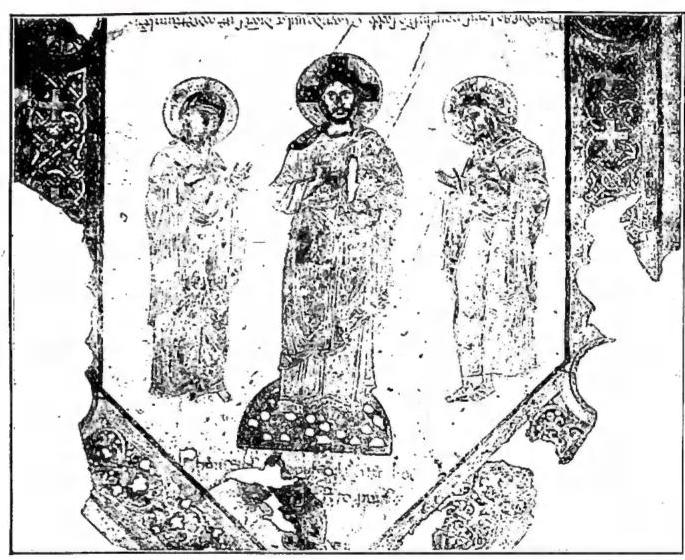
LITURGICAL SCROLL - Benedictionale (beginning of the 11th century). Deesis, with the donor and the inscription « Primicerus opus Silvester hoc foro pronus » at the feet of Jesus Christ - Bari, Cathedral Archives.The title of the work was marked on a label, generally of parchment, which, projecting beyond the edge, made it possible to identify the text without unrolling the scroll; at times it also bore the number of columns and lines of writing. Egyptian books, on papyrus, were generally in scroll form. The oldest known example dates to 2400 B.C., but it is proved that the scroll had already been used for writing in the hieroglyphic period by the fact that one of the hieroglyphs represents precisely a papyrus scroll.
In scroll form, on parchment and wonderfully illuminated, a few rare liturgical texts of the Church are still preserved (v. ROTOLO LITURGICO). Numerous examples survive among Hebrew texts, since the parchment scroll remained in use for a long time in the Synagogue.
BIBL.: E. Egger, Histoire du livre depuis ses origines jusqu'à nos jours, Paris n. d., pp. 13-15; W. Schubart, Das Buch bei den Griechen und Römern (Handbücher der königlichen Museen zu Berlin), Berlin 1907, pp. 26-97; Th. Birt, Die Buchrolle in der Kunst, Leipzig 1907; id., Kritik und Hermeneutik nebst Abriss des antihen Buchwesens (Handbuch der klass. Altertumswiss., 1. III), Munich 1913, pp. 263-80, 327-35; S. Dahl, Histoire du livre de l'antiquité à nos jours, translated from the Danish, Paris 1933, V. index. Renzo Frattarolo
Cite this article
“ROTOLO.” Enciclopedia Cattolica, vol. X (1953), p. 831. Azione Romana digital edition, https://azioneromana.com/article/rotolo.