
POZZUOLI, DIOCESI di. - City and diocese in the province of Naples. It has an area of 77 sq. km. with a population of 153,364 inhabitants, of whom 152,307 are Catholics; it has 40 parishes served by 70 diocesan and 25 regular priests; it has a seminary, an episcopal college, 5 male and 25 female religious communities.
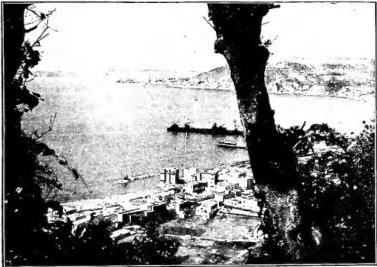
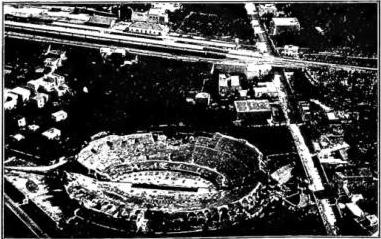
P., the Greek Dicaearchia, the Roman Puteoli, situated in the Gulf of Naples between Cape Posillipo and Cape Miseno, at the center of the volcanic zone of the Phlegraean Fields, was founded around 529 B.C. by some political refugees from Samos. Subject to Cumae, it followed its fate during the wars of the Etruscans and the Samnites. In 194 B.C. it became Roman territory and a colony was deduced there. From then on began the commercial importance of its port, which continued to grow until it achieved complete hegemony at the time of the Empire. All ships coming from Mediterranean ports made a stop at P., and merchants from every country flocked there, taking up residence, gathering in national corporations, and importing their religion along with their goods. Even the Jews, coming from the cities of the Diaspora and particularly from Alexandria, had their own commercial quarter in P., as Josephus attests (Antiq. Ind., XVII, 12). Under Augustus, due to the ever-increasing activity of the port, the mole was rebuilt on 15 gigantic piers (opus pilarum) which, although almost completely disappeared, still remain "one of the fundamental monuments in the evolution of port engineering from antiquity to the present day." Toward the end of the 1st century, when maritime trade shifted toward the mouth of the Tiber due to the organization of the port of Ostia initiated by Claudius in 42 A.D., the commercial importance of P. declined until it disappeared altogether at the dawn of the Middle Ages. Of the monuments of the ancient Roman city there remain: the market, also called the Temple of Serapise, famous for the phenomenon of bradyseism; the small amphitheater; the large Flavian amphitheater, where in 305 Januarius, bishop of Benevento, Sosius, deacon of Misenum, Festus the deacon, Desiderius the reader, Proculus the deacon of Puteoli, and the laymen Eutyches and Acutius were condemned to the beasts, later being beheaded not far from the Solfatara; the columbaria and burial grounds of the Via Campana; the thermal baths and the ruins of Roman villas scattered in the surroundings mirroring the sea.
The Cathedral, dedicated to the Puteolan martyr St. Proculus, stands on the ancient acropolis, where the Temple of Augustus was located, transformed like the Cuman basilicas into a Christian temple after the end of the persecutions. The architecture of the Augustan temple was respected in its primitive adaptation until the 11th century; later it underwent various modifications and remodeling; in the 17th century Bishop Martino de León (1631-50) rebuilt the Cathedral on broader foundations and of the ancient temple left six Corinthian columns with frieze and the inscription along the eastern facade: Calpurnius L. F. Templum Augusto cum ornamentis D. D. S. D. Among the churches of P., worthy of mention is that of S. Gennaro, also called of the Capuchins, in which is preserved the stone that every year, upon the renewal of the miracle of the blood of St. Januarius (Sept. 19), becomes stained with reddish patches.
Archaeology. - Regarding paleochristian P., the texts have left various indications which today can be determined with difficulty and not always with certainty. A passage in the life of the martyr Artemas specifies that his body was buried in P., in a place "qui ab accolis Campania dicitur" (Acta SS. Ianuarii, III, Paris 1863, 23, 1, 12), distant from P. about 4.5 km. In the Greek life of St. Januarius, a cemetery called "arenaria" is recorded, located near the Via Campana, that is, north of the city, in the Middle Ages called Campana and Campilione. This would be the cemetery mentioned, without other precise indications, in the Acta Artemae and in the Martyrologium Hieronymianum (BHL, I, 613-15). In truth, no cemetery galleries have been discovered in P. and only in Naples (v.), in the catacombs of S. Severo and S. Gennaro, are there frescoes with images of Puteolan martyrs.
After the 4th century (Acta SS. Septembris, VI, Antwerp 1757, pp. 784-85) the translations of their bodies
(Photo Exit)
POZZUOLI, DIOCESI di - Aerial view of the amphitheater.
toward their cities of origin began. At P. the three local martyrs Proculus, Acutius, and Eutyches were placed "in praetorio Falcidi, quod coniungitur basilicae S. Stephani in contrivio ipso" (ibid., p. 869). This contrivio was the bifurcation point of the Via Cella, coming from P., toward Capua to the left and Naples to the right. Here also the aforementioned "arenaria" seems to be located and, if it is true that in the centuries ranging from the end of the Empire to the Middle Ages praetorium was understood as a suburban villa, the indication of the Acta would refer to the villa of a certain Falcidius, a name known from an inscription found in Rome in S. Vitale (CIL, VI, 1, 1944). The said cemetery is supposed to be in the property area of that Falcidius, to which was annexed the church of S. Stefano, of which notable remains have come to light. The church, which would occupy an area of 36 sq. m. (G. De Criscio [V. BIBLICA.], p. 8, n. 1) with its facade to the east, was the first of P.; almost the entire floor remains, supported by an underground vault and two chapels on the outer sides. Another basilica was recognized by the existing ruins not far away; these are the ruins of a monumental complex of buildings that can no longer be identified. But perhaps they are to be related to a convent arisen on the praetorium, recalled by Gregory the Great (Ep., X, 6, 1: PL. 77, 1113) in a letter to the abbot Adeodatus, to whom he entrusts "monasterium Puteolis constitutum, quod Falcidis dicitur", left by the monks in such abandonment that not only is "Dei illic opus minime celebretur," but it is "pene pro derelicto... habeatur." When this monastery was founded and when it was completely abandoned is unknown. News of another basilica comes from the Acta Vaticana (p. 86), in which it is stated that St. Januarius was buried in a place called Marcianus ad sulphurotariam (sic) where a basilica worthy of the martyr was later built (4th century?). In its place there is now a Capuchin convent, but no trace remains of the old Basilica. Of a mausoleum with the relics of St. Julian translated from Nicomedia (Acta SS. Februarii, II, Antwerp 1658, p. 870, chap. 4), after 304; the only remaining indication is that it stood "uno miliario a mari".
Very few are the securely Christian inscriptions of P. (CIL, X, 3300, 3303-4-5-6, 3309, 3313, 3315) and only two are dated: that of the Puteolan bishops Theodorus and Misenus, respectively of 435 and 511 (CIL, X, 3298 and 3299). Remarkable is the marble tablet (ibid. 3310), coming from the ancient cathedral of S. Stefano, which states that for the untimely death of the little C. Nonius Flavianus, a "basilica," or cell, aedicule, or funeral oratory was erected by the parents in the church or leaning against the church.
Even rarer are the fragments of Christian sculptures: a) a reused stone with a Byzantine Cross, on the sides of which are the figures of Christ and of the nimbate St. Peter; b) a pedestal measuring 1.15 m on whose faces the Apostles Peter and Paul are carved with the Cross.