PARALITICO

Image from page 518
Image from page 518
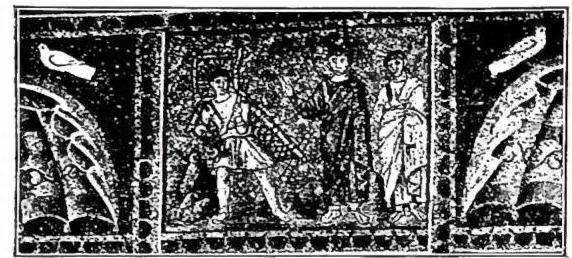
PARALITICO - Guarigione del p. Musaico nella parete superiore della basilica di S. Apollinare Nuovo (sec. vii) - Ravenna.

Bethsaida (Bethsaida or Bethesda) with five porticoes, under which sick people of every kind camped, waiting for an angel from heaven to descend and stir the waters, and healed the paralytic who had waited for 39 years for someone to cast him into the water at the opportune moment.

Christian art naturally seized upon this episode, depicting it repeatedly, though in different ways. Painters, however, preferred to represent the other scene of the healing of the paralytic of Capharnaum (Mt 9:6 ff.; Mk 2:12; Lk 5:25 ff.), in which the healed man departs with his bed on his shoulders; and they often place this scene next to another of the Baptism (cf. the depictions in the Greek Chapel of Priscilla and in Crypt A² of the Sacraments in St Calixtus), thereby emphasizing the symbolic connection between the healing of the paralytic and the regeneration from sin. The healing of the paralytic was frescoed in the 3rd century in the baptistery of Dura Europòs (Enc. Catt., IV, pl. 126). Sculptors, for their part, exploiting the possibility of presenting multiple scenes, sometimes superimposed, and the very nature of relief, which makes use of the background to create a richer reality of detail, have left some representations in which almost all the elements of the Johannine text recur. Only a few are known, but in compensation the compositions are all alike and occupy the central position on the fronts of sarcophagi, which all, in the same order, present an identical series of scenes. In Gaul the following fragments survive: a) at Die (Wilpert, Sarcofagi, pl. 230, 2), almost the entire upper scene with the portico of three arches; b) in the Museum of Clermont (ibid., pl. 230, 5), the two scenes superimposed, but the portico reduced to a single arch, according to the typology of columnar sarcophagi; c) at Arles (ibid., fig. 184), only a single arch with two heads of the sick; d) in the Museum of Vienne (ibid., pl. 230, 4), almost the entire upper zone and part of the broad undulating fillet that divided the two scenes.

Two other frontal slabs of sarcophagi, the most complete and important, are the Lateran 125 (ibid., pl. 230, 6) and that of the cathedral of Tarragona (ibid., pl. 230, 3), a faithful copy of the first. From these two fragments one can deduce the traditional iconography of the composition: the lower scene represents the paralytic lying on his bed and surrounded by the sick, while Jesus approaches from the right; the upper scene, separated from the lower by an undulating fillet, which is meant to signify the water contained in the pool of Bethesda, shows again the sick, the Lord in the gesture that marks his command, and the healed man departing with his bed on his back. All these fragments, the only ones to have survived, are to be assigned to the 4th century, with a single exception: the fragment from Die, on account of the nimbus hinted at around the head of the Lord, must be placed in the 5th century.

In the National Museum at the Baths in Rome there are also two fragments of sarcophagi with the paralytic (R. Paribeni, La collezione cristiana del Museo nazionale romano, in N. bull. arch. crist., 21 [1915], pl. 4, no.

considered predominantly from the semiological point of view (French school) or from the pathogenetic point of view (German school); it is, however, linked with the name of Kraepelin, who understood it as “a psychosis characterized by the development of a chronic, unchanging, systematized delusional system, produced by endogenous causes and evolving while preserving full lucidity of the sensorium and order of thought, will, and activity.” Beside this rather rare picture are placed the “reactive paranoid syndromes” and the “periodic paranoid syndromes,” the latter of which, however, fall within the symptoms of “manic-depressive psychosis,” of which they faithfully follow the course.

Paranoia and reactive paranoid syndromes have in common the ground on which they arise and develop, which it is more accurate to define as a “disposition” rather than a paranoid constitution. By this is meant a particular reactivity that predisposes to the onset of psychosis, under the influence of exceptional external events (paranoid syndromes) or common events of life (Kraepelin’s paranoia); in such an anomalous disposition there predominates the overvaluation of one’s own personality, the irritability of the ego, signs that are almost pathognomonic; among such individuals are frequent the “intransigents” who are often encountered in daily social life. Distrust, touchiness, the perpetual attitude of defense toward the environment explain the poor adaptability, the isolation into which they often withdraw, and the onset of antisocial reactions. A consequence of such an abnormal disposition is the error of judgment regarding the ego and the external world; logic is moreover distorted by the passion that temporarily or durably colors events and memories.

a) Kraepelin’s paranoia (chronic systematized delusion of the French authors) is characterized almost always by the development of a delusion upon a previous paranoid disposition (the delusion [v.] is, according to classical psychiatry, a mistaken judgment, possessed of irrefutable subjective certainty, against which neither criticism nor experience can prevail). Important is the perfect integrity of psychic functions outside the delusional construction, while the delusion itself is lucid, coherent, systematized, logical in its illogic, and the patient succeeds in elaborating the material to the point of almost eliminating every internal contradiction. The delusion generally arises from external events or affectively charged experiences that in themselves have nothing pathological; through the deformation that they undergo in the patient’s psyche, little by little even events that were previously indifferent or alien come to be experienced by him in relation to his delusion. Hallucinations are lacking (v.), though “revelatory dreams” may appear with a certain frequency, in which the deformation lies only in the interpretation that the patient gives of them. Paranoid delusion arises slowly, remains long crystallized, while gradually the intensity of affective participation diminishes.

In relation to the variation of content, one distinguishes: delusions of grandeur (inventive, reformatory, genealogical form), of jealousy, of persecution, which often combine with the conviction of having suffered harm while the persecutors may be family members, acquaintances, an entire social class; erotic, in which a platonic love develops toward a socially superior person by whom the deluded person feels requited; religious or mystical (which may be included in the form of grandeur); of mission, reform, etc.; of reference, in which events are experienced by the patient as evidently related to his own person (a form posited by Kretschmer in relation to the sensitive personality); querulous, in which the patient believes himself wronged in his true rights, makes long submissions to the authorities, continuous denunciations, etc.; in this form, in which Bleuler recognizes the “combative paranoid temperament,” the querulous paranoia assumes, together with persecutory delusion, particular medico-legal interest, because it can give rise, given the particular characteristics of the patient, to long and never-ending legal disputes, while the persecutory tendency can drive the subject to aggression against the supposed persecutors.

The age at which Kraepelin’s paranoia most frequently develops is around 30–40 years, but the first symptoms may appear as early as youth. It is an affliction that does not always require confinement; often, however, antisocial conduct forces security measures and sometimes even limitations on legal capacity. Paranoia must be distinguished from “paraphrenia” (Kraepelin) or hallucinatory paranoia of the French authors, which constitutes a bridge between paranoia and the schizophrenic paranoid syndromes.

b) Reactive paranoid syndromes are always related to emotionally experienced events (paranoid reactions), or to particular prolonged affective situations (situational psychoses); according to Jaspers, they fall within the category of psychogenic reactions: they arise, that is, from external events and depend closely upon them. As an intermediate link between these reactions and paranoia (p.), one may classify abortive paranoia (Gaupp), mild paranoia (Fiedmann), and latent paranoia (Kraepelin), in which the endogenous disposition and external events play a role of almost equal importance: these are cases of the sudden development of a previously latent delusion or the emergence of an abnormal conviction, stemming from events which the patient overvalues. In such cases, complete remission, leading to a return of the patient to his previous psychic state, is difficult to achieve.

Among the pure reactions, forms analogous to querulous mania are classified, but they differ in that a real legal dispute lies at their origin; often, with every new dispute, a querulous attitude may recur: "recidivating querulous delusion" (Kaecke). A corresponding form may also be found among reactionary delusions of reference.

In the group of "situational psychoses," the following are distinguished: "occupational psychosis," i.e., delusional developments that arise in certain categories of people due to environmental work conditions (e.g., governesses, attendants, etc.), in which the contrast between the position held and the subject’s cultural level or ideal aspirations may be highlighted. "Induced psychoses," frequent in individuals who live in close contact with a paranoid person, especially if isolated or mentally weak, hysterical, or themselves predisposed to paranoia; in these cases, the plausibility of the delusional ideas, the very character of the patient who is driven to proselytize, and the persuasive force animating him, overcome the critical faculties—especially if deficient—of those around him; thus, it often happens that, even beyond the social limits of the family, paranoids win others over to their convictions and succeed in forming parties, societies, etc., in which every member blindly believes in the apparent logic and truth of the delusional ideas of the leader. "Psychosis from isolation," in individuals who, due to illness or other reasons, are deprived of love; this group includes the delusion of persecution among the deaf and, more rarely, among the blind; such delusion may also be fueled by psychosensory disturbances of an illusory nature. In the delusion of persecution among prisoners of war, the difference in language creates a state of psychological isolation analogous to that of the deaf and the blind. "Prison psychosis" may arise either as a reactive form or from the development of a paranoid personality; it is generally of a persecutory type, following the loss of hope for freedom. Bleuler’s "prison complex" is something similar: patients are often convinced—sometimes based on hallucinations—that they have been acquitted, but since external reality contradicts this belief, delusions of persecution with hallucinations frequently develop. The delusional ideas of degenerates (Birnbaum) are incoherent, illogical, and variable in content, typical of delinquents with frequent association of psychosensory disturbances.

All these forms have a better prognosis than Kraepelin’s paranoia, since removal from the cause and cessation of psychogenic influences almost always decisively affect the course of the psychosis, even though the anomalous disposition persists—without which, in principle, the psychotic picture would not have occurred.