
MIRACOLO. —
I. NOTION AND DIVISION
Derived from the Latin mirari, it denotes an event that surprises and arouses wonder and astonishment. It is usually defined as: “A sensible event, wrought by God, beyond all the forces and laws of nature.” And since a miracle can transcend the laws of nature in three ways, theologians, following St. Thomas (Sum. Theol., 1°, q. 105, a. 8), classify miracles into three categories, according as they surpass the power of created nature: either in their constitutive element, or in relation to the subject in which they occur, or in the manner in which they take place. In De potentia, q. 6, a. 2 ad 3, the Angelic Doctor proposes another division, which does not perfectly coincide with the preceding one: miracles supra, contra, and praeter naturam. Supra naturam are miracles that surpass natural forces either absolutely or in relation to the subject in which they occur; contra naturam, those that oppose a particular inclination of some creature; praeter naturam, phenomena that nature cannot produce in the manner in which the Creator brings them about.II. POSSIBILITY OF THE M
God is omnipotent; he can therefore bring about whatever does not involve a contradiction in being, and thus also the m. Moreover, he created in complete freedom: in willing the laws of nature, he did not renounce the faculty of manifesting his power outside them. He can therefore, in certain cases, withdraw, limit, or modify their concurrence, and then the miraculous phenomenon will occur. Nor does the m. conflict with divine immutability, as though God were changing previously established decrees. By one and the same act of will, he established ab aeterno both the laws and the miraculous exceptions. All the change lies in creatures, not in God: one must not confuse the willing of a change with a change of will. Nor is the m. a correction that God makes to his work, which is perfect within its own order. Nor is it performed idly or capriciously; if God works m., he always accomplishes them for a higher purpose: either to manifest a particular benevolence toward some creature, or to inculcate his dominion, or to lend authority to some revealed truth. The m., then, is not a tear in the fabric of phenomena, but an embroidery, an ornament that brings out more clearly the goodness and wisdom of the divine Ordainer.Without doubt, science presupposes the stability of the laws of nature, but a physical, not a metaphysical, stability: left to themselves, the laws always operate in the same way. They are not, however, such as to exclude every exception on the part of the Creator. The scientist who moves within the field of sensible experience cannot, as such, enter the metaphysical field in order to deny the Transcendent or his intervention in the world; in no way can he demonstrate absolute or metaphysical determinism, so as to exclude every modification brought about by the Supreme Being.
Some physicists object that the laws of nature are so intimately interconnected that one of them cannot be suspended without suspending them all.
With the m., however, God does not suspend the law, but its application; he modifies the effect, not the law, which always remains with the full force of its application. The mutual interference of physical laws is not denied, but it is not such as to be disturbed by m. The repercussions of the m. in the universe occur according to the natural laws, and therefore it is not a cause of cosmic disorder, any more than any human action is.
Some physicists, since the energy of the universe is constant, believe themselves entitled to deny miraculous phenomena, which would imply the withdrawal and increase of cosmic energy. In reality, the principle “nothing is created, nothing is destroyed” does not have such universal scope as to exclude the creation of new elements, nor can it be extended to energies pertaining to the spirit. It applies only in the physical field and finds its certain application in the sphere of natural causality; under the hands of the natural scientist nothing is created or destroyed: there are transformations. But the principle cannot be extended to divine omnipotence, as though God could neither create nor destroy. In any case, miraculous action does not imply the creation of new elements, but the imparting of a new direction to existing cosmic energy. God can multiply loaves and form tissues from existing cosmic elements, without creating new energies.
Against the possibility of the m. one invokes contingentism or physical indeterminism, which denies the existence of constant laws. Indeed, it is not clear how God could make an exception in particular cases to laws, if these do not exist. It should be noted, however, that when indeterminism is spoken of today, this is almost exclusively in the field of atomic and nuclear physics, since the position of corpuscles, their velocity and direction, and the resulting phenomena can be known only approximately, unlike what occurs in the ordinary macroscopic and microscopic world. It is clear, however, that we are faced with a subjective, not an objective, indeterminacy: it would be arbitrary to regard corpuscles as outside the law, and thus to speak of objective indeterminacy.
In reality, when the great physicists speak of the “principle of indeterminacy,” they mean that one cannot possess precise knowledge of the position and motion of corpuscles, so as to predict their actions with certainty, as occurs in classical physics; they do not intend to exclude objective determinism. Indeterminism is the impossibility of predicting future phenomena, due to the imprecision of physical measurements: thus L. De Broglie (I quanti nella fisica moderna, Torino 1938, p. 220). Max Planck, Nobel Prize winner in physics, after stating that “our observations are too imprecise to be applied to a direct control of the law of causality,” adds: “There is no need to go further in explaining that physics, in all the problems of the atomic and molecular world, tends... to replace statistical laws—”
III. HISTORICAL KNOWABILITY OF THE MIRACLE
The miracle is a rare event, but this increases attention and prompts a more careful investigation. Moreover, insofar as it is perceptible, it is an event like any other and can be known in the same way, namely: either through direct observation, possible only for those who witness it; or through the testimony of those who have witnessed II. It is objected that, for the most part, miracles are attested by people from the common populace, untrained in criticism and prone to superstition. Their judgment therefore cannot be trusted. It may indeed be presumed that they mistook for a miracle something that in fact was not one. It is replied, however, that attesting that an event occurred is one thing, and attesting that it is miraculous is another. Great learning and culture are not required to testify that an event took place. Whether the event historically established was miraculous or not can then be judged in the light of modern knowledge.Some rationalists, following Hume, maintain that even miracles established with the greatest historical certainty cannot be admitted as true, since they contradict the laws of science. But the alleged conflict does not exist: the data of science and history can be reconciled. It is known with scientific certainty that physical laws, left to themselves, always operate uniformly, and that an exception effected by the supreme Ordainer is not incompatible with them. In other words, the scientific law attests a rule, while historical testimony attests an exception. It is illogical not to accept both.
IV. PHILOSOPHICAL KNOWABILITY OF THE M
The question arises whether it is possible to know that a phenomenon transcends every physical causality and represents an exception to the laws of nature. All the more so, it is said, since it might depend on unknown material energies. Nevertheless, it is known with certainty that nature cannot produce certain phenomena at all. Everyone knows, for example, that a single word cannot restore someone truly dead to life, and that a little water cannot instantly cleanse a person of gangrenous sores or leprosy. This has always been acknowledged by all peoples, of every age and culture. Common sense finds confirmation of this in science. Thus it is known that certain phenomena are naturally unrealizable; therefore, if an event belonging among these occurs, it must be said to depend on a cause transcending the physical order. If the preternatural character of some phenomenon remains doubtful, it will be called a doubtful miracle: this does not negate the existence of certain miracles.However great physical forces may be, they are always material: in order to act, they must be applied, and their effects are proportionate to them. And since material agents have a specific nature and a determinate structure, the phenomena that follow will always be determinate, not disparate. If, therefore, phenomena occur with characteristics opposed to those just mentioned, it must be said that they transcend material causality and depend on a free spiritual agent. Christianity is full of such phenomena. A word that heals at a distance, a voice that calms the storm, changes water into wine, multiplies the loaves, frees a possessed man, makes the fever cease, enables a paralytic to walk, and raises a man dead for four days cannot be regarded as an adequate cause of effects so disparate. Such phenomena, by reason of their variety and irregularity, bear no proportion to their physical antecedents and postulate a free cause transcending matter.
V. VALORE PROBATIVO DEL M
The m. is an absolutely certain criterion of Revelation, provided that it has a close connection with II. This connection may be explicit, if the thaumaturge performs prodigies to demonstrate the divine origin of his mission, or implicit, if this follows from the circumstances. For the m. is in fact a divine work: man can only obtain it through prayer. Thus, if the thaumaturge asks for it in confirmation of a doctrine, it is God himself who confirms that doctrine; if a person claims to speak in the name of the Most High and to announce to men a revealed religion, and performs m., these are like the seal impressed by God to authenticate the assertions of his envoy. God is free, but he cannot do evil. If, in the circumstances mentioned, he were to perform m. without intending to approve the thaumaturge’s doctrine, he would become a witness to falsehood and lead those present into an inescapable error: indeed, relying on common sense, they would take the m. as a divine confirmation and accept as revealed a doctrine that in fact is not.(phot. Alinari)
MIRACOLO - Healing of the woman suffering from an issue of blood. Mosaic from the sixth century - Ravenna, church of S. Apollinare Nuovo.
pp. 7–83; A. Gottardi, La discernibilità del m. e il suo valore probativo, Venice 1936; F. Fabbri, Il cristianesimo, Assisi 1949, pp. 119–42. Fabio Fabbri
VI. THE MIRACLES OF JESUS
Jesus Christ himself had said to the two disciples sent by John the Baptist: “Go and tell John what you have seen and heard: the blind see, the lame walk, lepers are cleansed, the deaf hear, the dead rise again” (Mt. 11:5); the same Redeemer, replying to the Jews who had asked him whether he truly was the Christ, had answered: “The works that I do in my Father’s name bear witness to me” (Io. 10:23 ff. and 5:36).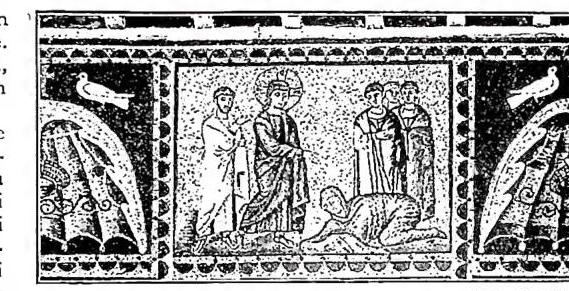
In non-funerary art, there are the scenes of the Lord walking on the waves and of St. Peter being saved, as well as the healing of the paralytic, DUBA EUROPOS (v.) dating from the middle of the third century.
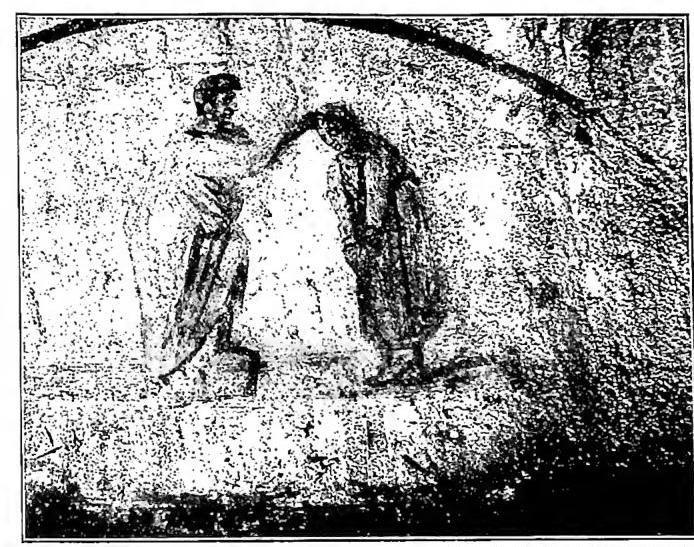
Precisely according to the text of the Synoptic Gospels (Mt. 8:2-3; Mc. 1:40-42; Lc. 5:12-13), the leper is healed by the simple touch of the Lord’s hand (Wilpert, Sarcofagi, pl. 220, first fragment on the left). By the simple gesture of Christ’s right hand, the possessed man is delivered, as is shown by the fresco from the first half of the third century in Catacumbas (G. Mancini, Scavi sotto la basilica di S. Sebastiano sull’Appia, in Notizie degli scavi, 20 [1923], pl. 10, 1 and 2), an ivory in the Louvre Museum from the fifth century (G. Duthuit and F. Volbach, Art byzantin, Paris 1903, pl. 10 B), and one of the mosaics of S. Apollinare Nuovo in Ravenna, dated between 493 and 526 (C. Ricci, Tavole storiche dei mosaici di Ravenna, S. Apollinare Nuovo, Rome 1934, pl. 1, fig. 2). Artists represent Jesus Christ in the act of performing miracles through various gestures, as the Gospel texts relate: the Lord is implored to lay his hands (in the Greek text), his hand (in the Latin text [Mc. 5:23; 7:32; Mt. 7:32]) upon the sick, or simply to touch them (Mc. 8:22); he places his fingers in the ears of the deaf-mute and moistens his tongue with his saliva (Mc. 7:33); instead, he lays his hands upon the eyes of the blind man of Bethsaida (Mc. 8:23) and upon the stooped woman (Lc. 13:11-15); he touches the leper (Mt. 8:2-3; Mc. 1:40-42; Lc. 5:12-13) and the blind (Mt. 9:2-3; 20:29-34); but he also restores sight by joining the eyes with earth moistened with saliva (Io. 9:1-38); the woman with the issue of blood is healed by merely touching the Lord’s garments; Lazarus’s sister approaches the divine Master in supplication (Wilpert, Sarcofagi, pls. 125, 5; 126; in order to represent the iam foetet of the Johannine text, the artist has her bring her fingers to her nose [id., ibid., pl. 115, 1]) or, filled with gratitude, kisses the Savior’s hand
(id., ibid., pls. 91, 207, 2 and fig. 186), a gesture also performed by the Canaanite woman with veiled hands, presented to Christ by a disciple (id., ibid., pl. 116, 1). All these scenes do not have a historical meaning, but were chosen by the teaching authority of the Church and reproduced to attest to the living faith in Jesus Christ, the divine thaumaturge sent down from heaven to heal humanity. Thus, in fact, St. Augustine indicates it: “ad sanandum grandem aegrotum descendit omnipotens medicus” (Sermo, 87, 11: PL 38, 527), and again: “Dominum nostrum et Salvatorem Jesum Christum medicum esse nostrae salutis aeternae” (Sermo, 88, 1: ibid., 38, 539).
An inscription discovered at Timgad expresses the same idea very well, invoking Jesus Christ as the one physician: “rogo te Domine: subveni Christe tu solus medicus sanctis et penitentibus” (G. Carcopino, L’invocation de Timgad au Christ médecin, in Rendiconti della Pont. accad. rom. di arch., 3rd series, 5 [1928], pp. 79-87).
The same representations, especially that of the resurrection of Lazarus, the multiplication of the loaves, and Jesus Christ walking on the waters, would recur in ivories, in gold glass, and in the iconographic cycles of basilicas, from those of Dura Europos in the middle of the third century to the grandiose cycles of the ancient and medieval basilicas, and in the stained-glass windows of Romanesque churches. There the scenes of the Lord’s miracles are at once narrative and didactic. St. Gregory the Great (590-604), repeating an idea already expressed by Paulinus of Nola, states that “the image is for the illiterate what writing is for those who know how to read; through images the illiterate learn what they must imitate; images are the reading book of the illiterate” (Ep., IX, 105: PL 77, 1027).
Enrico Josi
VII. THE MIRACLE IN THE CAUSES OF BEATIFICATION AND CANONIZATION
The miracles sometimes performed during their lifetime by the servants of God do not in themselves constitute proof of holiness; therefore, only those wrought through their intercession after death definitively confirm that holiness with divine authority. For this reason the Church has always held this supernatural element in the causes of beatification and canonization in high regard and even today, though according to a different criterion, regards it as an indispensable factor, at least in ordinary cases.Proof of a miracle is required for every canonization; for beatification, two cases are excepted: that of martyrs, when the martyrdom is absolutely evident and, in the absence of a miracle (can. 2116 § 2), a papal dispensation from this supplementary proof is possible; and that of “equivalent” beatification, for confirmation of a cult already legitimately in practice (can. 2134). For canonization, two miracles are always required, unless it has been preceded by an equivalent beatification, in which case three are required (can. 2138); for formal beatification, the number depends on the value of the evidence presented in the processes concerning heroic virtues. If this evidence consisted of direct or immediate testimony, two duly approved miracles are sufficient; if it was direct only in part, three are required; if all of it was indirect or documentary, the CIC requires four (can. 2117). The miracles admitted in the causes of the saints must consist in instantaneous and complete cures from incurable or serious illnesses, of an organic and not psychic or functional nature, obtained following invocation of the servant of God. For each miracle, the following must be established with certainty: the diagnosis of the illness, the prognosis, the fact of the instantaneous, complete, and inexplicable cure according to the laws of nature, and recourse to the intercession of the servant of God. The evidence must be supplied by immediate witnesses (can. 2020 § 7), corroborated by medical or other documents, collected under the scientific supervision of an official expert (can. 2088 § 8) or of other physicians of the S. Congregation of Rites; the attending physicians cannot be absent from among the witnesses (can. 2028). Moreover, practice requires, in accordance with can. 2031, that two examining experts examine the person cured if he is still alive and submit a written report on him to the investigating tribunal. The interrogations are conducted on the basis of special ques-
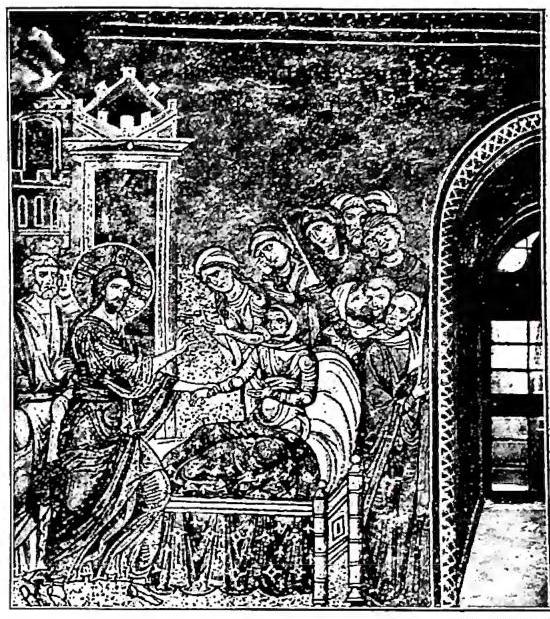
(Alinari photograph)
MIRACOLO — Jesus raises the son of the widow of Naim. Mosaic from the end of the twelfth century — Monreale, Cathedral.
questions prepared by the Promoter General of the Faith. The examination of the evidence is no less rigorous. A preliminary examination is now entrusted to a medical college recently established at the S. Congregation of Rites, which examines and discusses, in one or more plenary sessions, the two expert opinions required for each miracle by can. 2118 § 1. The college has at its disposal the entire body of evidence collected, which it may also have supplemented, and must answer a twofold question already put to the two official experts: namely, whether it concerns a true recovery from a specific disease; and whether such recovery is inexplicable according to the laws of nature (can. 2119). The collegiate report, accompanied by a reasoned account of the discussions held, is delivered to the cardinal prefect of the S. Congregation and then submitted to the formal discussion of the cardinals, prelates, and consultors, convened in a preparatory congregation, together with all the evidence collected in the dossier, the defense’s submissions, and the objections of the Promoter General of the Faith, who may avail himself of the technical advice of a private expert of his confidence. The whole, delivered in a printed volume, is called the “position.” The preparatory congregation discusses the miracles (no more than two at a time) in all their scientific and theological aspects, and, by decision of the cardinals, decrees whether or not the matter may proceed further. If affirmative, in the congregation called general, the cardinals, prelates, and theologians submit to the pope their consultative vote on the individual miracles proposed for the beatification and canonization of the servant of God in question; and the pope, if and when in his high judgment he deems it appropriate, orders the promulgation of the decree of approval, or, alternatively, orders such further clarifications as may be necessary.
VIII. MIRACULOUS CURES
These are cures that occur exceptionally, are accessible to examination by the senses, and are due to the intervention of God. In order for a physician, on an objectively scientific basis, to declare that a cure is miraculous,five factors demonstrable in a categorical manner must concur.
1) The prior existence of a serious illness accompanied by anatomical alterations (modifications, loss, or overproduction of tissues), with a diagnosis confirmed by the most reliable methods of investigation and with an unfavorable prognosis at least for the organ affected. 2) Repair of every organic lesion in so short a time as to be considered instantaneous (either absolutely or at least relatively). 3) Inefficacy of every therapeutic means, or at least of those employed. 4) Absence of the normal period of gradual recovery of function (the person healed may immediately walk or eat and digest with complete normality, etc.), or of the period necessary for the reabsorption of edema, ascites, pleural effusions, destruction of tumor masses, etc.; this, however, does not exclude a rapid progression in the subject’s state of health (increase in weight, strength, etc.). 5) Lasting cure—that is, one that does not end in an ephemeral improvement but, besides being complete, persists through subsequent examinations conducted after a considerable lapse of time.
Lourdes (v.), for example, the « Bureau des constatations médicales » invites the « graced person » to submit to a collegiate examination after at least one year, bringing certificates and reports from the attending physicians, a chart of the increase in weight, and anything else that may be useful for the assessment; this is followed by a highly rigorous examination, supported by radiological and laboratory tests; if all the members of the commission agree, the cure in question is declared to be of a preternatural order.
Moreover, a characteristic of a miraculous cure is that it is in constant correlation with religious acts performed by the sick person or by other persons (prayers, pilgrimages, applications of relics, images, water, earth, oil, etc., immersion in or ingestion of holy water). Sometimes, though not invariably, at the moment of healing the subject experiences particular, strange, or painful sensations, states of anguish, or loses consciousness; all this is of very brief duration, immediately followed by a sensation of calm and well-being and the impression of feeling cured; sometimes, coinciding with the cure, the person healed is pervaded by a wave of a gentle, indescribable fragrance (osmogenesis).
Positive science has attempted by various means to explain the m. in a way that would exclude God and his intervention. The suggestion (v.): in the mind of the sick person there develops the conviction that the illness is curable, that it is gradually coming to an end, that it no longer exists, and that health has now been regained. In support of this thesis, the instantaneous cures of certain nervous and psychic illnesses are cited, with recourse to the diagnosis of « hysteria » (v.). In so doing, however, one closes one’s eyes to the essential difference between the cure of a functional disorder and the disappearance of an organic disease caused by verified anatomical alterations. Bernheim himself said and taught that suggestion is the therapy of functions, and no scientist worthy of the name can seriously and honestly explain by suggestion the instantaneous cure of tuberculosis, a bone fracture, or an abscess that has been suppurating for a long time.
Charcot, referring to the work of suggestion and autosuggestion, wrote that the cause of miraculous cures must be sought in the « faith that heals »; faith, naturally, not understood by the author in the theological sense of the word, but as a psychic force capable of stirring the mind of the sick person. The « modernists », led by E. Le Roy, generally accept this theory; for them faith (« la foi qui guérit », « the faith healing »), in certain circumstances, is capable of unleashing a beneficial psychonervous shock, releasing a force that acts by stimulating the imagination, fostering emotion, exalting hope, intense desire, and the longing for healing, until, through the power of suggestion, it leads to the conviction and the fact of being cured.
The scientific untenability of such reasoning is entirely clear; but, leaving that aside, how can suggestion explain miraculous cures in infants only a few months old, truly physically incapable of experiencing the « faith that heals »; and in those who go to the shrines as skeptics, hostile, or despairing; or in those far removed from the enthusiastic manifestations of collective faith; or during a dispirited return journey or in sleep?
Many other theories seek to explain miraculous cures by invoking the presumed healing efficacy of psychic actions. They have recourse to so-called « psychotherapy » (v. to which suggestion and autosuggestion also belong). Psychotherapy may be empirical or systematic, and in all its various forms—whether it seeks to create psychic excitations capable of being reflected upon the somatic part through the pathways of the subconscious, or whether, psychoanalysis (v.), it proposes to transform unconscious psychic complexes, the cause of the illness, into conscious psychic processes and therefore processes controllable by the higher faculties—in all its forms it is employed by certain deniers of the m. to explain extraordinary cures, on the grounds that through the psychic route some therapeutic influence can also be exerted upon organic lesions. Apart from the fact that not all scholars agree with this latter assertion, even if one were to accept the theory in its entirety, it must be said that it proves wholly insufficient to explain miraculous cures. The curative action, in fact, as they themselves admit, is limited, whereas in the m. the cure is total; in order to observe some modification in the state of illness and in the organic lesions, even if it occurs, a very long time and numerous sessions conducted by a specialist, with the subject suitably prepared and under particular conditions of environment, concentration, etc., are required—that is, a procedure and mechanism antithetical to the instantaneous transformation effected by the m.
Regarding theories based on theosophy that presume to explain the m. through the direct influence of a strong faith and a complete conviction in the « unreality of evil » (« Christian science »), V. BAKER, MARY EDDY.
Other theories attempt to explain the m. by invoking causes beyond our sensory experience. Such is the theory of the « fourth dimension » (Zollner), defined by Schiapparelli as « the most ingenious and most probable that can be imagined »; or the « spiritist » explanation (Schrenck-Notzing, Koehler; for these V. METAPSICHICA; SPIRITISMO). In particular, it should be added that the adherents of these various conceptions hold that miraculous cures are phenomena due to the intervention of spirits, that is, disembodied souls. This granted, though not conceded, insurmountable objections arise. For the supposed sensible intervention of the disembodied manifests itself only when certain conditions proper to the spiritist séance are fulfilled (chain, medium, invocation of the dead, semi-darkness, etc.), none of which anyone has ever seen taking place in our shrines or being put into operation by the sick who were cured. Moreover, the power of disembodied souls, according to the spiritists themselves, is not « materially » superior to our power; it is therefore absurd to claim that the souls of the dead, with their « astral » bodies, could produce those material phenomena, those instantaneous cures, which living human beings, complete in soul and body, were unable to produce.
Another order of explanations rests on the admission of a particular healing virtue in certain “intermediary agents” of the miracle: material substances (relics, oils, earth collected in sanctuaries or waters springing there, etc.) placed in contact with diseased parts or used for drinking or bathing. It is thought that some powerful healing force might be contained in these “intermediary agents.” In particular, this hypothesis is applied at Lourdes to the water of the pools and to the earth of the grotto. It is well known, however, that the repeated analyses of the water and earth of Lourdes, carried out in various laboratories using the most modern methods of investigation, have yielded completely negative results. And, on the other hand, it is characteristic of medicines to act selectively and, for a given disease, with a constant, similar effect. At Lourdes, by contrast, and likewise at every other place of miracles, the most disparate forms of illness may disappear under the same apparent action, while patients who are completely alike are affected in entirely different ways by the same “intermediary agents.”
Other hypotheses put forward (the properties of chlorophyll in the plants of the area, iodine or magnetic effluvia from herds, the odors of certain kinds of hay, and the perfumes and aromas of the flowering vegetation near the sanctuaries) do not even possess the merit of seriousness.
Finally, to explain miracles, the “forces of nature,” mysterious and scattered everywhere, are invoked. It is asserted that there can be no phenomenon in nature that does not depend on natural forces, depart from the laws of nature, and lie outside or above nature.
For naturalists, therefore, miraculous healings are not phenomena superior to natural forces, but merely superior to our present knowledge; they are facts not opposed to the laws of nature, but effects of natural forces that are unknown today. For this reason, naturalists do not seek the cause of miracles in the known forces of nature (animal or terrestrial magnetism, emanations from rare metals, cosmic waves, etc.), but focus on the unknown forces of nature which, their faith assures them, will in the future be discovered by science, and then miraculous healings will be naturally explained.
This theory has already been answered above in the theological treatment of the miracle; here a special observation may be added concerning miraculous healings. Biology teaches that, when a bone is fractured or any organic lesion occurs, the consolidation and repair of the injuries take place gradually and progressively; that is, the blood must supply the elements necessary for the reconstruction of the new tissue over a period of time which varies according to the individual and the circumstances in which he lives—a period, however, that can never be eliminated. If miraculous healings depended on natural forces (known or unknown), if they were, that is, effects of causes immanent in nature, there would be in nature forces opposed to other forces and laws contrary to the laws of nature, something contradicted by the order that is instead seen to prevail in phenomena. In the study of nature, the forces at work and the laws governing them must be taken into consideration. Natural forces have existed since the moment of creation; the laws, evidently, were not all known at once, but were discovered subsequently and laboriously, as science progressed. Other laws will supplement our knowledge—new laws, but not new forces; it is impossible for new forces to be discovered, that is, for them to begin to exist, act, and make their effects felt at a given moment. This, on the contrary, would have had to occur at the sanctuary of Lourdes, where, mysteriously and all at once, from 1858 (the time of the Virgin’s apparition to Bernadetta), natural forces hitherto unknown, endowed with particular healing virtues, would have had to appear.
IX. FOLKLORE
Devotional and moralizing literature of a popular character has found a rich source of inspiration in miracles. Sacred dramas, narrative songs, and prose legends have evoked and transmitted among the people the memory of a highly varied series of miracles performed by Christ crucified, by the saints, and especially by the Virgin.In medieval theatre, miracles constituted almost a genre in themselves: it is enough to recall the Miracles de Notre Dame par personnages of a Parisian confraternity of the 14th century (edited by G. Paris and N. Robert in 7 vols., Paris 1876–83), and the various miracles brought to the stage by the Tuscan sacred plays of the 15th century. Italian popular and popularizing poetry includes numerous “stories” in ottava stanzas and little songs in short metres that narrate this or that miracle of the Madonna, the Crucifix, or the saints: among the latter, especially s. Anna, s. Alfonso de' Liguori, s. Antonio abate and s. Antonio di Padova, s. Gaetano, s. Girolamo, s. Giovanni, s. Nicola. All these short poems or narrative songs have a clear moralizing purpose, but they rarely attain the atmosphere of true poetry. They are also transmitted through popular booklets. Numerous legends of miracles likewise circulate in oral tradition in an unfixed form.
Miracles also find an interesting reflection in popular art, in the painted tablets made as ex voto, which reproduce the scene of the grace obtained miraculously: some of these ex voto, through their particular naïveté and spontaneity of inspiration, attain an expressive power of rare effectiveness. Here too, most of the miracles depicted are attributed to the Madonna.