
CANA. – A locality “of Galilee” (Io. 2:1, 11; 4:46; 21:2), distinct from the C. of the tribe of Aser (Ios. 19:28) and from the fortress of the same name in Arabia (Moab) mentioned by Fl. Giuseppe (Antiq. Jud., XIII, 15, 1). Its identification is disputed between the present-day localities of Kefr Kennah and Hirbet Qānah. Until recent times Kefr Kennah, 6 km. east-northeast of Nazareth on the “way of the sea” of Galilee, was regarded as C. by almost all Catholic Palestinian scholars. The principal argument of the proponents of this identification is the testimony of fourth-century pilgrims, first and foremost the Peregrinatio s. Paulae (PL 22, 491: “Not far [from Nazareth] C. is seen”); other texts in D. Baldi, p. 250 ff. Moreover, C. seems to have been in the southern part of Galilee:
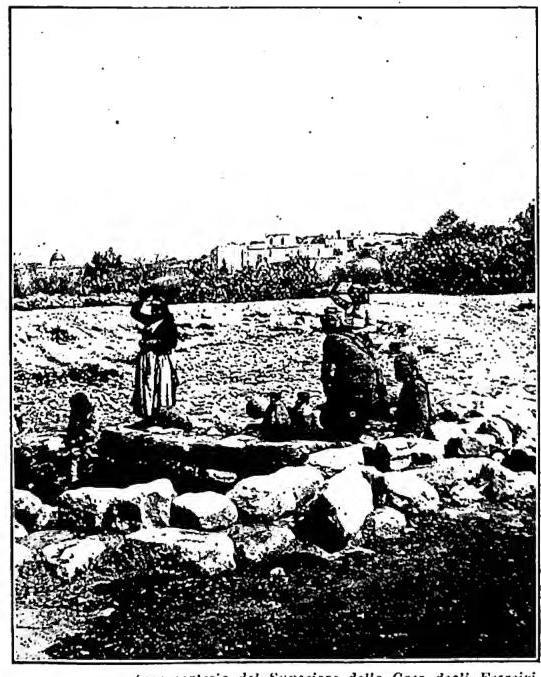
La ragione più forte è l'espressione Κανᾶ τῆς Γαλιλαίας in tutti i quattro passi in cui il Nuovo Testamento menziona C. Come la forma corrispondente di Fl. Giuseppe (Vita, 16) suggerisce, vi era una sola C. nella provincia settentrionale della Palestina: κώμη τῆς Γαλιλαίας ἢ προσαγορεύεται Κανᾶ. Questa era Hirbet Qānah. Ivi infatti si acquartierò Fl. Giuseppe come capo militare per difendere la Galilea (a. 66), avendo vicine le piazze forti di Sogana e Iotapatha. Da questa città per un'intera notte marciò con l'esercito verso Tiberiade e al mattino fu soltanto nelle vicinanze (πλησιάζων) di questa città (Vita, 17); il che non si addice a Kefr Kennah donde la distanza era solo di ca. 20 km. Infine, come dimostra l'esperienza odierna, la difficoltà di transitare attraverso la ragione di Hirbet Qānah, che è di natura basaltica, rende la marcia assai ardua, specialmente di notte. Questa ragione spiega anche perché l'ufficiale regio (Volg. regulus, Io. 4, 46, 52), partito da C. all'ora 7ª (ore 13 di oggi), solo all'indomani raggiunse la sua sede a Cafarnao: dovette infatti interrompere di notte il viaggio, il che non si sarebbe verificato nell'altra ipotesi, avendo egli potuto compiere 33 km. lo stesso giorno.
THE WEDDING AT CANA. - The earliest representations of this miracle of the Lord do not date before the third century; the account had also made an impression on the pagans, as is shown by the Passio of Teodoro and Didimo (P. Franchi de Cavalieri, Intorno alla Passio di Teodora e di Didimo, in Note agiografiche, 8 [Studi e Testi, 65], Vatican City 1935). Wilpert published the representations of the miracle found in the Roman catacombs; the oldest of these, in the cemetery Ad duas lauros, shows the scene
of the banquet in the background, while in the foreground on the right the Lord touches one of the six hydriae with the miraculous rod (Wilpert, Pitture, pl. 57; other examples in pls. 166, 1 and 186, 1 and in Nuovo Bull. d'arch. crist., 20 [1920], p. 83).
(fot. Alinari)
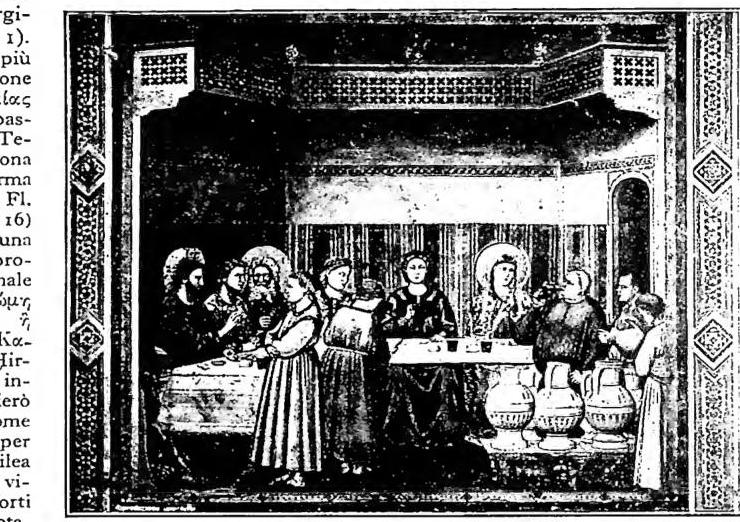
CANA - The Wedding at C. Fresco by Giotto. Padua, Scrovegni Chapel.
with the others (Eucharistische Malereien der Katahomben Karmonz in Alessandria, in Ehrengabe Deutscher Wissenschaft dargeboten von Katholischen Gelehrten, Freiburg 1920, pp. 273–82). Another example is provided by the painting in the underground church of Deir Abu Hennys at Antinoe. The scene is more frequent on sarcophagi: Christ touches with the thaumaturgical staff one of the water jars placed at his feet; the scene is often joined with that of the multiplication of the loaves (Wilpert, Sarcofagi, pls. 8, 3; 17, 2; 127, 2; 218, 1; 227, 2). On one of the sarcophagi of S. Vittore in Marseille, the scene of the
miracle is combined with that of the bearers of Canaan. The miracle of C. is also found in the mosaics on the vault of the baptistery of Naples and in the cycle of the basilica of S. Apollinare Nuovo at Ravenna.
The miracle of the Wedding at C. was also sculpted on one of the panels of the door of S. Sabina. In the gold-glass vessels, the water jars of the miracle of C. have the distinctive feature of being fitted with lids (R. Garrucci, Vetri ornati di figure in oro, Rome 1864, pls. VII, nos. 1 and 2; VIII, 1). In ivories it appears at Ravenna, on a diptych in Milan, on one in Palermo, in a binding in Oxford, etc.
Asterius of Amasea, in the fifth century, recalls that some Christians used very sumptuous garments on which they depicted Collecta ex historia evangelica argumenta, such as, for example, nuptias Galileae et hydrias (PG 40, 166–67).
During the excavations at Elatea, C. Diehl found near the site of the Church of the Panaghia, rebuilt in the thirteenth century, a large stone on which was written in Greek: “this is the stone that comes from C. of Galilee, where Our Lord Jesus Christ changed water into wine” (Bull. de corresp. hellénique, 9 [1885], p. 33).
Antoninus of Piacenza recounts in his itinerary that he went to C. ubi Dominus fuit ad nuptias, that he sat in that very place, and that he wrote there the names of his parents (H. Grisar, La pietra di C. e l'itinerario del cosiddetto Antonino di Piacenza, in La Civ. Catt., series 18, XI [1903, III], pp. 600–609).