PARACLETE. — An attribute of the Holy Spirit. It literally means “he who is called to one’s side” (παράκλητος, from παρακαλέω = “I call to one’s side”), especially in a judicial context, and thus signifies advocate, defender, patron, or intercessor. Since an advocate also has the duty to console the client, and since Greek adjectives in -τος can also have an active sense, some interpret the term as “consoler.”
Jesus attributes the title of *p.* to the Holy Spirit (v.), implying that He Himself is a *p.*: “I will ask the Father, and He will give you another *p.*, that He may abide with you forever, the Spirit of truth” (Jn 14:16 ff.; cf. 1 Jn 2:1). He attributes to the *p.* the office of teaching (Jn 14:26), of bearing witness in His favor (ibid., 15:26), and of convincing the world (ibid., 16:8-14).
In these passages from John, the Vulgate and the Syriac, Coptic, Ethiopic, and Gothic versions merely transcribe the Greek term *p.* without translating it; whereas the Armenian and Slavonic versions translate it, restricting the sense, as “consoler.”
In 1 Jn 2:1, where the author applies the term *p.* to “Jesus Christ the righteous,” the Vulgate appropriately renders it as *advocatus*. He is the advocate, the defender before the Father when someone falls into sin.
**
---
PARADISE. — In the New Testament, *P.* is the place of beatitude in heaven, the glorious and radiant dwelling of God, where the just will enjoy eternal happiness (Lk 23:43; 2 Cor 12:4; Rev 2:7); they will share, as a reward, in the “joy” and the “kingdom” of God (Mt 25:21, 23, 34; 2 Tim 4:8).
The evangelical expression “Kingdom of Heaven” implies that God dwells in heaven and that believers journey toward it (Mt 3:2; 4:17; 5:10, 19 ff.; 8:11; 11:11-12; 13:24-47; etc.). The apocryphal writings and rabbinic literature depict *P.*, which after the Fall was taken up to heaven, as the abode of the just after death or after the final judgment.
The Epistle to the Hebrews portrays eternal joy in the Promised Land (cf. Mt 5:4), transformed into a “heavenly calling” (Heb 3:1), which is a “rest” identical to the “rest of God” (ibid., 3:1-4:11). The faithful are journeying toward the “City of the living God” (Heb 12:22; 13:14), the “higher” (Gal 4:26) or “new” or “heavenly” Jerusalem, the spouse of the Lamb (Rev 21:1-22:5), overflowing with the resplendent glory of God, the synthesis of all “ineffable joy” (Dante, *Par.*, XXVII, 7). In *Purg.*, XXXII, 102, Dante shifts the allegory to the heavenly Rome (v. *visione beatifica*).
The Fathers aspire to the “true life” of heaven through death (St. Ignatius, *Ad Rom.*, 2-7). Saturus (Passio ss. Perpetuae et Felicitatis, 11-13) beholds *P.* in a vision as a wondrous garden. Prudentius (*Hamartigenia*, 830-58: PL 59, 1070 ff.) describes “the various rewards in the regions of *P.*,” and St. Augustine concludes *De civitate Dei* (XXII, 30: PL 41, 801-804) by treating “of the eternal happiness of the City of God and of the perpetual sabbath.” St. Ephrem, unifying the earthly *P.* and the heavenly *P.*, the beginning and end of the human drama, describes the three parts of *P.*: the summit, the sides, and the vestibule or fore-*P.*, also eternal, reserved for those who have sinned through ignorance or whose expiation on earth remained incomplete. Most identified *P.* with the “third heaven” (2 Cor 12:4), the dwelling of God and the elect. The return to *P.*, from which sin had excluded man, was the great hope of Christians. St. Gregory of Nyssa (PG 46, 417, 600) presents Baptism as entry into *P.* and the Jordan as a river of *P.* Holiness, the mystical life, is the rediscovery of *P.* (A. Weiss, A. Stolz). The spiritual itinerary of St. Ambrose is summed up in the eschatological, ontological, ascetical, and mystical return to *P.* St. Jerome exhorted Eustochium: “Ad paradisum mente transgredere: esse incipe quod futura es” (PL 22, 425; he alludes to the earthly *P.*: ibid., 400, 405).
**
We note: Romeo Archeologia. — A significant representation of the concept of *P.* is expressed in the apse (from P.
[^0]
[^0]: (A) P. P. von Weiser, *Skizzen der Gemäldesammlung in der Ermitage*
. P. von Weiner, *Meisterwerke der Gemäldesammlung in der Ermitage zu Pietrograd*, Munich 1923, p. 103).
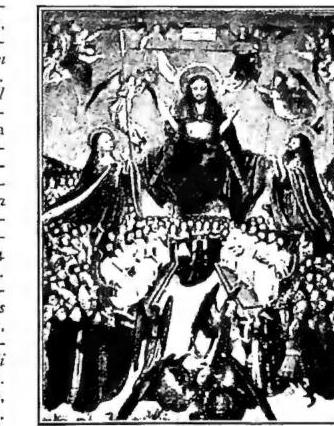
**PARADISE** — *P.*, detail from *The Last Judgment* by J. van Eyck (c. 1430) — Leningrad, Hermitage Gallery.

**PARADISE** — Deceased in the starry heaven. Fresco from the 4th century — Rome, Catacomb of Bassilla.
**PARADISE** — Sketch by J. Tintoretto for the *P.* of the Ducal Palace in Venice (c. 1590) — Paris, Louvre.
In the apse of St. Apollinaris in Classe, the holy bishop is depicted in beatitude within the celestial garden.
The deceased are often represented in beatitude among their saintly advocates, especially Peter and Paul; in Domitilla, the deceased Veneranda is welcomed into *P.* by the martyr Petronilla, in whose tomb she was laid (Wilpert, *Pitture*, pl. 231). In the cemeteries, the celestial garden is indicated by trees and plants with birds, flowers, and fruit; a typical example is the wall of a cubicle from the late 3rd or early 4th century in the Catacomb of Callistus, depicting five deceased in beatitude (Wilpert, *Pitture*, p. 425 ff., pl. 110). A simple garden is painted on a tomb in the so-called Novatian Cemetery on the Via Tiburtina (E. Josi, *Cimitero alla sinistra della Via Tiburtina al Viale Regina Margherita*, in *Riv. arch. crist.*, 11 [1934], p. 19). Damasus describes *P.* with expressions such as *regia caeli*, *caelestia regna*, *regna piorum*, *aetherias domos*, or *sinus*, *aeternam domum*, *aetheris... atria caeli*, in the elegy for Proiecta, m. in 383, with the phrase *aetheriam... caeli conscendere lucem* (A. Ferrara, *Epigrammata Damasiana*, Vatican City 1942, p. 302, and fig. 51). In the sepulchral poem of the deacon Redemptus, of Damasian flavor, it is said that *regia caeli* snatched him away and now *paradisus habet* (A. Ferrara, op. cit., pp. 233-35). The term appears in an epitaph from Goudorf on the Moselle (CIL, XIII, 7642). At Carthage, the expression *in pace et paradisus* is found (CIL, VIII, 13603); at Milevi, it is said of the deceased that he *paradiso lucis videre postulavit* (CIL, VIII, 9271); at Milan, the deceased implores the Almighty *ut paradisum lucis possit videre* (CIL, V, 6218). In St. Agnes, a certain Afrodite, d. in 382, was *optima servatrix legis faedique magistra*, and therefore *per eximios paradisi regnat odores, tempore continuo vernant ubi gramina rivis* (G. B. De Rossi, *Inscr. chr. Supplementum*, Rome 1915, no. 1703); in another at the Verano Cemetery, it reads: *inter felices animas et amoenam piorum prata* (id., in *Bull. arch. crist.*, 4th ser., 1 [1882], p. 95). In the inscription of a Felix at Bassilla: *in regno caelesti perque amoenam virentia* (id., *La cripta dei SS. Proto e Giacinto nel cimitero di S. Ermete presso la Via Salaria Vetere*, in *Bull. arch. crist.*, 5th ser., 4 [1894], p. 24).
*P.* was also the name given to the portico-enclosed area in front of the cemetery basilicas, where burials took place (G. B. De Rossi, *Roma sotterranea*, III, Rome 1877, p. 430). For example, the area in front of the basilica of St. Peter, surrounded by the quadriporticus, is called *p.* (Lib. Pont., II, p. 80).
Enrico Josi
ART. - Representations of Paradise developed in the visual arts in those of the Last Judgment, where the elect are customarily seen placed at the right hand of Christ the Judge and the damned at His left. This is the case in all medieval depictions and also in those from the early Renaissance, in which the image of Paradise is accompanied by that of Hell.
Among the most notable medieval representations of Paradise, the following may be cited: 1) a Byzantine-Benedictine fresco from around 1060 in the church of S. Angelo in Formis near Capua; 2) a Byzantine-Venetian mosaic from the 12th century in the cathedral of Torcello; 3) a Byzantine-Greek mosaic from the 13th century on the ceiling of the Florentine Baptistery; 4) a fresco by Giotto, datable to around 1305, in the Scrovegni Chapel in Padua; 5) the fresco by Nardo di Cione, executed around 1357 in the Strozzi Chapel in S. Maria Novella in Florence; 6) the fresco by Turone, executed around 1362 in the presbytery of S. Anastasia in Verona; 7) the late 14th-century fresco in S. Maria Maggiore in Tuscania. Also noteworthy is the grand fresco in the Camposanto of Pisa, attributed to Francesco Traini, which was damaged during military operations in 1944. The Last Judgment, carved in marble by Lorenzo Maitani around 1320 and adorning the fourth pillar of the façade of Orvieto Cathedral, presents a different iconographic arrangement. Christ the Judge is seen at the top of the bas-relief, surrounded by a mandorla of cherubim; the elect occupy the upper part of the bas-relief closer to Christ, while the damned of Hell occupy the lower part, farther away. The same vertical arrangement is followed by Jan van Eyck in the magnificent panel (c. 1430) now in the Hermitage in Leningrad. Among the most beautiful representations of Paradise are two panels from the early Italian Renaissance. One of these panels, painted around 1430, is the Last Judgment by the Blessed Angelico, preserved in the Museum of S. Marco in Florence. The other is the predella, dating from about a decade later, by the Sienese Giovanni di Paolo, in the Pinacoteca of Siena.
Some Flemish Last Judgments from the 15th century were conceived as triptychs; in these, one wing—the left one, i.e., to the right of Christ the Judge—depicts Paradise. The most famous of these, with the Last Judgment, is the one by Hans Memling painted around 1470 for Angelo Trani, a physician in Flanders. Sent to Italy by sea, the work was captured with the ship by the corsair Paul Beneke, who took it to Danzig. There, until 1945, Memling’s triptych was located in the church of S. Maria della Vergine. Another Flemish triptych, in which one wing depicts Paradise, is that by Hieronymus Bosch in the Doge’s Palace in Venice. Among the famous frescoes depicting scenes of the Last Judgment painted by Luca Signorelli between 1499 and 1502 in the Cappella di S. Brizio in Orvieto Cathedral is a section of the left wall that indeed depicts Paradise. In the Last Judgment frescoed between 1534 and 1541 in the Sistine Chapel, Michelangelo depicted the elect of Paradise in the upper part of the grand scene, thus following the vertical arrangement already used in the 14th century by Lorenzo Maitani and in the 15th by Jan van Eyck. Subsequent representations of Paradise alone are rare, that is, without an accompanying depiction of Hell.

Paradise – Sketch by J. Tintoretto for the Paradise of the Doge’s Palace in Venice (c. 1590) – Paris, Louvre.
In the inspired narrative, the historical fact, which is essential, must be distinguished from the descriptive elements (or “literary garb”), which correspond to the conceptions of a much later period in which it was written. The historicity of Paradise, of the full happiness of the first human couple, with the preternatural gifts of immortality, immunity from concupiscence, work as occupation and delight, and filial familiarity with God, stands out from the immediate context: creation of the universe, of man, the first sin, punishment.
This is echoed throughout the teaching of the Old and New Testaments (Rev 2:7; Prov 3:18; 11:30; etc.; Wis 2:23–24; John 8:44; Rom 5:12, 14; 1 Cor 15:21–22, etc.). This is evident from the very tenor of the text (B. Brodmann [V. BIBLICA.], pp. 213–36) and from the universal belief, widespread among all the peoples of the earth, in a lost primordial happiness (J. Feldmann [V. BIBLICA.], pp. 55–84; P. Heinisch, Problemi... [V. BIBLICA.], pp. 105–12). Attempted symbolic explanations (Philo, L. A., 1:45–97; 2:64; Op. 154–57; Origen; K. Barth), or worse, mythical ones (E. Kant, F. Schiller, E. Bösken), arbitrary and fanciful, are unproven and unprovable (P. Heinisch, Problemi [V. BIBLICA.], pp. 67–73).
Modern exegetes recognize a descriptive element in the geographical framework and rightly consider it impossible (and in any case of entirely secondary importance) to determine the actual location of Paradise (A. Bea, P. Heinisch, J. Coppens, F. Ceuppens).
The Bible (Gen 10:7–8, 29) knows two lands of Cush, one African and the other Asian; it is therefore not surprising that there are about eighty different explanations. From the text, one may infer that the author was thinking of the region of Lake Van and Lake Urmia, north of Mesopotamia (cf. Gen 8:4), where the Tigris and Euphrates have their sources; Pishon would be the Phasis (modern Rion) or the Coroch (Hevlat) and Colchis; Gihon (v.) would be the Araxes, and Cush the Akkadian Kaš, northeast of Babylon (thus E. Kalt, A. Šanda, H. Gressmann, etc.). Others have sought Paradise in central-southern Mesopotamia: the last two rivers would be only canals (Fr. Delitzsch, J. Theis, A. Deimel). Entirely improbable hypotheses have been proposed, ranging from those that suppose a syncretism of Akkadian and Egyptian elements to the one that identifies Paradise with the Sumerian giu-edin-na, not on earth but in the constellation Pegasus (A. Bea [V. BIBLICA.], p. 152; P. Heinisch, Problemi, p. 73 ff.).
The memory of the extraordinary vegetation of Paradise returns in the Bible as a hyperbolic term of comparison: Gen 13:10; Isa 51:3; Ezek 28:13; 31:8–9; 36:35; Joel 2:3; Sir 40:17.
ARCHAEOLOGY. — The four rivers flowing from the terrestrial paradise and watering the earth, Gihon, Phison, Euphrates, Tigris, are depicted on an architrave in Ostia and on a mosaic pavement discovered at Digne (G. B. De Rossi, *Mus...*

Paradise — Heaven, earth and hell. Painting on canvas: school of Viet-Nam.