
PARACELSO (THEOPHRAST BOMBAST VON HOHENHEIM). – Physician, naturalist, theosophist, born at Einsiedeln (Switzerland) on 10 November 1493, died at Salzburg on 24 September 1541. After graduating in medicine and wishing to pursue an independent path far removed from the then prevailing traditionalism of Arab and Galenic medicine, having taught his discipline at the University of Basel (1527–28), he travelled for a decade through Germany, Italy, France, and the Scandinavian regions, reaching as far as Moscow and Constantinople. He did not refuse to question even ordinary people—shepherds, gypsies, and peasant women—about their methods of treating illnesses, and gathered a large body of clinical and chemical observations.
As a man of the Renaissance, his view of the world was inspired by Ficinian Neoplatonism: man is a microcosm that reproduces the macrocosm, the universe created by God, whose Trinity is symbolically reflected in the three fundamental elements, according to P., of the universe and of man: mercury, sulphur, and salt; salt is the symbol of what is solid (its solid residue is ash); sulphur, of what is aerial (it is destroyed by fire); mercury, of what volatilizes when burned. Directing these elements is the archeus, or generative force, which resides in the stomach: it is responsible for balancing the aforementioned elements, since good health depends on them and not on humoral equilibrium Galen (v.) of which P. is an absolute opponent. The physician must therefore be a diligent observer of nature. P. promoted the study of chemistry applied to biology and was a precursor of modern medicine.
Although he declared that experience was his great teacher, he also believed in the influence of the stars and of plants, which could determine changes in the archeus on which the health of the body depends. He followed the (magical) principle of “signatures,” that is, the efficacy of a plant’s external form in treating diseases; he approved the use of thermal waters, of which he recalled the principal ones.
(fol. Paul, comm. arch. corre)
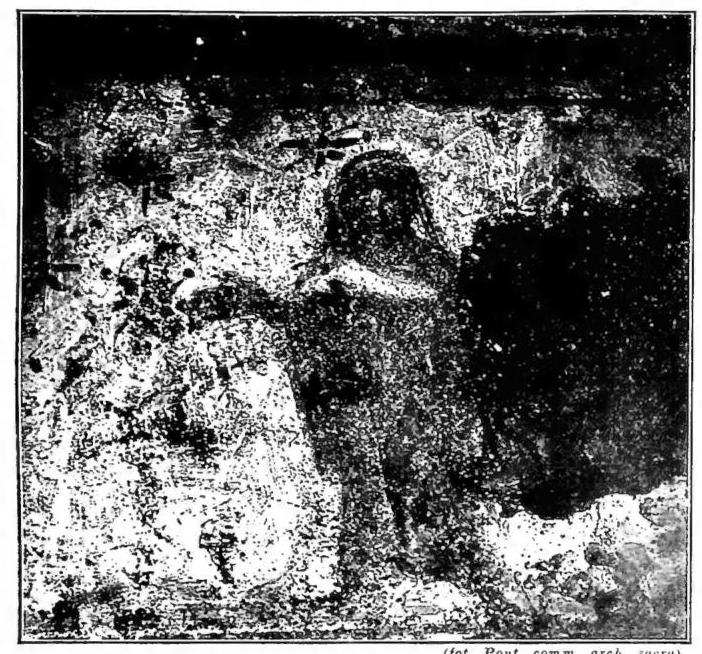
PARADISO — Deceased woman in the starry heaven. Fresco from the 4th century — Rome, cemetery of Bassilia.
1941; L. Englert, Paracelsus, Mensch und Arzt, Berlin 1941;
W. E. Peuckert, Das Leben T. P., Stuttgart 1941; I. Betschart,
T. Paracelsus, Einsiedeln-Zurich 1941; F. Spunda, *Das Weltbild
des Paracelsus, Vienna 1941; B. S. von Waltershausen, Paracelsus
am Eingang der deutschen Bildungsgeschichte*, Leipzig 1942; E.
Matzke, Paracelsus Anschauung von der Welt und vom menschlichen Leben, Berlin 1943; A. Miotto, P., Rome 1951. Nicola Turchi