
JOHN, APOSTLE, EVANGELIST, saint. - Author of the Fourth Gospel, three Epistles, and the Apocalypse.
OUTLINE:
I. Life and apostolate
II. The Gospel of J
III. The three Epistles of J
IV. Archaeology
V. Iconography
VI. Acts of J.I. LIFE AND APOSTOLATE
J. was the son of Zebedee (v.) and of Salome (Mk. 15:40 with Mt. 27:56 and 20:20). He came from a well-to-do family that employed “hired men” (Mk. 1:20), and Salome was one of the matrons who “ministered to Jesus” (Mt. 27:55) “with their resources” (Lk. 8:2–3). His place of origin is unknown.Together with his elder brother James, he was called by Jesus to follow Him; Boanerges (v.), a name not given in derision or jest but in honor, because the brothers were “eminent preachers and theologians” (Theophylact, In Mk. 3:17; PG 123,523). J. was the beloved disciple of Jesus. Despite his unruly zeal (Lk. 9:49, 54) and his ambition (Mk. 10:35), he was not only one of the three apostles most intimate with the Master but was the one “whom Jesus loved”; at the Last Supper, lying on Jesus’ right, he leaned back (ἀνακέκλιται) upon Jesus’ breast (Jn. 13:23,25), thus being able to question Him in private. Standing courageously at the foot of the Cross, Jesus entrusted His Mother to him (Jn. 19:26–27). He ran with Peter to the Sepulchre and, with Peter, was honored with a special revelation (Jn. 20:2,22–23).
It is debated whether J. introduces himself on two other occasions in the Gospel narrative: a) at the first calling of the Apostles, an unnamed companion of Andrew leaves the Baptist to follow Jesus (Jn. 1:35,40); b) in the Passion narrative, “another disciple known to the high priest” accompanies Peter, who is introduced into the courtyard.
The Fathers rarely address the first question; they often respond affirmatively to the second. Modern scholars, however, mostly identify J. as Andrew’s companion but do not equate him with the disciple known to the high priest. The connection between J. and Andrew is asserted by some (τινές), according to Chrysostom (who denies it), Theophylact, Euthymius (PG 59, 117; 123, 1179; 129, 1140), and the Catena (ed. J. A. Cramer, II, p. 194). The majority remain silent: Origen, Epiphanius, Cyril of Alexandria (PG 14, 180; 41, 916; 73, 217–20), and Augustine, Rupert, Albert the Great (PL 35, 1442; 169, 266). Others express doubt: St. Thomas, Maldonado. Modern scholars see J. here for three reasons: the vividness of the narrative, the variant in Jn. 1:41 “Andrew first finds (πρῶτος, not πρῶτον) his brother,” from which it is inferred that the new disciple also found his brother, i.e., that J. brought James; James in the apostolic lists always precedes Philip, which implies that he was called before Philip (Jn. 1:43).
That J. accompanied Peter (Jn. 18:16) was admitted by Chrysostom, Cyril of Alexandria, Jerome (PG 59, 449; 74, 596; PL 22, 1090). Augustine reasonably doubts this (PL 35, 1932) “perhaps therefore this is he,” since in Acts 4:13 J. appears unknown to the high priest.
According to the Acts and Gal. 2:9 (he is numbered among “the pillars of the Church”), J. held preeminent authority in the nascent Church.
Historically reliable tradition attests five facts about J.: he was the youngest of the Apostles; he possessed the prerogative of virginity; later he dwelt in Ephesus, where, after the exile he suffered on the island of Patmos (Rev. 1:9), he died a natural death in extreme old age under Trajan. His feast is celebrated on December 27.
St. Jerome (Adv. Jovinianum, 1:26: PL 23, 247 [259]) attests: “Iohannem tunc [when with Jesus] fuisse puerum, manifestissime docent ecclesiasticae historiae.” The virginity of J. is affirmed by the Monarchian Prologue (ed. H. Lietzmann, I, p. 13) “ut virgo virginem servaret” (though it expounds the legend that J. was married: Jn. 2:1–11), by the Pistis Sophia, 41:96 (ed. O. Schmidt, I, 42:148); and by the Acta Ioannis, 113 (ed. R. A. Lipsius, II, 1, 212). The residence of J. in Ephesus is attested by Irenaeus (Adv. Haer., II, 22:5 [33:3]; III, 3:4 [3]; PG 7, 785, 855) and by Eusebius (Hist. eccl., III, 23:4: PG 20, 255), who places his retirement in Ephesus at the beginning of the Jewish War (c. A.D. 67). Irenaeus, in the passages cited, relates that J. παρεδίδει αὐτοῖς [the presbyters of Asia] μέχρι τῶν Τραιανοῦ χρόνων. Epiphanius (Haer., 51:12:2: PG 41, 910): J. “wrote the Gospel after the 90th year of his life”; Agapius of Hierapolis (PG 7, 503): “after the Passion of the Lord he lived 71 years and died in the 6th year of Trajan.” Of his death Tertullian says (De anima, 50: PL 2, 780): “Obiit Ioannes, quem in adventum Domini remanum frustra fuerat spes”; similarly Hilary (De Trinitate, X, 37: PL 10, 372). Porphyry reproached Christ because the prediction of Mt. 20:23 had not been fulfilled in J., since “we know that J. died without martyrdom” (A. Harnack, Sitzungsberichte Akad. d. Wiss., Berlin 1921, pp. 269, 272, 835).
Many episodes are narrated about J.’s (Ephesian) life whose historical authority cannot be either proved or disproved. Polycarp related that J. “fled from the bath unwashed” at the presence of Cerinthus (Eusebius, Hist. eccl., IV, 14:6: PG 20, 337); so too Irenaeus (III, 3:4: PG 7, 853). A certain Apollonius narrates that J. in Ephesus raised a dead man (Eusebius, op. cit., V, 18:14: PG 20, 418). Clement of Alexandria transmitted the story of a disciple of J. who became a robber (Quis dives salvetur, 42:7: PG 9, 648–49). Tertullian reports the cauldron of boiling oil “from which the Apostle suffered nothing” (De praescr. 36: PL 2, 49), and so too Jerome (In Mt. 20:22: PL 26, 146 [149]). May 6 is the day of the dedication of the church “ante Portam Latinam” under Pope Adrian I. Jerome relates (In Gal. 6:10: PL 26, 433 [462]) that the aged J. constantly repeated: “Little children, love one another.” The Acta Ioannis narrate that the venerable old man amused himself with a little lamb and that a cup of poisoned wine did him no harm (ed. R. A. Lipsius, I, p. 426). The Jacobite-Arabic Synaxarium (PG 16, 387) under May 11 notes: “cast into the sea he was miraculously saved.”
Some doubted J.’s death, as Ambrose affirms (In Ps. 118, 20:12: PL 14, 1487 [1564]); the Pseudo-Dorotheus (PG 2, 1075) says that J. “lives with Enoch and Elias.” St. Augustine (In Io. tr. 124:2: PL 35, 1970–71) heard “from not untrustworthy men, that in certain writings, though apocryphal, it is found... that he [John] ordered a tomb to be made for himself and remained unharmed; and that, when it was dug and carefully prepared, he lay down there as if in a bed and immediately died; or, as some think, did not die but lay there as if dead... the earth is said gradually to heave and, as it were, to bubble up, and this is attributed to his breathing.” Similarly Michael Psellus (Spicilegium, ed. J. B. Pitra, IV, Paris 1858, p. 496).
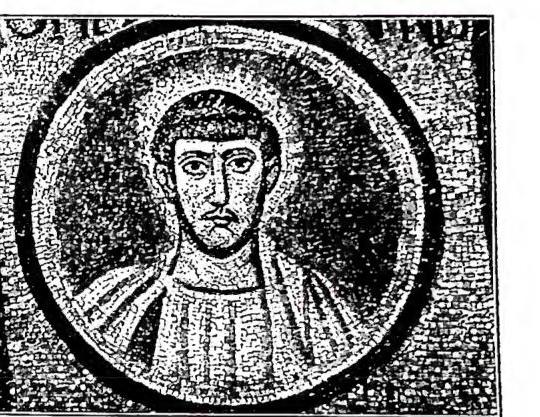
(photo: Anderson)
Al principio del sec. xx, molti teologi acattolici asserirono che l'apostolo G. fu ucciso con suo fratello Giacomo già negli aa. 41-44 dal re' Agrippa I. Se ciò fosse vero, risulterebbe che il IV Vangelo, venuto alla luce dopo i tre Vangeli sinottici, non può essere opera di G. apostolo. Per tale tesi è valorizzato soprattutto un detto, attribuito a Papia, come tratto «dal suo secondo discorso», conservato da due autori bizantini. Filippo Sidete (ca. il 430) riporta la parole di Papia in questa forma: Παπίας ἐν δεύτερῳ λόγῳ λέγει Ἰωάννης ὁ θεολόγος καὶ Ἰάκωβος ὁ ἀδελφὸς αὐτοῦ ὑπὸ Ἰουδαίων ἀγρρέθησαν (frammento di un cod. Barocciano, 142, in Texte u. Untersuch., V, 2, p. 170; ed. E. Preuschen, Antilegomena, p. 58; 2ª ed. p. 94; ed. E. X. Funk, Patres Apostol., I, p. 366 sg.). Giorgio Hamartolos (sec. ix) così presenta il detto di Papia: Παπίας... ὁ αὐτόπτης τούτου [Ἰωάννου] γενόμενος φάσκει ἐν τῷ δεύτερῳ λόγῳ τῶν κυριακῶν λογίων ὅτι ὑπὸ τῶν Ἰουδαίων ἀγρρέθη, πληρώσας δηλαδὴ μετὰ τοῦ ἀδελφού τὴν τοῦ Χριστοῦ περὶ τούτων πρόρρησιν. Così il cod. Coislessis 305 (sec. x); E. Preuschen, op. cit., 58; F. X. Funk, op. cit., pp. 367-70. In entrambe le relazioni, Papia riferisce il martirio dei due fratelli, ed invero accenna che ciò accadde nello stesso tempo. Afraate siro (sec. iv) enumera dopo Stefano, Simone (= Pietro) e Paolo «che furono martiri perfetti», Giacomo e G., «che hanno seguito le orme di Cristo maestro» (Demonstratio, 21, 23: Texte und Untersuchungen, III, 333, 4, p. 348, e Patrologia siriaca, I, 988). Un Martirologio siriaco, scritto da un ariano nel 411, che contiene «i nomi dei signori martiri» nota al 27 dic.: «G. e Giacomo apostoli in Gerusalemme» (ed. R. Graffin, Acta SS. Novembris, III, 1, Bruxelles 1894, p. [LII] e H. Lietzmann, Kleine Texte, 2, 9).
Poggiandosi su questi testi, molti moderni proposero la tesi della immatura morte di G. con a capo Ed. Schwartz (Über den Tod der Söhne Zebedaei [Abhandlungen Göttingen, phil. hist. Klasse, N. F., 7, V], Berlino 1904; Nachrichten Göttingen, 167 [1907], p. 266; Zeitschr. f. neut. Wiss., 11 [1910], pp. 89-104). Lo stesso aveva già accennato W. Bousset (Apokalypsis Jo., Gottinga 1896, p. 47). Lo seguirono principalmente: J. Wellhausen, Evang. Marci, Berlino 1903, p. 90 (2ª ed., ivi 1909, p. 84), id., Johannes, ivi 1908, p. 100; Ad. Jülicher, Einleitung, 5ª-6ª ed., Tubinga 1906, p. 367; 7ª ed., ivi 1931, p. 398; A. Loisy, in Revue d'histoire et de littérature religieuse, 9 (1904), p. 33; R. Knopf, Einführung, Giessen 1923, p. 122 sg. (con dubbi; nella 1ª ed., non dubitava: pp. 115, 273); G. Krüger, in Theol. Lit. Zeitung, 52 (1927), p. 247; J. Moffat, Introduction, 3ª ed., Edimburgo 1918, pp. 601-607 che enumera altri fautori, ad es. O. Pfeiderer, Urchristentum, Berlino 1902, p. 411 e W. Bauer, in H. J. Holtzmann, 3, 19.
Ma la maggior parte degli stessi protestanti respinge questa teoria: Th. Zahn, Einleitung, 3ª ed., II, Lipsia 1907, p. 474; A. Harnack, Theol. Lit. Zeitung, 34 (1909), p. 10, e Chronologie, Berlino 1912, p. 665; F. Spitta, in Zeitschr. f. neut. Wiss., 11 (1910), pp. 39-58; E. Riggenbach, Neue kirchl. Zeitschr., 32 (1921), pp. 692-96; P. Feine, Einleitung, 3ª ed., Lipsia 1923, p. 88 (ed. P. Feine-J. Behm, ivi 1936, p. 101 sg.). Tale tesi cronologica è inammissibile. Da Gal. 2, 9 consta che l'apostolo G. era una «colonna» della Chiesa gerosolimitana alcuni anni dopo l'a. 44. Per sciogliere tale difficoltà, Ed. Schwartz dovrebbe porre la conversione di Paolo negli aa. 28 o 29, il che è inammissibile (cf. Zeitschr. f. neut. Wiss., 11 [1910], p. 103).
Né Filippo Sidete né Giorgio riferirono esattamente le parole di Papia: a) Filippo chiama G. «teologo». Ma questo titolo era sconosciuto ai primi scrittori (Ireneo, Clemente Alessandrino, Origene); ricorre infine presso Pietro Alessandrino (PG 18, 519), Atanasio (PG 25, 84 C), Eusebio (PG 24, 880). b) Giorgio aggiunge un testo di Origene male citato (PG 13, 1385), e gli fa affermare ότι Ἰωάννης μεμαρτύρηκε; ma Origene dice esattamente che Giacomo fu ucciso da Erode, e G. esiliato a Patmos dal Re dei Romani.
È chiaro che Papia non ha parlato di G. Evangelista, ma di Giovanni Battista, e che quei due autori bizantini hanno confuso i due Giovanni, come è spesso avvenuto. Ecumenio, Teofilatto ed Eutimio Zigabeno, spiegando Hebr. 11, 35, uniscono il martirio che Giacomo e Giovanni subirono per decapitazione. Il terzo esplicitamente aggiunge al nome di G.: ὁ Πρόεδρος, gli altri non aggiungono nulla: hanno dovuto conservare la forma scelta da Papia, mentre il terzo sta al senso. Gregorio Nazianzeno tra le vittime (σφάγια) uccise per Cristo enumera Ἰωάννην ἐκείνον, Pietro, Giacomo, Stefano, non G. Evangelista (PG 35, 589).
Dionisio Alessandrino (m. nel 264 o 265), secondo Eusebio (Hist. eccl., 7, 25, 16: PG 20, 701), riferisce che ad Efeso si mostrano due sepolcri «di G.». Quindi Eusebio, fondandosi su Papia, distinse due
(da Fliehe-Martin-Frutez, in ed., Torino 1912, pp. 17)
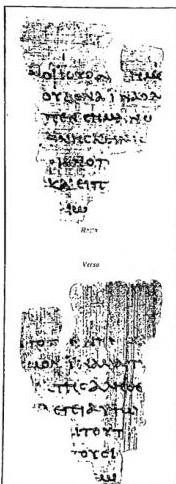
GIOVANNI, Apostolo, Evangelista, santo - Vangelo di s. G. 18, 31 b-33 a. 37 b 38 a. Frammento di papiro (p. 52) della prima metà del sec. II. È il più antico codice del N. T. - Manchester, John Rylands Library Gk 457.
discepoli di Cristo. Lo seguono: il «catalogo di Damaso»: «Iohannis apostoli epistola una, alterius Iohannis presbyteri epistolae duae» (Denz-U, 84), s. Girolamo (De viris ill., 9: PL 23, 623 [655]), Filippo Sidete (Texte und Unters., 2, p. 170; ed. E. Preuschen, Antilegomena, p. 94), le Constitutiones Apostolorum (VII, 46, 7; ed. F. X. Funk, I, 454) e molti autori posteriori.
Il testo di Papia (ca. 130?) enumera testimoni immediati, dai quali attinse la sua conoscenza della vita di Cristo: «Che se in qualche luogo arrivava qualcuno che aveva convissuto con i presbiteri (παρηκολουθηκώς τις τοῖς πρεσβυτέροις), avidamente l'interrogavo (ἐνέκρινον) sui detti dei presbiteri, che cosa (cioè) disse (εἰπεν) Andrea o Pietro, e che cosa Filippo, Tommaso, Giacomo o che cosa G. (ἡ τί Ἰωάννης) o Matteo o qualche altro discepolo (ἡ τις ἕτερος τῶν τοῦ Κυρίου μαθητῶν), o che cosa dicono Aristione e il «presbitero» G., discepoli del Signore (ἡ τε Ἀριστῶν καὶ ὁ πρεσβύτερος Ἰωάννης τοῦ Κυρίου μαθηταὶ λέγουσιν: Hist. eccl., 3, 39, 4). Questo nome di G. ritorna due volte, nei due elenchi di discepoli; giustamente quindi sembra che Eusebio abbia distinto due discepoli di nome G.; egli si professa discepolo del secondo, non del primo (n. 7): Ἀριστῶν ἀνέκρινον τοῦ πρεσβύτερου Ἰωάννου αὐτῆκων ἑαυτῶν φησιν γενέσθαι. Alcuni giungono a concludere che tutto ciò che si narra della dimora ad Efeso dell'«apostolo» G., si fonda sulla confusione dei due Giovanni.
Il testo di Papia va spiegato. Il vescovo di Gerapoli non distingue le persone, ma le testimonianze, secondo che erano «passate» («disse», εἶπε) o «presenti», cioè date da uomini ancora viventi («dicono» λέγουσιν) che chiunque poteva consultare. La stessa persona poteva appartenere ad entrambe le categorie. Papia sarebbe stato incoerente, se con i due epiteti ὁ πρεσβύτερος τοῦ Κυρίου μαθηταὶ avesse voluto distinguere i due Giovanni. Infatti nel primo catalogo numera sette Apostoli insieme ai presbiteri, ed infine li chiama discepoli del Signore. Perciò dalle parole di Papia non si può dimostrare che il presbitero G., il quale esplicitamente, come gli altri sei Apostoli, è chiamato «discepolo del Signore», si distingua dagli Apostoli.
This distinction is excluded by tradition, which knows of only one St. JOHN of Ephesus. Around 190, Polycrates, bishop of Ephesus, in opposition to Bishop Victor of Rome in the controversy over the celebration of Easter, lists (Eusebius, Hist. eccl., 5, 24, 2-6: PG 20, 493-96) “the great luminaries (μεγάλα στοιχεία) who taught and died in Asia,” men who every year celebrated Easter on the 14th of the spring month nīsin. They are: the Apostle Philip, Ἰωάννης ὁ ἐπὶ τὸ στήθος τοῦ Κυρίου ἀναπέσων, then Polycarp with four other bishops and some prophetesses; no mention whatsoever is made of any other JOHN, who, as a disciple of the Lord, would certainly have had to be listed. Irenaeus recalls the presbyters οἱ κατὰ τὴν Ἀσίαν Ἰωάννην τῷ τοῦ Κυρίου μαθητῇ συμβεβηκότες; he adds that some have seen not only JOHN but also other Apostles. He never distinguishes JOHN from a namesake.
Therefore almost all authors, including non-Catholics, recognize a single JOHN of Ephesus, e.g., Th. Zahn, F. Blass, G. Wohlenberg, J. Belser, who had defended a certain distinction, later retracted (Theol. Quartalschrift, 97 [1915], pp. 161-84). Other authors think the text was altered, such as Th. Mommsen (Zeitschr. f. neut. Wiss., 3 [1902], pp. 156-58), since the words μαθηταὶ Κυρίου are missing in the Syriac version (ed. P. Bedjan, p. 245; The ecclesiastical history of Eusebius in Syriac, ed. W. Wright and N. McLean, Cambridge 1898, p. 177, 14), where only “Aristion or JOHN ‘the presbyter’” is read. Most recently P. Vannutelli defended the two Johns (De presbytero Ioanne apud Papiam, Rome 1933).
II. THE “GOSPEL” OF JOHN
The authenticity of the Fourth Gospel is attested first of all by a man of historical credibility. Whoever affirms that JOHN son of Zebedee, and not another, wrote the Fourth Gospel, is Papias, bishop of Hierapolis in Syria. His first work, Λογίων κυριακῶν ἐξήγησις, in five books, is dated by Eusebius to the reign of Hadrian, ca. 135; today it tends to be placed ca. the year 100.
Eusebius links the work with the reign of Hadrian, and this suffices for his authority. But already from Irenaeus it is known that Papias flourished ca. 110; indeed Irenaeus seems to indicate that he wrote while St. Clement of Rome, who died in 96, was still alive (cf. Guhvenger, Papias, in Zeitschrift für katholische Theologie, 69 [1947], pp. 385-416). Papias is of supreme importance because he does not use his own words but preserves the sayings of ancient witnesses. Thus the preface of his work, preserved by Eusebius (Hist. eccl., 3, 39, 3: PG 20, 296): “I shall not hesitate to set down for you, along with my interpretations, what I once learned well from the elders (παρὰ τῶν πρεσβυτέρων) and stored in memory (καλῶς ἐμνημόνευσα), confirming thereby the truth”; this is followed by the list of witnesses cited above. The judgment of Eusebius that “Papias was of very small intelligence” (Hist. eccl., 3, 39, 13: PG 20, 300) is in vain objected to, since it does not concern the things Papias preserved from others. The text of Papias was preserved in a Latin preface to the Gospels, which was first known only in two manuscripts (Vat. lat., called Alexandrinus or Reginae, and Toletanus, of the 10th century); it is now known in ten manuscripts (D. de Bruyne, in Revue bénédictine, 40 [1928], pp. 195-214 [esp. 198]; C. Schiffer-M. Meinertz, Einleitung, 3rd ed., Paderborn 1921, p. 2*).
Text of the preface: “Begins the account according to JOHN. The Gospel of JOHN was published and given to the Churches (in Asia) by JOHN still living in the body, as Papias (bishop) of Hierapolis, a beloved disciple of JOHN, reported in his esoteric works, that is, in the last five books.” The final words are a mistranslation of the title “exegetical.” According to John 21:24, the book of JOHN might seem to be his posthumous work, i.e., published by another person after the author’s death. Papias rejects this opinion. Therefore it is not directly a question of the composition of the book, which is clearly recognized by all, but of its publication; this is attributed to that disciple of Christ whose death was doubted both because of Christ’s words and because of his extreme old age, namely the Apostle John himself. The supreme authority of this testimony derives from the fact that Papias calls himself a disciple of JOHN, and that his testimony is close in time to the composition of the book itself.
The argument is confirmed by the discovery of an extremely ancient mutilated leaf, from the time of Hadrian or Antoninus Pius, certainly written before 150: the papyrus Ryland gr. 457, which contains the account of John 18:31-34 and 37-38 in a form already somewhat altered from the primitive (H. Roberts, An unpublished fragment of the Fourth Gospel, Papyrus Ryland gr. 457, Manchester 1935; cf. A. Merk, in Biblica, 17 [1936], pp. 99-101). Thus, a few decades after its composition, the Gospel was already known in Egypt.
Rightly therefore the Biblical Commission insists, setting aside theological argument: “with solid historical argumentation it is demonstrated that the Apostle JOHN and no other is the author of the Fourth Gospel.”
One may add the testimonies of later writers, among which stand out passages of St. Ignatius, who, although not naming St. JOHN as author, allude to this by reproducing passages from the Fourth Gospel verbatim. Moreover, a splendid internal argument can be constructed, proving that the author is a Jew, thoroughly acquainted with Palestinian geography, one of the three intimates, indeed the very beloved disciple of the Lord (R. Cornely, Introductio in utr. Test. libros, III, p. 226 ff.). As for the purpose of the Fourth Gospel, the readers for whom the Evangelist wrote were not catechumens but believers already mature in the faith (John 1:16: “we all have received of his fullness”). The proximate end of the sacred writing is to advance them in faith and, through it, in communion with the life of God (20:31).
Specifically, the Fourth Gospel pursues a dogmatic-apologetic aim: it proves the divinity of Christ, which is defended apologetically against the first heresies, above all those of Cerinthus and the Docetae. JOHN also had a historical aim: he wished to supplement the Synoptics (by narrating events omitted by them) and to guard against their being misunderstood (John 3:24: “for John had not yet been thrown into prison,” as someone might have concluded from Mark 1:14; John 18:13: “they led him first to Annas,” not immediately to Caiaphas; Matthew 26:37; 19:1: “then Pilate took Jesus and scourged him,” therefore not when he had already condemned him).
H. Windisch had proposed the theory that JOHN wished entirely to supersede the Synoptics (Verdrängungstheorie). M. Meinertz rightly opposed this with his view that JOHN wished organically to complete the Synoptics (Theologische Revue, 27 [1928], pp. 161-70); and more fully F. Sigge, Das Joh. Ev. und die Synoptiker (Neutestamentliche Abhandlungen, 16), Münster 1935.
Modernists deny any historical character to the Fourth Gospel, claiming it merely delineates types or symbols (Nathanael as the seeker of Christ, Nicodemus as the doubter, etc.). But that the Fourth Gospel is a historical book is shown “ex praxi, quae in primis temporibus in universa Ecclesia constantissime viguit arguendi ex IV Evangelio tanquam ex documento proprie historico” (Biblical Commission, Reply of 25 May 1907). Moreover, the Fourth Gospel has several pericopes in common with the Synoptics: two miracles (the multiplication of the loaves, the walking on the water), the solemn entry of Jesus into Jerusalem, the supper at Bethany, and many episodes of the Passion. Since these parts are equally historical in JOHN and in the Synoptics, the same historical character must extend to the other connected narratives of the Fourth Gospel.
As to language, the Fourth Gospel was originally written in Greek (Epiphanius, Haer., 30,3: PG 41, 409). E. F. Burney, The Aramaic Origin of the Fourth Gospel, Oxford 1922, argued that the original was written in Aramaic, but he did not prove his thesis (Aramaisms suggest only a virtual translation, not a formal one).
For the most part the author observes grammatical rules well. The exceptions consist in: a) Latinisms: τίτλας (19, 19 sg.; cf. Le. ἐπιγραφή), πρατζάριον (18, 28; variant αὐλή), λεντίον (13, 4 sg.); b) Hebraisms, among which first of all the frequent parataxis (10, 22); G. has few subordinate clauses: absolute nominative (6, 37; 7, 38; 15, 2); neuter for masculine (6, 37: omne quod, and after the parallel τὸν ἐρχόμενον); the personal pronoun is not distinguished from the reflexive (1, 47: “Jesus saw Nathanael coming to him [πρὸς αὐτόν] and speaks of him [περὶ αὐτοῦ]”). Hebrew words are explained: Rabbi, Messias, Cephas, Siloam, Golgotha, Gabbatha, Rabbuni (except Bethesda; incorrectly Volg. Bethsaida). But particles are confused, above all ἵνα, which, like the Aramaic de, fulfills all functions (consecutive: 9, 2; objective: 4, 47, 17, 15; causal: 8, 56; equivalent to the relative pronoun: 5, 7). Διὰ with the accusative is equivalent to διὰ with the genitive (6, 58 bis: “as… I live for the Father [non propter P.] so whoever eats me lives for me [non propter me]”, and 15, 3). Cf. on all this J. Bonsirven, Les aramaïsmes de St. Jean l'Evangéliste, in Biblica, 30 (1949), pp. 405-32.
The proper character of G. must be understood thoroughly, as with the other sacred writers, in accordance with the admonition of Pius XII (Divino afflante Spiritu, in AAS, 35 [1943], p. 314). The peculiarities of G. are so many and so great that “the Johannine question” arose because of the differences between the Fourth Gospel and the Synoptics.
First of all, G. reports divine things about Jesus, not human things as his predecessors did. Already Clement of Alexandria notes this peculiarity (in Eusebius, Hist. eccl., 6, 14, 7: PG 20, 551). There is, however, no contradiction between the first three Gospels and the fourth, since the Synoptics also report divine things about Christ and G. reports human things. Jesus knows the secret thoughts of hearts (Mt. 9,4 and parallels), “he will send his angels” (Mt. 13,41); a “Johannine” passage in the Synoptics (Mt. 11,27; Lc. 10,22); Jesus “is the Son of the living God” (Mt. 16,16; 26,64). In the Fourth Gospel, moreover, Jesus uses a scourge of cords (2,15); tired, he sits down (4,6); he calls himself “a man” (8,40); he spits (9,6); he weeps (11,33); “my soul is troubled” (12,27); “I thirst” (19,28). The enigma lies in the person of Christ himself.
At first glance, the Synoptics present Galilee, G. Judea, as the theater of Christ’s ministry. This is easily explained. In Galilee was the simple people, in Jerusalem Jesus had to reveal himself to the leaders of the people. Note, however, what is found in Mt. 23, 37: “Jerusalem, how often I would have gathered your children,” and 26, 55: “Every day I sat among you (Jerusalemites) teaching in the Temple”; cf. Lc. 10, 38; Act. 10, 39: “What he did in the region of Judea and in Jerusalem.” Moreover, G., narrating how Christ “went up” from Galilee (2, 13; 5, 1; 7, 10, 14), and “went” into Galilee (4, 3, 43, 54), and walked there (7, 1, 9), indicates that Christ’s ordinary residence was Galilee.
Characteristic is the symbolic nature of G., who orders everything to point to a higher reality, whether through Christ’s works or the persons in the narrative, even through certain words.
Events: the miracle of water turned into wine and the multiplication of the loaves; Jesus walking on the water; the man born blind and the dispute that followed; the washing of the feet; while Judas went out “it was night”; the Mother of Christ, introduced twice into the Gospel story. Persons: Nathanael “a true Israelite, in whom there is no deceit”; Nicodemus signifies the hesitant. Phrases: “I have no one” (5, 7); the Greeks say: “We wish to see Jesus” (12, 21).
Hence many non-Catholics asserted that everything reduces to symbolism, denying the historical authority of these events. It has been claimed that the Mother of Christ is the Synagogue, from which the Church originated (W. Bauer, p. 224). The Biblical Commission rejected this system (29 May 1907). The Synoptics, moreover, also have such symbolic intentions: the three gifts of the Magi (Mt. 2, 11); “put out into the deep and let down your nets for a catch” (Lc. 5,4); the three languages in which the title on the Cross is written (Lc. 23,38).
The miracles of G. are few (eight), but most important. They amplify and specify what is read in the Synoptics.
Instead of “blind men” there is “a man born blind” (Io. 9). No sick person in the Synoptics has exceeded 18 years (Lc. 13, 11): here there is a man who had been ill for 38 years (5, 5). A healing at a distance is performed (Io. 4, 47, 54; but similarly Mt. 15, 28). Yet the two miracles narrated together with the Synoptics present no amplification, as do the miracles reported cumulatively (2, 23; 3, 2; 6, 2). Indeed sometimes the Synoptic account is richer than that of G. (the centurion of the city of Capernaum is altogether more perfect than the “royal official” of Io. 4, 46-54).
The discourses of G. differ completely from those of the Synoptics, which delight in simple words, above all in parables.
The Christ of G. mostly speaks of himself. Hence the special “I am” style that occurs about 38 times (E. Schweizer, Ἐγώ εἰμι [Forschungen zur Gesch. des N. T., 56], Göttingen 1938, pp. 9-46 [formula from Ex. 3,13]). Christ had to reveal himself while contending against the unbelievers.
“The style is too sublime; it is no wonder that such discourses were not understood,” observes A. Jülicher (Einleitung, 6th ed., p. 381). But we do not have stenographic reports, only skillfully written summaries.
It is no wonder that the style of Jesus is uniform with that of John the Baptist and the Evangelist. In every report of others’ words there is something subjective. The Evangelist shaped his style according to the Master’s manner of speaking. A continual dualism must be maintained: God-world; light-darkness, life-sin. Abstract terms recur constantly: truth, life, to testify, to believe (never πίστις). That dualism is very real, no less than the other “rich and poor.”
How could G. preserve after so many decades the memory of long discourses? The memory of Orientals is wonderful (as, for poetry, among some Slavic peoples). It is not excluded that first summaries were made and that parts of discourses were written down verbatim.
It is said that G. has no parables (in which the terms retain their primitive meaning), but only allegories (a continuous series of metaphors on the same object); so J. Vosté, Parabolae, I, 2nd ed., Rome 1933, pp. 55, 208. But G. has five true and perfect parables: 3, 8 sg. (the wind); 4, 37 (different workers); 11, 9 (traveling by day and by night); 13, 10 (the bath); 16, 21 (the woman in childbirth). On the other hand, in the Synoptics there are allegories (Mt. 3, 12 = Lc. 3, 17: the winnower who uses the sieve; Mt. 15, 13 sg.: the gardener who uproots the plant that another has planted in his garden). One can therefore only say: in the Synoptics parables prevail, in G. allegories.
It cannot be denied that in G. there is, in matters of style, a certain poverty and monotony, because the same ideas often recur.
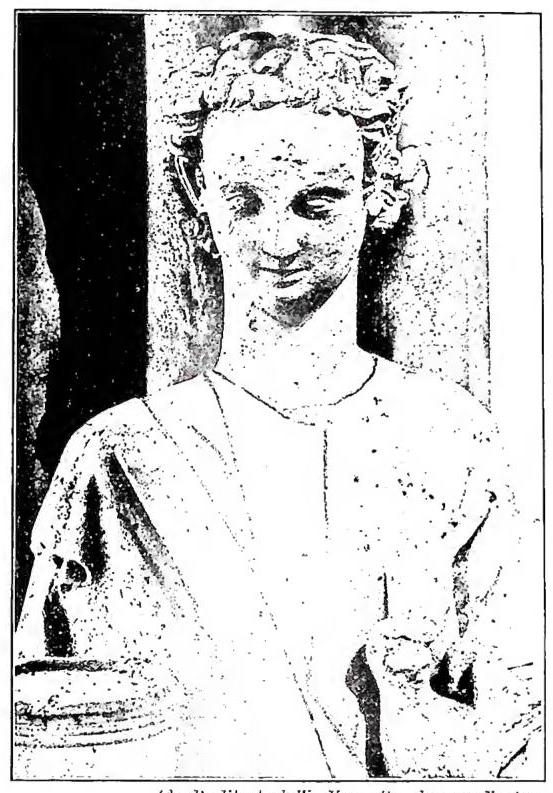
The arrangement of the Gospel follows a chronological order, though there is debate over whether chapters 5 and 6 have been transposed. The principle of the ordering is based on Jewish festivals (2:13 the first Passover; 5:1 an unnamed feast; 6:4 the feast of Passover [second or third]; 7:2 the feast of Tabernacles; 10:22 the Dedication; 11:55; 12:1; 13:1, the Passover of the Passion).
The opening consists of the Prologue (1:1–18) and the earliest testimonies of John and the first disciples of Christ (1:19–51).
Part One: Christ manifests His glory through His public teaching (chapters 2–12; subdivided into 2–6 and 7–12: the manifestation grows, along with the faith of the disciples, but also their opposition).
Part Two: Christ manifests His glory through His “exodus” (ἔξοδος: Lk 9:31), accomplished in Jerusalem: (13–17) among the disciples; (18–19) among His enemies; (20) risen — the Evangelist’s conclusion (20:30–31). A supplement added later (21). A conclusion added by the disciples (21:24–25).
III. THE THREE “EPISTLES” OF JOHN
There is considerable diversity in the tradition of the early centuries: the first and greatest is a homologoumenon, i.e., accepted by all Catholic Churches. Thus 1 John is declared by Eusebius to be such, while 2 and 3 John are listed, as not everywhere known in early times, among the antilegomena (Hist. eccl., III, 25,1: PG 20, 68 sqq.).In reality, not even 1 John was initially accepted by the Churches of Syria, in whose canon no Catholic epistle is named until St. Ephrem (U. Holzmeister, Prima Petri, Paris 1938, pp. 137–44, cites individual writers).
For 1 John, testimony exists from the Apostolic Fathers: Papias, as reported by Eusebius (Hist. eccl., III, 39, 17: PG 20, 300), “makes use of testimonies drawn from 1 John”; Polycarp, 7, 1 cites it: “Whoever does not confess” (ed. F. X. Funk, p. 648). The Muratorian Fragment (line 69): “Two epistles of John are held in the Catholic [Church].” Clement of Alexandria wrote a commentary (PG 9, 733–38) and uses the letter in his other writings. Similarly, Tertullian and Cyprian (Scorpiace, 12; Ep. 23, 2: PL 2, 171), and the treatise De singulorum clericorum, 30 (PL 4, 937; CSEL, 3, 3, 206). Irenaeus cites 1 and 2 John (C. H. Turner, Novum Testamentum s. Irenaei, Oxford 1923, pp. 190–92), as does Dionysius of Alexandria (Eusebius, Hist. eccl., 7, 25: PG 20, 707); and the Opus imperfectum, 34 (PG 56, 898): “as John testifies in his epistle.”
That all three Epistles are genuine is proven by the identity of vocabulary and style with the Gospel of John; hence even non-Catholics treat them in the same manner as the Fourth Gospel.
Noteworthy are certain terms exclusively proper to the Gospel of John and the Epistles: ἁμαρτίαν ἔχειν, ἀνθρωποκτόνος, γεννηθῆναι ἄνωθεν ἐκ θεοῦ, εἶναι ἐκ τοῦ κόσμου, περιπατεῖν ἐν σκοτίᾳ (νυκτί), παράκλητος, ἁμαρτίαν, τεκνίον (and Gal 4:19), τιθῆναι ψυχὴν ἑαυτοῦ (1 Jn 3:16; Jn 10:11, 17 sqq., 15:13). Other terms and phrases occur commonly: ποιεῖν τὴν ἀλήθειαν (1 Jn 1:6 = Jn 8:44); οὐκ ἔστιν ἡ ἀλήθεια ἐν τινι (1 Jn 1:8; 2:4 = Jn 8:44); ἐκ τῆς ἀληθείας εἶναι (1 Jn 2:21 = Jn 18:37); ἐκ τοῦ διαβόλου εἶναι (1 Jn 3:8 = Jn 8:44); ἐκ θεοῦ εἶναι (1 Jn 3:4, 1 = Jn 7:17; 8:47); ἐκ τοῦ κόσμου εἶναι (1 Jn 4:5 = Jn 3:32); ἐκ τοῦ κόσμου λαλεῖν (1 Jn 4:5 = Jn 3:31); τῆς γῆς, ἐν τῇ σκοτίᾳ, ἐν τῷ φωτί περιπατεῖν (1 Jn 2:11 = Jn 8:12; 12:35). Similarly, “life” (ζωή) is Christ (Jn 1:4; [6:48]; 11:25; 14:6 = 1 Jn 1:1 sqq.; 5:11, 20); “light” (φῶς) is God and Christ (Jn 1:4, 5, 7; 3:19 = 1 Jn 1:5, 7; 2:8).
The division of 1 John presents a major problem. The same ideas, above all faith in Christ, love of neighbor, and flight from sin, recur constantly. Here is one attempt at division: 1) the ethical thesis (against sins of lust, denial of charity, love of the world: 1:5–2:17); 2) the Christological thesis (2:18–27); 3) the ethical thesis is proposed again (2:28–3:24); 4) again the Christological thesis (4:1–6); 5) both theses are proposed together (so J. Belser, Johanneische Briefe, p. 9 sqq., following Häring, Weizsäckerische Jubiläumschrift, 1892, pp. 173–200). Another attempt was made by Schwertschlager.
1 and 3 John are rightly listed by Eusebius among the antilegomena (Hist. eccl., 3, 25: PG 20, 268). Already Origen numbers them together with 1 John: ἔστιν καὶ δευτέραν καὶ τρίτην, ἐπεὶ οὐ πάντες φασιν γνησίους εἶναι αὐτάς (in Eusebius, Hist. eccl., 6, 25, 10: PG 20, 584). Eusebius attributes these two epistles to the other John, “the Presbyter”; he is followed by Damasus (Denz.-U., 84), St. Jerome (De viris ill., 9: PL 23, 623), and the Constitutiones Apostolorum. 2 John is acknowledged by Irenaeus (I, 16, 3: PG 7, 634), the Muratorian Fragment (1, 69: “two epistles of John…”), and Clement of Alexandria, who distinguishes it from the “greater” (μεῖζων) and explains it in his Hypotyposes (PG 9, 737–40). 3 John, after
Origene, is admitted by Dionysius of Alexandria (Eusebius, Hist. eccl., 7, 25, 12: PG 20, 704; “G. neither in the 2nd nor in the 3rd appears as ἐνουακτῆ”), by the “Canon Mommsenianus,” and by Priscillian. Clement of Alexandria did not recognize it (ed. O. Stählin, IV, p. 26).
The Second Epistle of John seems to have been sent not to an individual woman (κυρία), but to an unknown Church (the same one to which the Third Epistle of John was sent); some have thought of the Roman Church. John exhorts the faithful to remain steadfast in fraternal charity and in the confession of Christ. The Third Epistle of John names three men: Gaius is praised for the help given to itinerant missionaries, Diotrephes (not, it seems, a bishop) is reproached for his arrogance and harsh ways, Demetrius is praised for the good reputation he enjoys. To the readers of both letters, John announces his imminent coming.
Recent Commentaries: Catholic: J. McEvilly, 3rd ed., Dublin 1875; A. Bisping, Münster 1871; I. A. van Steenkiste, Bruges 1876 (5th ed. by A. Camerlynck, 1909); A. F. Maunoury, Paris 1888; T. C. Ceulemans, Malines 1904; J. E. Belrer, Freiburg im Br. 1906; H. Poggel, Paderborn 1896; J. Bonsirven, Paris 1935. — Non-Catholic: B. Weiss, 6th ed., Göttingen 1899; H. J. Holtzmann, Freiburg im Br. 1891; 3rd ed. by W. Bauer, ibid. 1908.
Urbano Holzmeister
For the Apocalypse of John, V. APOCALYPSE.
IV. ARCHAEOLOGY
Early Christian art did not fix a definitive typology. Beardless and of youthful appearance, the Apostle is indicated by name both in the sarcophagus of Apt and in that of Bishop Concordius in Arles (Wilpert, Sarcofagi, I, p. 54, pls. 37, 2–3; 34, 3), as well as in the characteristic sarcophagus lid from Spoleto, now in the Lateran Museum, where the Evangelist figures as one of the four rowers of the mystical ship (the Church) guided by the Redeemer (ibid., p. 107, fig. 52). He appears beardless at Ravenna in one of the medallions in the monastery of S. Andrea (494–519), now the Archiepiscopal Chapel, and likewise, contrasted with St John the Baptist, in the mosaic of the oratory of S. Venanzius (640–42). The Evangelist is depicted in youthful guise in all the scenes in which he is shown together with the Madonna at the foot of the Cross, as, for example, in the Crucifixion painted in the cemetery of S. Valentino on the Via Flaminia (7th century), seen intact by Ugonio and Bosio, and in that of S. Maria Antiqua (8th century). In Byzantine images, beneath the Cross is found the Greek inscription “Behold thy son, behold thy mother,” as, for instance, in two small caskets, one of brass and the other of wood, formerly in the treasury of the sancta sanctorum, now in the Museo Sacro of the Vatican Library. G. is beardless beside the Lord in the reliquary donated by Paschal I for the jeweled Cross formerly in the treasury of the sancta sanctorum and now in the Museo Sacro of the Vatican Library (H. Grisar, Il sancta sanctorum ed il suo tesoro sacro, Rome 1907, p. 130, fig. 34).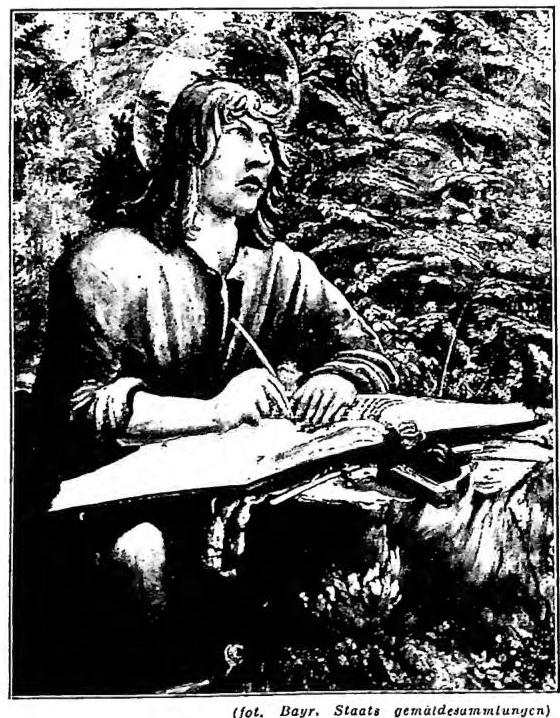
G. resting on the breast of the Redeemer was depicted in the mosaic cycle of the basilica of S. Ambrogio in Milan, as attested by the distich that illustrated the scene (v. E. Seletti, Iscrizioni cristiane di Milano anteriori al sec. IX, Codogno 1897, no. 228). Fabrics with scenes from the life of St John the Apostle were offered by Pope Gregory IV (827–44) to the Basilica of the Lateran (Liber Pontificalis, II, p. 82).
In the underground of the sancta sanctorum is a painting of about the 11th century that represents the raining of the manna upon the tomb of St John the Evangelist (Ph. Lauer, Les fouilles du sancta sanctorum au Latran, in Mélanges d'archéologie et d'histoire, 20 [1900], p. 263).
In the time of Alexander III (1159–81) the martyrdom of the Apostle was depicted in mosaic in the atrium of the Basilica of the Lateran, according to the text of a Life of St John dating from the 9th century (B. Mombritius, Sanctuarium, II, Paris 1910, pp. 55, 311; Wilpert, Mosaiken, p. 212, fig. 64). A clear testimony to the ordeal of the boiling oil suffered by the Apostle in Rome before his relegation to Patmos is found in Tertullian (De praescript., 36: PL 2, 59). The basilica of S. Giovanni ante portam Latinam was erected already in the time of Pope Gelasius (492–96), restored several times thereafter, and rebuilt by Celestine III (1191). On the façade of the apse the Apostle was then represented facing the Baptist (Wilpert, Mosaiken, pl. 257, pp. 932, 1204).
The veneration in Rome for the Apostle John was promoted by Pope Hilarius (461–68), who at the time of the Council of Ephesus had escaped the fury of Dioscorus by hiding in the tomb of St John. Hilarius erected an oratory in the Lateran in honour of the Apostle, near the Baptistery; on the exterior is preserved the inscription: “Liberatori suo beato Iohanni evangelistae Hilarus episcopus famulus XPI,” and within much of the mosaic decoration remains.
H. Grisar advanced the hypothesis that the form of the Lateran oratory reproduced that of the Apostle’s mausoleum in Ephesus (Analecta romana, Rome 1899, p. 558, no. 3). Enrico Josi
V. ICONOGRAPHY
St. JOHN the Evangelist, in late medieval art north of the Alps, is sometimes depicted holding a cup from which a serpent emerges; this is shown in several German Gothic sculptures and in paintings by Memling. As the seer of Patmos, St. JOHN is represented in a manner similar to the Evangelist, in a rocky desert and in the act of writing the Apocalypse. Such is the depiction, among others, by Giotto in the Peruzzi Chapel in Santa Croce, Florence, and engraved by Dürer in his illustrations of the Apocalypse.Subsequently, St. JOHN the Evangelist and St. JOHN the Baptist are often represented together, as Jacopo Torriti did at the end of the 13th century in the mosaic decorations in the apses of the Roman basilicas of San Giovanni and Santa Maria Maggiore. A fine depiction of St. JOHN the Evangelist as a young man was created in 1302 by Cimabue in the apse mosaic of the cathedral of Pisa, where the Saint stands to the left of the enthroned Christ.
Donatello’s statue in Santa Maria del Fiore, Florence, instead shows the Evangelist as an elderly, dignified figure in the guise of a prophet.
In art, there have been frequent representations of various scenes from the legend of St. JOHN the Evangelist, including its apocryphal details. His martyrdom in boiling oil was depicted by Filippino Lippi in the early 16th century in the Strozzi Chapel in Santa Maria Novella, Florence; Rubens painted it in an altarpiece for the church of San Giovanni in Malines. The scene of the resurrection of Drusiana was frescoed around 1320 by Giotto in the Peruzzi Chapel in Santa Croce, Florence, and nearly two centuries later by Filippino Lippi in the Strozzi Chapel in Santa Maria Novella. The assumption of St. JOHN is the subject of a fresco by Giotto in the Peruzzi Chapel in Santa Croce, Florence, and of another attributed to Pietro Lorenzetti in the church of the Servites in Siena. The scene in which St. JOHN drinks a cup of poison was depicted in numerous medieval stained-glass windows, among others in Assisi, Bourges, Chartres, Fournes, Reims, and the Sainte-Chapelle in Paris, etc.
Witold Wehr
VI. ATTI DI G
Scritti apocrifi in uso presso antiche sette eretiche. Eusebio (Hist. eccl., III, 25, 6) conosce Atti apocrifi di G. in uso presso eretici. Secondo Epifanio (Haer., 47, 1) si servivano gli encratiti di questi Atti; secondo Filastro (Dehaeres., 88) e Agostino (Contra adversarium legis et prophetarum, 1, 20, 39; cf. A. Harnack, Markion, Lipsia 1928, p. 429) furono letti presso i manichei e secondo Turribio di Astorga (Epistola ad Idac. et Cepon., 5) presso i priscillianisti. Da questo risulta che gli Atti di G. furono composti con altri Atti
In questi testi c'è la dottrina doctetica (manichea) riguardo al corpo di Gesù, e la legge di Mosè è attribuita al serpente. Inoltre si fa menzione di un inno di Gesù che, secondo Agostino (Epist., 237), era in uso anche presso i priscillianisti. M. R. James ha pubblicato in base a un codice Vindobonensis un altro frammento (M. Bonnet da un codice di Patmos, sec. XIV, pp. 179-93). Il racconto della morte serena dell'Apostolo, pubblicato da M. Bonnet,
pp. 203-15, che segue una tradizione più ricca, forse non fece parte degli antichi Atti di G. perché i manichei (cf. C. R. C. Allberry, A manichaean psalm-book, II, Stoccarda 1938, pp. 142-250) sembra abbiano conosciuto un'altra tradizione riguardo alla morte di G. L'edizione di Bonnet aveva il torto di voler ricostruire il testo originale degli Atti di G. con materiale di diverse recensioni (encratita, manichea, cattolica). Il testo originale aveva evidentemente una tendenza encratica (cf. il frammento latino pubblicato da D. de Bruyne, in Revue bénédictine, 25 [1908], p. 155 sg.), ma il testo originale è stato rielaborato dai manichei. Preghiere degli Atti di G. sono conservate in The book of Cerne (cf. Huypers, The prayer book of Aedelluald, Cambridge 1902, p. 233). Famoso è l'inno degli Atti di G. (cf. J. Kroll, Die christliche Hymnodie Programma, Braunsberg 1921, p. 59 sg.; M. Pulver, in Eranos Jahrbuch 1942, Zurigo 1943; C. R. C. Allberry, Manichean Studies, in Journ. theol. studies, 39 [1938], p. 337 sg.). Gli Atti di G. attribuiti a Prochovo e pubblicati da Th. Zahn con il titolo Acta Johannis (Erlanden 1880) sono un testo recente (sec. v) che non ha niente da fare con gli Atti antichi di G. - Vedi tavv. XL-XLI.