VALENTINO, SANTO, MARTIRE

VALENTINUS, Saint, Martyr. — The *Martyrologium Hieronymianum* for February 14 gives only: “At Interamna on the Via Flaminia, sixty-three miles from the city, the birthday of St. Valentinus.”

Article illustration
A basilica dedicated to St. VALENTINUS at Terni appears only in the biography of Pope Zacharias (*Liber Pontificalis*, I, p. 437).

Some hagiographers held that there were two Valentines: a bishop of Terni and a Roman priest, both martyrs on February 14 (*BHL*, 8460); others maintained that there was only one Valentine, the bishop of Terni; still others, only one, namely the Roman martyr buried on the Via Flaminia. Hagiographers mention a Roman priest named Valentine in the *Passio* of SS. Marius and Martha (*BHL*, 8463). Marucchi distinguished the two Valentines; Lanzoni (pp. 406–13) and J. P. Kirsch (*Der stadtrömische Festkalender*, Freiburg im Br. 1924, pp. 206–207) preferred the martyr of Terni, excluding the Roman. According to Delehaye, the hagiographers created two homonymous saints from a single original. It seems more probable that the Valentine from Terni, residing there, became a Roman martyr because he was brought to Rome for trial and suffered martyrdom there, the jurisdiction of the *praefectus Urbi* extending to the hundredth milestone from the city.

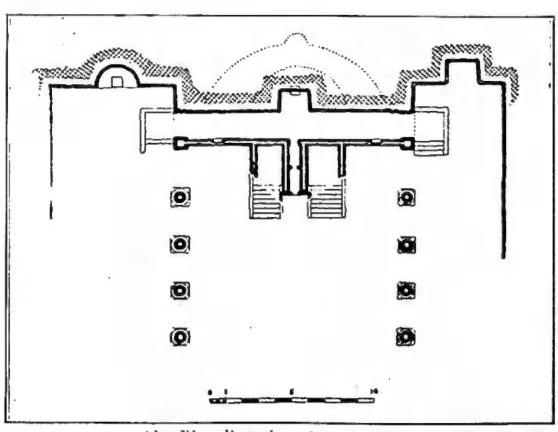
THE CEMETERY OF ST. VALENTINUS. — The martyr was buried in Rome in an open Christian cemetery on the second milestone of the Via Flaminia, where Pope Julius I erected a basilica in his honor. Inscriptions found there attest to the veneration of the martyr from the fourth century onward. The memoria had an apse about 4.40 meters wide, built directly against the embankment, recently identified by the architect B. M. Apollonj-Ghetti. This apse was part of the original memoria, of which three perimeter walls remain; these were largely demolished and replaced by the colonnades of a three-aisled basilica, brought to light in 1888 during the construction of a new road by the Municipality of Rome and described by O. Marucchi. In a third phase, the crypt and raised presbytery were constructed. The crypt walls were revetted with marble slabs, and its entrances were created by opening breaches in the perimeter walls of the memoria and constructing two staircases at the end of the side aisles.

The construction of the basilica is assigned by the *Liberian Catalogue* and the *Liber Pontificalis* (I, p. 205) to Pope Julius I (336–52); the third phase with the crypt is attributed by the *Liber Pontificalis* to Pope Theodore (642–49; I, p. 333), while the *Notitia ecclesiarum* attributes it to Pope Honorius I (625–38; R. Valentini and G. Zucchetti, *Codice topografico della città di Roma*, II, Rome 1942, p. 73). The basilica was later enriched by Benedict II (684–85; *Liber Pontificalis*, I, p. 473), Adrian I (772–95; ibid., p. 504), Leo III (795–816; ibid., II, pp. 9, 20), who also renewed its roof (*ibid.*, II, p. 28), and Gregory IV (827–44; *ibid.*, II, p. 78). In 1905, fragments of a Philocalian letter from a poem composed by Damasus were extracted from the ruins of the basilica; this poem was previously unknown in epigraphic collections (*A. Ferrua, Epigrammata Damasiana*, Vatican City 1942, no. 49, pp. 197–198). In February 1928, a fragment on three lines was uncovered with the text: “... ut esset..., sepulcr... presb(iter) in-stans)”; the lettering and the “presbiter instans” of the third line are identical to the inscription found near the tombs of the martyrs Protus and Hyacinthus in the catacomb of Bassilla, placed there by the priest Theodore (*A. Ferrua, op. cit.*, no. 49, II, p. 199). At the same time, a marble sarcophagus was recovered with a roughly carved front depicting Jesus before Pilate and the *Crux invicta* beneath which two soldiers sleep. Under Pope Nicholas II, the abbot Teubaldo restored the church and monastery, completing the work on February 3, 1906.

Article illustration

The chronicle of the monastery of St. Michael “ad Monam” records the visit made in the 11th century by a pilgrim to the basilica of St. Valentinus (*J. Mabillon, Vetera analecta*, Paris 1723, pp. 350–56). Among the abbeys of Rome, that of St. Valentinus is mentioned by P. Mallio and by John the Deacon (*Ch. Hülsen, Le Chiese di Roma*, Florence 1927, p. 129), but in the Turin Catalogue of the churches of Rome (c. 1320), the church of St. Valentinus outside the gate is described as “sine muris” and “non habet servitorem” (*ibid.*, p. 28, no. 57).

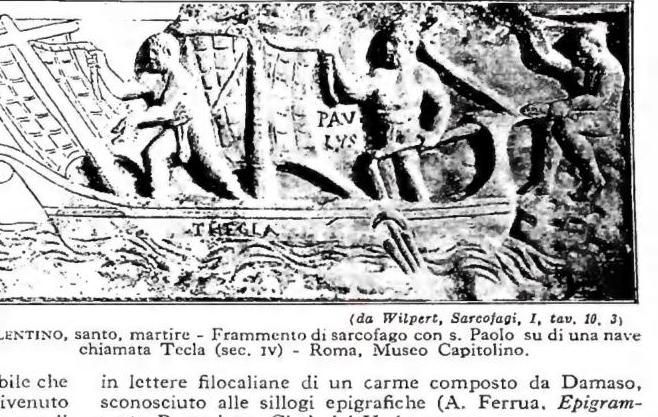
The relics of the martyr appear to have been translated toward the end of the 13th century to the chapel of St. Zeno in St. Praxedes. The remains of the underground cemetery were reconstructed in 1594 by P. Ugonio and A. Bosio, who left a summary description. At that time, they noted an image of Jesus Christ crucified with four nails, his feet resting on a suppedaneum, clothed in a colobium, with the sun and moon above the cross and the Blessed Virgin and the Evangelist John below. In a niche on the opposite wall was a painting of the Blessed Virgin with the Child Jesus and the inscription “Sia Dei genetrix,” of the same type as one Panfilo (v.). On the other walls were scenes reproduced by Bosio, including the Visitation of the Virgin, two scenes from the legend of the midwife Salome taken from the *Protoevangelium of James*, and three figures of saints, including “Ses Laurentius.” After Ugonio and Bosio, the underground galleries were converted into a cellar, and part of the painting of the Crucifixion was destroyed. In 1870, the land previously belonging to the Augustinians was confiscated and sold. In 1877, O. Marucchi entered the underground cemetery and recognized the paintings described by P. Ugonio and A. Bosio. Many inscriptions were found in the above-ground cemetery, including several consular ones dating from 318 to 523. One fragment reads: “ad lomnu(m) V(alentinum... refrigeret) tibi V(alentinus)”; another indicates: “depositus est ad d(omnum Valentinum).” In a metrical inscription of a “Pastor medicus,” one reads: “addetur et tibi Valentini gloria (sancti).” Among the walls of the basilica, a fragment of a sarcophagus was extracted, now in the Capitoline Museum, depicting a ship named “Thecla,” with “Paulus” at the helm. Notable are two epigraphic fragments referring to two deceased persons from Interamna, i.e., Terni: the first is of a “Venerosa who was born in the city of Interamna” in 355 (*O. Marucchi, Le catacombe rom.*, 2nd ed., Rome 1933, p. 610); the second commemorates an “Augurina civis (Internamen)sis” (*ibid.*, p. 625). They, having died in Rome, were buried near the martyr originally from Terni. In the basilica is a marble fragment with the inscription: “semper et ubique devoti.” Some epigraphs, including one recording the purchase of a tomb by the fossor Acillinus, are now in the Christian Museum at the Campo Santo Teutonico.

BIBL.: O. Marucchi, *La cripta sepoltrale di S. V. sulla Via Flaminia rinvenuta e descritta*, Rome 1878; id., *Il cimitero e la basilica di S. V.*, 1878; id., *Di una sconosciuta iscrizione*, 1881 (1905), pp. 103–22; id., *Scoperte di antichità crist. nell’area della basilica suburbana di S. V.*, in *Bull. Comm. arch. com. di Roma*, 5th ser., 55 (1927), pp. 261–67; id., *Ulteriori osservazioni sulle scoperte al primo miglio della Via Flaminia*, ibid., 56 (1928), pp. 119–32; V. FEDERICI, GIACOMO, in *Arch. Soc. rom. di st. patria*, 22 (1899), p. 226 ff.; P. Fr. Kehr, *Italia Pont.*, I, Berlin 1906, p. 257; B. M. Apolloni Ghetti, *Nuove indagini sulla basilica di S. V.*, in *Riv. di arch. cristiana*, 25 (1949), pp. 171–89. Enrico Josi

VALENTINUS THE GNOSTIC. — He came to Rome under Hyginus. He flourished under Pius and remained until the time of Anicetus (*Irenaeus*, III 4, 3; Greek text in Eusebius, *Hist. eccl.*, IV, 11, 1); thus he lived in the first half of the second century in Rome.

According to Tertullian (Adv. Valentian., 4), he would have hoped to become Bishop of Rome. V. was therefore mediocre and, as such, also delivered homilies; he took an interest in worship, for which he composed psalms. It is wrong to see in him only a philosopher. According to a tradition recorded by Epiphanius (Haer., XXXI, 2, 3), V., born in the coastal region of Egypt, would have been educated in Alexandria and spread his doctrine in Egypt and Cyprus (ibid., XXXI, 7, 2). This tradition is of doubtful authenticity. It is not easy to place V. within the history of the Gnostic movement, but the Epistle of V. found in Epiphanius (37, 5, 1 ff.), which forms part of a kind of *kephalaia*, suggests that V. was acquainted with earlier Gnostic speculations and modified his viewpoint. According to St. Irenaeus, his doctrines would be those of the Sephites (Ophites; Haer., I, 30, 1-4). The earlier Gnostic traditions came from an Aramaic environment, as is evident from the text cited by Epiphanius (Haer., XXXI, 2, 8 ff.; cf. the note by Holl). From Hippolytus we learn that V. spoke of a vision in which he saw an infant who revealed himself as the Logos (Pref., VI, 42, 2; cf. also the infant in V.’s psalm, ibid., 37, 7); perhaps a Sephite speculation is presupposed here, which, based on an apocryphal Gospel, related the birth of Jesus to the intellectual light of the star of the Magi (on this speculation cf. the *Chronicle of Zupin*, in U. Monneret de Villard, *Le leggende orientali sui magi evangelici* [Studi e testi, 163], Città del Vaticano 1952). The visionary character of V., which places him alongside the prophets of the earliest Gnosticism, is also revealed in a fragment of a psalm (Hippolytus, *Philos.*, VI, 37, 7), where V. affirms that he saw “in the spirit” the connection between the individual elements of the world.

From a Jewish (or Jewish-Christian) tradition comes V.’s idea that the heart (and not the soul) is the center of the human person. The dwelling of our heart is inhabited by demons (Epistle of V. in Clement of Alexandria, *Strom.*, II, 20, 114 ff.), until it is purified by the “Father,” or by the Logoi, as later tradition will say (Hippolytus, *Philos.*, VI, 34). Analogies for this formulation are found in the *Shepherd of Hermas*. Whether, according to V., Adam, after his creation, became an object of terror for the angels (Epistle in Clement of Alexandria, *Strom.*, II, 8, 36, 2 ff.), or whether V. distinguished between Adam and a prior *anthropos* (man) (ibid.), he likewise bases himself on Jewish traditions.

But besides Jewish or Jewish-Christian traditions, one can observe in V. a polemical engagement with the Encratites. Thus, to a certain extent, he becomes an ally of Clement of Alexandria in his struggle against the Encratites. V. sought to deepen the spirituality of the Encratites while avoiding their dualism, but the phrase “dissolve the world” in one of V.’s homilies (Clement of Alexandria, *Strom.*, IV, 89, 3) is almost certainly an echo of an Encratite formulation in the *Gospel of the Egyptians* (ibid., III, 9, 63). One may therefore say that the Sephite Gnosis and the doctrines of the Encratites are antecedents of V.’s Gnosis.

Outside of the few citations from the homilies, psalms, and epistles of V. (his *Gospel of Truth* [Irenaeus, *Haer.*, III, 11, 3; cf. Ps.-Tertullian, *Adv. om. haer.*, 12], recently discovered but not yet published), the principal source for V.’s doctrine is Book I of Irenaeus’ *Adversus haereses*, supported in part by Hippolytus, who drew on another source. It is surprising that Irenaeus, unlike Clement of Alexandria, did not have original writings of V. himself at hand but relied on commentaries (*Hypomnematia*) of the Valentinians, in which, in their eagerness to form a “system,” the charm of the original intuition was lost.

It is not the place here to enter into the details of this system, but it is interesting that the “Unknown Father” has beside him Silence. One may probably think of Jewish speculation that saw in creation a passage from divine silence (4 Ezra 7:30; Apocalypse of Baruch 3:7). Another interesting point is the manner in which the defection of Sophia (Wisdom) from the Divine Father is recounted. Her *Enthymesis* gave rise to Sophia’s departure from the Pleroma. But the word *Enthymesis* is one of the Greek translations of *jeszer*, i.e., the evil inclination in man. Ultimately, therefore, a Jewish anthropology is presupposed and projected into the world of God (the Pleroma) itself. The defection of Sophia is described as an “extension” (*ekteinin*), followed by a “restriction” (*systelein*) after encountering a barrier called the frontier (*Horos*) or Cross. The idea of the extension and restriction of Sophia is probably V.’s personal interpretation of an earlier Sephite speculation (later also in the Kabbalah) that spoke of the extension and restriction of the divine glory and which also finds reflection in the apocryphal Acts of the Apostles. The doct

![page_608_image_1.png](page_608_image_1.png)