
VISITATION OF MOST HOLY MARY. – Feast of the universal Church, celebrated on 2 July with the double rite of the II class.
The basis of the feast is the historical evangelical event (Lk. 1:39–56), namely the visit which Our Lady made, after the announcement of the mystery of the Incarnation, to Elizabeth, mother of the Precursor, with the brief but wondrous scene of the greeting, which concluded with the Magnificat. The divine Mother then remained in the home of her relatives for about three months.
The episode entered the official practice of the Roman Church when the liturgy of Advent developed there,
that is, as early as the 6th century: the pericope in question was assigned to the Friday of the Ember Days of Advent, but only as a commemoration in preparation for Christmas (Th. Klauser, Das römische Capitulare Evangeliorum, I, Münster in V. 1935).
On the same Roman date of 2 July, the Greek Church celebrates a Marian feast. If the later traditions may be trusted, under the Emperor Marcian (450–57) the wooden chest in which the body of Our Lady was supposedly placed after her death is said to have been brought to Constantinople; this relic was deposited in the church of the Blachernae. The liturgical celebration appears under the title ἡ σοφὸς τῶν βλασιερῶν. But another tradition reduces the same feast to the κατάθησις, that is, the deposition, in the same church, under the Emperor Leo I, in 469, of a garment belonging to Our Lady: according to Metaphrastes, the « maphorion » (= veil), and according to Nicephorus Callistus, the « omophorion » (= scapular). Others believe that the « chest » was nothing other than the precious reliquary in which that garment was enclosed. The Emperor Constantine VI later gave this garment to Charlemagne, and from then on it was displayed at Aachen, especially during the celebrated « Heiltumsfahrt », which is repeated every nine years. Yet Soissons also claims to possess the same garment, brought there from Constantinople in 1204, the year in which the city was conquered by the Latins. An attempt has been made to find another basis for the date of 2 July in the same evangelical narrative. Taking 25 March as the date of the Annunciation, and calculating three months for Our Lady’s stay with Elizabeth, while taking into account that the birth of John the Baptist falls on 24 June, and judging that Our Lady was still present on the eighth day, when the child was circumcised, she would have departed precisely on 2 July, the day after the octave of s. John.
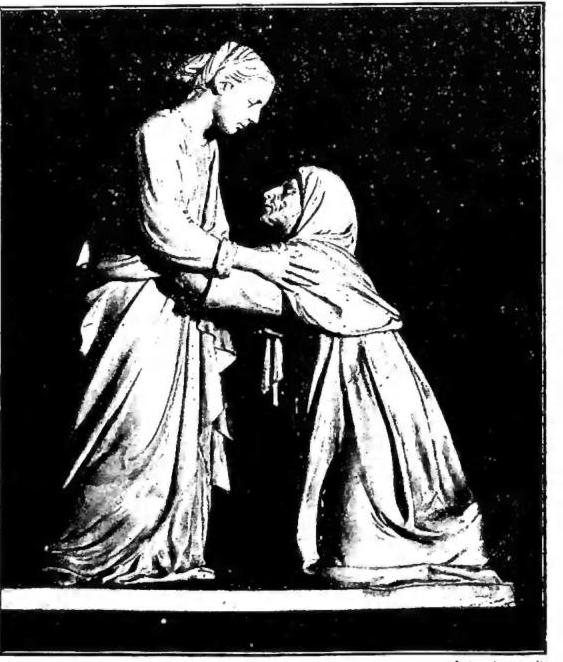
(phot. Annari)
VISITATION of MOST HOLY MARY – The V. Group in glazed terracotta from the school of the Della Robbia – Pistoia, Church of S. Giovanni Fuorevitas.
Among its most fervent promoters was the powerful archbishop of Prague, Giovanni di Jenstein (1388–96), who composed, to implore Mary’s help, a rhymed Office, fixing the feast, for unknown reasons, on 28 Apr.
Urban VI, after the tragic events of his pontificate, decided with the cardinals at the Consistory of 8 Apr. 1389 to introduce the feast on 2 July, with a vigil of fasting and an octave, and also had Cardinal Adamo Easton, bishop of London, prepare a rhymed Office according to the taste of the period. But he died before he could publish the relevant documents (15 Oct. 1389). His successor Boniface IX adopted the idea and, on 9 Nov. 1389, immediately after his election, published the bull Superni benignitas conditoris (Bull. Rom., ed. Turin, IV, pp. 602–604), prescribing the said feast, with double rite, vigil and octave, and extensive indulgences. The Council of Basel, in session XLIII, on 1 July 1441, reaffirmed the bull of Boniface IX (Mansi XXIX, 211–14), but because of the schism part of the Church did not accept the feast. Nevertheless, the Office composed in the name of the Council by Tommaso de Corcellin achieved a certain diffusion. At the ecumenical Council of Florence, on the other hand, under the presidency of Eugenius IV, the Syriac, Maronite and Coptic patriarchates accepted the feast, which they still celebrate on the Roman date. Nicholas V, with the bull Romanorum gesta Pontificum (26 March 1451), republished the bull of Boniface IX in full, with the intention of inducing all particular Churches unanimously to accept the feast (Bull. Rom., ed. Turin, V, pp. 106–107). Sixtus IV, a Franciscan, introduced into the Franciscan liturgical books (1475) a new proper Office with an octave, dedicating his church of S. Maria della Pace to the mystery of the V. Pius V, in the general reform of the Roman liturgical books, abolished the various offices and Masses in use for the said feast, nor did he remove the vigil and octave; he adopted the Office of the Nativity of Mary, with a few necessary modifications and with other lessons. From then onward the date of the feast was uniform, whereas previously it was celebrated, for example, in Paris on 27 June, in Reims and Geneva on 8 July, in Prague and Regensburg on 28 June, in Avranches on 1 Apr., in York on 2 Apr., etc. Finally, Clement VIII, in the new reform of the liturgical books (1602), when he raised the feast to the new rite of double major which he had introduced, had the Office of the Visitation revised by the Minim Father Ruiz; proper antiphons and responsories were then added, the lessons were moved and introduced, and after this the Office assumed the form it still retains. Pius IX, after the period of the Roman Republic, which ended precisely on 2 July 1849, raised the feast to the double rite of the II class, which it still retains (decree Quam Sanctissimus, 31 May 1850).
In the 12th century, the type of the very simple scene with the two ladies had already been established, as can be seen in a marble high relief in the Bishop’s Palace of Pano, on a panel of the lateral bronze door of the cathedral of Pisa, the work of Bonanno, datable to around 1180, and on the paschal candlestick of the cathedral of Gaeta, where an angel witnesses the sacred scene. The V. painted among the lateral scenes of the paliotto of S. Giovanni follows the same pattern; this is a work in a Byzantine manner from the first two decades of the 13th century, preserved in the Gallery of Siena.
Depictions of the late Middle Ages are usually enriched by the presence of two maidservants behind the Virgin and s. Elisabetta respectively. The
oldest depiction of this type is seen among the enamels of Eilsberto’s portable altar, a work of German goldsmithery datable to between 1150 and 1160; in Italian art, in one of the scenes of the mosaic vault in the Florentine Baptistery, executed around 1270, in Giotto’s Scrovegni Chapel in Padua, and again in the V. Siena, the work of Niccolò Pisano with assistants, from around 1268, as well as among those of the pulpit of the cathedral of Pisa, the work of Giovanni Pisano, from the early 14th century, and among the bas-reliefs of the façade of the Cathedral of Orvieto, attributed to Lorenzo Maitani and executed between 1320 and 1330. A beautiful depiction of the same type is also found in the cathedral of Pistoia, on a panel of the silver paliotto made in 1368 by Andrea di Jacopo d'Ognabene.
In some 14th-century depictions of the v., due to Florentine art, only the maidservant accompanying the Virgin appears. Thus Andrea da Pontedera did in a panel of his door of the Florentine Baptistery, cast in bronze in 1336, and Taddeo Gaddi in a small painting executed around 1340, now in the Museum of the Academy of Florence. In about 1440, in the predella of the Annunciation of Cortona and in that of the Annunciation of Montecarlo at S. Giovanni Valdarno, Beato Angelico followed the scheme with the two maidservants; so did his pupil Zenobi Strozzi in the predella of the Annunciation, now in the Prado in Madrid. Transalpine late Gothic art did not usually paint the maidservants; thus in the panel by an anonymous 15th-century master of the Swabian school, in the Civic Museum of Vipiteno, and in that by Rogier Van der Weyden, in the Museum of Turin.
It was the Renaissance that introduced changes into the scene, first of all in the attitude of s. Elisabetta, who is often seen kneeling before the Virgin: as in an enameled terracotta by the Della Robbia school on an altar in Pistoia, and in Domenico Ghirlandaio’s painting of 1491 (Louvre, Paris), where two maidservants are still visible. But around 1500 they were replaced by a sumptuous retinue. A fresco by Ghirlandaio (around 1490) in the major chapel of S. Maria Novella in Florence foreshadows this arrangement. In Pinturicchio’s fresco in the Borgia Apartment, completed in 1497, the Virgin is accompanied by s. Giuseppe. The same occurs in the window by Guglielmo de Marcillac, in the choir of S. Maria del Popolo in Rome. In the V. attributed to Andrea del Sarto (Spada Gallery in Rome), the scene is set in a square, as also in Vittore Carpaccio’s panel, in the Museum of Venice. Pontormo, in the fresco painted in 1516 in the cloister of the Voti of the S.ma Annunciata in Florence, and Sodoma, in the one painted around 1530 in the oratory of S. Bernardino in Siena, made the V. ceremony; they were followed around the middle of the 16th century by Francesco Salviati in the fresco of the oratory of S. Giovanni Decollato in Rome. By contrast, the work of the Florentine Mariotto Albertinelli, now in the Uffizi and painted in 1503, recalls the concise medieval figurative model. A reworking of it, with a representation of the Annunciation in the foreground, was executed a few years later by the Sienese Girolamo del Pacchia, now in the Gallery of Siena. In the same Gallery of Siena there is a fine V. by Giacomo Pacchiarotti, set against the background of a magnificent Roman arch placed in perspective and witnessed by six different saints grouped at the sides. In the same Gallery of Siena there is also another V. by Pacchiarotti, with two maidservants, painted in the central part of a triptych in which s. Gioacchino stands beside s. Elisabetta.
Depictions of the V. from the late 16th century sometimes convey an image of poignant contemplation: noteworthy is Barocci’s altarpiece in the Chiesa Nuova in Rome. An exquisite 17th-century work for its gentle quality as a genre scene is the V. painted in a picture in the Borghese Gallery, formerly attributed to P. P. Rubens (from around 1630), now considered to be by his pupil Martin Mandrekens. — Vedi tav. CL.