
PONTORMO, JACOPO CARUCCI (CARRUCCI), known as Il. - Florentine painter, b. 24 May 1494 near Empoli, d. in Florence in 1557. Son of Bartolomeo di Jacopo di Martino Carrucci, a pupil of Ghirlandaio whose works are unknown, Jacopo went to Florence around 1507 and, according to Vasari, was first at the school of Leonardo da Vinci, then with Albertinelli, Piero di Cosimo, and Andrea del Sarto. In reality, Pontormo cannot be said to have been a pupil or follower of any one master in particular, if one considers the multiplicity of aspects and the discontinuity of development evident in his works.
While a small Annunciation he painted in 1508, which reveals him as a child prodigy praised by Raphael, has been lost, and only a pale memory remains of the papal coat of arms of Leo X executed on the door of the Annunziata church in 1513, around the same year date the small Monochrome Stories of a Holy Nun (Florence, Accademia), where alongside memories of Albertinelli and Andrea del Sarto one senses an uneasy and incisive Pontormesque vision, even in the strange intensity of hallucinated gazes. Less significant, with clear recollections of Raphael and Andrea del Sarto, is the fresco (Florence, SS. Annunziata, Capella di San Luca; 1513) representing the Madonna and Saints. More important, however, is the fresco of the Veronica (1515; Florence, Convento di Santa Maria Novella), which reflects elements drawn from Andrea del Sarto, Leonardo, and Michelangelo, interpreted in a strong, plastic, and dynamic manner; theatrical yet rigorous in effect.
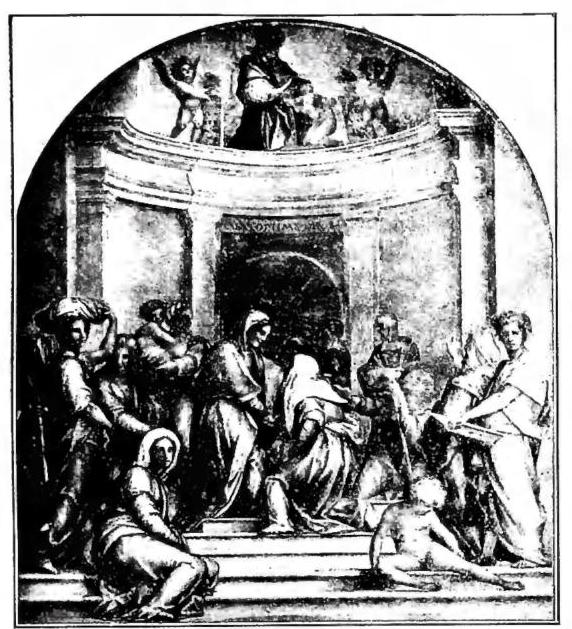
The chiaroscuro and spatiality of Andrea del Sarto, together with recollections of Raphael and Fra Bartolomeo, are recalled in the fresco of the Visitation (Florence, SS. Annunziata; 1516), where a composite classical equilibrium is maintained. The altarpiece of San Michele Visdomini (Florence, 1518) instead manifests Pontormo’s mannerist crisis, that is, the search for almost expressionistic modes, both in the elongated proportions of the figures and in the study of emotions and movement. The frescoes at Poggio a Caiano (1519–20), studied in numerous drawings (Pontormo was a great draftsman), document the artist’s anxious critical stance, yet the pictorial realization is frank, like an oasis of rare summer serenity. Then Pontormo’s restlessness reasserts itself through new problems of interpretation, as in the frescoes of the Certosa (Galluzzo, Florence; 1523–25), which presuppose a study of Dürer, if not directly, then through his prints, which had been circulating in Italy for several decades.
In Dürer, Pontormo saw a humanity psychologically and religiously penetrating; and in terms of form, certain chromatic and inventive abstractions that stimulated his anticlassical and intellectualistic tendency, yet remained distinctly drawing-based and, in details, vividly realistic. The Stories of the Passion at the Certosa thus evoke a strange, disconcerting world. But once the immediate contact with German art had been overcome, the Dürerian suggestions, resolved into a subtle rhythm woven of linear motifs, precious luminous qualities, and refined chromatic relationships, enabled Pontormo to attain moments of the highest order, as in the Annunciation and the Deposition in Santa Felicita (1526–28; Florence), and in the Visitation at Carmignano (1528–30). The so-called Halberdier, in the Fogg Museum of Cambridge (U.S.A.), also belongs to the Dürerian period. Among the portraits by Pontormo, always most noble, aristocratic, and spiritual, are noted: that of a student (Milan, Castello Sforzesco; 1522); that of a gentlewoman in Florence (Uffizi); that of Cosimo the Elder (ibid.; ca. 1523); and that of a gentlewoman in Frankfurt (Städel Museum; ca. 1540). Numerous drawings survive, especially the important group at the Uffizi. - See pl. CXVIII.