
LEONARDO DA VINCI – Self-portrait. Drawing – Turin, Palazzo Reale.
Codice Atlantico: military engineering, the construction of weapons, architecture, sculpture, painting, and the bronze horse, that is, the monument to Francesco Sforza. On 25 Apr. 1483 he undertook, together with the brothers Evangelista and Giovanni Antonio De Predis, the execution of the altarpiece for the chapel of the Confraternity of the Immaculate Conception at the church of S. Francesco: questions of price and payment dragged on for a long time; in one of the documents the painters state that the central panel with the Virgin (later called the Vergine delle rocce) is the work of L.; in 1508 the agreed payments were concluded. Probably between 1506 and 1508, with or without the consent of the commissioners, the copy now in London was made; in any case, L.’s participation in it was limited. The original soon went to France (according to tradition, during the time of Francesco I), while the copy went to England in 1785 (it entered the National Gallery in 1890). It is known from several sources that he painted the portrait of Cecilia Gallerani when she was still «in an imperfect age», as Cecilia herself wrote to Isabella d’Este in 1498. Later he painted the portrait of Lucrezia Crivelli. The subsequent history of neither portrait is known, and every identification of them is now conjectural.
He must soon have begun studies for the monument to Francesco Sforza; L. himself writes: «on 23 April 1490... I began the horse again»; in Nov. 1493 it must have been well advanced. From studies for the casting or transport, it can be seen that the horse was walking, with its left foot raised. It measured more than 7 metres at the withers and therefore presented enormous casting difficulties, which L. was ill-suited to overcome, given his limited experience in this field. He lost years; in 1499 il Moro fled before the French troops, and the mould was «made a target for Gascon crossbowmen»; nevertheless, Ercole I in 1501 asked to purchase II. His request was not granted, and shortly thereafter it must have been completely destroyed.
From the reports of contemporaries and from documents, it is known that the Cena in the refectory of S. Maria delle Grazie was completed between 1497 and 1498, after a long and discontinuous period of work. It is also established that L. worked in the Castello Sforzesco on the decoration of the «Saletta negra», of which no trace remains; that he worked on the dome of Milan Cathedral and repeatedly on Pavia Cathedral, on the staging of spectacles, and so forth. Most of the drawings of canals, war machines, mechanics, engineering, and so on date from these years. From 1497 he received an annual pension of 2,000 ducats. He did not flee before the French invasion; indeed, it was then that he first came into contact with French dignitaries. In any case, at the end of 1499 he went to Mantua, where he made a drawing-portrait of Isabella d’Este, and then to Venice; in Apr. 1500 he was in Florence.
From a letter by L. da Novellara to Isabella d’Este, it is known that in Apr. 1501 he had already completed the cartoon for the panel depicting the Madonna con s. Anna, now in the Louvre; he had two pupils with him who painted under his direction and with his collaboration. In Oct. 1503 he began work on the Battaglia di Anghiari for the Hall of the Council (Palazzo Vecchio): he executed the cartoon with great energy; in 1505 he began the painting, unfortunately using a strange technique, a pseudo-encaustic method of which he had conceived the idea from Pliny, with abundant use of Greek pitch. The painting failed to dry and «ran»; nevertheless preserved for decades, it was destroyed during the redecoration of the hall after 1550, and the cartoon, though greatly admired and extensively studied, was also dispersed. In 1506 L. was in Milan (settlement of the dispute over the Vergine delle rocce), by then fully established in the circle of the new French rulers; in 1507 and 1508 he was in Florence, in 1509 in Milan, and in 1513 in Rome, in the service of Giuliano de’ Medici, brother of Leone X. He certainly remained there throughout the summer of 1516; during this Roman period he was little sought after as an artist: the most important commission entrusted to him concerned hydraulics, namely the study of the reclamation of the Pontine Marshes.
Between the end of 1516 and the beginning of 1517 he moved, taking with him paintings, manuscripts, and drawings, to Amboise, to the Château of Cloux; he received a generous pension from the King of France and was, we must suppose, surrounded by great esteem, although by then, paralysed in his right hand and prematurely aged, his artistic activity seems to have been reduced to drawing and the direction of his pupils, among whom was the deeply trusted Francesco Melzi. To him, in his will of 23 Apr. 1519, he left his manuscripts and drawings; it fell to him to notify L.’s brothers that «such a man... passed from this present life on 2 May (1519), with all the rites of Holy Mother Church and well disposed... May Almighty God grant him eternal rest».
II. THE ARTISTIC WORK
We have no document or information concerning the Annunciation that arrived at the Uffizi in 1867 from S. Bartolomeo at Montoliveto (Firenze); concerning it, even if only gradually, a nearly unanimous recognition has been reached in recent decades that it is L.’s first important and individual work: Verrocchiesque is the exceedingly elaborate lectern of the Virgin, but in her very figure there is a regularity and sweetness of features, a simple, spontaneous, yet monumental posture that do not belong to the master; the angel is painted in less bright, warmer colours, both in the garments and in the face, whose modelling is exceedingly gradual and whose formal definition possesses supreme intensity and elegance; the landscape, seen from above, is extraordinarily intricate, its geological and vegetal elements carefully studied, the forms becoming blue with the greatest subtlety and merging into one another in the distance.It is, however, reported in Vasari’s Vita, and even earlier, that L. coloured an angel in A. Verrocchio’s Baptism, now in the Uffizi; evidently the head of the first of the two angels is by L.; but, as had been conjectured and as radiographic examinations have shown, the landscape too, with its pattern of great rivers and waterfalls among sheer mountains, is a repainting, and evidently by him; nor, in this picture of troubled and uneven execution, can it be ruled out that L.’s brush passed over other parts as well. Also belonging to this Verrocchiesque period is the Madonna and Child in Munich, whose attribution to L. has likewise gained acceptance in recent decades (Berenson and A. Venturi, initially opposed to it, R. Longhi, etc.). The small Annunciation in the Louvre is now likewise generally regarded as L.’s. One of the two Virgins Mary begun in 1478 may be recognized in the not perfectly completed Benois Madonna (Leningrad), in which the Child’s lively and perceptive action, as he struggles to fix his gaze on the flowers in his hand, the easy, self-contained grouping, and the characteristic types and movements recall drawings from those years; whereas after the Annunciation of the Uffizi it is reasonable to place the Portrait of a Woman against a Background of Juniper Branches from the collection of the Prince of Liechtenstein, in which the portrait of Ginevra Benci (b. ca. 1458), mentioned as L.’s as early as by the Anonimo gaddiano, is to be recognized: a figure of great nobility of posture, of exceedingly gradual definition, and extraordinarily alive in every feature.
L.’s greatest work of the Florentine period is the Adoration in the Uffizi, abandoned when only the first layers of colour had completed the drawing and partially provided an initial chiaroscuro and initial modelling to some of the figures: the traditional hut, gradually eliminated in the preparatory drawings, has now become a tumultuous and admiring crowd around the melodious, closely gathered group of Mary and the Child, against a background of parts of classical architecture, stripped of every decoration and perspectivally perfect; beyond lies the mountainous landscape dear to him. The purity, energy, and character of the figures are impressive. The populous yet perfectly ordered vastness of the scene is incomparable. The S. Girolamo in the Vatican Pinacoteca must belong to these same years; it too was abandoned very soon, yet the head is powerfully characterized. In the Virgin of the Rocks, the most complex completed work to have come down to us without excessive damage from time, we again find, with an inventiveness new to Italian art, his repertory of geological and botanical details; in the group of the four figures (s. Giovannino, Maria, Gesù, and the Angel) there is an exceptionally intimate and harmonious connection; in the Virgin, the unfinished type of the Florentine Adoration is fully realized; in the children, a feeling is achieved at once of vivacity and extraordinary concentration: nudes already powerful, classically euphoric, yet tenderly apprehended in the character of earliest childhood; the angel’s head is of great beauty. The shading is still softer than in the Florentine paintings and extends over somewhat more of the bodies; that is, the characteristic Leonardesque sfumato is already present, and it should be particularly noted that it serves to define the form itself down to its most subtle details.
It is not rash to recognize in the young Woman with an Ermine of the Czartoryski collection in Cracow the portrait, from the early Milanese years, of Gallerani.
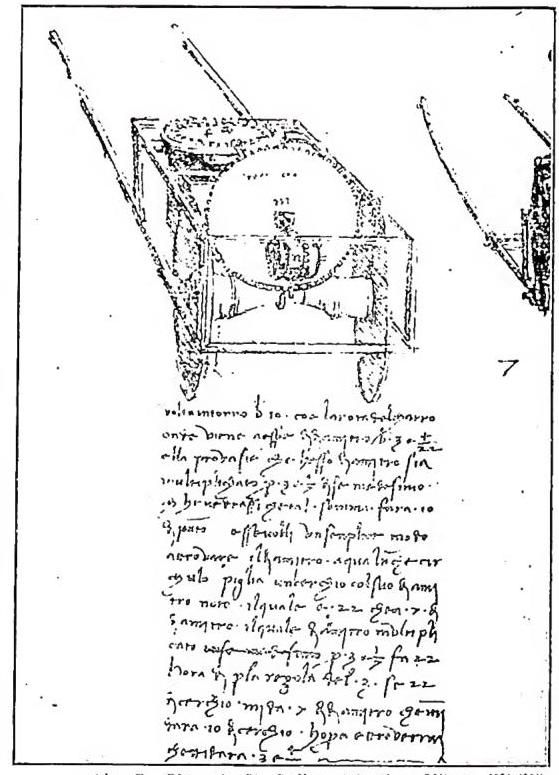
(from G. Piumati, Il Codice Atlantico, Milano 1851-1891)
LEONARDO DA VINCI - Cogwheel - Milan, Biblioteca Ambrosiana, cod. Atlantico, fol. 1°, fig. 3°.
The catalogue of L.’s works, which in his youthful period cannot always easily be distinguished from those of Verrocchio and Lorenzo di Credi, and which later, as has been seen, benefited from the collaboration of pupils, includes other works of less evident stature: such as the so-called Belle
(Anderson photograph)
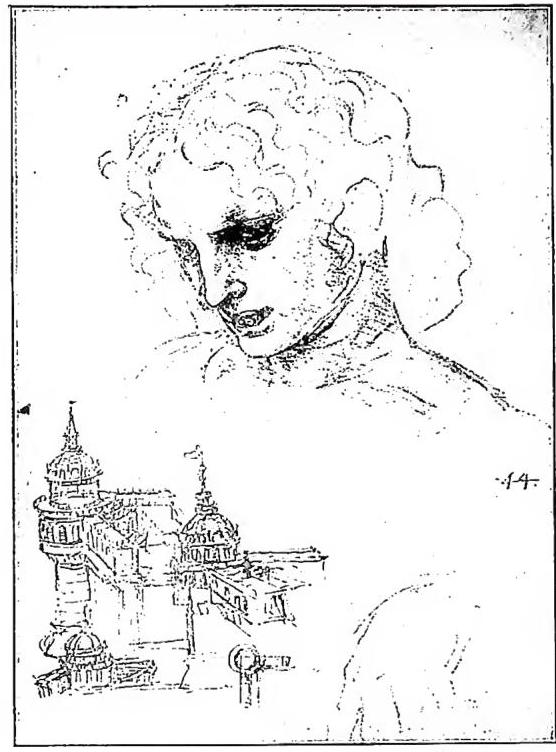
LEONARDO DA VINCI - Study for one of the Apostles of the Last Supper of S. Maria delle Grazie. Below: pen sketch of architecture - Windsor, Royal Library, f. 12552.
The Louvre Ferronière; the S. John the Baptist in the same Museum; the Madonna Litta of Leningrad; the Dishevelled Woman, a sketch in the Pinacoteca of Parma attributed to L. by A. Venturi; the Madonna with Child Duveen (formerly Dreyfuss), etc. The original fragments of the talented and interesting decoration with branches, leaves, and knots in the Sala delle Assi (Castello Sforzesco) disappeared when it was imitatively recreated in 1901; just as by now the portraits of Lodovico il Moro, his wife, and the added children, opposite the Last Supper and Montorfano’s Crucifixion, have almost entirely disappeared.
Of the greatest importance for L., as for no other painter of the Renaissance, is the body of drawings (of which, apart from those that are purely scientific, several hundred sheets have come down to us): notes for machines and architecture; extremely rapid sketches from life of animals, human figures, gestures, groupings of figures, and elements of landscape, often modulated, with an ever-increasing search for expressiveness and melodic ease of line, several times on the same sheet; studies of anatomy and botany; often exquisitely finished heads, executed to perfection; drawing activity in preparation for his paintings, in order to try out and clarify their conception, or without concern for a subsequent pictorial execution, for the sheer joy of fixing an impression and a memory, or as commentary on his writings: an immense, wondrous figurative diary. The expressive and evocative power of his most rapid drawings may be said to be unique in the art of every time and place; while the sense of modelling and light that he achieves in his fully executed drawings is unsurpassed.
The reconstruction of L.’s sculptural work, on the other hand, is entirely conjectural and is based partly on distinguishing, within Verrocchio’s sculpture, works that, by virtue of a new sensibility and refinement, are plausibly those of the great pupil, and partly, for the subsequent periods, on identifying works in which there is an evident and greater use of Leonardesque motifs: among the latter is the highly lively little bronze Horse in the Museum of Budapest, which is connected with a type and conception of the horse that persisted in L. for a long time.
In the Florentine art of the period of his early youth, L. grasped the energy and vitality of the line, the complex modulation of groupings, and the tireless modelling of great illusion; and he brought all these values to a higher degree in expressing a world of his own, dominated by wonder and tranquil joy at the emergence and materialization of things into life. This was consequent upon an entire cast of mind of his, known to us from his writings. Giorgio Castelfranco
III. L. ARCHITECT. — In his letter of introduction to Duke Ludovico il Moro, after speaking of his art as a military engineer, L. added: “in peacetime I believe I can satisfy admirably in comparison with anyone else in the design of public and private buildings, and in conducting water from one place to another”; yet he has left us no completed architectural works that can be unequivocally attributed to him.
Nevertheless, there are very numerous drawings by him in which not only his architectural tastes are clearly defined, but also, very often, the elements necessary for their practical realization. In other words, these are not architectural fantasies, but genuine architectural projects, reflecting not only his ability to assimilate and elaborate stylistic data gradually acquired and variously developed, but also his taste as a practical experimenter and his mechanical interest in utilitarian solutions. These are drawings ready to be translated into models of houses, palaces, stables, laundries, fortifications, and above all churches, with complex centralized structures and one or more domes, in which there is also evidence of a sustained spatial investigation pursued essentially through a continuous interplay of shadows and light generated by the centralized or opposing masses, the vital forces of the structural organism.
The great models of Roman and fifteenth-century Florentine architecture, above all that of Brunelleschi, form the foundation of his architectural culture, which nevertheless soon turned toward the Lombard tradition, into which he inserted his name with the greatest authority alongside that of Donato Bramante, who undoubtedly knew and developed in his works some of L.’s ideas. Thus, some of his ideas were probably employed in the construction of Pavia Cathedral, while others were developed by Cristoforo Solari in the presbyterial area of Como Cathedral. On the other hand, when contemplating the beautiful S. Maria della Consolazione at Todi, whose conception is generally attributed to Bramante and whose execution is owed in large part to Cola di Matteuccio da Caprarola, it is still the great name of L. that most insistently comes to mind. Emilio Lavagnino
IV. SCIENTIFIC STUDIES
Throughout his life, L.’s interest in the natural and biological sciences—cultivated through reading, observation, experiments, etc.—was exceptionally great and persistent, arising from a desire for knowledge that was at once encyclopedic and unified.1. Geology
Among his statements most admired as anticipations of modern science are those concerning the movements by which lands submerge and emerge; hence his explanation of the presence of shells, fish skeletons, and fossil algae in stones and emerged lands. In this he had received his initial direction from Greek (Aristotle) and medieval science; in any case, he follows with great clarity the fossilization of organic remains coagulated in the “slime,” which, rising, becomes petrified and incorporates them. He studied the geological history of the Valdarno, which he believed originally consisted, from Gonfolina (the gorge between Lastra a Signa and Montelupo) upward, of two lakes, while below Gonfolina there had already been a sea; he asserted the alluvial origin of the Po Valley, and also discerned geological changes in remote regions (Persia, Syria, etc.). He paid the utmost attention to the effectsof meteorological agents, to the appearance of rock formations, on which he dwells in numerous drawings, and to the formation of clouds, rains, storms, floods, etc. It should not be forgotten that he was a good topographer and cartographer (maps of Tuscany, the Pontine Marshes, Imola, etc.) and an uncommon excursionist, especially in the Lombard Alps (Monte Rosa).
2. Botany. — As a botanist, in addition to possessing extensive morphological knowledge, he raised several new problems in plant biology: that is, he was the first to observe and define the arrangement of leaves in relation to their insertion on stems and their branching (phyllotaxis); he made observations on the absorption of water by plant roots, on the structure of trunks in concentric layers, from which the age of the plant can be deduced, etc.
3. Zoology. — With regard to his work as a zoologist, anatomist, and biologist in general, it has not yet been clearly distinguished what he owed to the scientific culture of his time from what were his genuine discoveries. He practiced the dissection of human bodies extensively and assiduously, and also, to a lesser degree, that of animals; he produced a very large number of anatomical drawings (using several sections for a given organ), generally with an accuracy exceptional for his time; he employed the method of injecting solidifiable liquids into hollow organs, especially the brain, and devoted particular attention to the anatomy and functions of the brain (and of the associated nervous system), the heart, and the eye. Among animals, he studied the horse better than anyone else, especially in connection with the Sforza monument, although there are groups of drawings certainly made from life of horses in free movement, not studies preparatory to this work.
Giorgio Castelfranco
4. Geometry. — Given the remarkable perfection of the elements set forth by Euclid and Archimedes, L. had no occasion to dwell on fundamental questions; rather, he developed criteria for applying geometry to the solution of problems in the various sciences, beginning with purely geometrical ones, such as the quadrature of lunes and the volumetric equivalence of different solids, and extending to the more complex problems of mechanics. He also devised an entire series of geometrical instruments, such as the proportional compass, the compasses for drawing ellipses and parabolas with continuous motion, and the oval lathe for drawing and, when necessary, engraving given ellipses on a rotating disk with a special stylus; all had a structure analogous to that of instruments and tools still in use today.
5. Statics. — Statics, which concerns the construction of buildings, domes, bridges, etc., and the simple instruments required for these purposes, had been studied extensively by the ancients, and L. certainly knew the works of Aristotle, Archimedes, Heron, Vitruvius, and the more recent work of G. Nemorarius; L. reworked and extended many concepts, in particular the fundamental concept of the moment of a force with respect to a point, which he applied in very numerous cases and especially to the study of the so-called simple machines—inclined planes, screws, pulleys, block and tackle, etc.—drawing conclusions rediscovered shortly afterward by Guido Ubaldo del Monte. L. also made notable advances in the consideration and determination of the centers of gravity of geometrical figures (tetrahedra, round and polygonal pyramids, etc.) and of real bodies, distinguishing them into three types—natural, accidental, and volumetric—which correspond precisely to those still considered by modern technology. Likewise, by completing G. Nemorarius’s considerations on the resolution of the force (weight) of a heavy body supported by a cord suspended between two points, with the determination of the tension in the two branches of the cord itself, he was the first to arrive at the reciprocal notion of the preceding one, namely, the notion of the composition of any two concurrent forces. Similarly, after deriving from problems posed by Aristotle the fundamental condition for the stability of the balance, L., through a bold generalization, arrived at the discovery of the condition for the stability of any body resting on a plane: namely, that the vertical line passing through its center of gravity must fall within the polygon drawn between the outermost points supporting the body itself.
6. Dynamics. — Dynamics, regarded by the ancients as less useful and interesting than statics and incorrectly conceived and formulated by them, began shortly before L.’s time to arouse greater interest as a doctrine necessary for the study of the motion of projectiles; but the lack of reliable earlier studies was immediately felt. L. arrived at the first sufficiently precise notions of several of the necessary elements, namely force, percussion, and impetus, and, through his simple definition of force, directly opposed Aristotle with regard to the motion of projectiles and arrows, firmly asserting that the medium (air) not only does not assist it but actually slows it down and shortens its range. L. must have reflected deeply on these questions, rendered difficult by widespread erroneous preconceptions supported by the authority of Aristotle, and it was thus that he arrived at the notion we now call the inertia of material masses; his statements, as well as the body of his considerations, leave no doubt on this point: «Ogni moto attende al suo mantenimento, ovvero ogni corpo mosso sempre si move, in mentre che la potentia del suo motore in lui si riserva» and «Ogni moto seguirà tanto la via del suo corso per retta linea, quanto durerà in esso la natura della violenza fatta dal suo motore». Thus the first of the three classical laws of motion was definitively established. L. did not, however, succeed in clearly deducing the second, which we now call the Galilei–Newton law, whereas he had a clear conception of the third, concerning the equality of action and reaction. Yet, despite his not having a complete knowledge of the laws of motion, L. succeeded in establishing many of the characteristics of the phenomenon of the free fall of bodies: the proportionality between the velocity attained and the time elapsed; the independence of this velocity from the body’s weight; and the eastward deviation of falling bodies (owing to the Earth’s rotation). He was also able to determine the ratios between free fall and fall on inclined planes, and to observe that falling along given sections of curves is always slower than falling along the corresponding chords.
(by courtesy of Prof. V. Morioni)
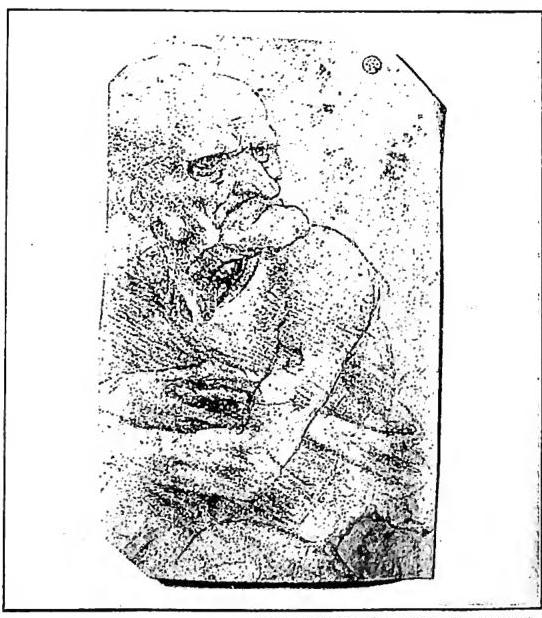
LEONARDO DA VINCI - Caricatural drawing - Rome, Cabinet of Prints and Drawings.
fixed at both ends, and to beams supported at their ends, determining for the latter also, in part, the law of bending under a central load. For carrying out the necessary measurements and for experimental checks, L. devised various apparatuses, among them a testing bench for the tensile strength of metal wires. The accurate drawings of these devices, made about 450 years ago, display a surprising resemblance to those of analogous modern apparatuses.
8. Science of building and mechanical constructions
L. undoubtedly had a clear idea of what this difficult discipline should be, often setting itself antithetical aims such as the strength of constructions and economy of materials. Indeed, he attempted an initial theory of the circular arch, already used since the remotest times, both with and without a tie-rod, recognizing its thrusts and its critical points, or points of greatest stress, even under asymmetrical loads. Considering the contrast between the strength of the complete arch and the weakness and instability of the two halves that constitute it when taken separately, he calls the arch “a fortress caused by two weaknesses.” The devices devised by L. to facilitate major constructions, to raise great weights, to facilitate excavations, etc., are extremely numerous. His studies on friction are likewise very interesting; he distinguishes sliding from rolling friction, and experimentally determines, on special testing benches, certain laws governing them, by criteria analogous to those still employed three centuries later by C. A. Coulomb in his classical researches.9. Fluid mechanics
In his very numerous hydraulic works, especially in Lombardy, L. evidently does not content himself with following the ancient empirical rules resulting from similar works carried out over the centuries, but seeks to understand as fully as possible everything concerning the statics and dynamics of fluids (liquid or gaseous). In hydrostatics he enunciates the fundamental principle, which he applies to communicating vessels containing liquids of different densities, and gives the correct interpretation of the hydrostatic paradox. In the dynamics of flowing water, L. arrives at the fundamental principle of constant discharge, which states that, in a watercourse of varying cross-sections under steady conditions, velocities are everywhere inversely proportional to the cross-sections. Concerning gases, L. had correct ideas about compressibility and weight. He was the first to interpret the flight of birds on the basis of the displacement of the air beneath wings moving, relative to the surrounding air, with sufficient velocity, noting the interesting fact that this velocity must be greater than that of the escaping air. L. also enunciates the general principle now called that of aerodynamic reciprocity.10. Physics
L. certainly knew the other branches of the physics of his time as well, though he concerned himself with their further development only incidentally; he made extensive use of them, however, in solving the numerous problems that presented themselves to his mind. Thus, from the reflection of light upon a spherical surface he derived a noteworthy interpretation of the ashen light of the moon; and from knowledge of the camera obscura, already known to the Arabs, he was led to discover in every eye a small dark chamber, now regarded as the primary element of all vision. He was also interested in the interpretation of light,which he admits propagates through air and ether by waves analogous to those of sound, at first instantaneously and then almost instantaneously.
11. The inventions of L., that is, his new and complex discoveries capable of achieving specific practical results, are incredibly numerous and varied: from certain machine tools analogous to those reinvented in the nineteenth century, to every kind of lifting apparatus; from improved canal locks to swing bridges; from drills and boring machines driven by gears to rolling mills; from chimney caps turning according to the wind in order to prevent the return of smoke, to roofs with movable vanes on windmills; from chains now called Galle chains, such as those now used on bicycles, to compass suspensions reinvented by Cardano; from printing presses to mechanical roasting-spits, etc. Numerous, too, are L.’s studies of military interest, from those concerning assaults upon fortresses to those relating to windlass-operated cannon and machine guns.
12. The problem of mechanical flight long occupied the mind of L. and was often regarded as one of his utopian
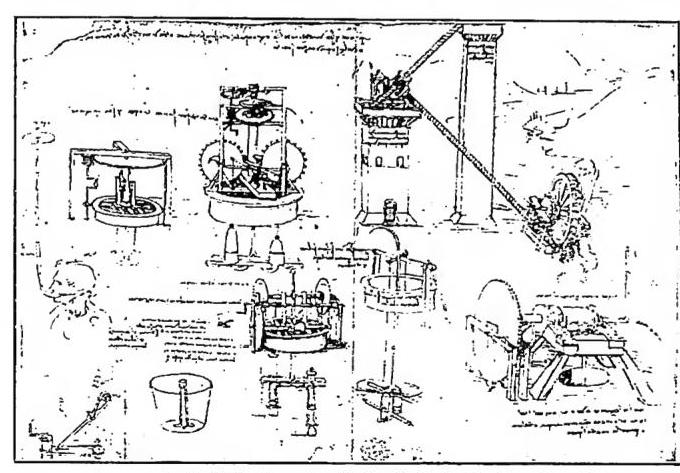
LEONARDO DA VINCI — Study in hydraulics. Suction pumps and apparatus for underwater breathing, interspersed with notes concerning pumps — Milan, Biblioteca Ambrosiana, Codex Atlanticus, fol. 380 r b.
fixation: a judgment that the achievements of this century proved rash. It is true that L. could not have the satisfaction of ascertaining any practical result from his ideas on flight; but today we know that what was essentially lacking was not knowledge of the phenomenon of sustentation, which he was in fact the first to interpret fairly correctly, but the impossibility of having at one’s disposal the necessary dynamic power, or, in more popular language, an engine sufficiently powerful and light. Some express their surprise that L. did not immediately understand the futility of his efforts, given that impossibility. But in order seriously to appreciate the difficult question, one must consider that the problem of flight involved two kinds of difficulty: that of understanding whether and how a heavier-than-air body could fly mechanically; and that of providing it with the necessary mechanical power. Birds, heavier than air, fly, and today we know that they fly very economically in relation to their expenditure of energy. It was therefore logical to seek to imitate them. But man does not possess within himself the devices necessary for sustentation, and must procure them artificially: in other words, in order to fly he had to carry with him in flight the requisite supporting organs and therefore have at his disposal dynamic power far greater than his own. Nature has endowed birds with a strength, relative to their weight, greater than that of men; yet it is scarcely sufficient for them to take flight; once in flight, the perfection of the wings provided them by nature enables them to remain aloft with little expenditure of strength: but it is well known that large birds, even eagles, cannot begin their flight unless they have before them a certain free space which they traverse, also helping themselves with their feet. This being granted, one understands why L. did not immediately intuit the necessity of powerful auxiliary engines; the problem involved solving a question no longer qualitative but quantitative, physical and physiological, for which it was necessary to have recourse to the universal principles of conservation, of which an exact notion was acquired only about the middle of the last century. With countless other devices for flight, L. sketched