
LEONARDESCHI. — If by this term one were to understand all the artists who drew inspiration or motifs from the master’s great models, making use of them to the point of imprinting new aspects upon their own artistic expression, the scope would have to be extended far too broadly, since Leonardo’s painting spoke to Raphael as it did to the Florentines (such as Piero di Cosimo and Bachiacca), to Correggio as it did to the Venetians, to Sodoma as it did to the artists of Lodi (Agostino da Lodi), to Dürer as it did to the Flemish (Quentin Matsys and Joos van Cleve), and to the French. But by the term L. are here meant the painters of the Lombard orbit who followed the master most closely: collaborators in the execution of works, translators into painting of sketches and models, or simply copyists.
(Alinari photograph)
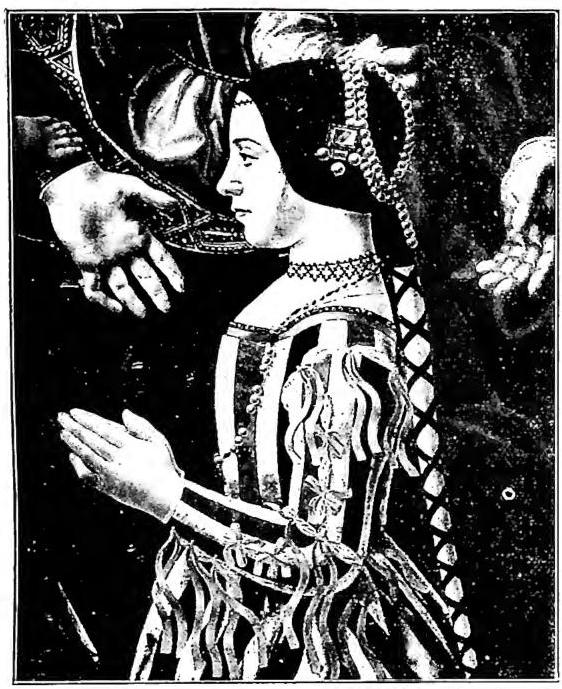
LEONARDESCHI — Beatrice Sforza, Detail of the Sforza altarpiece. Milan, Pinacoteca di Brera.
(v.), and Cesare da Sesto, in whom Leonardesque modes are combined with predominant Venetian, fifteenth-century Lombard, or central Italian influences. The Lombard premises of fifteenth-century painting cannot, moreover, be disregarded even in the case of those artists who, during the last decade of the fifteenth century or the early years of the sixteenth, drew close to the master, to such an extent as to earn the appellation of l.; these artists appropriated Leonardo’s motifs, often superimposing them in the most superficial manner upon traditional terminology. Such was the monogrammist X, known for the Louvre Circumcision, signed and dated 1491, in which the Leonardesque element, extraneous to the fifteenth-century composition, is concentrated in the central group of the Madonna; and the Master of the Sforza Altarpiece, so called after the altarpiece with the Madonna enthroned now in Brera (formerly in S. Ambrogio ad Nemus in Milan), datable to 1495. This altarpiece belongs to the tradition of Foppa and Zenale, yet the subtle chiaroscuro treatment of the Madonna and Child, as well as of the portrait of Ludovico il Moro, testifies to Leonardo’s proximity; his premises are perceptible in the later Madonna with s. Giacomo in the Cora collection in Turin, whereas the panel with s. Giuseppe and s. Anna in the Louvre, or the series of the Apostles, fragments of a predella divided among the Museo del Castello Sforzesco, the Priester collection in Vienna, and the National Gallery in London—certainly earlier than the Brera altarpiece—show the artist consummated in traditional forms. A similar position, though with a lesser physiognomic resemblance to Leonardo’s types, may be recognized in the so-called Painter of S. Eufemia, to whom are attributed the fresco with the Madonna, s. Caterina, and the donor in the chapel of the church of S. Eufemia in Milan, and the Madonnone in the Melzi villa at Vaprio d’Adda; and, more doubtfully, the Creation frescoes formerly in the abbey hall of the church of S. Antonio in Milan and now in the Museo del Castello Sforzesco.
Bernardino dei Conti (born in Pavia in 1450, died in 1526 or ’28; his works are dated from 1496 to 1523) also belongs to the Lombard tradition of Civerchio and Foppa. As a painter of portraits for the leading families of Lombardy, in the wooden dryness of the busts and the rigidity of the profiles (v. the portrait of Francesco Sforza as a child, 1496), he reveals no echo of an understanding of Leonardo; yet, while retaining the same characteristics, he subsequently applied himself to the master’s models in the Madonna and Child (1501) and in the Marriage of s. Caterina in the Carrara collection in Bergamo; or in the later (1522) Madonna and Child with s. Giovannino in Brera. Lombard motifs must likewise be taken into account in the case of the belated Cesare Magni, active from 1530 to 1533 (Madonna with s. Girolamo and s. Pietro, formerly in the Cook collection at Richmond, 1530; Crucifixion, in the cathedral of Vigevano, 1531; frescoes including s. Martino and s. Giorgio, in the sanctuary at Saronno, 1533), who in the Holy Family in Brera demonstrates only a distant and mediated descent from Leonardo. The Leonardesque reflections in Francesco Napoletano (active in Milan around 1500), known for the signed panel with the Madonna and saints in the Kunsthaus in Zurich, are equally remote; there Leonardo’s typologies are intermingled with Lombard and Flemish echoes, the latter perhaps brought by the painter with him from Naples. Francesco Napoletano was also credited with the Madonna and Child, likewise in the Kunsthaus in Zurich, owing to an erroneous interpretation of the signature FR.LIA, which should instead be understood as Fernando Llanos, the painter from Valencia, who in 1506, together with Fernando Yanez de la Almedina, was engaged there in painting the Stories from the Life of Mary in the Cathedral; he is mentioned as « Fernando Spagnolo » in the payments of the Florentine Signoria for the painting of the Battle of Anghiari, dated 1505.
(phot. Anderson)
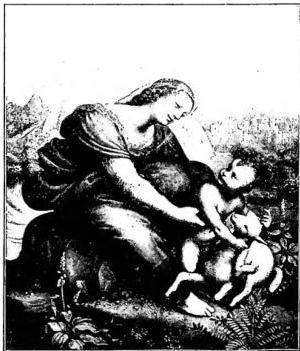
LEONARDESCHI — The Virgin and Child. Painting by Cesare da Sesto (1477–1528) — Milan, Galleria Poldi Pezzoli.
A group of works has been attributed to him, centered on the Vertumnus and Pomona in the Kaiser Friedrich Museum in Berlin (the Colombina in the Hermitage in Leningrad; the Holy Family, formerly in the Neles collection in Munich; the replica of the Leda in the Galleria Borghese in Rome), which reveal a translation of Leonardo’s prototypes in a coolly Mannerist sense—taking Roman and Raphaelesque modes into account. Indeed, in the Portrait of a Young Woman of 1525, comparisons with Raphaelesque portraiture have repeatedly been recognized. The numerous replicas left by unknown copyists of the Virgin of the Rocks, the Last Supper, Saint Anne, the Mona Lisa, and Saint John bear witness to the widespread success of Leonardo’s models—translated with variations and modulations, but without understanding their actual significance. Their work often assumes documentary value when they concern compositions for which today only sketches or drawings by the master are known. Such are the Vierge aux balances in the Louvre, the Madonna and Child with the Infant Saint John in the Uffizi (a replica of a motif repeated very frequently), the many variants based on Leonardo’s drawings for the Madonna of the Cat, and the replicas of the two versions of the Leda. — Vedi tav. LXXI.