
PORTRAIT. —
I. ARCHAEOLOGY
The portrait was a characteristic feature of Roman art. The Christians had no portraits either of the Savior or of the Blessed Virgin; among the Apostles, Peter (v.), Paul (v.), and Andrew (v.) had typical physiognomic features.In the cemetery paintings, executed rapidly, no true portraits are found; in Domitilla there is a bust in a kind of triptych (Wilpert, Pitture, pl. 134). In Callistus, the owner of a cubiculum had her face fixed on canvas in the vault above the entrance, while the bust was executed in fresco (ibid., pl. 134, 1). In the same cemetery there is a true portrait, that of the deceased Dionysias in the cubiculum known as that of the five saints (ibid., pl. 111). Some portraits are found in certain cemetery frescoes in Naples (H. Achelis, Die Katakomben von Neapel, Leipzig 1936, passim) and in some gold-glass vessels, such as the Brescia medallion (v.), and one also in the Museo Sacro of the Vatican Library (W. De Grüneisen, Le portrait, Rome 1911, p. 76, figs. 87–88). A good portrait is that of the deceased Turtura in widow’s dress, in Commodilla, from the seventh century (B. Bagatti, Il cimitero di Commodilla, Vatican City 1936, p. 109, fig. 96). Some saints were represented at a very early date, such as s. Agnese with the appearance of a puella, according to the texts (v. AGNESE, fig., vol. I, col. 468); s. Ambrogio (v. fig. vol. I, col. 985) and s. Agostino (G. Wilpert, Il più antico r. di s. Agostino, in Misc. Agostiniana, II, Rome 1931, pp. 1–3; V. AGOSTINO, fig., vol. I, pl. 39). While those of the other saints represented in the
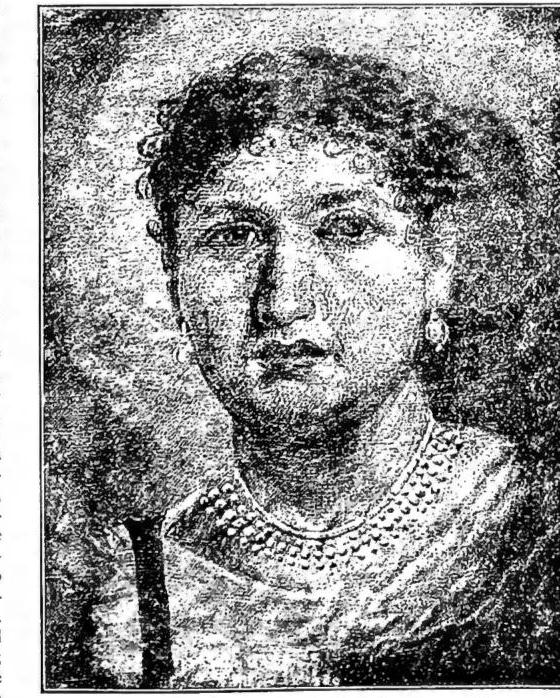
RITRATTO – Portrait of Alina, daughter of Herod. Tempera-painted canvas from the 2nd century A.D., originating from Hawara Fayyūm – Berlin, Archaeological Museum.
cemetery frescoes, such as Cecilia, Sebastiano, Quirino and Policamo, Sisto II, Cornelio, Cipriano and Ottato in Callisto; Marcellino, Pietro, Tiburzio and Gorgonio in the cemetery «inter duas lauros»; Abdon, Sennen, Pollione, Pimenio and Milix in Ponziano; Simplicio and Faustino in Generosa; the saints Felice, Adautto, Merita, Stefano and Luca in Commodilla; Callisto, Sisto, Lorenzo and Ippolito in the gilded glasses, etc.
A certain number of truly artistic portraits are those offered to us by some mummy covers from the Fayyûm (G. Wilpert, La nimbe carré, in Mélanges d’archéologie et d’histoire, 26 [1906]; W. De Grüneisen, Le portrait, Rome 1911, passim). More refined and more artistic is the portrait of the deceased on Christian sarcophagi, where the models in use are continued either with the type of the «imago clipeata» in the center of the sarcophagus, or where the bust of one or more deceased persons, often the two spouses, is sculpted on a convex circular surface like a clipseus, or else the image is sculpted as enclosed within a shell valve. Another form, likewise of Roman tradition, is that of the deceased represented in bust or standing, often holding the volume of the «lex christiana», against a background of drapery or a curtain designated by the names parapetasma, antiprodium, cortina, velum, to which a symbolic value has also been ascribed, whereas it seems more plausible to recognize in it a simple ornament (G. Bovini, I sarcofagi paleocristiani. Determinaz. della loro cronologia mediante l’analisi dei r., Vatican City 1949).
Enrico Josi