Machine translation of the 1948–1954 Italian original. The original text is authoritative.
PONZIANO, CIMITERO di. — It is situated on the right of the Via Portuense, with an entrance from the Monteverde hill, at Via Alessandro Poerio 57.
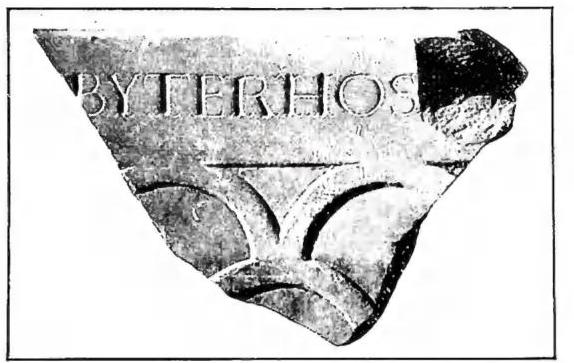
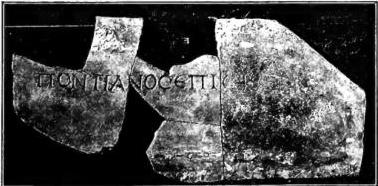
It is mentioned, from as early as the mid-fourth century, by the Depositio Martyrum, which, on «tertio Kalendas augustas» (30 July), indicates the commemoration of the martyrs Abdon and Sennen «in Pontiani, quod est ad ursum pileatum»; by the Martyr. Hieronymianum, p. 402; and by the Liber Pontificalis, in the biographies of Popes Anastasius I (399–401) and Innocent I (401–417), who were buried in this cemetery. The «notizia ecclesiarum» identifies it as an «ecclesia magna». Pope Hadrian (772–95) restored the Basilica erected above ground over the tomb of SS. Abdon and Sennen (Lib. Pont., I, p. 509), which was restored to its former splendour by Nicholas I (858–67) (ibid., II, p. 161). In 1907, the remains of the «ecclesia magna» mentioned by the «notizia ecclesiarum», erected over the tomb of the martyrs Abdon and Sennen, came to light; two fragments of the marble decoration installed by Damasus in their honour were then discovered, bearing two hexameters engraved in Philocalian characters (A. Ferrua, Epigrammata Damasiana, Città del Vaticano 1942, pp. 96–97). The information concerning the eponym of this cemetery is uncertain. Against Panvinio’s hypothesis that he was the Pope of that name, who died in Sardinia and was later transferred to Rome, to the cemetery of Callistus, other archaeologists, such as Bosio, considered it more probable that he should be identified with the Roman nobleman whom the Acta Callisti indicate as the owner in this Transtiberine region. The indication «ad ursum pileatum» is connected with some image of this kind existing in the area.
The relics of the martyrs Abdon and Sennen were transferred under Gregory IV to the urban basilica of S. Marco. Other martyrs MANILIO (v.), Pumenio, Pollio, Vincent and Candida, about whom no certain information is available. Antonio Bosio entered it for the first time on 26 July 1618. From then on, no regular excavations were carried out, but only reinforcement work on the monuments that had been explored; it is therefore impossible to determine the original nuclei with certainty. The known sections contain galleries dating from the end of the third and the fourth centuries, excavated in extremely friable clayey rock and crossed by drainage channels. Consequently, their present condition is poor, and exploration is made extremely difficult by the waterlogged soil. It has nevertheless been possible to identify: 1) the burial place of SS. Pollio, Pumenio and Milix, with their painted images beside those of SS. Peter and Marcellinus, together with their respective names and numerous graffiti, among which one recording the obituary date of Milix is particularly important; 2) a cubiculum decorated with frescoes, commonly known as the «Baptistery». It is reached by means of a large staircase, in the arch of which the bust of the Redeemer is painted twice, one of them having been commissioned by a certain «Gaudiosus». In the cubiculum, situated at a lower level than the surrounding gallery, ancient burial loculi are visible, blocked on two sides by projecting structures, one frescoed with the scene of the Baptism of Christ, the other with the scene of the crowning of SS. Abdon and Sennen, flanked by SS. Milix and Bicentius. Beneath an arch created in the left-hand wall, water flows into the chamber and gathers in a basin decorated with a jewelled cross. It was precisely the presence of water that led Bosio and modern archaeologists to identify this place as a baptistery. Styger, however (Die römischen Katahomben, Berlino 1933, pp. 271–73), rejects this identification, both because of the small size of the chamber (m. 1 × 1.35) and because of the immediate proximity of the bodies deposited there. The water, he argues, was not brought there; indeed, there is no supply channel, but it entered the chamber when a drainage channel happened to be cut through. The structures subsequently built, namely in the sixth century, transformed the chamber into a small «temple of the Jordan». In a region to the right of the staircase providing access to this chamber there is a cubiculum whose lunette above the arcosolium contains a naval scene.
The epigraphic material from the underground cemetery is fragmentary: names of owners of loculi, invocations and symbols. Mention should be made of the inscription of a certain «Sabinus Santias, artis ispeclaris», beside which the tools of his trade were carved. In 1917, while a building was being constructed in the cemetery area, part of the above-ground section of the cemetery itself was discovered.
BIBL.: A. Bosio, Roma sotterranea, Roma 1632, pp. 114, 119–39; Wilpert, Pitture, pp. 453–54, 489, 528, tavv. 173; 225, 2; 255; 257–58; id., Sarcofagi, I, p. 81, tav. 64, 9; p. 98, tav. 130, 7; II, p. 299, tav. 232, 13; p. 345 sgg., tav. 255, 6; B. Manna, Contributi allo studio del cimitero di P. sulla Via Portuense, in Bull. arch. Comm. di Roma, 51 (1923), pp. 163–224; A. Silvagni, Inscript. Christ., nuova serie, II, Roma 1935, nn. 4500–4744. Gabriele Ferrari
Cite this article
“PONZIANO, CIMITERO DI.” Enciclopedia Cattolica, vol. IX (1952), p. 1051. Azione Romana digital edition, https://azioneromana.com/article/ponziano-cimitero-di.