
VINCENT, saint, martyr. — Spanish deacon, a victim of the Diocletian persecution, probably in 304; he is among the few martyrs recorded in the calendar of Polemius Silvius
(CIL, I, 2nd ed.,
p. 259).
The poetic account of Prudentius in the hymn dedicated to him (Peristephanon, V) is not substantially different from that of the Passio (BHL, II, 1247 ff.; suppl., pp. 306, 307; BHG, p. 263); but the original Passio differs from that which has come down to us. V., deacon of Valerius, is brought to Valencia to be judged; after enduring many cruel torments, the martyr’s body is exposed to wild beasts, then cast into the sea and restored by the waves; the sand is his first tomb («sacra fovens harenis viscera vicem sepulcri praebuit» [Prudentius, loc. cit., 506-508]); when peace came «altar quietem debitam praestat beatis ossibus». A basilica is erected, and soon his veneration spreads. Prudentius also commemorates V. in the fourth hymn of his Peristephanon in honor of the eighteen martyrs of Saragossa (vv. 77-78, 89-108). Notable is a sermon in his honor by St. Justus of Urgell, in which the holy deacon is called «nobis vernula, noster ex genere... noster in tumulo», etc. (B. De Gaiffier, Sermons, cited in bibliography).
His deposition is recorded on 22 January in the calendar of Carthage, in the Martyrologium Hieronymianum, and in the Synaxarium Ecclesiae Constantinopolitanae; in the second it is also commemorated on 11 and 22 January, 19 April, 21 August, and 31 October; in the third, on 11 November together with St. Victor and St. Menas, and on 6 August for the dedication of his church ἐν τῷ κάμῳ beneath the walls of Constantinople. He is the most famous of the martyrs of Spain; his veneration spread so rapidly that St. Augustine asks: «quousque vel romanum imperium vel christianum nomen extenditur natalem non gaudet celebrare Vincentii?» (Serm. 276; PL 38, 1257). Indeed, six sermons «in natali o in festo Vincentii martyris» by St. Augustine are known (PL 38, 1252-68), delivered on 22 January in the years 410 (serm. 274), 411 (serm. 275), 412 (serm. 276), and 413 in Carthage in the basilica Restituta (serm. 277); also the sermon De Esau et Jacob (PL 38, 33-52), delivered between 410 and 412. From one of these we learn that in Africa the Passio of the Saint was read in church at the time of St. Augustine («quae nobis hodie recitata est» [PL 38, 1255]). Another Sermo in natale sancti Vincentii is in Miscellanea Agostiniana, I. Rome 1930, pp. 243-45. Paulinus of Nola recalls him: «Vincentius extat Iberis» (Carm., XIX, 153 and XXX, 7: PL 61, 520, 673; likewise Venantius Fortunatus: PL 88, 270); Eugenius of Toledo, c. 650, composed an epigram in his honor (PL 87, 361); Hildebert wrote a poem for him (PL 171, 1301); St. Peter Damian an hymn (PL 145, 947), as did Adam of Saint-Victor (PL 196, 1475 ff.).
The Mozarabic Liber Sacramentorum (ed. M. Férotin, Paris 1912, cols. 112-21) contains a Mass in honor of St. V. in which the tunic woven from top to bottom is mentioned; to this Mass is connected the sermon «cunctorum» falsely attributed to St. Augustine, St. Leo, or St. Maximus of Turin. In 531 Childebert brought the tunic to Paris at the monastery of St. V., later St-Germain-des-Prés (Gregory of Tours, Historia Francorum, III, 29); in Rome
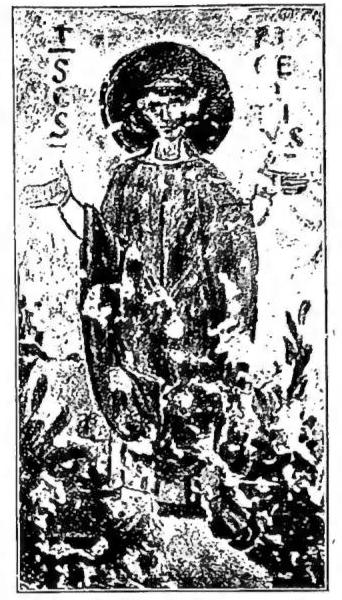
St. V. was honored immediately at Saragossa, Salona (F. Bulic, L'iscrizione di s. V. Salona, in Bull. d'arch. e storia dalmata, 29 [1906], pp. 246-56), Sagunto, Béziers, Toulouse, Vaison (CIL, XI, 499), Agen, Chalon, Ugento, in Switzerland, etc.
His relics (brandea) were venerated at Carmona (CIL, XII, no. 374), in Africa (P. Monceaux, Enquête sur l'épigraphie chrétienne d'Afrique, Paris 1909, nos. 193, 262, 304) and especially at Tamalla, now Tocqueville in Algeria (Bull. arch. du Comité, 1909, p. 56). Monasteries were founded in his honor at Le Mans (PL 72, 638-40), at Volturno (v. VINCENZO AL VOLTURNO, SAN), at Metz (PL 160, 713), and at Conques in the time of Charles the Bald.