
VILLENEUVE-LÈS-AVIGNON. - Ancient Benedictine abbey in the diocese of Avignon.
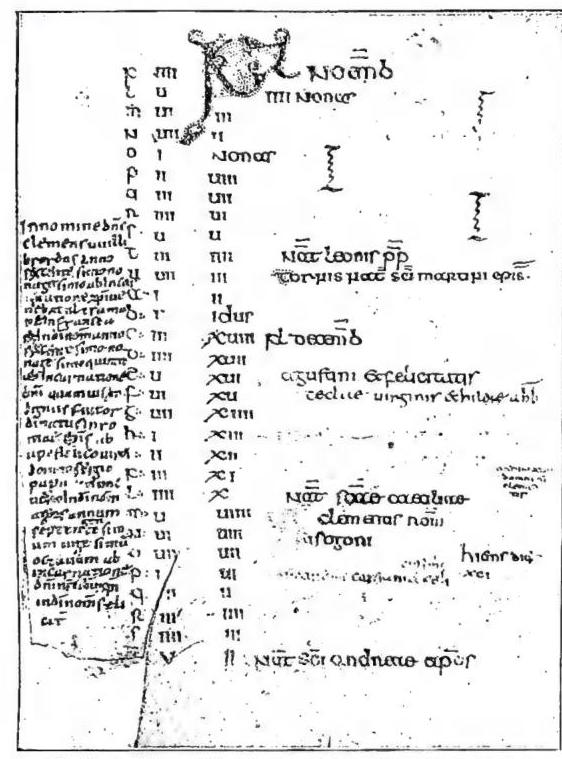
WILLIBRORD, Saint. V. with the notice of his arrival in France (690), of his episcopal ordination in Rome (695) and of his age, 78 years (728). Beside the XI and X Kal. (21-22 Nov.) a note in another hand recalls the «dies natalis episcopatus» of V. - Paris, Bibl. nat., ms. lat. 10837, fol. 39°.
On the hill of Andaon situated opposite Avignon, on the right bank of the Rhone, in Roman times an altar was erected to Silvanus, which in Christian times was replaced by a chapel dedicated to St. Michael; according to tradition, there in 587 St. Caesaria died in a grotto. In 987, through the donation of Edelbert, judge of Provence, and of his wife Teucinda, the Benedictine monastery of Sts. Andrew and Martin was founded there, recognized in 999 by Pope Gregory V; the abbey in time enlarged its possessions and the monastic buildings were enlarged after the Maurist Congregation was introduced there in 1637.
The primitive chapel of St. Michael changed its title to that of St. Nicholas, from the 11th to the 17th century, and then to that of St. Caesaria; it stood to the north of the abbey. The church of St. Andrew, to the north of the cloister, was consecrated in 1118 by Pope Gelasius II and enlarged in the 14th century; beneath the apse was the crypt; the octagonal bell tower was Romanesque; it was razed to the ground by the Revolution. At its side arose a chapel called of Notre-Dame or of the dead, and nearby the church of St. Martin was erected, consecrated in 1024; there Cardinal P. Blan was buried in 1409; it collapsed in 1603 and was rebuilt by the Maurists in 1650, under the title of St. Caesaria. The Revolution also destroyed this church, of which the church of Pujat preserves the choir balustrades and a bell of 1511.
For the group of dwellings to the west of the abbey, the parish church of Notre-Dame-de-Belzëvet or of Bellevue arose in the 12th century; on the door is engraved the dedication «XV KL. Dec. Dedicacio S. Maria». In the 14th century it became the chapel of the fort Saint-André and the parish was transferred to where it still is, downstream, in the church of Saint-Pons. Cardinal Arnaldo De Via, nephew of John XXII, built a palace there and founded the church consecrated by that same Pope on 1 June 1333 under the title of Notre-Dame; he also founded there a collegiate chapter and donated an ivory statue of the Madonna and Child, still venerated; he was buried there in 1335. Later, on the north side of the church, a cloister was built. In 1791 the church became the parish of V. under the name of St-Pons.
Pope Innocent VI on 2 June 1356 promulgated the bulls of foundation of the charterhouse of St. John the Baptist at the foot of the hill of Andaon, which in 1362 took the name of Val-de-Bénédiction. The church was consecrated, in the presence of the Pope, on 19 Aug. 1358 by Guy of Boulogne, cardinal of Auvergne; there were buried in 1362 Innocent VI and his nephew Cardinal A. Aubert. The pontifical chapel preserves frescoes attributed to Matteo di Viterbo from the time of Innocent VI. The Charterhouse was enlarged in 1372 by Cardinal P. Selva di Montirac and enjoyed great prosperity in the 17th century; in 1633 it founded the branch of St. Mary Magdalene at Marseille.
King Philip the Fair granted privileges to the inhabitants settled on the hill around the abbey, which was surrounded by walls and fortified to secure the crossing of the Rhone; a sturdy tower was erected in 1302, restored in the 14th and 15th centuries; little by little a new Villeneuve St-André thus took shape, subject to the King of France, with its own mint, rival of Avignon, which belonged to the counts of Provence and from 1308 to 1411 was the seat of the popes. V. then grew larger and had cardinalitial palaces.
Bibliography3 works
Enrico Josi