
MARIA MADDALENA (Magdalene), santa. - Woman so called be-
(courtesy of Mgr. A. P. Frutaz) MARIA MADDALENA (Magdalene), santa. - Donna chiamata così per-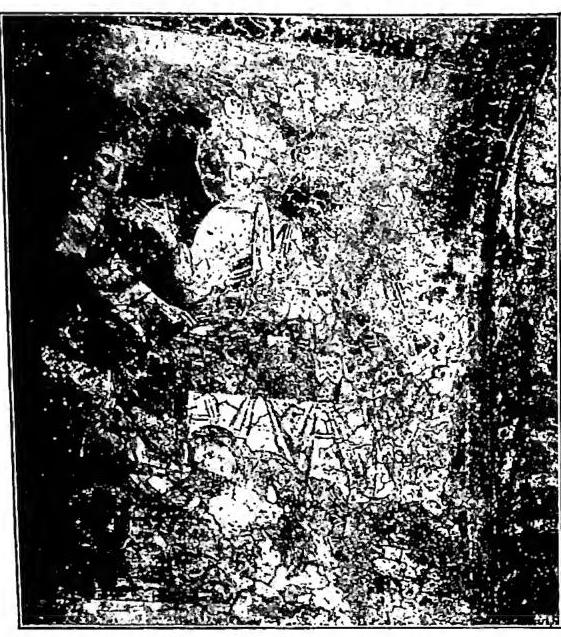
Three women are distinguished by: Faber Stapulensis, M.-J. Lagrange, U. Holzmeister, G. Sickenberger, Innitzer, Marchal, F. Prat, Dorado, and many others. Two women are distinguished by: A. Calmet, F. S. Patrizi, G. Belser, L. Murillo, who identify M. M. with Mary of Bethany, distinguished from the anonymous sinner of Luke. G. Knabenbauer also distinguishes two women, but identifies the sinner with Mary of Bethany.
Many others, following the Latin liturgy, speak of a single woman: this opinion could be called common in the Latin Church from St. Gregory the Great until the 16th century. However, the ancient Latin Fathers held discordant opinions. St. Augustine and St. Jerome changed their minds in different works. Among modern writers who still maintain the unity of the three Marys, mention should be made of Didon, Le Camus, Fouard, F. Kaulen, Lesêtre, A. Lemonnier, Simon, and G. Mezzacasa.
The best way to attempt a solution to this intricate question seems to be the exegetical one. The Gospels never explicitly identify the three women. In fact: St. Luke, after speaking of the anonymous sinner who, in the house of Simon the Pharisee, anointed Jesus' feet with ointment, washed them with her tears, and wiped them with her hair (7:36-50), passes im-
mediately to speak of the pious women cured of unclean spirits and infirmities who followed Jesus: among these he lists M. M. without mentioning the sinner (Lk. 8:1-2). Further on (ibid. 10:38-42) he speaks of the sisters Martha and Mary without identifying the latter with any of those previously presented. He will speak of M. M. again among the pious women who went to the tomb (ibid. 24:10), calling her by the same name as in 8:2, without identifying her with others.
Mt. 26:6-13 and Mk. 14:3-9 speak of a woman who, in the house of Simon the leper, anointed the head of Jesus, causing comments due to the waste. St. John specifies that the woman who anointed the Lord was Mary, the sister of Lazarus and Martha; the banquet had been offered in Bethany in thanksgiving for the resurrection of Lazarus (Jn. 12:1-8; cf. 11:2). There is no mention of the sinner or of M. M. It is not possible to identify this anointing, which preceded the Passion by a short time, with the one reported by Lk. 7:36-50, due to the difference in time and place.
Those who maintain the identity of Mary of Bethany with the sinner rely especially on the fact that John (11:2), introducing Mary the sister of Lazarus for the first time, says that she was the one « who had anointed (ἡ ἀλείψασα) the Lord and wiped (καὶ ἐκμάξασα) his feet with her hair ». From the aorist participles (ἀλείψασα, ἐκμάξασα) it might seem that John is alluding to a previous action, precisely to that of Lk. 7:36-50. Thus Mary of Bethany is identified with the anonymous sinner! The proponents of the distinction reply that the aorist participles can refer to an event not yet narrated (specifically the anointing that will be reported in chapter 12), but already known to everyone. Judas is also introduced as the one who betrayed (ὁ παραδούς) before his betrayal is recounted (Mt. 10:4; cf. Mk. 3:19; Lk. 6:16). From a comparison of the Synoptics with John, it appears that Mary of Bethany anointed the Lord (Jn. 11:2) starting from the head (Mt. 26:7; Mk. 14:3) and finishing at the feet (Jn. 12:3).
A characteristic common to the three women, emphasized by the proponents of identification, is their love for Jesus. Prat (v. BIBLICA), p. 500 f., replies: « This very love, examined closely, does not have the same characteristics in the three women: penitent love in the anonymous sinner of Luke, love of gratitude in M. M., and love of ecstatic contemplation in Mary of Bethany ».
The fact that M. M. was delivered from seven demons does not imply that she was stained with sins; in Luke's account of the sinner, there is no mention at all of demonic possession. Other reasons for distinguishing Mary the sister of Lazarus from M. M. are based on the diversity of the names of persons and places: the former is always called simply Mary by both Luke and John, whereas the latter is distinguished by the epithet Magdalene, which seems to indicate her native city (Magdala). The Synoptics record M. M. among the pious women who had followed Jesus from Galilee to Jerusalem (Mt. 27:55; Mk. 15:
(from Wilpert, Sarcofagi, III, suppl., p. VI)
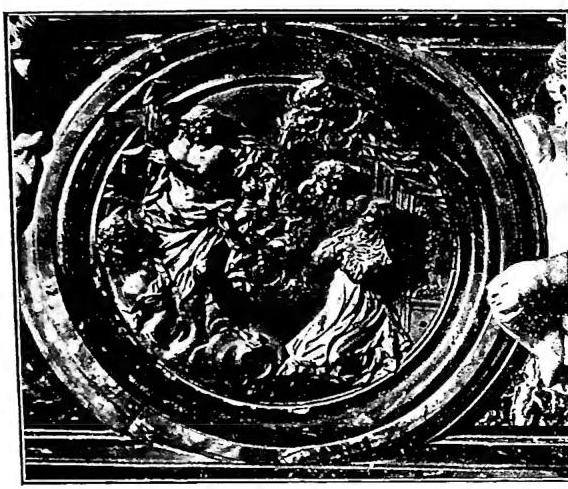
MARIA MADDALENA, santa - Mary of Bethany pours the balm and the sinner anoints the feet of the Lord. Polychrome wood bas-relief (11th century) - Castelchiodato, a hamlet of Mentana (Rome).
41; Lk. 23:55) and who assisted him on his journeys (Lk. 8:2). The sister of Lazarus, on the other hand, is presented as being from Bethany, near Jerusalem.
504. The question of the three Marys in tradition was thoroughly studied by M
J. Lagrange, Jésus a-t-il été oint plusieurs fois et par plusieurs femmes?, in Rev. bibl., 9 (1912), pp. 504-32 and by U. Holzmeister, Die Magdalenenfrage in der christlichen Überlieferung, in Zeitschr. f. huth. Theol., 46 (1922), pp. 406-22, 504-32. For further bibliographical details V. H. Simón - G. G. Dorado, Prael. bibl. Nov. Test., I, Turin 1947, nos. 398-505.Pietro De Ambroggi
ARCHAEOLOGY. - According to G. Wilpert, the apparition of the risen Jesus to M. M. is sculpted on one of the sides of a sarcophagus found in the 16th century in St. Peter's in the Vatican (Sarcofagi, pl. 121, 2-4).
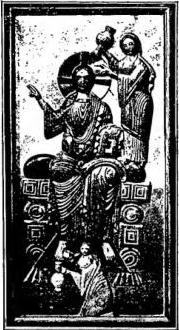
In a marble reliquary box (capsella) in S. Giovanni Battista in Ravenna, Jesus appears to M. M. and the other Mary (R. Bartoccini, La capsella marmorea cristiana rinvenuta a Ravenna, in Riv. di archeol. crist., 8 [1930], pp. 299-302; reproduced under V. MARIA [varie donne bibliche]); the same scene is found in a miniature of the Rabbula Gospels of the year 586 (H. Leclercq, Croix et Crucifix, in DACL, III, II, fig. 3380).
The appearance of the angel to M. M. and the other Mary at the tomb, according to the Gospel texts (Mt. 28, 1-10; Mk. 16, 1-13; Lk. 24, 1-12; Jn. 20, 1-18), is the one most frequently represented in early Christian art.
Indeed, it is found on Christian sarcophagi, such as the lost Vatican sarcophagus published by A. Bosio (Roma sotterranea, Rome 1632, p. 79; Wilpert, Sarcofagi, p. 325) and in the sarcophagus of S. Celso in Milan (id., loc. cit., p. 330; and pl. 243, 6); in the sarcophagus of Servanne, however, there is also M. Salome mentioned by St. Mark (16, 1-7; id., loc. cit., pl. 15, 2). It is also found in a series of ampullae from Bobbio and Monza (H. Leclercq, Ampoules, in DACL, I, II, figs. 457, 458, 459; id., Monza, ibid., XI, II, fig. 8439). Furthermore, it recurs in one of the panels of the wooden door of S. Sabina in Rome (5th century); on one leaf of the ivory diptych of Munich (5th century); in the ivory diptych of the Cathedral of Milan (Venturi, I, fig. 390); in one of the mosaics of S. Apollinare Nuovo in Ravenna (years 493-526); on a metal book cover of a liturgical book with embossed figures (9th century) in the Louvre Museum in Paris (Venturi, II, p. 643 and fig. 483); in the 9th century on the silver reliquary of Paschal I in the treasury of the "Sancta Sanctorum" (Ph. Lauer, Le trésor du Sancta Sanctorum, in Mémoires et Monuments Piot, 15 [1907], pl. 9); on an ivory in the Saltikoff collection (H. Leclercq, Ascension dans l'art, in DACL, I, II, fig. 989), and later in one of the mosaics of the Cathedral of Monreale.
Lazarus (v.), that of St. M. M. flourished in Provence. In Provence, near St-Maximin, there existed a large cave called S. Maria de Balma or Ste Marie-de-la-Baume. In this place, from the mid-13th century, the episode of the penance of St. M. M. was localized, derived from the legend that had grown around the life of St. Mary of Egypt at Vézelay, where the cult of St. M. M. had appeared from the mid-11th century, imagining that M. M. and Maximin had come from Palestine to Provence, where their tombs were pointed out—which from 1279 were instead believed to be at St-Maximin (L. Duchesne, La légende de ste Marie Madeleine, in Fastes épiscopaux de l'ancienne Gaule, I, 2nd ed., Paris 1907, pp. 321-59).
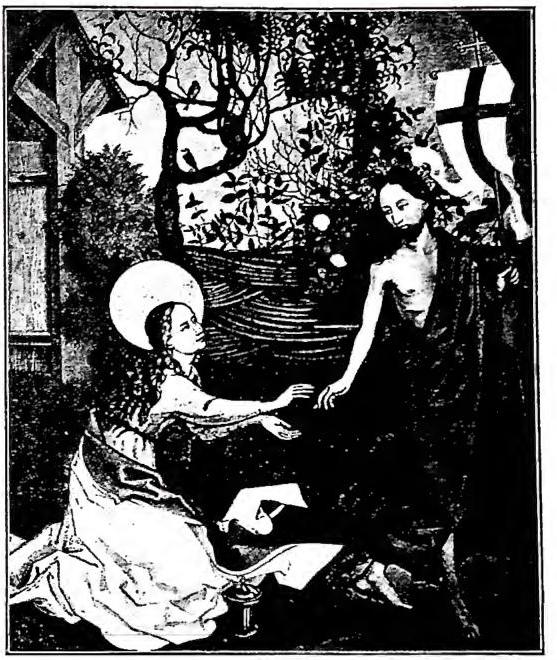
ICONOGRAPHY. - Giotto and his school executed two important series of frescoes, both featuring the story of M. M., in the Saint's chapel in Assisi and in the Bargello in Florence. While the latter are now lost, the Assisi series is still preserved and presents scenes from her life, among which the one where she offers
(photo Braun)
In scenes of the Crucifixion, M. M. stands beside the Cross, praying with uplifted hands (see Giotto's fresco in Assisi and the pinnacle of the Pisa polyptych by Masaccio in the Naples Museum). Lucas van Leyden in an engraving and Marco Koffemann in a large painting depicted her, in the 16th century, as a dancer.
In devotional images dating back to the 15th century, M. M. is initially depicted as the bearer of the jar of ointment. Thus Piero della Francesca in the Duomo of Arezzo, Carlo Crivelli in a panel at the Kaiser Friedrich Museum in Berlin, Chiodarolo in Bergamo at the Accademia Carrara, Timoteo Viti in the cathedral of Gubbio, and Bartolomeo Montagna in the church of S. Corona in Vicenza (where M. M. is depicted in a sacra conversazione with other saints), as well as in paintings by Piero di Cosimo, Luini, Giampietrino, etc. Images of the Saint are also frequent in northern countries, and in those
With the 16th century and the Baroque era, the preferred representation of the Saint is in the guise of a penitent in the desert and in the cave, as in paintings by Titian and by Timoteo Viti in Bologna (1508). At other times she appears in ecstasy, and in the act of receiving Communion, as in paintings by Ribera in Naples at the Filangieri Museum, by Calvaert in the Turin Gallery, by Cerezo in the Vienna Gallery, by Becerro in the Prado Museum, etc.
Also worthy of mention are the cycles of scenes from the life of M. M. depicted in the stained glass windows of Gothic cathedrals. In the windows of the cathedrals of Bourges, Lyon, and Chartres, only the evangelical scenes are represented. By contrast, the events of the Saint's legend are also included among the 10 panels of the stained glass window in the chapel dedicated to her in Assisi. - See pl. XIII.