
KISS. — In the Catholic liturgy it is a frequently used gesture and expresses veneration and homage, affection and fraternal union, or subjection. It carries a natural symbolism indicating love, respect, and union, and has become part of religious as well as civil ritual among very many peoples; it has replaced that form of adoration known as προσκύνησις. A distinction is made between the k. of persons (k. of peace) and the k. of sacred things.
SUMMARY —
I. The kiss of peace
II. The kiss of the Pope’s foot
III. The kissing of the hand
IV. The kissing of sacred objects.I. THE KISS OF PEACE
1. At Mass
At Mass, the kiss of peace is given either through a mutual embrace or by presenting for kissing a small, picture-shaped tablet called the “peace” (v.). The embrace is used among the clergy assisting at Solemn Mass; the “peace” is used for the clergy at sung but non-solemn Masses and for the laity at Solemn Masses. The kiss of peace is of very ancient usage, and in the New Testament (Rom. 16:16; I Cor. 16:20; II Cor. 13:12; I Thess. 5:26; I Pt. 5:14) the faithful are repeatedly instructed to exchange it with one another. It is called φίλημα ἀγάπης (osculum pacis; I Pt. 5:14), φίλημα ἅγιον (osculum sanctum). From Justin (Apol. I, 65) there is evidence of a kiss concluding the litany prayers before the Eucharistic celebration. A similar kiss of peace before the Eucharistic prayer is still customary in the Eastern liturgies; it also appears in the same place in Hippolytus’s Traditio Apost. (3rd century), in the Gallican, Mozarabic, and ancient Ambrosian liturgies.(Phot. Enc. Cett.)
BACILE – B. of embossed brass with the profile of M. T. Cicerone (16th century) – Andalo, church of the Immacolata.
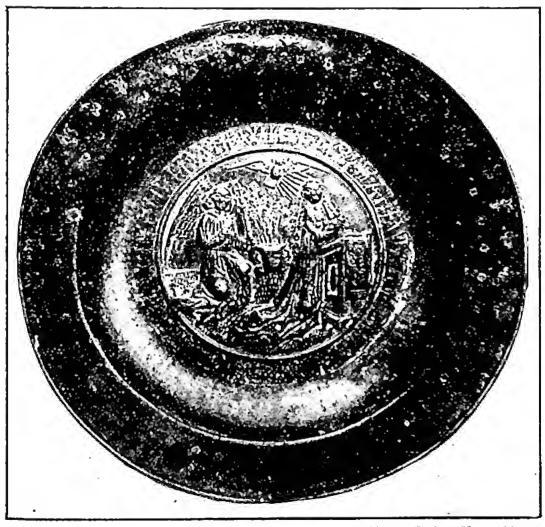
It is certain that in the 5th century the current Roman practice of giving the b. of peace after the Canon was not yet customary, as is shown by the intervention of Innocent I (Ad Decent.: PL 20, 553). In Africa, from the beginning of the 3rd century, Tertullian (De oratione, 18) speaks of a b. of peace quod est signaculum orationis, after the “prayer”; from this it can be seen that, if oratio does not specifically mean the Oratio Dominica, it indicates the sacrificial prayer, and not the pre-sacrificial litany prayer. St. Augustine (Sermo 227: PL 38, 1101) continues to testify in Tertullian’s sense: «Post ipsam (orat. Dominicam) dicitur: pax vobiscum: et osculantur christiani in osculo sancto».
Today the b. of peace is omitted at Requiem Masses, on Holy Thursday, and on Holy Saturday (the Easter Mass).
The omission of the former is explained by the votive and therefore private origin of such Masses; for the others, medieval writers found, and modern writers repeated, various divergent reasons, among them the avoidance of an analogy with Judas’s b. on Holy Thursday. The true reason is that to which Tertullian alludes when he records the fact (De oratione, 18, PL 1, 1178: «sic et die Paschae... merito deponimus osculum»), namely, the penitential character imparted to such Masses by the fast, whereas the b. is a sign of fraternal joy.
The b. of peace was given among the faithful at a sign from the deacon: ἀπέσπασθε ἀλλήλους (Constitutiones Apostolorum, VIII, 11,9): Pacem habete, etc. Perhaps at first the distinction of the sexes was not observed in the b. of peace, as appears from the precaution noted in an agraphon cited by Athenagoras (Legatio pro Christianis, 32: PG 6,964). But already in the 3rd century, just as the b. between the faithful and catechumens was forbidden, so too was it forbidden between Christian men and women (Hippolytus, Trad. Apost.). In the 4th century, while the Constit. Apost. (II, 57; VIII, 11,9) merely advised the separation of the sexes in church, they expressly enjoined it in the exchange of the b. of peace, from which the excommunicated and public penitents were excluded; their reconciliation took place precisely through the b. of peace (pacem dare): V. ASI. The practice of the b. of peace by means of a mutual embrace was preserved in the West until the 13th century (In-
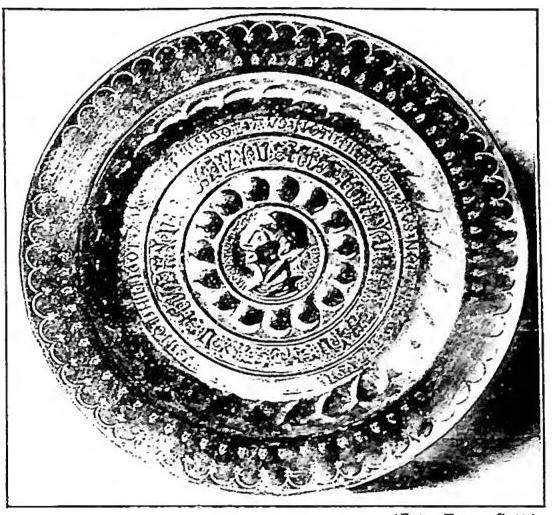
(photo Gab. Fot. Naz.) BACILE — German art basin from the 15th century — Atri, cathedral treasury.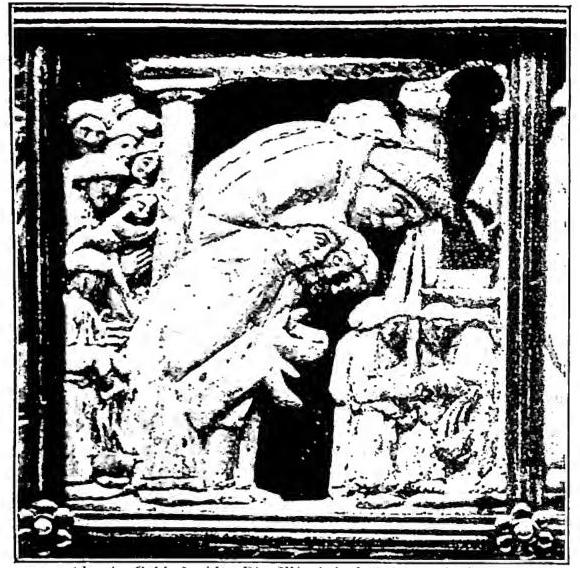
and in some places until the 15th–16th centuries.
From the 13th century onward, first in England, the practice arose of giving the kiss of peace by having people kiss a tablet made of wood, metal, or stone (Pax, Paciferum, Pacificale, Instrumentum pacis, osculatorium, tabula, asser ad pacem, cf. J. Braun, Das christliche Altargerät, Munich 1932, p. 560 ff.), which was first kissed by the priest celebrating Mass. The practice was adopted by Pius V in the reform of the Missal (Ritus servandus in celebrat. Missae, 10,5) as a general usage, until it declined around the 18th century.
Besides this kiss of peace, common to all liturgies and recalling Mt. 5: 23 ff., the kiss was widely used in the papal liturgy. At Mass, during the singing of the Introit, the Pontiff kissed some of his ministers; two of them had already kissed his hands (Ordo Rom., I, 11, 4,5; V, 5,6: PL 78, 941; 970, 986 ff.).
Connected with this ancient practice is the kiss that the Pope receives on the face and chest from the last three cardinal priests before ascending the altar (Innocenzo III, De Sacro altaris mysterio, I, 11: PL 217, 805); in turn, after kissing the altar, the Pope kisses his deacons, who reciprocate with a kiss on the chest (Innocenzo III, op. cit., 1, 15: PL 217, 807).
2. In the Sacraments
At first, when Confirmation immediately followed Baptism, after the rite the bishop kissed the neophyte (Ippolito, Traditio Apost., Testamentum D. N. I. C., 2, 9).In Penance, the kiss was anciently a characteristic ceremony and was the clearest expression of the meaning of readmission into the fraternity of the Church through the Sacrament.
A kiss of peace also existed in Ordination (Ippolito, Trad. Apost., Constit. Apost., VIII, 5, 10).
In the Middle Ages this kiss perhaps acquired the meaning possessed by analogous customs of feudal investiture. It still survives today: twice in episcopal ordination (Pontif. Rom.: De Consecr. electi in episcopum) and once in priestly ordination (ibid.: De consecr. presbyteri).
Extreme Unction, too, was accompanied by a kiss (Pseudo Dionigi, Eccl. Hier., 7, 2: PG 3, 456). The Synod of Auxerre (578), canon 12, forbids kissing the dead.
In Marriage, among the Greeks the kiss at the end of the ceremony is still found today, while among the Romans it seems to have constituted the legal act of marriage (C. Krüger, Codex Justin., in Corpus Juris Civilis, II, Berlin 1895, p. 194) and, according to Tertulliano (De Virginibus velandis, 11), to have formed part of the rite, like the exchange of rings. In the Middle Ages the spouses gave each other the kiss of peace, which the bridegroom had received from the priest at the Pax Domini of the Mass.
In the administration of the Eucharist, too, there is the kiss that the celebrating Pontiff gave the deacon after administering Communion to him, and that the deacon in turn gave the subdeacon after presenting him with the Precious Blood (Innocenzo III, De Sacro altaris mysterio, 6, 9: PL 217, 911; Caerem. Episcop., 2, 29, 3). The other communicants, as well as the deacon, before receiving Communion, kissed the bishop’s hand (today, the ring).
The kiss of peace also occurs in the blessing of abbots and knights, in the coronation of the king and queen (cf. Pont. Rom., respectively), and in monastic profession.
In the blessing of abbesses, after the rite they receive the nuns for the kiss of peace (Pontif. Rom.: De bened. abbatissae).
In the Mozarabic liturgy, the bishop kissed the abbess whom he had blessed. Another kiss of peace is used at the end of the Council among the participants (Caerem. Episcop., 1, 31, 19).
II. THE KISS AT THE POPE’S FOOT
A kiss that has an entirely different meaning from that of peace is the kiss at the Pope’s foot, both in the liturgy and in ceremonial processions. Its use dates back to the most remote antiquity and has its roots in Oriental etiquette (J. Horst, Proskynein, in Neu-testamenti. Forschungen, 3rd series, 2 (Gütersloh 1932), pp. 55 ff.); it is known from the Old and New Testaments (Ps. 71:9–11; Is. 49:23; Lk. 7:38–45, 15:20; Mt. 26:49) and does not always have a distinctly religious meaning. In this connection, mention should be made of the account in the Liber Pontificalis (ed. Duchesne, Paris 1886–92, I, pp. 275, 391; II, p. 107), according to which the emperor Justin kissed the feet of Pope John I, Justinian II those of Pope Constantine, and the papal court in 847 those of Pope Leo IV, morem conservantes antiquum. This custom of kissing the Pontiff’s foot, already noted in the Ordo Rom., I, 11, has been preserved in the papal liturgy, in which the two subdeacons, Latin and Greek, kiss the Pontiff’s foot, as also in the rite of adoration of the newly elected pope and in the ceremonial of private audiences.III. THE KISSING OF THE HAND
Kissing the hand likewise appears to be a very ancient practice as a sign of love and respect. In the liturgy, the hand is kissed by the bishop-elect, after the examination, to the consecrating bishop (Pontif. Rom.: De Consacr. electi in episcopum); by the ministers to the Pontiff before leaving the sacristy, which is therefore also called the Salutatorium; and by all to the Pontiff, the bishop, and the abbots when receiving Communion from them (the ring is now kissed). The same practice prevails in the Greek liturgy. In general, the kissing of the hand is used in the liturgy whenever something is received from or placed in the hands of the priest.IV. THE KISS OF SACRED OBJECTS
In antiquity,the kiss signified not only love but also respect:
hence the kissing of sacred objects. Among these kisses,
mention should be made of those of relics, the cross, blessed
palms and candles, sacred vessels and vestments, and above all
the kissing of the book of the Gospels and of the altar.
The Ordo Rom., I, 8, prescribes the kissing of the sides of
the altar by the assisting deacons (salutare = to kiss), and by
the Pontiff, who repeats the gesture at the Offertory.
In the time of Innocent III the altar was kissed only three
times; but a century later nine such kisses were noted.
Cf. G. Durando, Rationale Divini Offic., IV,
39, 6 (Paris 1854); F. J. Dölger, Zu den Zeremonien der Messliturgie, II: Der Altarhuss, in Antike u. Christentum, 2 (1930), p. 190 ff.