
EUCHARIST. - It is the prolongation of the Incarnation (Leo XIII, encycl. Mirae caritatis, 18 May 1902). Just as the Word of God became present under human guise to procure salvation, rendering to God the homage due through the satisfactory atonement for sin and meriting all spiritual goods (objective redemption), so Jesus Christ renders Himself present under the Eucharistic species to apply the work of salvation, in its ascending phase, by renewing the sacrifice of the Cross, and in its descending motion, by infusing Grace through the sacramental rite of Communion (subjective redemption). The E. therefore implies the truth of the real presence of the Body, Blood, Soul, and Divinity of Jesus Christ under the appearances of bread and wine, the sacrifice of the Mass (v. MASS) and the sacrament of Communion (v. COMMUNION). Due to the multiplicity of mysteries it contains, the E. is the compendium of faith, the center of gravity of Christian piety, the polestar that orients all the activity of the Catholic Church. Its numerous names reflect the variety of its aspects: Body of Christ, Body of the Lord, the Venerable, Sacrifice of the Altar, Mass, Synaxis, Viaticum, Communion, Divine Table, Most Holy Sacrament.
The classical name εὐχαριστία derives from the account of the institution, where it is narrated that Jesus gave thanks (Mt. 26:26; Mk. 14:22: εὐλογήσας; Lk. 22:19; 1 Cor. 11:23: εὐχαριστήσας), and is already found in use by the Didaché (9, 1-5; 10, 1-6), by St. Ignatius of Antioch (Smirn., 7, 1; Phil., 4), by St. Justin (Apol., I, 66: PG 6, 427), and by St. Irenaeus (Adv. Haeres., 2, 18: PG 7, 1027-29), and it befits the mystery, which is a perfect rendering of thanks (cf. F. Cabrol, Eucharistie, in DACL, V, cols. 686-92).
A. THE E. IN DOGMATIC THEOLOGY.
SUMMARY:
I. Origins of the E
II. Truth of the Eucharistic presence
III. Transubstantiation
IV. Mode of the Eucharistic presence
V. Conclusion: the E. in the divine plan.### I. ORIGINS OF THE E.
I. THE POSITIONS OF INDEPENDENT CRITICISM
At the end of the 19th century, as the denial of the Divinity of Jesus Christ matured through rationalist systems, it was logical that the problem of the origins of the Eucharist would emerge and be resolved in harmony with the general orientation of criticism. Indeed, A. Harnack (Brot und Wasser: die eucharistische Elemente bei Justin, Leipzig 1891), after attempting to demonstrate that the eucharistic elements in the nascent Church were bread and water, constructed upon this presumed ritual variation (in antiquity: bread and water, later: bread and wine) a theory on the original meaning of the Last Supper: Jesus did not concern himself with the elements, which may vary, but with the meal itself, which he blessed, teaching his disciples to sanctify the most important act of bodily life and promising to be with them, in his power to remit sins, at every banquet they would celebrate in his memory (dynamic theory).The following year, A. Jülicher (Zur Geschichte der Abendmahlsfeier in der ältesten Kirche, in Theologische Abhandlungen Carl von Weizsäcker zu seinem siebzigsten Geburtstag 11 Dec. 1892, Freiburg im Breisgau 1892, pp. 215-250), rejecting Harnack’s hypothesis, proposed a new interpretation of the Last Supper: Jesus performed parabolic gestures with precise reference to his imminent end, offering his disciples the broken bread and the cup filled with wine, as in a transparent symbol (not enigmatic, as Weizsäcker had held since 1886) he would indicate to them the fate that awaited him: my Body will be broken like this bread, my Blood will be poured out like this wine (symbolic theory). The system immediately garnered broad consensus. Some critics, such as O. Holtzmann, C. Clemen, K. Völker, and H. Weisel, accepted it without substantial variations, while others, like E. Haupt, R. A. Hoffmann, H. Wendt, and M. Goguel, saw in the gestures of the Last Supper the symbol of Jesus’ loving dedication. R. Eisler discerned in them the revelation of the messianic dignity of the Nazarene Rabbi.
Closely related to Spitta’s conception are those of J. Hoffmann (fraternal banquet in anticipation of the Kingdom), A. Schweitzer (prototype of the messianic feast), and A. Andersen and A. Loisy (farewell meal in the perspective of the imminent realization of the Kingdom of God).
Having thus explained the Last Supper in a natural or rational manner, critics were compelled to confront another problem. Nearly all, in fact, admit that 20 years after Jesus’ death, St. Paul in I Cor. (c. 57) speaks of the Eucharist as a mystery implying the real presence of the Lord’s Body and Blood, offered in sacrifice and the cause of a spiritual union among the faithful. In such a brief span of years, a purely symbolic rite would have undergone such a transformation as to be enriched with a content...
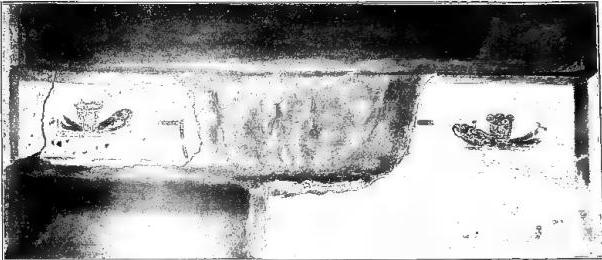
EUCHARIST - Pecci Eucharistic. In the original, at the center of the castle, one sees the cup with red wine (2nd century). Rome, Cemetery of S. Callisto, so-called crypts of Lucina.
transcendent. The many attempts to explain this singular phenomenon can be reduced to three. The transformation is considered to have occurred either through a contribution of the Christian consciousness, through a pagan infiltration, or through a Jewish influence; in any case, St. Paul must be recognized as the principal factor in the evolution.
The explanation seemed superficial even to its own authors and, if proposed exclusively, radically incapable of providing an adequate solution to the problem. Therefore, with great patience, the prototype of the Eucharist was sought among pagan religions, which St. Paul would have introduced into Christianity. The first to advance the comparativist hypothesis was P. Fardner (The origin of the Lord's Supper, London 1893), who asserted with certainty that St. Paul, while in Athens, became acquainted with the Eleusinian mysteries and that in a vision he felt invited by the Lord to introduce the sacred banquet into the Christian communities, in which the participant establishes immediate contact (scavavata) with his god. Thus arose the Pauline account of the Last Supper, which influenced the Synoptics and all the Churches. The author, having realized how enriched the hypothesis was, honestly rejected it (Explanatio evangelica, London 1899, p. 454 ff.). W. Heitmüller (Taufe und Abendmahl bei Paulin, Darstellung und religiöse Beleuchtung, Gottingen 1903, pp. 37-52) sought to demonstrate, through a kind of psychological method, that humanity has always desired to unite with God, especially through a sacred banquet. In support of his thesis, he cited the example of the cannibalism of some Mexican tribes, who ate war prisoners believing them to be identified with the god Tetacatlipoca, the theophagic supper practiced by the same peoples on the occasion of the winter solstice, the Dionysian omophagy, the consumption of the camel among the ancient Bedouins of the Sinai peninsula, etc. When asked which rites historically influenced St. Paul, Heitmüller responded with great caution, alluding to the Essene banquets and the supper of Mithra. But, he added, the atmosphere breathed by the nascent Church was filled with mystery cults' "bacilli," so one can think of a kind of bacillary inoculation, through which the mysteric conception of the Eucharist insinuated itself imperceptibly into St. Paul and his disciples.
M. Goguel (L'Eucharistie des origines à Justin Martyr, Paris 1910, pp. 187-88) insisted on the same idea of a spontaneous influence of pagan mysteries, which occurred at a certain moment in the religious evolution of Paul of Tarsus, the circumstances of which, however, escape the most careful historical investigation. A. Loisy (Les mystères païens et le mystère chrétien, ibid. 1919), on the other hand, believed he could identify in the Eleusinian mysteries, the Dionysian omophagy, the banquet of Attis and Cybele, and the supper of Mithra the deepest analogies with the Christian banquet. According to the author, these similarities were not merely abstract, for Paul and the primitive communities drew inspiration from them to inaugurate the Eucharistic Supper; Christianity, however, did not slavishly copy them but rather conformed to the mysteries in essence, surpassing them.
Another essay is offered by P. Smith (A short history of Christian theology, Chicago and London 1922), who, after extensively studying cases of the consumption of a sacred drink and a religious meal, concluded with the idea, widespread in antiquity, of a true theophagy. This concept was not extinct among the initiates of Eleusis: St. Paul drew his Eucharistic inspiration from there. This is a return to Heitmüller's position, without his moderation. According to M. Dibelius (Die Formgeschichte des Evangeliums, 2nd ed., Tübingen 1933), one of the foremost proponents of the Formgeschichtliche Methode, the Eucharist arose from a cultic need of the primitive faithful; in order to legitimize the new institution, the Christian community created the narrative of the Last Supper, whose "proto-form" is given by the logion "τούτῳ ἔστιν τὸ οὖμά μου", which Jesus would have pronounced to indicate the body of his disciples in intimate communion with him: it was thus the formula of the bread as an expressive figure of the spiritual union of the faithful (Mystical Body). Later, under the influence of Hellenic mysteries, it assumed the sacramental meaning that tradition attributes to II. To this current of ideas is linked the final stance of A. Loisy (Les origines de la Cène eucharistique, in Congrès d'histoire du christianisme, I, Paris 1928, pp. 82-86, and especially in La naissance du christianisme, ibid. 1933, pp. 188-214).
(Int. Alinari)
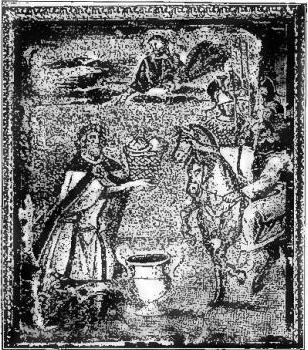
EUCHARIST - Sacrifice of Melchizedek. Mosaic in the central nave of the Basilica of S. Maria Maggiore (6th century - Rome).
Some critics, impressed by the failure of the numerous "mystery" attempts, became convinced that the "Eucharistic phenomenon" is better explained when placed within the more natural framework of Jewish rites and beliefs. The Jewish scholar R. Eisler (Das letzte Abendmahl, in Zeitschrift für die weitestamentliche Wissenschaft und die Kunde der älteren Kirche, 24 [1925], pp. 161-92; 25 [1926], pp. 5-37) is a fervent advocate of this method, which was partly applied by H. Lietzmann (Messe und Herrenmahl, Bonn 1926) and fully by J. Pain (Jésus, Dieu de la Pâque [*Christianisme*, 37], Paris 1930), who sees in the Jewish Passover the prototype banquet on which the Eucharistic agape was modeled.
Around these well-known and qualified theories, others develop, linked to the general tendency of skeptical criticism. In the Anglican environment, where, until the well-known bishop G. Gore, the historical fact of the institution of the E. by Jesus was accepted, doubt has penetrated with C. Quick (The Christian Sacraments, cited by A. E. Morris, Jesus and Eucharist, in Theology, 26 [1933], p. 242). For R. Harris (Eucharistic origins, London 1927), Jesus' words "this is my Body" referred to the soma or haoma of the Indo-Iranian peoples, while Christians, rather unintelligently, understood them as referring to the σῶμα (body) of Christ. There is no need to mention the explanations disseminated by the collection Christianisme, published in Paris under the auspices of Couchoud. One finds assertions such as: "It is around the year 250 (sic!), that Hippolytus of Rome instituted the memorial, by virtue of which bread and body must be offered in remembrance of the death of Christ." A more equitable Swedish theologian identifies three fundamental layers in the genesis of Eucharistic faith: the Synoptic mystery of the personal presence of Jesus at the table as priest; the Pauline mystery of the presence of Christ in the Mystical Body; the Johannine mystery of the presence of Jesus in the sacramental elements of the divine banquet (Y. Brilloth - A. G. Hebert, Eucharistic Faith and Practice Evangelical and Catholic, London 1930).
O. Cullmann (La signification de la Ste-Cène dans le christianisme primitif, in Revue d'histoire et de philosophie religieuse, 10 [1936], pp. 1-22; Le culte dans l'Église primitive, Paris-Neuchâtel 1944; Italian trans., Rome 1948), following Lietzmann, distinguishes two sources of the current E.: the Last Supper, of which St. Paul preserved the echo, and the banquet celebrated by the risen Jesus with his disciples. The primitive E. is connected to this second convivium, dominated by the faith in Jesus' return among his own, on the anniversary of the Resurrection, in expectation of his return at the end of time. This conception inspires the volume by G. Deluz, J.-Ph. Ramseyer, E. Gaugler, La Ste-Cène (Cahiers théologiques de l'actualité protestante, 1, hors série), Paris-Neuchâtel 1945). Recently, A. G. Hebert, Le trône de David, French trans. by P. Fruchon, Paris 1950, pp. 173-96, has given an exclusively sacrificial interpretation of the Last Supper.
THE HISTORICAL TRUTH ON THE ORIGINS OF THE EUCHARIST - This is deduced from the testimonies of the Gospels and St. Paul, which, even when considered in their purely human and natural value, irrefutably document the fact of the institution of the Eucharistic rite by Jesus on the eve of His death. The four New Testament accounts are reported below:
Mt. 26, 26-28
Mk. 14, 22-24
26 While they were eating, Jesus took bread, blessed it, broke it, and giving it to His disciples, said: Take and eat, this is My Body.
27 And taking the chalice and giving thanks, He gave it to them, saying: Drink from it, all of you,
28 for this is My Blood of the covenant, which is poured out for many for the forgiveness of sins.
Lk. 22, 19-20
19 Taking bread, giving thanks, He broke it and gave it to them, saying: This is My Body, which is given for you. Do this in memory of Me.
20 Likewise, He took the chalice after supper, saying: This chalice is the new covenant in My Blood, which is poured out for you.
22 While they were eating, taking bread and blessing it, He broke it and gave it to them, saying: Take, this is My Body.
23 And taking the chalice, giving thanks, He gave it to them, and they all drank from II.
24 And He said to them: This is My Blood of the covenant, which is poured out for many.
24 and giving thanks, broke it and said: This is My Body, which is for you. Do this in memory of Me.
25 Likewise, He took the chalice after supper, saying: This chalice is the new covenant in My Blood. Do this in memory of Me.
A simple reading immediately reveals the substantial agreement of these venerable documents, which is not undermined by accidental divergences. This concordia discors suggests a special affinity between Matthew and Mark on the one hand, and between Luke and Paul on the other. It is therefore customary to distinguish two sources: the Petrine (Mark was a disciple of Peter) and the Pauline (Luke was a disciple of Paul), which differ in the following points:
a) regarding the moment of institution: the Petrine source places it during the supper, the Pauline at the end of the banquet;
b) regarding the words over the bread, the Petrine source reports only "This is My Body," while the Pauline adds "which is given for you" or simply "for you";
c) regarding the words over the wine, the Petrine source first mentions the blood and then the covenant ("This is My Blood of the covenant"), while the Pauline inverts the order, recalling first the covenant and then the blood ("This chalice is the new covenant in My Blood");
d) regarding the command to renew the Eucharistic rite, the first source does not report it, while the second does: once in Luke, twice in Paul.
Independent critics attempt to demolish the value of the testimonies just cited, starting from the concept of institution, which implies the duration over time of what is instituted. For a rite to be considered regularly instituted, it is required that the institutor give the order and establish the conditions for its duration through the centuries. The Eucharist precisely lacks the essential basis for its permanent institution: the command of Jesus. Indeed, Paul's testimony is not reliable because, by invoking a special revelation from the glorified Christ (I Cor. 11, 23), he clearly shows his intention to legitimize, in the eyes of the faithful, the novelty he introduced by attributing it to an express command from heaven. Matthew, who was present at the Last Supper, and Mark, a disciple of Peter, an earwitness of the Master's last words, are silent about the order to repeat the Eucharistic banquet. Moreover, Luke in vv. 19-20 is not authentic; thus, his testimony, which would in any case be devoid of value because it depends on Paul, falls. Finally, John, the disciple who rested his head on the Master's breast in the Paschal cenacle, has nothing to say about the presumed institution that occurred on that occasion.
It is not difficult to break the individual links of this chain of denials. Precisely the Pauline incipit: "Ego enim accepi a Domino, quod et tradidi vobis: Ἔγώ γὰρ παρέλαβον ἀπὸ τοῦ Κυρίου, ὁ καί παρέλωσα ὑμῖν" (I Cor. 11, 23), which has given rise to the most unexpected and implausible subjectivist interpretations, transports us onto the objective plane of reality. In fact, the expression παραλαμβάνων ἀπὸ does not indicate, in this case, receiving from Jesus by way of immediate revelation, but by way of tradition, mediated revelation, that is, through the other Apostles who were direct witnesses of Jesus' teaching. Several arguments support this exegesis:
1. In chapters 11-14 of I Corinthians, St. Paul proposes to restore, in their integrity, the customs common to all the Churches. This intention emerges from various passages: in chapter 11, 16, where the veil of women is discussed, the Apostle writes: "We have no such custom, nor do the Churches (plural, according to the Greek text) of God"; here St. Paul distinguishes the communities he founded (nos) from those established by the other Apostles (Ecclesiam Dei), and yet all agree in the same tradition. In chapter 14, 33, he admonishes: "As in all the Churches of the saints, women should keep silent in the assemblies" (Greek text), and immediately in V. 36 he asks: "Did the word of God come forth from you, or did it reach only you?"—a clear allusion to the same teaching in force in all Christian communities, according to which women must keep silent in sacred gatherings. Precisely in this context falls the passage concerning the Eucharist; therefore, for this rite as well, St. Paul recalls the Corinthians to the common tradition of all the Churches derived from the Apostles.
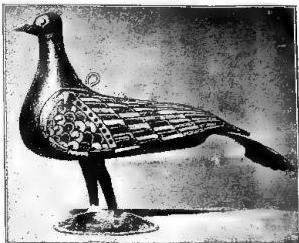
EUCARISTIA - Eucharistic Dove. Limousin art bronze with enamels (ca. 12th century) - Barletta, church of the Holy Sepulchre.
The term παραλαμβάνεων occurs many times in the Pauline epistles (I Cor. 11:23; 15:1-3; Gal. 1:2, 9, 12; Philip. 4:9; Col. 2:6; 4:17; I Thess. 2:13; 4:1; II Thess. 3:6) and, with the exception of Col. 4:17, it is always used to signify a religious knowledge that is received. Now, the subject, except in Gal. 1:12, never receives such knowledge directly from Christ, but through human teaching. It is due to a stylistic exigency of Paul that the text of I Cor. 11:23 is interpreted as referring to a mediated revelation.
3. The clause in I Cor. 11:23 bears a clear resemblance to the phrase in chapter 15:3: « παρέλωσα γὰρ ὑμῖν ἐν πρώτοις. ὁ γὰρ παρέλαβον: tradidi enim vobis in primis, quod et accepi, quoniam Christus mortuus est etc. ». Now, in chapter 15, St. Paul is certainly not speaking of a revelation but of a tradition received from the Apostles. The same interpretation must be applied to chapter 11:23. Nor can it be objected that in chapter 15:3 the ἀπὸ τοῦ Κυρίου is missing, because when speaking of Jesus' death, one could not say that the news was learned from the dying man himself, whereas it was quite possible to assert having received a teaching from Christ through the account of direct witnesses (cf. E. B. Allo, La synthèse du dogme eucharistique chez saint Paul, in Revue biblique, 30 [1921], pp. 321-343, where the author resolves further difficulties that have been raised: in favor of this exegesis have aligned Batiffol, Ruch, Goossens, Allevi, Coppens, in the works cited in the bibliography).
The anteriority of the Eucharist to St. Paul is also deduced from St. Mark. The independence of this Evangelist from I Cor. 11:23-25 appears increasingly well-founded, because if Mark depended on Paul, he would not have omitted the command to repeat the rite; moreover, only Mark preserves the eschatological tone (14:25) of the Eucharistic banquet and the entirely unique tenor of the formula for the chalice. These particularities have appeared to critics themselves as individuating notes that confer an unmistakable physiognomy to the Marcian narrative. If Mark does not depend on Paul, both trace back to an older and common source: one thus arrives at the beginning of the preaching of Peter and Matthew and the other Apostles. Precisely at the origins, Matthew repeated the Lord's phrase: « This is my Blood of the covenant » later gathered by St. Mark. This clause has a particular value because it alludes to the covenant that Jesus substituted for the Mosaic one at the very moment He celebrated the Eucharist, which, as a constitutive element of the new pact, acquires the same characteristics of stability and perpetuity inherent in the concept of covenant. Implicitly, Matthew and Mark enunciate the fact of the divine institution of the Eucharist.
The account of St. Luke (22:15-20) begins with the narration of the legal supper: «15: And he said to them: With desire I have desired to eat this pasch with you, before I suffer. 16: For I say to you, that from this time I will not eat it, till it be fulfilled in the kingdom of God. 17: And having taken the chalice, he gave thanks, and said: Take and divide it among you. 18: For I say to you, that I will not drink of the fruit of the vine, till the kingdom of God come » and continues with the narration of the Eucharistic Supper (vv. 19-20) mentioned above. Independent criticism rejects vv. 19-20 as inauthentic because they are missing in the Codex Bezae and in the Latin codices Vercellensis, Corbionis, Vindebonensis, etc., which present the so-called Western text. Such a stance is critically untenable because these two verses are found in all the Greek minuscule codices (except the D of Beza), in all the versions (except the Syriac Curetonian), and in many Fathers (cf. G. Sacco, La Koinè del Nuovo Testamento e la trasmissione del sacro testo, Rome 1928, p. 197). On the other hand, once the longer, so-called Eastern recension is admitted, the origin of the shorter Western text is well explained. The copyist, in fact, reading in V. 17 « he gave thanks », was persuaded that it referred to the Eucharistic chalice, especially since the following verse reports the eschatological phrase that Matthew and Mark place immediately after the chalice of the Eucharist. Having formed this conviction, he proceeded without scruple to the suppression of V. 20, deeming it superfluous. The Lucan account, in its Eastern recension, to be considered authentic, is independent of that of Paul because it has an entirely unique progression in describing the two suppers, legal and Eucharistic, in placing the eschatological discourse before the institution of the Eucharist, and in omitting in the same discourse the adjective « new »; one is thus in the presence of a new testimony in favor of the institution of the Eucharist by Jesus, who, according to Luke, after the consecration of the bread, said: Do this in memory of me (v. 19, cf. J. Coppens, Les origines de l'Eucharistie, d'après les livres du Nouveau Testament, in M. Brillant, Eucharistia, Paris 1934, pp. 31-32).
St. John does not recount the institution, it is true, but the discourse of Jesus on the absolute necessity of the Eucharist, as the bread of life, for all men (chapter 6:51-55), would not have been reported if in the Evangelist's thought the fact of the Last Supper, by then known to all, had not been present (cf. P. Doncoeur, Des silences de l'Évangile de saint Jean, in Recherches de science religieuse, 21 [1934], p. 600).
Rightly did the Council of Trent, in session XIII, chapter 1, define that « our Redeemer instituted this so admirable Sacrament at the Last Supper, when, having blessed the bread and wine, He declared with clear and perspicuous words (disertis et perspicuis) that He was giving them His Body and His Blood, and that those words are reported by the Evangelists and repeated by St. Paul » (Denz-U, 874, cf. 844 and 875). Pius X condemned the following Modernist proposition: « Not all that St. Paul narrates concerning the institution of the Eucharist is to be taken in a historical sense » (Denz-U, 2045, cf. 2039).
BIBL.:
E. B. Allo, La synthèse du dogme eucharistique chez saint Paul, in Revue biblique, 30 (1921), pp. 321-343; P. Batiffol, L'Eucharistie, Paris 1913; M. Brillant, Eucharistia, Paris 1934; J. Coppens, Les origines de l'Eucharistie, in Eucharistia, Paris 1934, pp. 31-32; P. Doncoeur, Des silences de l'Évangile de saint Jean, in Recherches de science religieuse, 21 (1934), p. 600; G. Sacco, La Koinè del Nuovo Testamento e la trasmissione del sacro testo, Rome 1928.
A. Vaccari
III. BRIEF RESPONSE TO INDEPENDENT CRITICS
The verdict of history has by now turned against them. Due to the rapid succession and mutual contradiction of their theories—which have a precedent only in the endless combinations imagined by Gnosticism—they have fallen into general disrepute. The bankruptcy of the system could not have been more resounding. Starting from a deliberately agnostic preconception, formulated by J. Réville (Les origines de l'Eucharistie, Paris 1908, p. 641) as follows: «We shall never know what Jesus said to his Apostles in that solemn hour», the critics, immediately afterward, explain in detail what Jesus said and did on that occasion. Such a method reveals how little objectivity they employ in attributing to Jesus their own ideas, more or less religious, of men without faith. Catholics, on the other hand, accepting with scientific honesty the New Testament documents, historically and critically examined, place themselves in a position to grasp the objective meaning of the Last Supper. The words and gestures of Jesus, in their natural and obvious sense (as will be seen more clearly below), indicate the sovereign gift of the Master, who offers his Body and his Blood, mysteriously immolated, as food and drink to his disciples.This doctrine, which spontaneously emerges from the brief Gospel account, could not have been introduced by St. Paul, as if channeling into the narrow bed of Christianity the abundant waters of pagan religiosity. Indeed, a diligent and detailed study of all historical fragments concerning ancient religions, especially the mystery cults, has led to the conclusion that «this slice of paganism» (ein Stück Heidentum), to use the expression of O. Holztmann, St. Paul could not have cut from any of the cults then in existence. It has never been proven that the savior gods of Greco-Roman syncretism were literally dead and resurrected gods, and it is debatable whether the mysteries truly intended to commemorate their passion, whether the initiates attributed a salvific efficacy to this passion and its commemoration, whether this efficacy derived from the union of the faithful with the passion of the gods, whether this union was effected through a sacrificial meal whose essential rite consisted in the distribution to the initiates of blessed bread and a cup of consecrated wine, and finally whether the salvation thus obtained was personal and spiritual, assured for all eternity (cf. J. Coppens, Eucharistie, in DBS, II, col. 1206). Despite these substantial differences, there are distant analogies between the E. and pagan mysteries; these have been excessively fantasized, and «when it came to the crux of the matter, fireflies were taken for lanterns, or it was claimed that a mosquito is in every way equal to an eagle, since both have wings, fly, and feed on blood» (G. Ricciotti, Vita di Gesù Cristo, 4th ed., Milan 1940, p. 670). Moreover, even if pagan religiosity had offered any prototype of the E., the psychology of the convert from Tarsus would have prevented its adaptation to Christianity. An indomitable adversary of paganism, by virtue of his Jewish origin and Christian education, he exclaims: «Quae autem conventio Christi et Beilal» (II Cor. 6:15) and warns: «Nolo vos socios fieri daemoniorum» (I Cor. 10:20), fully revealing his spirit. Furthermore, his position as a latecomer and former persecutor did not allow him to alter in any way the tradition in the presence of those who had been eyewitnesses to Jesus' work, without a chorus of protests arising from all sides (cf. E. Pinard de la Boullaye, Gesù Cristo e la storia, trans. by G. Actis, Turin 1931, pp. 117-47).
Recent investigations into Jewish analogies have demonstrated that the E. is a unique rite, defying any comparison with the data of the Old Testament and the institutions of Palestinian and Hellenistic Judaism (cf. Coppens, Eucharistie, loc. cit., col. 1193).
EUCHARIST
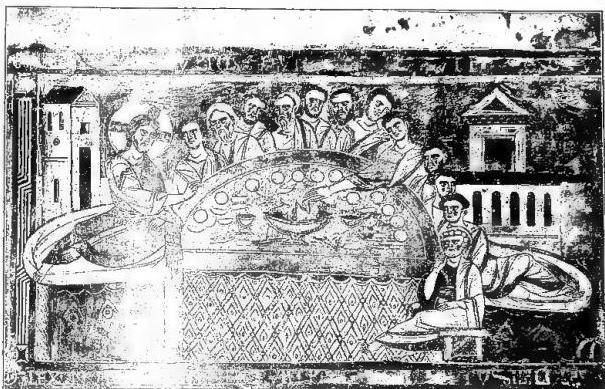
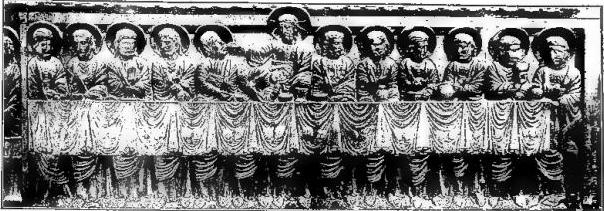
Last Supper. Fresco by the Cassinese school (11th century) - S. Angelo in Formis. Cathedral.
The most comprehensive and profound works that summarize and refute radical theories are: W. Berring, Die Einsetzung der heiligen Eucharistie in ihrer ursprünglichen Form nach den Berichten des Neuen Testament kritisch untersucht, Münster 1901; K. G. Goetz, Die heutige Abendmahlsfrage in über geschichtlichen Entzuschau, 2nd ed., Leipzig 1907 (the author is Protestant but defends the Catholic thesis); J. Lebreton, Eucharistie, in DFC, I, cols. 1349-67; C. Ruch, Eucharistie d'après la Ste Écriture, in DThC, V, cols. 689-1120; B. Frischkopf, Die neusten Erörterungen über die Abendmahlsfrage, Münster in Westfalen 1921; W. Goossens, Les origines de l'Eucharistie Sacrement et Sacrifice, Gembloux-Paris 1931 (remarkable for its breadth, erudition, and certainty); J. Coppens, Eucharistie, in DBe, II, cols. 1140-1215 (clear and concrete, with a rich bibliography of Catholic authors); id., Les origines de l'Eucharistie d'après les livres du Nouveau Testament, in M. Brillant, Eucharistie. Encyclopédie populaire sur l'Eucharistie, Paris 1934, pp. 3-36; A. Arnold, Der Ursprung des christlichen Abendmahls im Lichte der neusten liturgiegeschichtlichen Forschung, Freiburg im Breisgau 1937 (focuses particularly on Lietzmann, Wester, and Fr. Case O.S.B.: mystical presence).
In particular: F. Campino, Evoluzione di sistemi sulle origini dell'E., in La scuola cattolica, 63 (1935), pp. 296-312; E. Floris, Il metodo della «Storia delle forme», Rome 1933, pp. 141-59; J. de Montcheuil, L'Eucharistie dans le Nouveau Testament, in Mélanges théologiques, Paris 1946, pp. 23-48 (critique of O. Cullmann). On the alleged relations between the Eucharist and pagan mysteries: M. Jugie, Mystères païens et le Paul, in DFC, II, cols. 684-1014; M. J. Lagrange, Mélanges d'histoire religieuse, Paris 1914, pp. 69-130; id., Les mystères d'Éleusis et le Christianisme: Attis et le Christianisme, in Revue biblique, 28 (1919), pp. 157-217; 419-80; id., Les mystères païens et le mystère chrétien, ibid., 29 (1920), pp. 420-46 (critique of Loisy); A. D'Alès, Lumen vitae, 2nd ed., Paris 1916, pp. 38-77; L. Venard, Le Christianisme et les religions des mystères, in Revue du clergé français, 103 (1920), pp. 182-200, 283-88; U. Fracassini, Il misticismo greco e il cristianesimo, Città di Castello 1922; N. Turchi, Fontes historici mysteriorum, Rome 1923; id., Le religioni misteriosofiche del mondo antico, ibid. 1923; M. J. Lagrange, M. Loisy et le modernisme, Juvisy 1932, pp. 200-17; A. J. Festugière, L'idéal religieux des Grecs et l'Évangile, Paris 1932; id., Le monde gréco-romain au temps de Notre-Seigneur, 4 vols., ibid. 1935; C. Ruch, Les rites eucharistiques et l'histoire comparée des religions, in M. Brillant, Eucharistie, ibid. 1934, pp. 719-34; L. Allevi, Ellenismo e cristianesimo, Milan 1934, pp. 128-41; G. M. Polestra, I misteri pagani e il cristianesimo, Florence 1944 (with abundant bibliography at pp. 391-401); H. Rahner, Griechische Mythen in christlicher Deutung, Zurich 1945; N. Turchi, Le religioni misteriche del mondo antico, Milan 1948 (at pp. 125-28, comparison with Christianity). On relations with Judaism: J. Coppens, Les soiélium analogues juives de l'Eucharistie, in Ephemerides theologicae Lovanienses, 8 (1931), pp. 131-148; id., Eucharistie, in DBe, II, cols. 1102-93.
II. THE TRUTH OF THE EUCHARISTIC PRESENCE.
I. ERRORS
The Gnostic-Manichaean dualism, attributing material creatures to the principle of evil, had to reject the Eucharist. This error, singular in its essence but protean in its manifestations, nourished the denial of real presence for a millennium. The Docetists, the first in this series, attributing to Christ an apparent body (ἔσσεω), did not believe that His flesh was present in the Eucharist (Ignatius M., Smyrn., 7, 1). The Archontics, widespread in the 4th and 5th centuries in Palestine and Armenia, admitted seven heavens dominated by seven princes, the last of whom, called Sabaoth, was considered the cause of evil, the father of the Jews, and the institutor of the Eucharist (Epiphanius, Haer., 40: PG 41, 680-84). The Euchites, also called Messalians or Enthusiasts, originating in Mesopotamia and later spreading to Pamphylia and Lycaonia, placed the essence of religion in prayer (εὐχή), considering the Eucharist an ordinary food (Theodoret, Hist. eccl., 4, 10: PG 82, 1144). The Paulicians, whose origin and name remain obscure, moved from Syria to Asia Minor and in the 11th century, through the Byzantine Empire, settled in Bulgaria, where, through the work of a certain Bogomil (hence the new name Bogomils), they took root (cf. V. N. Scharenkoff, A study of Manicheism in Bulgaria, New York 1927). Subsequently, spreading throughout the Balkan countries, they penetrated Italy (Patarines), France (Bulgars, Albigensians), England (Publicani), and Germany (Winckelers) through Dalmatia (Traù). They are the famous Cathars, declared enemies of the Eucharist (cf. S. Runciman, Le manichéisme médiéval, French trans. by S. Pétrement and L. Marty, Paris 1949, passim).
The Eastern error has a cosmological basis, while the Western one is rather gnoseological. In the West, indeed, Berengar of Tours (d. 1088) began his struggle against the Eucharist from dialectical motives. In that century, all Christendom, led by Gregory VII, was in ferment. Intellectually, three tendencies emerged: anti-dialectical (St. Peter Damian), moderate (St. Anselm), and ultra-dialectical. The greatest exponent of the latter was Berengar (v.), who, neglecting arguments from authority, strove to demonstrate, by reason alone, the impossibility of Eucharistic conversion: if accidents are everywhere, there the substance is, noting that after Consecration the same accidents as before remain, he concluded that nothing had been transformed. Moreover, he added, nothing can be changed into a pre-existing thing. From these premises, he slipped into the denial of real presence: if the Body of Christ were in the Eucharist, it would have to be present as many times as there are consecrated Hosts; there would be a multiplication of the same Body: this is absurd (cf. Berengarii T. de Sacra Coena adv. Lanfrancum, ed. W. H. Beckenkamp, The Hague 1941, passim). With such reasoning, Berengar, if he showed little theological sense, revealed however an intellect sharpened by a spirit unafraid to touch the real difficulties inherent in the mystery. The Catholic world was disturbed, an avalanche of protests, treatises, and condemnations poured upon the audacious scholastic of Tours, who in the Lateran Synod of 1079 abjured his error in the hands of Gregory VII.
In the 12th century, Hugh Speroni, echoing Berengar’s thought, held that the bread blessed by Jesus was not His Body but the sign of His Body (cf. Barino da Milano, L'eresia di Ugo Speroni nella confutazione del Maestro Vacario, Vatican City 1945, pp. 268-289). These ideas circulated among all medieval sects (Petrobrusians, Waldensians, Flagellants, Tanchelmists, Wycliffites) until they flowed into Protestantism.
Luther did not dare deny real presence, especially because (as he himself confessed to the "reformers" of Strasbourg) the Gospel text is too clear and also because in his soul there always remained that mystical foundation which demanded closeness and union with Christ. He erred, however, and gravely, on other points of Eucharistic doctrine. Carlstadt, the coarse and fanatical archdeacon of Wittenberg, was the first who, rebelling against Luther, dared in 1524 to interpret the words "this is my Body" in the sense that with the pronoun "this" the Lord, not being able to signify the bread which is of masculine gender (dignoc), would have indicated, pointing to Himself, His own body in its natural state. Luther railed against Carlstadt, who, finding refuge in Strasbourg, spread the error there. Just at that time, the envoys of Cornelius Hoen, a lawyer from The Hague, arrived in Germany, bearing a Eucharistic letter in which the words "Hoc est Corpus meum" were explained as: "Hoc significat Corpus meum." Luther drove them away with scorn; then they turned to Basel, where they were well received by Oecolampadius, who communicated the letter to Ulrich Zwingli, a priest without vocation, who had long been meditating on how to rid himself of the Eucharist. This was the occasion for him to manifest himself, and the painful and lengthy sacramental controversy arose, dividing the "Reformation" at its birth. Carlstadt, Zwingli, and Oecolampadius were branded by Luther with the nickname "scourges of the Sacrament" or "Sacramentarians," which rightly remained with them, because in the Eucharist they admitted only a sacred sign (sacramentum) representing the Body of Jesus. Seeing how much damage this struggle had caused Luther, Calvin thought to find a kind of compromise that would succeed if not in erasing at least in covering the deep divisions of the "Reformation." Insinuating himself with ambiguous phrases and tortuous periods, the cunning theologian of Geneva taught that in the Eucharist the Body of Christ (which is only in heaven) is present in the sense that the bread, receiving from above an irradiation of the virtue of the Lord’s Body, acquires a particular sanctifying power that is transmitted to the communicants (dynamic or virtual presence). The Anglicans slipped, despite an apparently orthodox phrasing, toward Calvinist ideology, until in the 19th century, with the Oxford Movement, they attempted to return to the Catholic conception, which Newman reached in 1845, while Pusey remained halfway, becoming, after 1845, the venerated leader of the Tractarians and Puseyists. In Germany and other Protestant countries, Eucharistic faith increasingly weakened, so much so that it is difficult to find an "evangelical," even orthodox, who admits real presence. The liberals, having rejected the supernatural altogether, descended into radical denials, which have been discussed at the beginning.
The Modernists, the last epigones of dogmatic liberalism, while denying real presence, judge it opportune to behave before the Catholic tabernacle as if Christ were present, because this helps to nourish religious sentiment (Eucharistic pragmatism: cf. E. Le Roy, Dogme et critique, Paris 1907, pp. 18-20; 258-59). J. Turmel (Histoire des dogmes, V, IV 1936, pp. 205-25) maintains that the dogma of real presence arose only in the 9th century. Notes on the Eucharist (permanent symbol of the realization of the mystical Christ) in E. Buonaiuti, Storia del Cristianesimo (I, 2nd ed., Milan 1944, pp. 59, 63).
BIBL.:
Per gli errori antichi: J. de Ghellinck, Patristique et Moyen Âge, I, Parigi 1946, pp. 151-55; A. d'Alès, La théologie de s. Épiphane, Parigi 1934, pp. 193-200; H. Leclercq, L'Eucharistie chez les hérétiques, in DACL, V, coll. 1201-1212. Per Berengario: A. Fliche, La réforme grégorienne, III, Lovanio 1937, pp. 139-45; J. de Montclos, Lanfranc et Bérenger, Lovanio 1971. Per le eresie medievali: H. Grundmann, Ketzergeschichte des Mittelalters, in Die Kirche in ihrer Geschichte, a cura di K. D. Schmidt e E. Wolf, I, Gottinga 1961, pp. 1-186. Per il protestantesimo: J. Paquier, L'Eucharistie dans le protestantisme, Parigi 1929; H. B. Swete, The Holy Eucharist in the New Testament, Londra 1900; P. Althaus, Die christliche Wahrheit, Gütersloh 1948, pp. 450-60. Per il modernismo: A. Houtin, Histoire du modernisme catholique, Parigi 1913; A. Loisy, Mémoires pour servir à l'histoire religieuse de notre temps, Parigi 1930-31.
A. Piolanti
II. TEACHING OF THE CHURCH
The Church has rejected Eucharistic errors as they emerged. Its most solemn interventions were prompted by Berengarius and the Protestants.Against Berengarius, thirteen synods were convened (from 1050 to 1095), the most important of which were: the Lateran Synod of 1059 (under Nicholas II), where the heretic was made to read a formula, not entirely felicitous, drafted by Cardinal Humbert of Silva Candida (cf. L. Ramirez, La controversia eucarística del siglo XI: Berengario di Tours a la luz de sus contemporáneos, Bogotá 1940, pp. 60-78), and the Lateran Synod of 1079, where, before St. Gregory VII, Berengarius pronounced this clear formula: « Credo che il pane e il vino... in virtù delle parole del Redentore si convertano sostanzialmente (substantialiter converti) nella vera e propria... Carne e Sangue di Gesù Cristo e che dopo la consacrazione c'è il vero Corpo, che nacque dalla Vergine, che patì sulla Croce, che siede alla destra del Padre, e il vero Sangue, che agorgò dal suo costato, non solamente in segno e figura, ma in proprietà di natura e verità di sostanza (in proprietate naturae et veritate substantiae) » (Denz-U, 355).
The Council of Trent (sess. XIII, ch. 1 and can. 1) addressed Protestant errors in their various nuances: « Prima di tutto il S. Concilio insegna che in questo almo sacramento della S.ma E., dopo la Consacrazione del pane e del vino, sotto le specie di queste cose sensibili, si contiene veramente e sostanzialmente N. S. Gesù Cristo, vero Dio e vero Uomo... Se qualcuno negherà che nel S.mo Sacramento dell'E. si contenga vere, realiter, substantialiter, il Corpo e il Sangue insieme con l'anima e la divinità di N. S. Gesù Cristo e perciò tutto Gesù Cristo, ma dirà che in questo Sacramento vi è soltanto in segno, o in figura o in potenza, sia scomunicato » (Denz-U, 874, 883). Other Church documents can be found in A. D'Alès, De Eucharistia (Paris 1929, pp. 72-73).
III. POSITIVE PROOFS OF THE CATHOLIC TRUTH
Since the real presence is a mystery that surpasses the powers of the intellect and eludes the experience of the senses, it can only be known through revelation.1. Scripture recounts three events (the promise, the institution, the celebration of the Eucharist in the nascent Church) from which the Catholic truth emerges. The promise is narrated by St. John in chapter 6 of his Gospel. Taking the miracle of the multiplication of the loaves as his starting point, Jesus elevates the thought of his listeners to the idea of a spiritual bread, which is identified with his flesh, exempt from natural laws. Jesus develops these ideas with progressive clarity until he arrives at those lucid expressions that defy all the subterfuges of a convoluted exegesis: « In truth, in truth I say to you, unless you eat the Flesh of the Son of Man and drink his Blood, you shall not have life in you. He who eats my Flesh and drinks my Blood has eternal life, and I will raise him up on the last day. For my Flesh is true food, and my Blood is true drink. He who eats »
EUCHARIST - Last Supper, executed by the Campionesi Brothers (1170-1220), detail of the sculptures of the - Pontile - Modena, Cathedral.
my Flesh and drinks my Blood remains in me and I remain in him. As the Father, who has life in himself, sent me and I live through the Father, so he who eats of me will live through me" (vv. 53-57).
The realism of these expressions is further highlighted by Jesus' attitude toward his listeners. The audience consisted of three groups of people: the Jews, the disciples, and the Apostles.
The Jews, that is, the adversaries who waged relentless war against the Lord, understood Jesus' words in their literal sense and cried out at the absurdity: "How can this man give us his Flesh to eat?" Jesus' conduct, as revealed throughout the Gospel, follows this pattern: when his listeners misunderstood his words, he took great care to dispel the ambiguity (cf. Jo. 3, 3-8; Mt. 16, 6-12), but when they interpreted them correctly yet refused to accept them due to the intrinsic difficulty of their content, he did not modify his discourse; instead, he reaffirmed the same idea in many ways. In the present case, Jesus did not soften the slightest nuance of his statements; rather, he insisted three times on the same concept—that his Flesh and his Blood are truly food and drink. The realistic interpretation of the adversaries corresponded exactly to the Master's thought, which he upheld with divine firmness against their unbelief.
The disciples, less hostile than the Jews, did not absolutely deny the possibility of the statement but pointed out its difficulty: "durus est hic sermo." Even before the intellectual discomfort of the disciples, Jesus did not retract the smallest part of his discourse. Instead, with the kindness he reserved for those of good will, he dispelled the crude interpretation with which they understood the words of the promise: they thought, in fact, that one should eat the Flesh of Christ as one consumes butchered meat (the Capernaum interpretation). Jesus, with a phrase of exquisitely Semitic color, said: "It is the Spirit that gives life; the flesh is of no avail. The words that I have spoken to you are spirit and life" (v. 64); that is, life always proceeds from the Spirit, and thus even my Flesh, separated from the Spirit—that is, from the Divinity—cannot give life, but united with it, it can vivify in a manner fitting to human nature and possible to divine omnipotence. If with this new expression he provided the disciples with the key to a higher exegesis, he did not retreat from his position, as proven by the fact that from that moment, many of the disciples, despite the clarifications received, turned away from him.
Then Jesus turned to the elect portion of his listeners and provoked the apostolic college to take a stand: "Do you also wish to go away?" St. Peter, on behalf of the Twelve and as if bearing the seed of the faith of the whole Church, cried out: "Lord, to whom shall we go? You alone have the words of eternal life. We believe and know that you are the Christ, the Son of God."
Engraved in the minds of the Apostles, the words of the promise form the natural backdrop against which the scene of the Last Supper is set. When Jesus, barely a year after the discourse at Capernaum, took the bread and said, "This is my Body," and holding the cup of wine in his hands added, "This is my Blood" (Mt. 26, 26-28; Mk. 14, 22-23; Lk. 22, 19-20; I Cor. 11, 24-25), the Apostles immediately saw in the Master's gesture the fulfillment of the promise made on the shores of the lake. And it could not have been otherwise, for the terms are of particular clarity. The phrase "This is my Body" constitutes a demonstrative proposition in which the subject (this) vaguely indicates what will be clarified by the predicate; in the predicate, Jesus declares it to be his Body, so that at the end of the proposition, the Lord held in his hands, under the appearances of bread, his Body. The words have no other meaning, especially since Christ, with a certain emphasis, says: this (τοῦτο) is my Body, this (τοῦτο) very thing that is given and immolated (διδόμενοι) for you. Such insistence clearly indicates the identity of his natural Body with the Eucharistic one. In the phrase "This is the Blood of the covenant" (τῆς διαθήκης), the Mosaic expression echoes: "hic est Sanguis foederis" (Ex. 28, 8): the two covenants are juxtaposed, both established in Blood. True was the Blood used by Moses, true is the Blood employed by the new lawgiver.
Moreover, in the supreme hours of life, no man uses enigmatic expressions; Jesus, true man, did not depart from this psychological law: the disciples noted this when, during the priestly discourse, they exclaimed: "nunc palam loqueris et nullum proverbium dicis" (Jo. 16, 29). He could not, at that moment when he was founding the new economy and instituting the greatest Sacrament, use enigmatic expressions that would have caused endless disputes among his disciples. Furthermore, Jesus had before him, in the mirror of the beatific vision, all Christian generations: he foresaw how his words would be interpreted. Under the Protestant hypothesis, Jesus, despite this, would have used ambiguous terms, thus deceiving the faithful of all centuries. With Christian realism, Erasmus wrote to Bero (in 1529), in the midst of the sacramental struggle between the "reformers": "I have never been able to persuade myself that Jesus, who is Truth and Goodness itself, permitted his bride, the Church, to adore a piece of bread (frustulum farinae) in his place for so many centuries." A simple and profound argument, which should have deterred the innovators from frantically seeking scriptural footholds for their error. They have accumulated many texts that would be parallel to the Eucharistic phrase "Hoc est Corpus meum," in which the word est would mean significat. For four centuries, philology has shown the illegitimacy of such a procedure (cf. H. Hurter, Theologiae dogmaticae compendium, III, 10ª ed., Innsbruck 1900, pp. 300-303; J. Lebreton, Eucharistie, in DFC, I, coll. 1357-58; L. Lercher - F. Dander, Institutiones theologiae dogmaticae, IV, 1, 2ª ed., Innsbruck 1948, pp. 218-19).
Obedient to Jesus' command, "Do this in memory of me," immediately after Pentecost the Apostles began the celebration of the Eucharistic mystery in all the cities of their evangelical conquests, and thus the "fractio panis" was celebrated in Jerusalem (Act. 2, 42), in Troas (Act. 20, 7-11), and in Corinth (I Cor. 11, 17-34). It was precisely in the latter city that those disorders surrounding the κυριακὸν δεῖπνον occurred, which provoked St. Paul's letter, in which the faith of the nascent Church is captured in the act of its normal exercise. The Apostle, indeed, in chapter 10, rejecting as illicit the consumption of idolothytes (meats sacrificed to idols), uses expressions from which the idea of real presence clearly shines forth: "Calix benedictionis cui benedictimus, nonne communicatio (κοινωνία) Corporis Christi est, et panis quem frangimus nonne participatio (κοινωνία) Corporis Christi est" (I Cor. 10, 16). According to the force of the Greek term κοινωνία, St. Paul means that Eucharistic Communion is the real, physical participation in the entire and undivided Body of Jesus.
In the following verse 17, he speaks of the social effects of the Eucharist in such a way as to leave no doubt about the true presence of the Lord's Body: "Because there is one bread, we who are many are one body, for we all partake of the one bread" (eucharistic). If the Eucharist were just any piece of bread, it could not unify the faithful.
In chapter 11, wishing to correct the abuse that had arisen of not waiting for one another in the fraternal agape that preceded the sacramental supper, St. Paul recalls the account of the institution. The Apostle likes to highlight the contrast between the love of Jesus carried to the extreme and the ingratitude of men who, at that very moment, were plotting betrayal. The incise "in qua nocte tradebatur" is certainly chosen to deter the faithful of Corinth from those abuses, which would have placed them on the same level as those who opposed the love of Jesus with the ingratitude of betrayal, and he adds that warning, destined to shake the consciences of Christians of all times: "For as often as you eat this bread and drink this cup, you proclaim the Lord’s death until he comes. Therefore whoever eats the bread or drinks the cup of the Lord unworthily will be guilty of the body and blood of the Lord. Let a man examine himself, and so eat of the bread and drink of the cup. For he who eats and drinks unworthily, eats and drinks judgment to himself, not discerning the Lord’s body. For this reason many are weak and sick among you, and many sleep" (vv. 25-29). If the Body of Jesus were not present under the eucharistic appearances, St. Paul could not say that one eats his own condemnation who does not distinguish the Body of the Lord from common food.
2. Tradition shows the continuity and homogeneous development of the concepts and practices already established in biblical documents. St. Justin Martyr, addressing his Apologia to the emperor, the Senate, and the Roman people around the middle of the 2nd century, states textually: "We have learned (ἐδιδάχθημεν) that the eucharistized food... is the Flesh and Blood of the Incarnate Jesus" (Apologia, I, 66: PG 6, 427). The first Christians learned from teachers (διδάσκαλοι), whose teaching had a public character, that the consecrated bread and wine were the Body and Blood of Jesus. What truly impresses is this social and collective character of the ancient testimonies regarding the Eucharist: liturgical documents (Didaché, 9 and 10; Traditio Apostolica of St. Hippolytus, ed. Quasten, pp. 29-30; Anaphora of Serapion, 4, 15; Apostolic Constitutions, 8, 11-15); letters to entire communities (Ignatius M., Smirn., 7, 1; Eph. 20; Phil. 4); catecheses directed to all aspirants to Baptism (St. Cyril of Jerusalem, Catecheses mystagogicae, III, IV, V: PG 33, 1098-1115; St. Ambrose, De mysteriis, 9, n. 54: PL 16, 407; De Sacramentis, 4, 23: PL 16, 441; Theodore of Mopsuestia, Catecheses, ed. Rücker, Münster 1933, pp. 19-42); homilies delivered in the presence of all the faithful (St. John Chrysostom, Hom. 24 in I Cor. 1-4: PG 61, 199-204; St. Augustine, Serm., 207: PL 38, 1099); funerary inscriptions (epitaph of Abercius and of Pectorius of Autun) and catacomb paintings (cf. R. S. Bour, Eucharistie d'après les monuments de l'antiquité chrétienne, in DThC, V, coll. 1183-1209), books of public controversies (St. Irenaeus, Adv. haeret., 4, 18: PG 7, 1027-29; Tertullian, De resurrectione carnis, 8: PL 2, 806).
This imposing complex of public documents reveals not the thought of this or that doctor, but the lived faith of the whole Church. This fides simplex (ἀλλὰ πίστις) universally admits that after the Consecration, the bread and wine are the Body and Blood of the Lord. By virtue of this fides, the Eucharist is commonly called the holy thing par excellence: τὸ ἅγιον (Didaché, 9, 15; Dionysius of Alexandria, in Eusebius, Hist. eccl., 7, 9), "Sanctum" (Tertullian, De spectaculis, 25: PL 1, 732), and is therefore treated with religious care: "Calicis aut panis etiam nostri aliquid decuti in terram anxie patimur" (Tertullian, De corona, 3: PL 2, 99); "Nestis qui divinis mysteriis interesse consuestis, quomodo, cum suscipitis Corpus Domini, cum omni cautela et veneratione servatis, ne ex eo parum quid decidat, ne consecrati muneris aliquid dilabatur. Reos enim vos creditis, et recto creditis, si quid inde per negligentiam decidat" (Origen, In Ex. hom., 13, 3: PG 13, 391); it is accorded a cult of adoration: "Nemo illam Carnem manducat nisi prius adoraverit" (St. Augustine, Enarr. in Ps., 98, 9: PL 37, 1264; cf. St. Ambrose, De Spiritu Sancto, 3, 79: PL 16, 795; St. John Chrysostom, In Mt. hom., 6: PG 67, 78).
Christian faith has always sought a rational illustration: fides quaerens intellectum. Alongside the simplex fides of the masses, even in the early centuries, a intellectus fidei of the few developed—a science of faith (γνῶσις), also with regard to the Eucharist: thus theologia eucharistica was born. And it arose spontaneously, out of a didactic necessity (catechetical teaching), a polemical need (refutation of errors), and an exigency of life (Christian spirituality).
The classic catecheses of St. Cyril of Jerusalem, St. Ambrose, and Theodore of Mopsuestia expound eucharistic doctrine under a threefold aspect: biblical, theological, liturgical. Beginning with the texts of the New Testament, where the real presence is clearly affirmed, they trace back to the Old Testament to identify its figures (τύπος; manna, Melchisedech, paschal lamb) and allusions (Ps. 5, 22; 33, 49; 52, 103 and Cant., various passages). They then proceed to illustrate the intimate meaning (δύναμις) of the Eucharist: the bread
(Int. Aliveri)
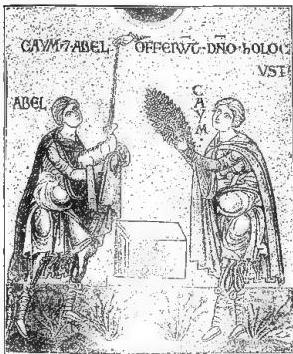
EUCARISTIA - The sacrifice offered by Abel, pleasing to God, a figure of the Eucharistic Sacrifice. Mosaic in the main nave of the Cathedral (12th century) - Monreale.
and the wine, while retaining their appearances, are truly the Body and Blood of the Lord, who renews His immolation to apply its fruits to the faithful. Thus, illustrations of the various rites, which possess a symbolic value (sacrament) in relation to the great realities announced by Scripture and rendered present in the celebration, are introduced (cf. J. Danielou, La catéchèse eucharistique chez les Pères de l'Église, in La Messe et sa catéchèse, Paris 1947, pp. 33-72).
Error makes one cautious. St. Augustine, accustomed to combating various heresies, observed: "Multae res ad fidem catholicam pertinentes, cum ab astuta inquietudine haereticorum agitantur, et considerantur diligentius, et intelliguntur clarius, et instantibus praedicantur" (De Civitate Dei, 16, 2: PL 41, 477).
For the earliest defenders of the dogma, the brief allusions and the subtle connections of the Eucharist with other mysteries became buttresses of the contested truth. Thus, St. Irenaeus demonstrates from the Eucharist the possibility and fittingness of the resurrection of the flesh against the Gnostics (Adv. haeres., 4, 18, 33; 5, 2: PG 7, 1027-29, 1124-27). Tertullian affirms the reality of Christ’s Body against the Marcionites (Adv. Marcionem, 1, 14, 5, 50; 5, 8: PL 2, 562, 460, 480), St. Hilary of Poitiers the unity of nature between the Father and the Son against the Arians (De Trinitate, 8, 13-17: PL 10, 245-49), St. Optatus of Milevis the unity of the mystical body against the Donatists (De schismate Donat., 6, 1: PL 11, 1063), St. Cyril of Alexandria the hypostatic union against Nestorius (Adv. Nestor., 4: PG 76, 192-93), and St. Leo the Great the integrity of Christ’s human nature against the Monophysites (Serm., 9, 3: PL 54, 452). The real presence was a doctrine so deeply ingrained in the minds of both Catholics and heretics that it constituted the commonly admitted point in the fierce controversies of those times (cf. J. B. Franzelin, De Eucharistia, 5th ed., Rome 1932, pp. 137-43).
If error makes one attentive, love makes one intelligent, for "amor ipse notitia est." The early Christians concentrated their inquiries on this fundamental cell of the dogma: amor multiplicat imquisitionem. From this, they ascended to the other mysteries, illuminating their truest and deepest connections. Starting from Jn. 6:52-57, considered the summit of Christian revelation, the Fathers of the Church examine in their mutual relationship the mysteries of the Trinity, the Incarnation, and the Eucharist. The latter is presented by them as an extension of the second and as a link connecting it to the first, because the divine life, circulating within the bosom of the One and Triune God, communicated to us in the Incarnate Word made our food, enables us to ascend to the first source. St. Ignatius of Antioch, disciple of St. John, inaugurates this precious series of testimonies: "The Eucharist is the flesh of our Savior Jesus Christ, that same flesh which was immolated on the Cross for us and which the Father raised" (Smirn., 7, 1). St. Justin develops this parallel between the Incarnation and the Eucharist: "As by the power of the Word of God, our Savior Jesus Christ had flesh and blood for our redemption, so the food eucharistized by a word of prayer derived from Him, having become Eucharist (by which our flesh and blood are nourished for a spiritual transformation), is the flesh and Blood of the Incarnate Jesus. Thus we have learned" (Apologia, 1, 66: PG 6, 428). In the 4th century, the idea attains its fullest development in St. Hilary of Poitiers: "If Christ truly took the flesh of our body and, being born of the Virgin, is true man, and we in the Eucharist truly receive the flesh of His Body, and thus we are one (unum) because the Father is in Him and He is in us, how can one affirm only a unity of will, if He communicates to us His very nature in the Sacrament of perfect unity? He (Christ) lives for the Father, because in His eternal generation He did not receive a foreign and different nature... Therefore, with the Son and through the Son, we are united with the Father, not only by will and religious devotion, but really and inseparably by the dignity of (adoptive) sonship that has been communicated to us and by the Son Himself, who dwells in us with His flesh. This is the mystery of true and real unity, which we defend against the heretics" (De Trinitate, 8, 13: PL 10, 246). St. Cyril achieves an even greater degree of clarity: "The Only-Begotten Son, who is begotten from the essence of God the Father and has in His nature the Father who begot Him, became flesh, united Himself with our nature by an ineffable union, and with this body of clay He willed to reunite what was by nature infinitely separated—God and man—and to make men partakers of divinity... Therefore, that we might attain unity with God, the Only-Begotten Son found in His wisdom and in the counsels of the Father an admirable way. He sanctifies the faithful by the communion of His Body and makes all one and the same Body with His own (σύσσωμος). Thus, we are all one (unum) in the Father, in the Son, and in the Holy Spirit, by the unity of relation and the conformity of piety, and above all by the communication of the sacred Body of Jesus Christ and of the same Spirit" (In Io. 11, 11: PG 74, 559). This doctrinal synthesis, the fruit of the most mature theology of the Fathers, highlights two capital points of the Eucharistic dogma: the reality of Christ’s Body in the Sacrament and its identity with the Body born of the Virgin. The reality of the Body is evident, for upon it rests the parallel between the Incarnation and the Eucharist, and it is the same reality that makes one understand how the work of union, begun in the Incarnation, is prolonged and perfected in the Eucharist. The identity of the Eucharistic Body with the historical one is no less clear: the principle from which the Fathers start is that only the body hypostatically united to the Word can be the source of life (panis vitae), and all their efforts are concentrated on explaining how this unique Body "τὸ ἓν ἐκεῖνο σῶμα" (St. Gregory of Nyssa, Oratio catechetica, 37, 4: PG 45, 94) can reach all the faithful and unify them.
This Eucharistic theology developed in profoundly different spiritual climates. The schools of Antioch and Alexandria, while adhering with sincere faith to the dogma,
The two tendencies met and merged in St. Augustine, whom Protestants and Modernists in vain hailed as the patron of an empty symbolism. The holy Doctor, in fact, united the realism of the purest Roman and African tradition (Hippolytus, Tertullian, Cyprian) with a symbolism of Alexandrian flavor, though developed in an ecclesiological function against the Donatist schism. With limpid reasoning, St. Augustine distinguished in the Eucharist: a) id quod scidetur, the sensible species; b) id quod creditur, the Body and Blood of the Lord; c) id quod intelligitur, the complex of the mystery as a symbol of the Mystical Body; “What you see is the bread and the chalice; things that fall under your eyes. What your faith demands is this: the bread is the Body of Christ, the chalice is the Blood of Christ. This has been briefly expounded, for it suffices for faith. But faith desires instruction (fides instructionem desiderat); for the Prophet says: Nisi credideritis, non intelligetis (Is. 7:9). You might say to me: You have commanded us to believe, now explain so that we may understand (intelligere). If you wish to understand (intelligere) what the Body of Christ is, listen to the Apostle: Vos autem estis Corpus Christi et Membra (Rom. 12:4-5)” (Sermo 272: PL 38, 1246). The two streams of Antiochene and Alexandrian tradition, which thus so well converged in the limpid channel of Augustinian theology, became muddied in the harsh polemics of the 9th century. Paschasius Radbertus perhaps pressed too hard on realism, while Ratramnus insisted on symbolism in a way that gave rise to suspicions about his faith. Ratramnus found supporters in Rabanus Maurus, Gottschalk of Orbais, Druthmar of Stavelot, Ælfric, and Remigius of Auxerre. More numerous and authoritative were the followers of Paschasius: Haimo of Halberstadt, Adrevaldus of Fleury, Hincmar of Reims, Gezo of Tortona, Ratherius of Verona, and Odo of Cluny. Through the Cluniac monasteries, the Paschasian tendency prevailed. At the end of the 10th century, Heriger of Lobbes attempted a reconciliation of the two currents, leaning however toward Paschasius, in whose name the truly erroneous symbolism of Berengar of Tours was defeated. Many were the anti-Berengarian polemicists: Durand of Troarn, Guitmund of Aversa, Lanfranc of Canterbury, Alger of Liège, and Gregory of Bergamo, who prepared the marvelous flourishing of the 12th century. The Eucharistic works of Odo of Cambrai, Guibert of Nogent, Geoffrey of Vendôme, Honorius of Autun, Hugh of St. Victor, William of St-Thierry, Peter Lombard, Robert of Melun, Baldwin of Canterbury, and Innocent III are the natural foundation upon which St. Thomas Aquinas, “Eucharistiae praeco et vates maximus” (Pius XII, enc. Studiorum ducem, 29 June 1927), built his compact edifice. Near the Aquinate worked with intelligence Alexander of Hales, St. Bonaventure, St. Albert the Great, Peter of Tarentaise, and Richard of Mediavilla. Scholasticism, in its maturity, elaborated a formula in which realism and symbolism harmonize in a complete system: Sacramentum tantum: the Eucharistic accidents, symbol and cause of the hidden reality; Res et Sacramentum: the Body and Blood of Jesus Christ, which are the effect (res) of the Sacramentum tantum constituted by matter (bread and wine) and form (the words of Consecration) and the efficacious sign (Sacramentum) of Grace, which unites all communicants (v. communicant) with Christ and among themselves in a mystical organism destined to ascend, with the Head, to the vision of God (res tantum).
This solid system withstood the attacks of Protestantism, which provoked in the Church new defenders of the dogma, who, employing the humanistic method, enriched the positive proof with precious data. From St. John Fisher to Cardinal Mendoza, from John Gropper to St. Robert Bellarmine and Cardinal Du Perron, until endless streams of patristic, liturgical, and theological testimonies spread throughout Europe. After centuries of struggles, blockages, and surprises, the new theology, in which positive culture and philosophical speculation merge, with Scheeben, Billot, and De la Taille, has begun to construct syntheses worthy of the great mystery.
EUGENIO III, papa
The political difficulties did not prevent Eugene III from carrying out an intense pastoral activity. He worked for the reform of the clergy, the defense of ecclesiastical rights, and the spread of the faith. He supported the Cistercian order, of which he had been a member, and favored the foundation of new monasteries. He intervened in the affairs of the Church in England, where he sent the legate Nicholas Breakspear (the future Adrian IV), and in Spain, where he promoted the reconquest of the territories occupied by the Moors. He also worked for the union of the Eastern Church, sending legates to Constantinople and supporting the efforts of the Byzantine emperor Manuel Comnenus.
But the most important event of his pontificate was undoubtedly the Second Crusade. In 1145, Eugene III issued the bull Quantum praedecessores, in which he called the Christian princes to take up arms to defend the Holy Land, threatened by the Turks. The crusade, however, ended in failure, due to the discord among the Christian leaders and the military superiority of the Turks. Despite this, the bull of Eugene III had a great historical significance, as it marked the beginning of a new phase in the history of the crusades, characterized by the direct intervention of the papacy in the organization of the expeditions.
Eugene III was also a man of culture and piety. He was the author of a treatise on the spiritual life, De consideratione, which he dedicated to his master St. Bernard. The work, written in the form of a letter, is a meditation on the duties of the pope, and contains valuable advice on the government of the Church and the spiritual life. Eugene III was beatified by Pius IX in 1872.
Sulle prove della S. Scrittura: in generale: N. Wiseman, Horse Syriaca, Roma 1828, pp. 18-53; id., Lectures on the real presence of the Body and Blood of our Lord Jesus Christ in the Blessed Eucharist, Londra 1836; Lebreton, Ruch, Goossen, Coppere, Arnold, nelle opere già indicate; L. Perrot, La S. Eucharistie dans son pays d'origine, Parigi 1938.
Su s. Giovanni: F. Cavallera, L'interprétation de chapitre VII de Saint Jean, Une contrecerce exégétique au Concile de Trente, in Revue d'histoire ecclésiastique, 10 (1909), pp. 687-700; A. Durand, L'Évangile de St Jean, 13e ed., Parigi 1928, pp. 244-47 (storia dell'esegese); J. Vosté, Studia Johannes, 2e ed., Roma 1930, pp. 195-99; F. S. Müller, Premiatio Eucharistique, in Gregorianum, 11 (1930), pp. 161-70; M.-J. Lagrange, Évangile selon Jean, 3e ed., Parigi 1936, pp. 160-96; D. Holzmellner, Steigerndes Wiederholungen in den Schriften des Neuen Testaments, in Theol. prob. Quetzalschrift, 90 (1937), pp. 86-87; F. Prat, La promesse de l'Eucharistie dans St Jean, in J. Calca, Le p. F. Prat, Parigi 1942, pp. 192-207; L. Tondelli, Cesò accendo a Giovanni, Torino 1943, pp. 110-30; I. Tapia Garrido, El sentido eucarístico del capítulo sexto en las teologías postorientales, Granada 1943; E. B. Allo, L'Évangile spirituel de St Jean, Parigi 1944, pp. 70-71; I. Gillet, Vita in Evangelio I. Ioannis, in Collectanea Mechistonia, 34 (1940), pp. 292-98.
Sui Sinottici: J. Lebreton, La vie et l'enseignement de Jésus-Christ, II, 3e ed., Parigi 1931, pp. 219-31; L. de Grandmision, Jésus-Christ, II, 3e ed., ivi 1931, pp. 69-73; F. Prat, Jésus-Christ,
II, 6ª ed., IV. 1933, pp. 289-88, 507-26; L. C. Fillion, Vita di Gesù Cristo, III, trad. m. di G. Fieri, Torino 1940, pp. 215-46; L. M. Lagarano, L'Evangelo di Gesù Cristo, trad. II. di L. Gramsci, Brescia 1941, pp. 285-321; C. Ricciotti, La vita di Gesù Cristo, 4ª ed., Milano-Roma 1942, pp. 350-78; J. Bonsirven, Les enseignements de Jésus-Christ, Parigi 1946, pp. 370-76.
Su s. Paolo; E. Manganet, L'Eucharistie dans le Paul, in Revue poétique d'apologisations, 13 (1911), pp. 33-48, 303-16, 342-70; P. Van Imschout, L'Eucharistie d'après le Paul, in Coll. Le Gendouen, 9 (1922), pp. 113-20; L. Tondelli, Il pensiero di s. Paolo, Milano 1926, pp. 183-208; E. B. Allo, Première Épître aux Corinthiens, Parigi 1934, pp. 236-45, 269-316; P. Prat, La teologie de s. Paolo, II, trad. II. di G. Albers, Torino 1937, pp. 137-60; H. Henge, L'Eucharistie chez le Paul, in Revue ecclésiastique de Liège, 29 (1938), pp. 161-74; T. Amiot, L'encarpement de la Paul, II, Parigi 1938, pp. 39-40.
Sul document della tradizione, I testi dei Padri concernenti l'E. sono raccolti da F. Beguinot, La très Sainte Eucharistie. Exposition de la foi des douze premiers siècles de l'Église, 3 voll., Parigi 1922 (sonza critica); J. Quanten, Monumente eucaristico et liturgico etristianum, 7 fascicoli del Christogium Patristicum, Roma 1935-37 (ottima); M. J. Roach de Journal, Eucharistique Patriotique, Friburgo in Br. 1947 (v. Index theol., pp. 779-80). In generale: G. Barville, Eucharistie d'après les Pères, in DThC, V, coll. 1141-83; V. Ermani, L'E. nella Chiesa nascente, Roma 1906; G. Rauschen, L'E. e la Pentecza nel primo secolo della Chiesa, Firenze 1909 (da leggere con cautela); P. Barille, Etudes d'histoire poétique, L'Eucharistie, 6ª ed., Parigi 1930 (opera preziosa). In particolare: sull'archéologie cf. R. Bout, Eucharistie d'après les monuments de l'entremité chrétienne, in DThC, V, coll. 1183-1209 (con ampio bibliografia); F. J. Dolger, Die Eucharistie nach Leuchtthe trichristlicher Zeit, Münster 1922; G. Wilpert, La fede della Chiesa nascente, Città del Vaticano 1938, pp. 288-94 (v. DOMATICHE, SCRATIERI), S. Giustina; M. J. Lagarano, Si Postia, Parigi 1914, passim; O. Perle, Lages et LECTURE, 1940, 66, in Divin Thomas, 18 (Friburgo in Br. 1940), pp. 296-316; M. Irenou; A. D'Alex, La doctrine eucharistique de la Lande, in Recherche de science religieuse, 13 (1923), pp. 24-36; A. D. Simonin, A propos d'un texte eucharistique de la Lande, in Revue de science philosophique et théologique, 23 (1934), pp. 281-93; D. Van den Eynde, Eucharistie et duodes rebus cantans, in Antoninum, 15 (1940), pp. 13-28; Tondelli, 1940, pp. 33-70; M. D'Alex, La théologie de Terénilien, Parigi 1902, pp. 335-70; M. D'Alex, La théologie de Cyprien, IV. 1922, pp. 149-71; S. Ambrose et S. Girolamo; S. Lisicki, Quid et Athenium de S. San Eucharisticie, 1940, pp. 335-70; M. S. Agelvic, Doctrine et Héroeux de S. San Eucharistie, Roma 1931; S. Carlile et Gerusalemme et Cappadoci; J. Marquardt, S. Cyrillic et H. Baptism, Christiania, Eucharistie mysticorum interpres, Lippia 1882; J. Maier, Die Eucharistielehre der drei grossen Kappadexter, Friburgo in Svizzera 1915; S. Giovanni Griscomi; A. Nage, Die Eucharistielehre des hl. Johannes Chrysostomus, Friburgo in Br. 1900; A. D'Alex, Un texte eucharistique de la Jean Chrysostome, in Recherche de science religieuse, 23 (1933), pp. 441-63; S. Cirillo Alessandrino; I. Mahé, L'Eucharistie d'après le Cyrillic d'A., in Revue d'histoire ecclésiastique, 8 (1907), pp. 677-96; A. Struckmann, Die Eucharistielehre des hl. Cyrilli von A., Paderborn 1910; H. du Manoir de Juaye, Dugue et spiritualité chez le Cyrillic d'A., Parigi 1944, pp. 188-203; Padri et Scrittori siriosi; T. Lamy, De Syracuse fide et dioridion in Re eucaristica, Lovanio 1899; S. Agostino; C. Adam, Die Eucharistielehre des hl. Augustinus, Paderborn 1908; G. Lecolet, La doctrine de l'Eucharistie chez le Augustin, Parigi 1930 (contro Turmel); G. Bracci, Victima Sancta, Torino 1936 (contro Rauschen); P. Bertocchi, Il simbolismo ecclesiastico dell'E. in V. Agostino, Bergamo 1937; B. Busch, De initiatio Christum secundum doctrinam, Augustini, Roma 1939; G. Alaspina, Le proscenitiae reali et transubstantiatione eucharistica in tradition Africana post Augustinum, Quito dell'Equatore 1943; Th. Camelot, Réalisme et symbolisme dans la doctrine eucharistique de la Augustin, in Revue des sciences philosophiques et théologiques, 31 (1947), pp. 394-410. Per tutto il medioevo: J. R. Gelsemans, Die Eucharistielehre der Vorscholistik, Paderborn 1926; M. J. J. J. J. J. J. J. J. J. J. J. J. J. J. J. J. J. J. J. J. J. J. J. J. J. J. J. J. J. J. J. J. J. J. J. J. J. J. J. J. J. J. J. J. J. J. J. J. J.
### III. TRANSSUBSTANTIATION.
This is the means by which the Body of Jesus Christ becomes present under the Eucharistic species. This term, which appeared in Eucharistic literature during the Berengarian controversy and was soon adopted in the Church’s official documents, became the hallmark of orthodoxy. Its real content was defined by the Council of Trent, which describes it as “a singular and wondrous conversion of the whole substance of the bread into the Body and of the whole substance of the wine into the Blood of Christ, with only the external appearances remaining unchanged” (Denz-U, 884).
Conversion is the passage of one thing into another and formally implies: a) two positive terms, a terminus a quo and a terminus ad quem; b) the cessation of the former to make way for the latter; c) an intrinsic, ontological connection between the terminus a quo and the terminus ad quem; d) the permanence of a common element, which serves as a real bond between the two successive terms.
Transubstantiation is a singular conversion, that is, unique in the entire order of nature. Indeed, all conversions that occur in the sensible world either alter the quantity and quality of things or, at most, change the substantial form, as happens, for example, in the transformation of wine into vinegar. However, in nature, there is no conversion that alters matter itself—the common substrate of all corporeal beings—upon which the infinite variety of sensible things is woven. Precisely what cannot occur naturally happens, by divine omnipotence, in the Eucharist: the total passage of the matter and form of the bread into the Body and Blood of Jesus Christ.
In this total passage of one substance into another lies the characteristic feature of transubstantiation and the primary source from which all the differences between natural conversions and this supernatural one proceed.