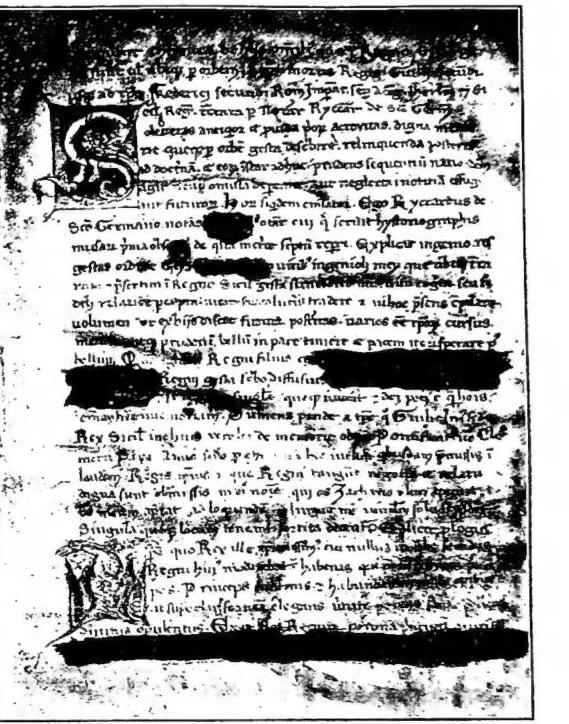
RICCARDO di MEDIAVILLA. — Franciscan philosopher and theologian, known as doctor solidus, born ca. 1249, died ca. 1307–1308. Biographical information is scant and uncertain; he is thought to have been of English origin, although the identification of Mediavilla with Middletown in England, as opposed to Menneville and Moynerville in France, is still debated.
He studied at Oxford; around 1278–80 he is found in Paris. In 1283–85 he belonged to the commission established to examine COLIVI (v.). In September 1284 he obtained his licentiate in teaching, which he exercised until June 1287. He was magister et socius at the house of s. Lodovico di Tolosa in Naples (cf. Analecta franciscana, 7 [1951], p. 14). On 20 September 1295 he was elected superior of the province of Paris. It is unlikely that he returned to England.
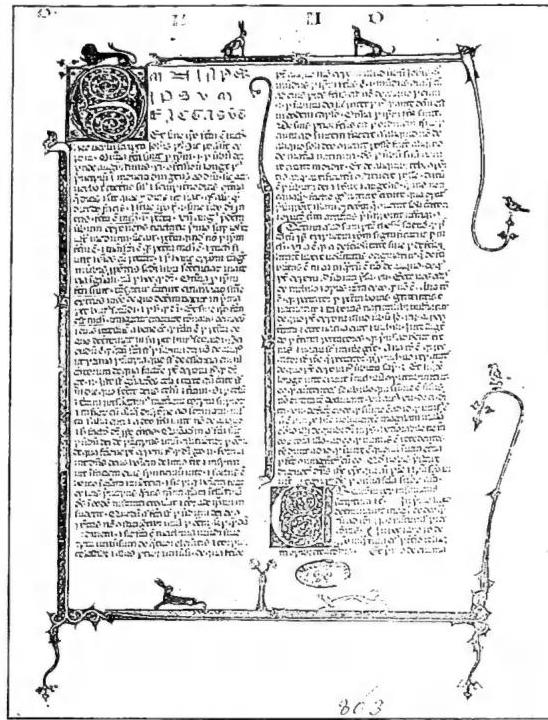
RICCARDO di MEDIAVILLA — Commentarius in librum II Sententiarum. Fourteenth-century manuscript — Vatican Library, cod. Vat. lat. 863, f. 17.
probably written in 1284 (unpublished, except for XIII in De humanae cogniziora ratione, Quaracchi 1883, pp. 221–245; for the titles cf. E. Hoedda, Les quaestiones disputatae de R. de M., in Recherches de science religieuse, 6 [1916], pp. 500–13); three Quodlibet (Venice 1507), held respectively in 1285, 1286, and 1287; Quaestio de privilegio papae Martini IV (Quaracchi 1925): this is an extensive defense of the privilege granted to the Mendicant Orders to hear confessions without the prior approval of the bishops and parish priests; Quaestio de gradu formarum (ed. R. Zavalloni, Louvain 1951, in the series Philosophes médiévaux); and four sermons, delivered ca. 1281 and 1283.
A traditionalist with respect to the Franciscan school, he often acted independently, reconnecting with Thomist positions or admitting them simply as probable. He gave particular importance to the sciences and to canon law. In theology R. remained faithful to s. Bonaventura on various theses: theology is a practical science; Grace and charity are not really distinct; the will is the foundation of the supernatural virtues; there is a composition of matter and form in the Angels and their multiplication within the same species; there is a duality of filiation in Christ, etc. He moved toward Thomism, without fully adopting it, in rejecting seminal reasons, the sin of the Angels at the first instant, the possibility of the Incarnation of the Word without sin, and likewise in regard to the impeccability of Christ, etc.
He showed himself more independent of Thomism and Aristotelianism in philosophy, where, while generally following the path of s. Bonaventura, he adopted positions of his own and placed particular value on experience, willingly directing his studies toward nature. In psychology he was a moderate realist in the question of universals; he denied the univocity of being in God and creatures, and opposed the possibility of eternal creation. In psychology he admitted the plurality of forms; the principle of individuation is supplied by the incommunicability of the essence and not by matter signata quantitate; he attributed primacy to the will over the intellect, admitting self-determination of the volitional act as the source of freedom.