Machine translation of the 1948–1954 Italian original. The original text is authoritative.
LUDOVICO di TOLOSA (LUDOVICO D'ANGIÒ), saint. — Second son of Carlo II, king of Naples, brother of Roberto d'Angiò, and great-nephew of s. Luigi IX, king of France, born at Nocen dei Pagani (or at Brignoles in Provence?) in 1274, died at Brignoles on 19 August 1297. At the age of fourteen he was sent to Barcelona as a hostage for the liberation of his father, who had been taken prisoner by Pietro d'Aragona. He remained in Catalonia until 1294. During his captivity, Celestino V promoted him to the archbishopric of Lyon (7 October 1294), but without effect.
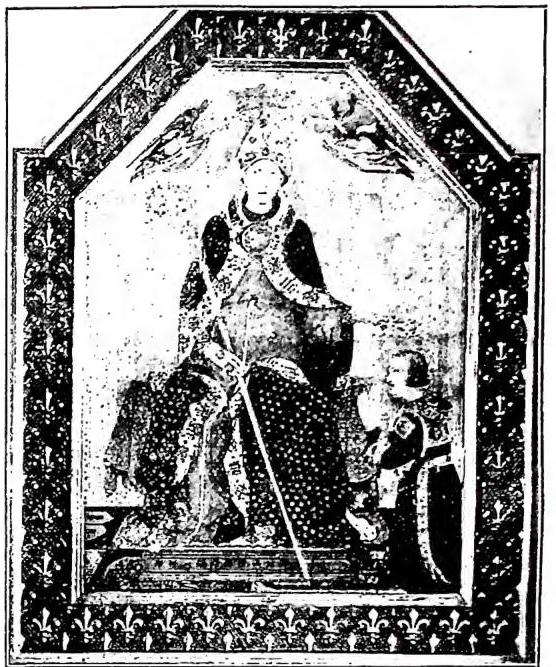
(Alinari photograph) LUDOVICO DI TOLOSA, saint — S. L. of Tolosa crowns Roberto d'Angiò king. Painting by Simone Martini (1317) — Naples, Pinacoteca.During an illness, he vowed to enter among the Franciscans, with whom he had also completed his scientific education. Consequently, he renounced in favor of his brother Roberto his rights of succession to the Kingdom of Naples. Ordained a priest in the summer of 1296, on Christmas night of the same year he made his vow; he received the Franciscan habit from the minister general Giovanni de Murro and made his vows in his hands, without undergoing the novitiate, with the consent of Pope Bonifacio VIII, who had already proposed the episcopal see of Tolosa to him and consecrated him on 30 December following. In February 1297 he departed from Rome for his see, but first went to Paris, where he met Filippo IV il Bello. He reached Tolosa at the end of April or the beginning of May. During his brief episcopate, his charity shone above all. Having departed to visit Queen Bianca, his sister, in Catalonia, on his return he stopped in Provence, where his father Carlo II was staying, and there, at Brignoles, on 19 August of the same year, he died of consumption, at only 23 years of age. According to his will, his body was transported to the Franciscan church of Marseille and in 1423 transferred by Alfonso di Aragona to the cathedral of Valencia. The process began in 1307; Giovanni XXII concluded it on 7 April 1317 with the canonization. Feast day: 19 August. He appears to have written some sermons and a treatise on music.
BIBL.: Among the ancient Vite, the important one is that of his contemporary and confidant Joh. de Orta, in Anal. Boll., 9 (1890), pp. 281–341; Acta SS. Augusti, III, Paris 1867, pp. 775–882; B. Kleinschmidt, St. Ludwig V. Toulouse in der Kunst, in Archivum Francisc. Historicum, 2 (1909), pp. 197–215; M. R. Taymber, St. Louis of Toulouse and the process of canonisation in the XIVth century, Manchester 1929; C. Vielle, St Louis d'Anjou, Vanves 1930; A. Heysse, De vita s. Ludovici ep. Tolosani contenta in codd. Paris, Nat. lat. 5376 et Ottob. lat. 2316, ibid., 40 (1947), pp. 118–42. Procesus canonizat. et legendae variae, in Anal. Francisc., VII, Quamechi 1951.
Alberto Ghinato
Cite this article
“LUDOVICO DI TOLOSA (LUDOVICO D'ANGIÒ), SANTO.” Enciclopedia Cattolica, vol. VII (1951), p. 989. Azione Romana digital edition, https://azioneromana.com/article/ludovico-di-tolosa-ludovico-d-angio-santo.