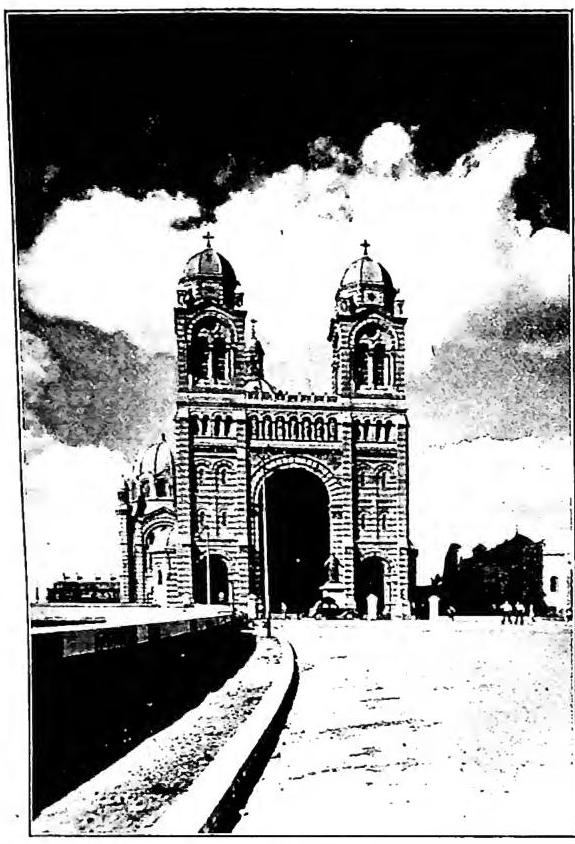
MARSIGLIA, ARCIDIOCESI di. — Capital city of the Bouches-du-Rhône department in France.
It has a population of approximately 900,000 inhabitants. The archdiocese is divided into 4 archdeaconries and comprises 110 parishes, served by 321 diocesan priests and 220 religious priests, a minor and major seminary, 26 male and 50 female religious communities (Ann. Pont., 1951, p. 265).
The diocese was initially a suffragan of Arles, then of Aix; it was suppressed by the French Revolution in 1801 and re-established in 1822. Pius IX granted the bishop of M. the privilege of the Sacred Pallium on 1 April 1851; Pius XII, by the apostolic constitution Inter conspicuio of 30 January 1948, elevated the church of M. to the rank and dignity of an archiepiscopal church, promoting the present bishop, Mons. J. Delay, to archbishop (AAS, 40 [1948], pp. 309–11).
I. HISTORY
Founded by the Phocaeans around 600 B.C., M. is the oldest city in Gaul. From that time onward, its commercial relations with the eastern Mediterranean, the Ionian Sea, Attica, Egypt, and then Magna Graecia and Italy are documented by pottery exports. Destroyed by G. Caesar in 49 B.C., it did not flourish during the Empire and retained only its port of Nice, while the rest of the territory had passed under the colony of Arles, founded in 46, which, together with its diocese, extended as far as the coast of Hyères in the 5th century.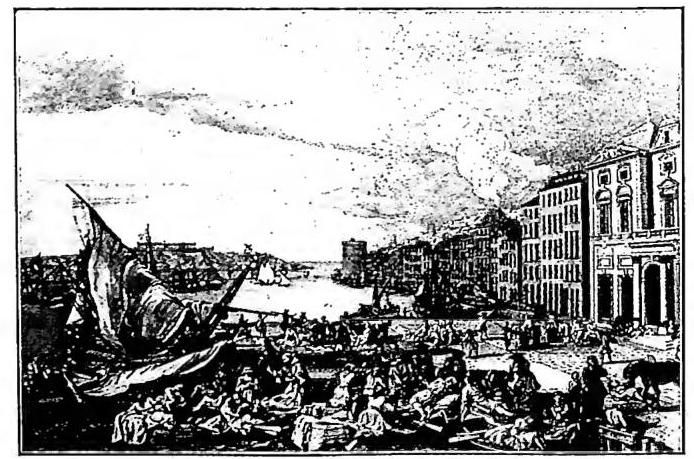
The Church of M. also possesses the lost epitaph, reported by Peiresc at Aubagne (probably originating from the « locus Gargarius»), which commemorates a Q. Vetinius Eunoctus, with the symbol of the fish, and perhaps a graffito on plaster at Saint-Remy (« locus de Gianum ») in the Alpilles, with a fish and the word ἰγθύς written twice. The sarcophagus of La Gayolle, depicting the fisherman, the Good Shepherd, and the anchor, is an imported work from the middle of the 3rd century, whose provenance is unknown and which was used in a Christian « memoria » of the 6th century at La Gayolle.
Hagiographical legends mention the martyrdom of St. Victor, an officer in the imperial army, killed under Maximian and subsequently patron of the 5th-century abbey, who must probably be identified with Victor of Alexandria. The story of Lazarus as the first bishop of M. is likewise a legend: he is said to have landed on the shores of Provence after the death of the Redeemer, in the company of the holy women Mary Magdalene, Mary of James, and Mary Salome.
Oresius, the first securely attested bishop, attended the Council of Arles in 314; he was accompanied by two representatives of the castellum of Nice, which was closely dependent on M. and would maintain its episcopal independence until the 5th century against the new bishop of Cimiez, capital of the province of the Maritime Alps. The Church of M. suffered the backlash of the ostracism to which the city had been subjected under the Empire and remained on the margins of the organization of the new ecclesiastical cities. It formed an enclosed territory within the vicariate of Gaul, whose prefecture was transferred in 395 from Arles to Trier. Its bishop Proculus (380–428) first entered into a jurisdictional Aix (v.), which had been elevated to a metropolitan see of Narbonensis II; then, in 398, at the Council of Turin, he claimed the churches of the new province of M. in which certain bishops had been consecrated by him. Lazarus, bishop of Aix, deposed in 411, at the fall of Constantine III, took refuge with Proculus and was certainly buried in the abbey of St. Victor; his epitaph (PP. Lazarus), now lost but transmitted by Peiresc, is undoubtedly the basis for locating the tradition of St. Lazarus at M. Proculus himself entered into conflict with Patroclus, bishop of Ar-
(courtesy of Mgr. A. P. Frutaz)
MARSIGLIA, ARCIDIOCESI di — The Capuchins of M. during the plague of 1720–21. Detail from an engraving by J. Rigaud — Assisi, Museo francescano.
ARLES (v.), whom Pope Zosimus in 417 had made primate of the churches of the Viennese and Narbonnese provinces.
Among its most distinguished bishops are Venerius (431–52), Honoratus (c. 495), St. Theodore (566–91), Serenus (596–601), admonished by St. Gregory concerning paintings in the churches; Maurosius in the 8th century; Honoratus II, who began the restoration of the abbey of St. Victor; Peter of Montlaur (1214–29), who founded the first chapel of Notre Dame-de-la-Garde in 1214; Cardinals Guillaume Sudre (1361–66) and Philippe de Cabassole (1356–68), patron of F. Petrarch; Mgr. C. Seyssel, who took part in the Lateran Council of 1513; Cardinal Innocent Cibo (1517–30); Eustace Gault (1639–40), an Oratorian, and his benevolent brother J. B. Gault (1642–1643); Mgr. De Belzunce, who devoted himself during the plague of 1720; J. B. de Belloy (1755–1801), later cardinal archbishop of Paris; E. de Mazenod (1837–61), founder of the Oblates of Mary Immaculate; and P. Cruice (1861–65), founder of the Institute of Advanced Studies for Paris.
II. MONUMENTS - The great Christian monuments of M. still extant are the Cathedral and the abbey of S. Vittore. Their foundation conforms to the principles of early Christian urban planning, which placed the buildings of the new cult in cities where public life continued within the ancient setting until the Merovingian period. The Cathedral, dedicated to the Madonna, is called La Major, to distinguish it from another church likewise dedicated to the Virgin, Notre-Dame des Accoules, built on the outskirts of the city, at the end of the Greco-Roman enclosing walls near the bend of the Ource, not far from the Porta Gallicana, which opened onto the coastal road.
The location of the Church of M. from the 4th century onward is attested by the presence of the baptistery, whose plan was identified in 1850, when it was demolished to make way for the new cathedral; situated north of the church, it was externally square in plan, with a central vaulted rotunda and dome supported by eight columns, and with an ambulatory inscribed within an octagon 23 m. in diameter. In the Merovingian period, however, M. was attacked or occupied in turn by Ostrogoths, Visigoths, Burgundians, Franks, and Saracens, and divided between civil and religious authority (lower city and upper city); it withdrew to the better-defended part, namely the acropolis of the hill of St-Laurent (castrum Bobonii); the episcopal see, more exposed to pirate attacks, appears to have been transferred to the site of the abbey of S. Vittore, south of Lacydon, where the church is known as «Notre Dame et St-Victor». The Chapter did not return to the ancient see until the end of the 10th century, when Guglielmo il Liberatore, after driving the Saracens from the coast of the Maures, was able to restore peace in Provence. The Cathedral, after having been for some time at Notre-Dame des Accoules, rose again from its ruins at the end of the 10th century and was entirely rebuilt in the manner of Romanesque churches, about 1150. It is of the Provençal type, with three naves; the crossing of the transept bears a dome; the apse, preceded by a choir communicating with the side aisles, is decorated with an arcade resting on small columns. Unfortunately, it was mutilated after 1850 to make room for the new Cathedral. Of the ancient structure there remains a 12th-century marble antependium representing the Virgin seated between St Lazarus and St Cannat, bishops of M. In the 15th century Francesco Laurana and Tommaso di Como, sculptors at the court of King Renato, built for the Chapter the altar of St Lazarus, enclosing his reliquary (1474-81).
The other early Christian buildings of M. arose in its suburban cemeteries. One of these, that of the «plaine de St. Michel» on the road to Italy, was situated around the church of St Stephen; it is known for the meeting held there in 581 between Duke Gundulfo and the rector Dynamius. Upon its ruins, the church of Notre-Dame-du-Mont was built in the 16th century. More famous is the abbey of St-Victor, founded by Giovanni Cassiano for the relics of St Victor. Cassiano, called to M. by Bishop Proculo shortly after St Onorato had founded the monastery of Lérins, established two monasteries on the southern shore of
(from E. F. Le Blant, Sarcophages chrétiennes de la Gaule, Parisi 1806. pl. IV) MARSIGLIA, archdiocese of - Sarcophagus known as that «of the Cassieri» (beginning of the 5th century) - Marseille.
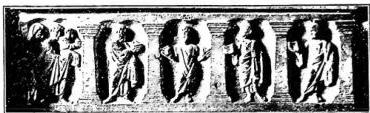
The importance of the Abbey eclipsed that of the episcopal see. Its school of theology and literature constituted a centre of religious and intellectual life, to which was attached the tendency later condemned under the name of Semi-Pelagianism. Because of the relics venerated in the church, its necropolis (partly explored in 1942) became the rival of the Aliscampa of Arles. Workshops of funerary sculpture maintained during part of the 5th century the plastic Arles (v.); to them should be attributed the fine Christian altar now preserved in the Musée Borély, decorated with doves, lambs, and vine branches.
Other churches to be noted are: the church of St Cannat or of the Preachers, with apse and bell tower of the 17th century; the church of St Ferrel or of the Augustinians, dating from the end of the 15th century, with vaults rebuilt in the 19th century; the church of Notre-Dame-du-Mont-Carmel (16th-17th centuries); and the church of St Theodore. The church of S. Vincenzo de' Paoli, also called that of the Reformed, after the former convent of the Augustinians, was erected to the design of Mons. Pouguet between 1849 and 1890. The church of the Sacred Heart on the Prado was erected following the vow of Mons. H. de Belzunce during the plague of 1720; he consecrated the city of M. to the Sacred Heart on 4 June 1722. The church has only recently been completed and opened for worship.
Among the most venerated shrines in the diocese is that of Notre-Dame-de-la-Garde, overlooking the city at 152 m. above the sea, founded in 1214; a large church was built there in 1544 and renewed in 1864 by H. Esperandieu.
In the church of S. Vittore, the statue of Notre-Dame-des-Confessions or des Martyrs is greatly venerated; likewise the shrine of Notre-Dame-du-Sacré-Coeur at Chateau-Gombert.
Among public buildings may be noted the Ecole des Beaux Arts and the municipal Library, with precious manuscripts and incunabula; the Musée des Médailles, with a unique numismatic collection of Massaliote and Provençal coins and of the Order of the Knights of Jerusalem; the museums des Beaux Arts, of natural history, Grobet Labadie, Can'un (1916), or of decorative arts in the Hôtel de Montgrand, du Vieux Marseille in the pare Amable, Chanot de la Ma-