
PALLIO. — This is a white woolen band 4–6 cm. wide, distinguished by 6 black silk crosses, wrapped around the shoulders, with its two ends hanging, one over the breast and the other down the back; it is adorned with 3 jewelled pins (aciculae), on the breast, the back, and the left shoulder.
It is a liturgical insignia of honor and jurisdiction, reserved to the pope and to metropolitan archbishops. Within 3 months of his consecration or confirmation, the metropolitan must request the p. from the pope; this obligation dates from the second half of the 9th century. The delivery or imposition of the p. takes place in Rome by the first cardinal deacon; outside Rome, at the metropolitan see, by the bishop appointed for the purpose, after the solemn Mass and after the metropolitan archbishop has pronounced the oath of allegiance (since the 11th century, instead, after the profession of faith). The metropolitan wears the p. only at pontifical Masses in his own church and in those of his province on the days established by the Pontificale Romanum (I, I, tit. XIV, n. 10), on the feasts of the Immaculate Conception and of s. Giuseppe, added by Leone XIII, and at ordinations, consecrations, etc. It is a personal insignia and may not be lent to another; if an archbishop is transferred to another metropolitan see, he must request a new one. The pope, vested with supreme power and full jurisdiction, always wears it at solemn Masses and everywhere.
It is made from the wool of 2 white lambs blessed on 21 January in the basilica of S. Agnese (v. AGNELLI, BENEDIZIONE degli). At First Vespers of ss. Pietro e Paolo, the new p. are blessed by the pope and kept in a gilded silver casket near the Confession and tomb of S. Pietro, in order to be delivered to the metropolitans.
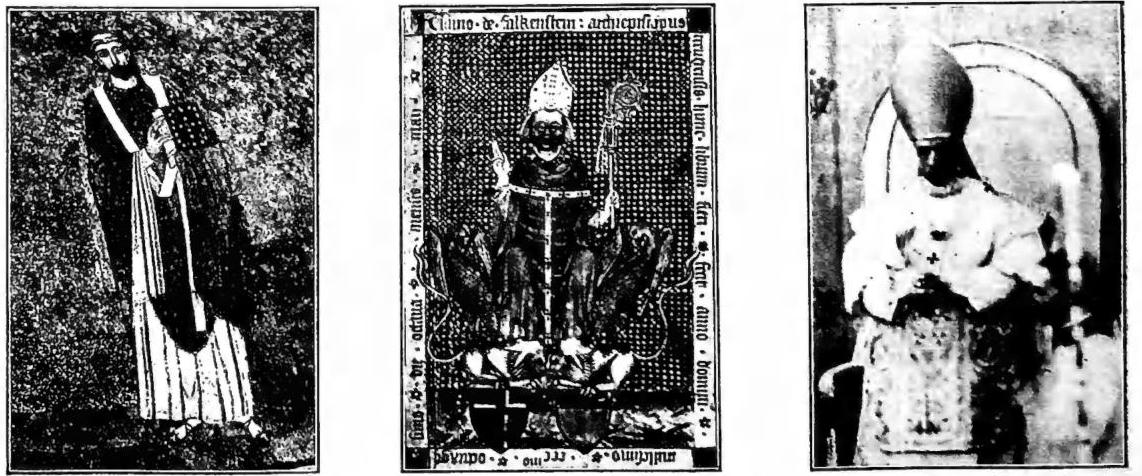
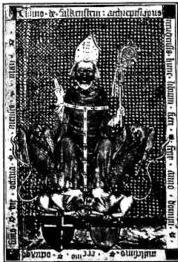
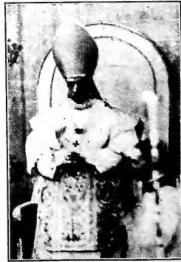
ivory of Trier, in a procession with relics (mid-5th century), and more clearly in the figure of Bishop Maximian in the mosaic of S. Vitale at Ravenna (first half of the 6th century), show it in the form of a scarf around the shoulders, with the two ends hanging from the left shoulder. From the mid-9th century the two ends began to hang down, fastened with two pins, exactly in the middle of the chest and back; a third pin secured it to the left shoulder. Subsequently, instead of the pins, there was a permanent seam; the three pins remained decorative. The two ends, originally of considerable length, reaching to the knee, were shortened after the 15th century to their present form (that of the 17th century). The ornamentation of the p. with the cross, already begun in the Ravennate mosaic, increased in the Carolingian period; in the Middle Ages (Innocent III) it was red. The p. of the archbishop of Cologne, Clement Augustus (d. 1761), had two black crosses and six red ones. At first the p. was considered proper to the pope; bishops and archbishops wore it only by his concession. This concession dates from the 6th century; Pope Symmachus granted the privilege to S. Caesarius of Arles in 513.
Regarding the origin of the p., T. Klauser has recently followed Duchesne’s thesis, namely, that it was an imperial grant; others derive it from the ancient mantle of the philosophers, similar to the folded toga contabulata (lorum). Braun, on the other hand, sees in it an imitation of the Greek omophorion (ὠμορφόριον), which in the West became an insignia proper only to the pope, whereas for all the bishops of the East it is a liturgical insignia.