
OSTENSORIO. — This is a sacred vessel (monstrantia, tabernaculum [mobile or portable], custodia) used for the solemn exposition of the Most Blessed Sacrament or for carrying it in procession, and used only in the Latin Church.
It consists of a kind of reliquary (square, round, or cylindrical in shape) fitted with glass and supported by a base resembling that of a chalice. The Host is placed in a semicircular support (called lunula or lunette because of its crescent shape, and sometimes called «Melchisedech» in southeastern Germany; Gen. 14:18), fixed inside the reliquary by means of a groove. The whole, ranging in height from 40 to 120 cm, is surmounted by a small cross (S. Congr. dei Riti, decr. 2957). Neither the material (gold, silver, or gilded copper; decr. 3162 ad 6) nor the blessing is prescribed; only the lunette, which for propriety’s sake is made of gilded metal, is blessed (decr. 926 ad 5).
The o. was introduced in the fourteenth century following the practice, which became more common in the fifteenth century, of exposing the Most Blessed Sacrament for public adoration. At first, exposition was carried out with the ciborium or with a box-shaped vessel fitted with glass.
But because of the desire to see the Holy Host and, especially, to carry it unveiled in solemn processions, special o. were constructed. Pietro Siffrin
ART. – In the Gothic period (14th–15th centuries), when its use became more widespread alongside reliquaries, from which it derived, the monstrance was conceived as a small temple, the house of the Lord, and, fully adhering to the models of archi-
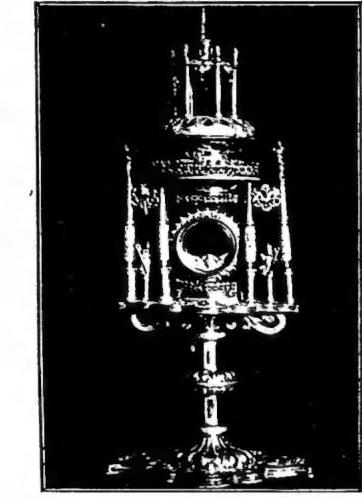
(photo: Gab. fot. naz.) OSTENSORIO – O. of the cathedral of Velletri (19th century).
pinnacles, buttresses, statuettes, changing according
to regional variations, with a prevalence
of crystal in Venice, with Catalan-style
reflected arches in Sicily or
Sardinia, and with harder,
more ironlike forms
in Lombardy (examples at Lovere,
church of S. Giorgio;
at Rossano, Cathedral; at Milan, Castello Sforzesco, etc.).
Following the example of the
grandiose o. made in
Spain and in southern Italy, especially in Sicily,
some o. reached
a height of about 2
m. and had to be
carried by hand during processions.
An exceptional example is the one preserved in the cathedral of
Enna, the work of Paolo Gili (16th century). During the Renaissance, in the various regions, also with regard to the forms of the o.,
goldsmiths looked to the models of the new architecture;
thus the general form of the o. was not changed, but small columns, pediments, and cupolas were substituted for buttresses and spires, in the search for greater harmony in the proportions, and the base and shaft were decorated with minute chased work (Peja, church
of S. Antonio; Corlago, church of S. Pancrazio), etc.
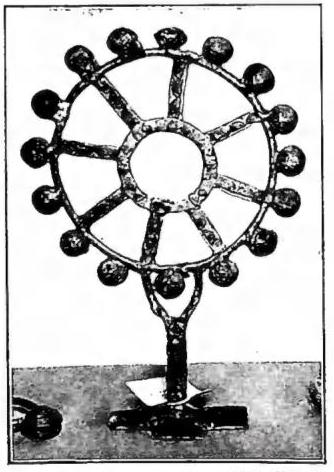
o., called «sunburst», began to be preferred. Identifying the Eucharist with the radiant sun, the crystal case containing it was enclosed
within a circular frame from which rays
of varying length extended, often alternating in gold and silver,
adorned with gems or with flowers in enamel (Palermo, S. Domenico) or coral (Trapani, National Museum). The imagination
of artistic goldsmiths gave this type other decorative
details: the shaft was interrupted or formed by figures of saints supporting the sphere (Padua, church of S. Luca;
Castel di Sangro, Cathedral), or by pairs of angels (Bagnara, mother church; Stilo, church of S. Giovanni Teresti; Vibo Valentia, church of S. Leo Luca,
etc.). Freed from every compromise with architecture, the o.
in the eighteenth century assumed splendid forms in the perfect unity
of movement that passes from the base to the shaft in a vortex
of gold, from which above rises the radiant sphere crowned
by adoring little angels, or covered with clusters of grapes
and ears of grain, as was favored by the goldsmiths Filiberto, Michele
Kuerner, Viennese, Angelo Spinazzi, Mercurio, Sebastiano
Juvara, and many others (e.g., Chiuduno [Bergamo], church
of Maria Assunta; Bergamo, church of S. Alessandro della
Croce; Piacenza, church of S. Lazzaro; Palermo, National
Museum; Messina, church of Monte Vergine, etc.).
Neoclassical taste at the beginning of the nineteenth century stiffened
the forms but did not substantially change the type, which remained
the preferred model for industrial reproductions. More
recently, at the various exhibitions of sacred art, it has been seen
with what insistence, and often with how many refined
experiments, modern goldsmiths have developed the motif
of the o., very often achieving the same nobility as the ancient
models. – Vedi tav. XXIX.