
OREFICERIA. —
I. PALEOCHRISTIAN GOLDSMITHING
In the biographies of the popes, the Liber Pontificalis contains lists of precious objects or fittings made of rare metals donated to the ancient Roman churches, but donations predating the sixth century must be accepted with reservations. Antiquity often used gilded bronze (v. the statue of Marcus Aurelius, or the shafts of the columns of the Lateran Basilica, now incorporated into the altar of the Most Blessed Sacrament). In the proper field of goldsmithing, it may be noted that silver and copper were gilded, and that there also existed an alloy of gold and silver which had the color of amber and was therefore called electrum. When two metals were not mixed by fusion but inserted into one another, the result was what is now called agemina, that is, inlay work (v. Baptistery). Metals were also decorated with engravings (chased plate). If, in order to bring out the design properly, a black paste was inserted into the cuts, the result was niello work (from nigellus). But more vivid effects were provided by the inclusion of vitreous pastes (enamels), the oldest technique being the pouring of the vitreous material into a recess (the champlevé technique, that is, the technique of the areas left uncut), followed by that of cells with applied plates (the cloisonné technique). It b-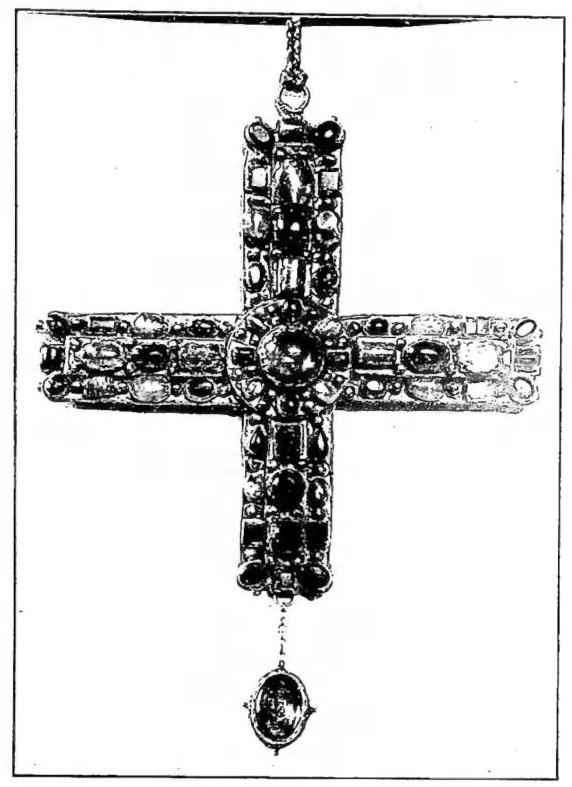
In truth, goldsmithing possessed great traditions, and therefore an entire refined technique. Bishops vied with one another to furnish the house of God with precious objects. The faithful also offered it their private belongings, including objects with profane representations, which explains why such items have been found in the treasuries of basilicas. At times sovereigns even donated their crowns. A notice in Theophanes’ Chronographia (ad a. 593) relates that the emperor Maurice received a splendid crown from Sophia, widow of Justin II, and from his wife Constantina. After admiring it, the sovereign sent it to the church and had it suspended above the altar by means of three gold chains studded with precious stones. This greatly displeased the two donors. A famous document recording a donation to a church is the Charta Cornutiana (a. 471), concerning the benefactions of the Catholic Goth Fl. Valila. It mentions, among other things, a considerable quantity of silver furnishings, in vessels and lamps, and states their total weight, ascertained on the public scales (ad stateram urbicam).
Discoveries of goldsmiths’ work (apart from the more explicitly profane objects) have been numerous. Nevertheless, they represent only a very small part of what the documents lead us to suppose, since antiquity and the Middle Ages greatly delighted in precious furnishings. Invasions, various thefts, and appropriations that led to the destruction of objects in order to melt down their metals or make use of their rare stones (as during the French Revolution and the Napoleonic period), as well as melting down or selling them to meet particular needs, reduced the immense patrimonies of basilicas and monasteries to a few, often mutilated specimens. At times an object was supplemented in a much later period.
A celebrated discovery of furnishings was that made by Grisar beneath the altar of the private chapel of the Popes in the Lateran Patriarchium (Sancto Sanctorum). Omitting the later works of goldsmithing, we may recall the gemmed cross of the sixth–seventh century, which contained a fragment of the True Cross immersed in balsam (now, like all the other relics, in the Sacred Museum of the Vatican Library). It is a work in solid gold, with settings of red stones, gem inlays, and borders of those extremely fine, beaded wires called «filigree». This «stauroteca» (reliquary of the Holy Cross) must certainly be identified with the one that Stephen II (752–57) carried in procession through Rome when the Lombard king Aistulf threatened the City. It is still covered with the balsam with which it was anointed by the Popes in the Middle Ages. Another cross-shaped reliquary from the same treasury, by contrast, is entirely made of enamel and contains representations from the cycle of the Infantia Salvatoris. An inscription on the rim gives the name of Paschal I (817–24). The «cloisonnage» of enamel here provides one of the oldest examples of this technique, since it does not consist of thin partitions but of broader crustae, which might be regarded as an imitation of opus sectile marmoreum, were it not for the borders of the inlaid pieces. Both the stauroteca and this reliquary were kept in silver boxes decorated with repoussé figures from the first decades of the ninth century. The only surviving remnant of the most ancient gifts to the Vatican Basilica (now in the treasury of St. Peter’s) is the cross of the emperor Justin II and his consort Sophia (565–78). The object consists of a gilded silver sheet with repoussé images and additions of precious stones or pearls, some mounted in capsules along the edges, others hanging. The faces of the imperial couple appear in the repoussé work. An inscription (which may be a translation of an original in Greek) declares: «Ligno quo Christus humanum subdidit hostem - dat Romae Iustinus opem et socia decorem». Among gifts to other churches in Rome, we may recall, among the relics of the Four Crowned Martyrs, a splendid round, vase-shaped case used for the head of St. Sebastian. Gregory IV (827–44) offered it to the Basilica (inscription), but the case is older than this Pope, since on its bottom is the monogram of a matron, perhaps of the fifth century: Anatole. The object is Hellenistic in style. The church of SS. Silvestro e Martino ai Monti possesses an exceptional example of a silver lamp (the gabata type), with a trellis-like interlacing and the dedication: «Sancto Silvestro ancilla sua votum solvit».
In recent times, a group of sacred silver objects was discovered near Città di Castello (at Canoscio), comprising pyxides, trays, spoons, and a strainer. The pyxides have the form of those in the Carthage treasure, now in the British Museum (a treasure rightly dated to the fourth–fifth century). The hospice of Pammachius at Porto yielded plates and a silver spoon (fourth–fifth century). They were dispersed among various collections. By contrast, a fine group of fifth-century Christian silverware from the Caelian house of the Valerii (two spoons, two amulae, a small amphora with sacred images, and a glass) is in the Sacred Museum of the Vatican Library. The celebrated Esquiline treasure should also be recalled; it is now largely in the British Museum, but its representations are exclusively profane in character.
From Antioch on the Orontes, or from its vicinity, come several sixth–seventh-century examples of silver repoussé work, including a chalice, a cross, and three book covers (the most striking one with two apostles), as well as an extraordinary chalice, a Syrian work of the sixth century. It is entirely traversed by vine foliage in openwork, while the figures of Christ, the Apostles, a sheep, and an eagle project from its surface (v. riprod. alla voce ANTIOCHIA DI SIBIA). The precious object is now in a private collection in New York. The island of Cyprus has yielded two series of objects (both brought to light in the district of Kyrenia): the first is in the British Museum, while the second is divided between the Morgan collection (New York) and the Museum of Nicosia (the latter was accompanied by coins from the period 565–685, and the other may likewise be assigned to the sixth–seventh centuries). The group in the Morgan collection is of particular interest, with plates decorated with scenes from the story of David (Wilpert believed them to be forgeries, but without sufficient evidence). The Museum of Cairo houses the treasure discovered at Luxor, where there are silver book covers with inscriptions, one of which mentions an «abba» Abraham (it was the material of a diaconia of the fifth–sixth centuries). The treasure of Stümä (Aleppo district) is in the
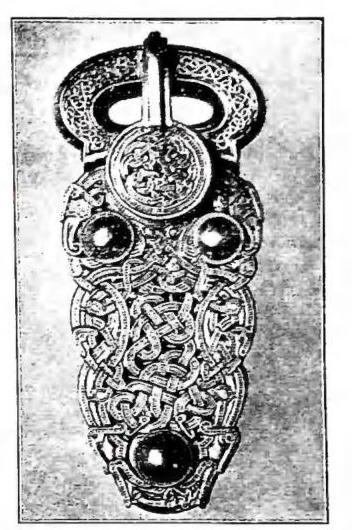
(from The Sutton Hoo Ship - Burial, London D7, ltr. 1) OREFICERIA - Large gold buckle in barbarian style from the Sutton Hoo Treasure (seventh century) - London, British Museum.
(phot. Gab, national phot. )
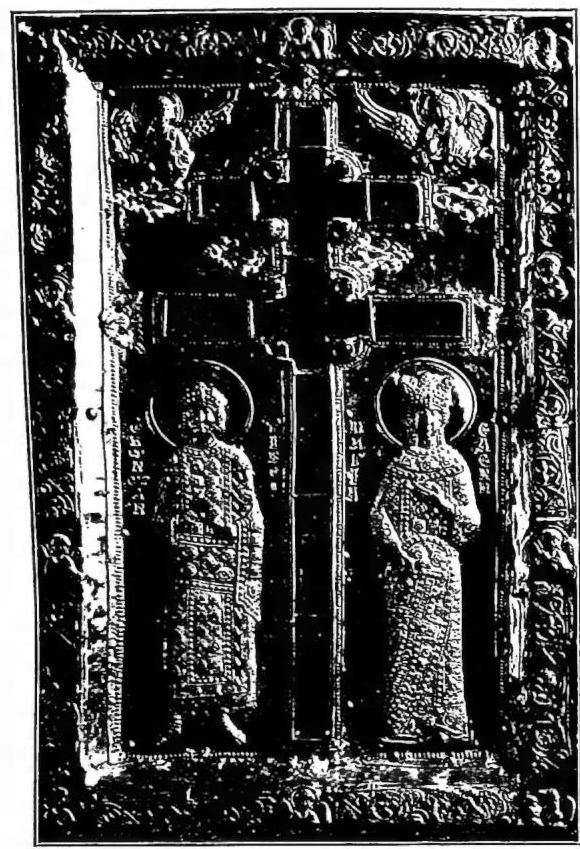
OREFICERIA - Reliquary of the True Cross with the figures of Constantine and St Helena.
Byzantine art (13th century) - Urbino, Palazzo Ducale.
It is a capsella from the Sancta Sanctorum with the Adoration
of the Cross. Examples of small reliquary chests from the
barbarian period are omitted, among which particularly noteworthy
are that of Hertford, which also has a setting of gems,
those of St-Benoît-sur-Loire, St-Bonnet-Avalouze,
the cathedral of Chur and the church of Sion, both
in Switzerland, and that of the monastery of St-Maurice d'Agaune,
also in Switzerland; the latter is a marvellous example with
a golden openwork grille on a red background, stones, and a cameo:
a Frankish work of the 7th century.
As for chalices and patens, one should recall the chalice with
two handles, entirely faceted into lobes in its lower part,
which comes from Gourdon (today in the National Library
of Paris). Garnets and turquoises are set among the delicate
gold filigree appliqués that cover the upper part of the bowl:
a Merovingian work of the 6th century, although it was found with
Byzantine gold coins. A rectangular gold plate with a cross
in the centre accompanies the chalice. The contrast between
the gold openwork and the red background is interesting. Lost
is the tall chalice of Chelles, which, besides similar openwork, had
chequered sections of white and green enamel. It was believed
to be the work of St Eligius, the famous Merovingian goldsmith. Of
historical value is the chalice of Kremsmünster (Austria), with
the epigraphic reference to Tassilo, duke of Bavaria («Tassilo
dux fortis Liutpric virgo regalis»: end of the 8th century). Elegant
in its slender form, it bears interlaced decorations comparable
to the Scandinavian ones, oval in shape and featuring figures of
Christ and the Evangelists. By contrast, the chalice of Celtic
workmanship, that of Ardagh (Ireland), is low. Of simple
workmanship and bearing an inscription concerning a deacon named
Orso is the chalice of Lamon (Trentino). V. CALICE. Among
the patens are that of Berezoff (Siberia), formerly in the Stroganoff
collection and now once again in Russia (with a fine representation of
two angels and the Cross; the work belongs more to the 5th than to the
6th century); that of Bishop Paternus, also found in Russia; and that of
Suger (green enamel background with small fish in relief in gold
sheet; a border of gold settings with stones; the object formed part
of the treasury of the abbey of St-Denis and was believed to date from
the 6th century). In our view, it may be a Merovingian production of the
7th century. Among the vessels, one should recall that of Emesa (today
in the Louvre). It is amphora-shaped and has clipei with Christ, the
Madonna, and Saints: a Syrian work of the 5th century.
The crowns suspended from the ciborium above the altar have
already been mentioned in connection with those of Monza. But one
must add the large group found at Guarrazar, now all assembled in Ma-
drid (National Museum). It is a splendid collection of votive crowns
with repoussé work, openwork, and gems. The crowns still have
their suspension chains, which are themselves finely worked. From
the centre hang crosses lavishly set with gems. It is learned from an
inscription that the donor was «Recesvin-
thus Rex» (associated with his father Chindaswinth in 649, he
became sole king in 653 and died in 672). A reliquary cross, richly
set with gems and edged with pearls (6th–7th centuries), is in the
cathedral of Tournai.
As a fixed altar worked in precious materials, only that made in the
early Middle Ages by the goldsmith Vuolvinio in the Ambrosian
Basilica can be cited. It is decorated in repoussé with the Stories
of St Ambrose and richly adorned with enamels, gems, and cameos.
Its date is disputed. Some parts were added later, but certainly
the oldest section belongs to the 9th century.
A Carolingian reliquary known only through reproductions was that
of the abbey of St-Denis. It was called l'escrain de Charlemagne,
but it must have belonged to Charles the Bald. It was entirely
studded with gems.
Among processional crosses are the well-known ones of Brescia
(Sacred Museum), Ravenna (Cathedral), and Cividale (Museum): the
first (8th century), adorned with gems and gilded glass—the most
beautiful known—with portraits of a 4th-century family; the second,
with silver repoussé medallions (busts of saints). The central part
with the Madonna is later than the 6th century, when the cross must
originally have been made; the third (with a crude Crucifix) is a
barbarian work, perhaps of the 8th century. Among the small crosses
(for individual use), several encolpia are made of precious material.
The most interesting is the gold one found at S. Lorenzo fuori
le mura in Rome and now in the Vatican Sacred Museum. It has
floral designs standing out against the dark niello background. An
annular ring set into a screw fitting has been added. An inscription
reads: «Nobiscum Deus Emmanuel - Crux est vita mihi. Mors,
inimica tibi». The work may date from the 6th century.
II. MEDIEVAL AND MODERN ART
Around the year 1000, works of exceptional beauty appear: the golden altar frontal of the basilica of S. Marco, the Gospel Book of Capua, the Cross of Gaeta, the Cross of Cosenza, the Gospel Book of Bishop Ariberto in the Treasury of the cathedral of Milan, the small altar of the cathedral of Agrigento, and the golden altar of the basilica of S. Ambrogio in Milan all display a wealth of experience and indisputable taste. From that time onward, the goldsmith’s art seems to have developed along two different lines: in the north, in the German countries, it was then practiced particularly in Hildesheim, Essen, and Ratisbona, from whose workshops came the golden altar of the cathedral of Basel, now in the Musée de Cluny in Paris. In France, on the other hand, works of goldsmithing were produced especially in the Benedictine abbey of Dijon, in Paris, at Chartres, Limoges (v.). The latter city soon assumed a decided pre-eminence over the others through the use of recessed champlevé enamels, which replaced filigree and Byzantine-style enamels. In the south, the most active center was then southern Italy, principally the court of the Norman kings of Sicily, Palermo, where Arab and Byzantine artists worked with combined experience. Here Byzantine techniques and forms were preserved with greater fidelity, while some elements of Arab taste were absorbed into the decorative repertory, such as the stylized palm tree, an example of which appears on the filigree, pearl, enamel, and gem-encrusted crown of Costanza II (Palermo, Cathedral), on the reliquary of S. Marziano (Messina, Cathedral), and on Ruggero’s superb mantle in Vienna (Kunsthistorische Museum). In Gothic goldsmithing, the tendency to imitate architecture is prevalent (13th–15th centuries), with the use of spires, pinnacles, pointed arches, and statuettes within niches, and even of the very form of reliquaries constructed like Gothic shrines. Some techniques were neglected (the use of gems set into filigree surfaces), while others were added: openwork and low relief with polished motifs on a stepped background. The pictorial effect is achieved not through the juxtaposition of colored gems but through sculpture, tooling, repoussé, openwork, and above all the use of enamels. These are now translucent, that is, poured over a relief-decorated ground, and display such a variety of colors as to rival painting, especially in Siena, the master of the new technique after the example set in 1290 by Guccio di Mannaia in the chalice made for Niccolò IV (Treasury of S. Francesco in Assisi). From Siena, highly skilled goldsmiths traveled to work in Napoli, Sicily, Avignon, and Hungary: maestro Toro da Siena was in Avignon, as was Giovanni di Bartolo, the great Sienese goldsmith and author of the exceptional reliquary bust of S. Agata in the cathedral of Catania. The perfection of the techniques (the reliquary of the Holy Corporal executed by Ugolino di Vieri da Siena in 1338 for the cathedral of Orvieto), the delicacy of the motifs, and all the experience of the Sienese school sought to surpass the Venetian workshops, where goldsmithing underwent great development in the 14th and 15th centuries, giving itself over to the most delightful caprices of the Flamboyant Gothic style. In these works, the surfaces are continually pierced, fringed, and adorned with layers of curling leaves and extremely delicate filigree around crystal vessels, with a free, rich, and felicitous compositional and ornamental imagination (chalice in the Victoria and Albert Museum, London; candlestick in the basilica of S. Marco in Venice; cross of S. Giorgio degli Schiavoni, etc.). In the other regions of Italy, too, flourishing schools arose during the Gothic period: in Abruzzo, grand processional crosses were produced especially in the workshops of Aquila, Teramo, and Sulmona, decorated with friezes and pierced spheres, with superimposed figures executed in full relief. When Sienese influence somewhat mitigated the local harshness, works of great merit were produced, especially through the efforts of Nicola da Guardiagrele, in which every detail is perceived and treated with careful expertise. In Lombardia, following contacts with France and Germany, Gothicism assumed highly pronounced forms both in the dense decoration and in the upward-thrusting line. Grandiose and magnificent imitations of Spanish goldsmithing were produced in Sicily, where, especially for the cathedrals of Palermo, Catania, and Enna, reliquary shrines were made (Catania, Cathedral: reliquary chest of S. Agata; Enna, Cathedral: shrine by Paolo Gili) on the grand scale of those by Juan de Arpha. Gothic art also took on Catalan accents in Sardegna (processional cross of the parish churches of Guspini; reliquaries in the church of S. Eulalia in Cagliari) and in Sicily (reliquary cross) at Mazzara, S. Martino delle Scale, Caltanissetta, etc. French goldsmithing was splendid during the Gothic period, and of unsurpassed elegance was the skillful union found in it of the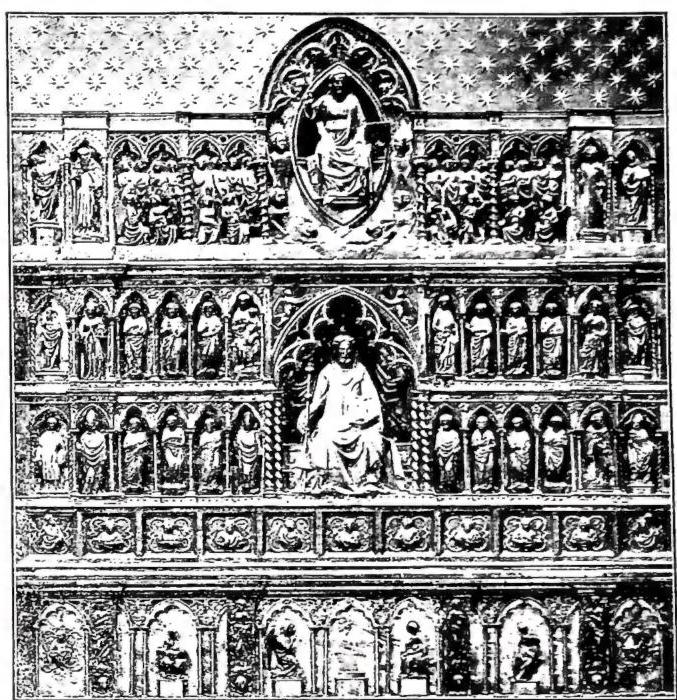
English goldsmithery of the 15th century shows a marked orientation towards French models. Goldsmithery was also very richly produced in the Iberian region, which had highly active workshops in Barcelona and Saragossa, where themes and models derived from France and Tuscany were developed. Typical are the reliquary busts in the cathedral of Saragossa, the monstrance of the parish church of Salvador de Burriana at Los Cuevas de Canart, the crosses adorned with enamels in the churches of Cuencabuena, Linares, and Parreras on the island of Majorca, and the chalices of the cathedrals of Tortosa and Toledo.
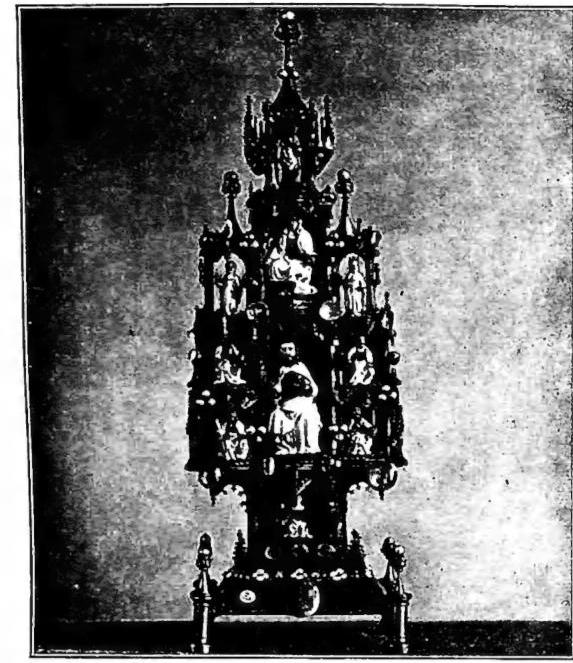
GOLDSMITHING - Reliquary. French or Flemish art of the 15th century. Paris, Louvre.
by Ugolino di Vieri; Florence, on the other hand, absorbed and imitated all the Sienese decorative achievements, but was itself inclined to transfer, wherever possible, more properly sculptural investigations into the highly malleable material. Sienese goldsmithing led to the reliquary of Ugolino da Vieri; Florentine goldsmithing to the Pistoia antependium. But Siena was unable to escape Florentine imitation, and in the first half of the Quattrocento the antependium of the baptistery of S. Giovanni was a work of sculpture in which notable artists such as Verrocchio, Pollaiolo, Michelozzo, and the most skilled goldsmiths took part; in Florence there were the most accomplished sculptors, GHIBERTI, LORENZO (v.), POLLAIOLO, PIERO (v.). These were the greatest, but, as Benvenuto Cellini says, “there have been countless practitioners of this art of goldsmithing, all of them our Florentines.” BELLINI (v.) too was both goldsmith and sculptor, and is known for his truly exceptional technical virtuosity and his acute sensitivity in responding to the voices of matter. He worked among goldsmiths of great renown, praised or hated by him, such as Luca Agnolo, Amerigo Amerighi, excellent in enamel work, Piero di Nino, expert in filigree, and Lucanio da Jesi. Few works are associated with names: the gilded silver saltcellar in the Vienna Museum with Benvenuto Cellini; the Farnese casket in the National Museum of Naples with Antonio Manno and Giovanni di Castel Bolognese; the gilded silver Cross in the Vatican Basilica with Antonio Gentile; the pax of Pio IV in Milan Cathedral with Caradosso; the pax in the Treasury of Palermo Cathedral with Sansovino; the Gospel Book of Padua Cathedral with the goldsmith Alvise; the covering of the Grimani breviary in the Biblioteca Marciana with Alessandro Vittoria; the Cross of Domaso with Pietro Lierni; and very many other works with Girolamo delle Croci, the brothers Rocchi, Giulio Danti, Bartolomeo Spano, at Lodi (church of the Incoronata), Perugia (Duomo), Reggio Emilia (Cathedral); but all the goldsmiths of the Renaissance, though working in workshops in which various survivals from earlier centuries remained, ended by employing the same techniques and drawing upon the same decorative repertory. And this occurred not only in Italy but almost everywhere throughout Europe. The technique of minute, fragile, highly elegant relief is common to all goldsmiths. Relief creates small planes, highly mobile surfaces multiplied by continuous faceting, and light, finding there curves, recesses, and planes, plays with them, kindles and extinguishes the tone of the gold, makes it transparent and opaque, pale and brilliant. Upon surfaces thus chased, plastic elements are superimposed or enclosed within niches, increasing the movement of light and shade. In their search for colour, they made use of every experience: enamel was superimposed upon minute sculptures, also adorned with hard stones, whose infinite possibilities were studied in decorating and in creating cups, objects, and jewels, and in engraving gems, studying them in the light of colour; in setting them among friezes, in modelling pearls into small figures or monsters, in engraving crystals and alternating them with chased golden surfaces, Italian goldsmiths were most expert. Not only sacred goldsmithing, but also large gilded silver dishes (Florence, Palazzo Pitti; Cagliari, Cathedral; Trapani, Museum, etc.), saltcellars (Rospigliosi collection), table stands, candlesticks, caskets, buttons, jewels—every sacred or profane object—was adorned with decorative motifs drawn from the vegetal or zoomorphic world, competing in monstrous combinations with Romanesque decoration, in naturalistic variety with Gothic decoration, and in decorative rhythms with the most changeful Oriental ornamentation: tritons and nereids, centaurs and sirens, dolphins and horses, winged fish and quadrupeds, candelabra and garlands; monsters and chimeras, dreams and follies. Ornament flourishes alike upon crosses, chalices, and jewels, a flowering of matter modelled into forms of miraculous harmony. In the last decades of the Cinquecento, decoration upon the surfaces of works could scarcely be restrained by the structural line, by the strongly accentuated projecting profiles and mouldings that articulated the surface. It was enough to exaggerate the proportions of the plastic ornaments and lessen the rigour of the architectural articulation to bring about the end of Renaissance equilibrium. From Baroque architecture, in Italy and throughout Europe, goldsmithing drew certain experiences, but rightly did not think of imitating the architectural forms themselves, even in the relation between mass and space, as had occurred in the Gothic period: it took inspiration from the instability of surfaces, from contrasts between curves and straight lines, from the grafting of plastic forms into the very course of the ascending line of stems, and from the taste for polychromy. To obtain dynamic effects, goldsmiths were driven to study the surface of the material and animate it by means of violent repoussé work and persistent hammering, while at the same time interrupting curving and undulating lines with cuts, fragmentations, resumptions, and flourishes. As the proportions of objects increased greatly, owing to that love of grandeur typical of the century, it became necessary to abandon the minute decoration dear to the Renaissance in favour of other, easier means that would make it possible to obtain magnificent effects rapidly. The various surfaces of chandeliers, candlesticks, dossals, and antependia, which formed the sumptuous ecclesiastical furnishing even in the humblest churches, were worked in repoussé and then adorned with garlands, festoons, or statuettes, or, especially in antependia, with perspectival views. The treasuries of Italian churches overflow with Baroque works, upon which, besides our own artists, foreign artists also worked, such as that Baldassarre Krigl, who for the monstrance offered by Prince Doria Pamphili to the church of S. Agnese executed a most rich encrustation of precious stones and pearls. Toward the first third of the Settecento, goldsmithing once again attained great nobility of technique and form. From the various investigations aimed at obtaining colour solely through contrasts of light and shade arose an entirely new experience: that of allowing the flows of light to run over the precious planes of silver and gold sheets, without interruptions of frames or harsh contrasts, but with the natural transition from the base to the sphere or the chalice, as in nature from root to flower. During this period goldsmithing itself exerted a strong influence on the formation of architectural Barocchetto: from the glory cards in silver sheet adorned with pendants and festoons, to the overdoors of Filippo Juvara’s palaces, from the refined motifs of table silver or antependia to the architecture of Raguzzini or the Amato, the step was brief. In the Settecento, more than of gold, it was the triumph of silver and, among all gems, of the pearl. Silver (so sweet and soft) provides artists
possibilities for continually creating effects of tranquil and pleasing light, aristocratic decorations and, when fashioned in filigree, fragile and graceful objects; the pearl, combined with pale gold, found the most delicate applications in Venetian jewelry. It is impossible to recall all the artists who worked for the Church and for palaces in the seventeenth and eighteenth centuries. Mention may be made of the Filiberti family, many of whose works remain in Parma; of Giovanni Giardina, Giuseppe Galiardi, and Antonio Gigli; of Carlo Guarnieri; of Filippo Tofani, Angelo Spinazzi, Giuseppe D'Angelo, and Pietro and Filippo Juvara. This marvelous production—which aroused enthusiasm even in Lisbon, for the furnishings of the chapel of S. Giovanni supplied by Roman goldsmiths, and in Spain, for the Sicilian silverware sent by the viceroys—was interrupted by the neoclassical fashion: it solidified the volumes, halted and stiffened the undulating decorative lines, wearied the hands, and dulled the imagination. Decorative motifs drawn from Egypt made their appearance: lotus and palm leaves on the bases, and on the column-shaped shafts, formerly fluted and furnished with Ionic or Corinthian capitals; the use of cameos, even in jewelry, and of engraved gems in Hellenistic imitation became fashionable. In general, however, the golden age of goldsmithing now seemed to have set, above all because, toward the end of the nineteenth century, mechanical production became widespread and was able to provide imitations of the ancient according to modified types suited to the functions of the Church and the needs of civil life. The execution of unique pieces came to be regarded as an exception, produced by isolated artists who continued to preserve, in Milan as in Florence, Venice, and Palermo, technical nobility and felicity of conception. - Vedi tavv. XV-XVII.