
SUGERO. — Abbot of the Abbey of St-Denis in Paris, b. at St-Denis or Argenteuil in 1081, d. at St-Denis on 13 January 1151.
He entered the priory of St-Denis de l’Estrée in 1091, where he remained for ten years and studied together with the son of King Filippo I, Prince Luigi (later Luigi VI); in 1106 he represented his abbot at the Council of Poitiers; on 9 March 1107 he met Paschal II at La Charité-sur-Loire, where the Pope consecrated the church; in the same year his abbot sent him as provost to Berneval, and then, in 1109, to Tours-en-Beauce, one of the abbey’s great estates; Luigi VI sent him as his envoy to Gelasius at Maguelonne on 15 November 1118, and to Callistus II in February 1119 at Cluny and in January 1122 at Bitonto. Upon the death of Abbot Adamo, he was appointed his successor and, having returned to St-Denis, was immediately ordained a priest on 11 March 1122; the following day he was blessed as abbot. His first concern was to reform the abbey, which had been penetrated by a worldly spirit. At the same time he continued to be an adviser to Luigi VI and VII, and during the absence of the latter, which he had opposed, for the Second Crusade, he was appointed regent of the Kingdom (1147–49). The regency was so successful that Luigi VII, on his return, bestowed upon him the title of “Father of the Nation.” Death overtook him as he was preparing to depart on a new crusade, which he himself had organized.
He left several works important for the history of the period: Vita Ludovici Grassi regis and Historia Ludovici VII (which in its present form is the work of a monk of St-Germain-des-Prés), both excessively laudatory and incomplete with regard to blameworthy episodes involving the two Kings. Several letters and political documents are also preserved, as well as a lengthy testament from 1137.
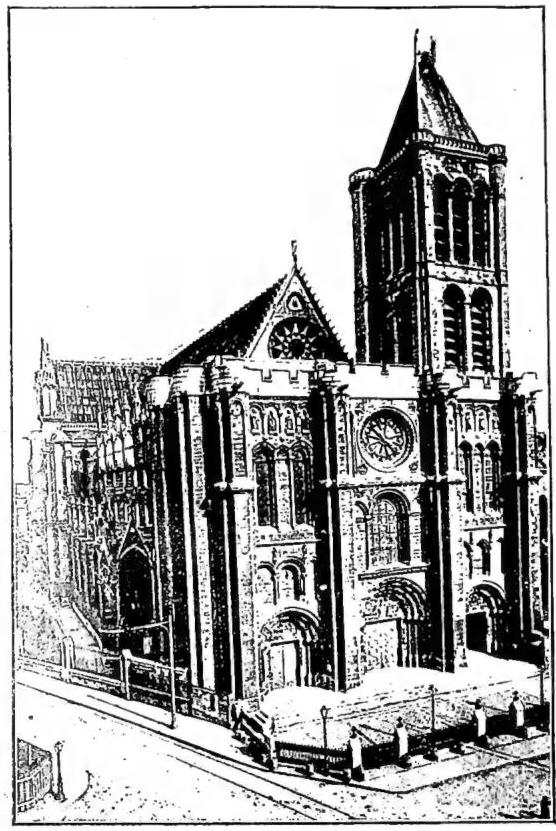
(photograph by Arts Phasomécaniques)
SUGERO - Abbey church of St-Denis, rebuilt by Abbot S. (12th century), with subsequent alterations.
262; S. Mac Knight Crosby, New excavations in the abbey church of St-Denis, in Gazette des Beaux-Arts, 1914, pp. 115–26). S. enlarged it, obtaining the monolithic columns from Pontoise and the roof beams from the forest of Yveline. The entrance had bronze doors; the one on the left belonged to the ancient church and had been donated by a monk, Airard, represented there on the two leaves offering the door to S. Dionigi. The inscription dates from the second half of the 11th century and was copied by A. van Bucher of Utrecht in 1585, and more accurately by Peiresc (L. A. van Langeraad and A. Vidier, in Mém. de la Soc. hist. de Paris et de l'Isle de France, 26 [1899], pp. 59–195, and B. De Montesquieu, in Bull. de la Soc. notion. des antiq. de France, 1946). S. offered the other two doors in gilded bronze. On the central one, the bas-reliefs represented scenes from the Passion, Resurrection, and Ascension of the Lord; S. was depicted at the feet of the Lord, seated at table with the disciples of Emmaus. He also dictated the corresponding inscriptions and surrounded the two new doors with sculptures; on the left-hand one he had a mosaic executed. The three doors were removed and melted down by the Revolution (14–20 April 1794), which shattered the heads of the statues; those that were saved are now in the Louvre Museum. On the tympanum of the central door was placed the Last Judgment, followed by medallions of the Apostles, the resurrection of the dead, the wise and foolish Virgins, the signs of the zodiac, and the months. Formigé recently rediscovered these scenes beneath a layer of dust. On 14 July 1140, the foundation stone of the new choir was laid in the presence of King Luigi VII; the crypt was then enlarged by adding radiating chapels; the high altar of the new choir was dedicated to the saints Dionigi, Rustico, and Eleutero. In the Libellus de consecratione ecclesiae S. Dionisii (ed. Lecoy De la Marche, pp. 211–38), S. described the consecration
which took place on 11 June 1144, adding to it the ceremony of laying the first stone of the foundations of the new choir. S.’s basilica subsequently served as a model for the cathedrals of Cambrai, Laon, Notre-Dame de Paris, Noyon, and Senlis. Damaged by lightning, it was begun to be rebuilt by P. de Montereau in 1230, and the work was completed in 1280. Caterina de' Medici added the Valois chapel. The explorations carried out in 1938–39 and from 1946 to 1953 brought to light part of the foundations, made of large blocks, of the Carolingian Basilica completed in 775 by Abbot Fulrado, as well as the apse and its passageway to the crypt. Formigé also identified a plan of the Holy Sepulchre traced on a stone, which is a copy of the one made by the Franciscan Bernardino Amico in 1515–16; it is known that in 1605 the canons of St-Denis called the Franciscans to serve the Basilica.