
SENLIS. — An ancient diocese and a town serving as the seat of a subprefecture of the department of Oise in France, situated on the right bank of the Nonette River and surrounded by extensive forests. In the Roman period it formed part of the second province of Belgica; it was then first called Rotomagus, later Augustomagus, and subsequently Silvanectes, from which the present name derives.
The town formed part of the Kingdom of Clovis; in 987 Hugh Capet was elected king of France there, and until Henry IV his successors often resided there. In 1417 it was besieged by the Armagnacs, but was liberated by the Burgundians and the English, who remained there until their defeat by Joan of Arc at Montépilloy in 1429.
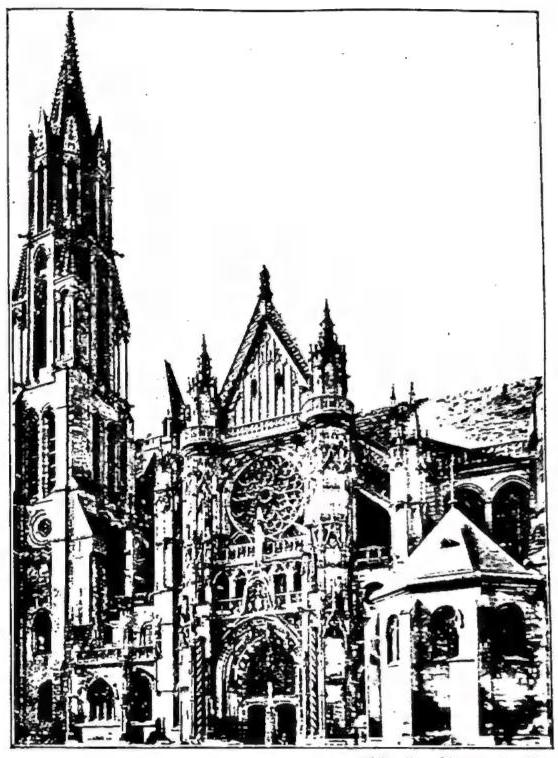
(phot. La Cigogne-Senlis) SENLIS - South portal (13th century) of the former Cathedral.
(from Marche, T.C.I., Milan 1953, fig. 186)
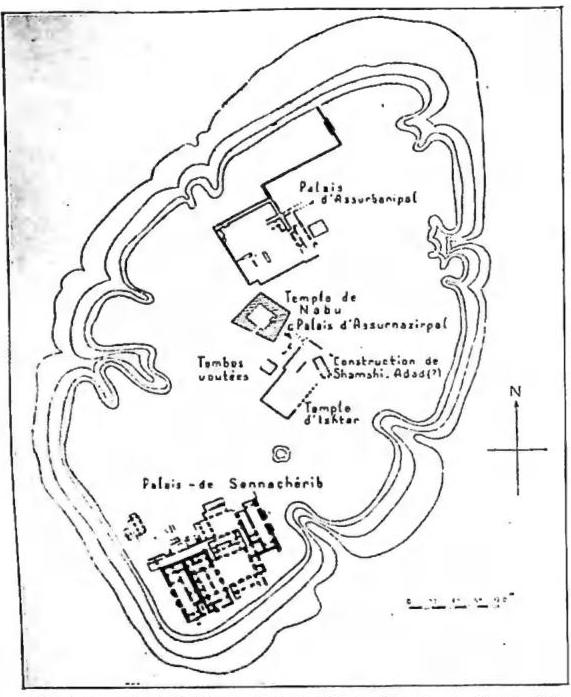
(from A. Parrot, Archéologie mésopotamienne, Les étapes, Paris 1936, p. 118, fig. 118)
SENNACHERIB – S.’s palace in the plan of Nineveh.
now transformed into a market, had been erected in 1029, but of that period only the northern bell tower remains, whose façade was added in 1432; the other, to the south, was erected in 1615; the façade dates from 1516. The three-naved interior has pillars with Gothic capitals decorated with fantastic figures; the choir and transept date from the 13th century. To the right of the church is the Public Library. The former church of St. Frambourg, formerly collegiate, dates from the end of the 13th century and has a single nave; it is now reduced to a workshop. The former Romanesque church of St-Aignan, with some Gothic additions, has been transformed into a theatre; of the former church of the Cordeliers only the portal remains, as is the case with the former church of the Carmelites, which had been erected in 1303. The Vieux Château is built on the Roman building; it served as a royal residence from Clovis to Henri IV. Under Louis VI, the chapel was erected in which St. Louis founded the priory of S. Maurizio in 1264 and deposited relics of the martyrs of the Theban Legion; it was demolished during the Revolution. The Hospital of Charity had an attached chapel dating from 1706, transformed into the Musée de la Vénérie. The abbey of St-Victor, founded in 1062 by Queen Anne, wife of Henri I, was noteworthy; today the building is used as the residence of the St-Victor College, directed by the Eudist Fathers. The church dates from 1138 and was restored in the 17th century; the bell tower is from the end of the 12th century, while the large adjoining cloister dates from 1680. 3 km southeast of S. lies the abbey «de la Victoire», founded by Philippe Auguste after the Battle of Bouvines; Louis XI made it a daughter house of the abbey of St-Victor in Paris. It was suppressed in 1783. The church was rebuilt between 1472 and 1519.