
SÉEZ (now Sées), DIOCESE OF. - City and diocese in the department of Orne in Normandy (France). It has the same boundaries as the civil department, with an area of approx. 6200 sq. km. Its population is 273,181
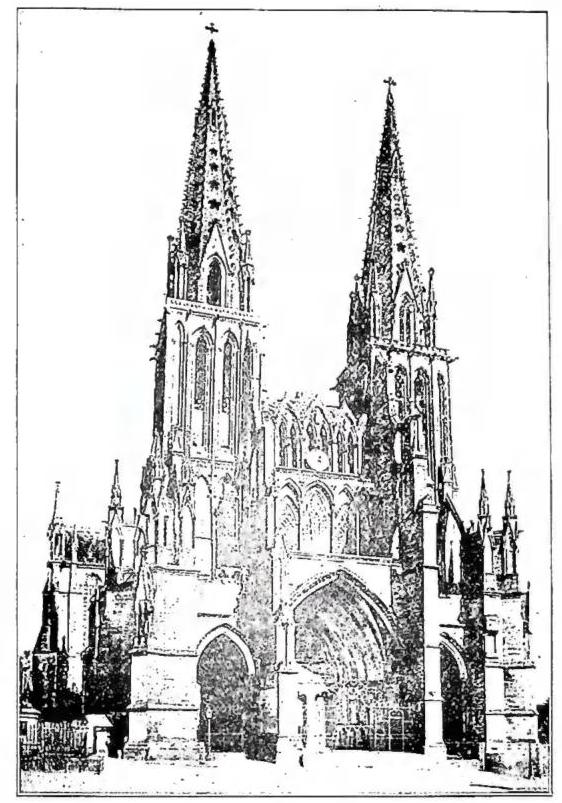
(phot. Arts photomécaniques)
It is the ancient city of the Saii. Three 12th-century codices provide the names of the bishops of S., but offer no reliability prior to the year 900; while the list lacks two certain bishops of the 6th century and two of the 9th. At the Council of Orléans in 511 a bishop Litard appears, "Uxomensis" or of Uxoma, that is, of the "pagus" of Exemes in the territory of the diocese of S. Passivus appears at the Councils of Orléans in the years 533, 538, 541, and 549, once called "Ecclesiae Bescotenae episcopus", and twice "Sagensis Ecclesiae". Leodobaudus was at the Council of Paris in 573; Amlacarius at that of Chalon-sur-Saône in 650; Sassobodo was at the Council of Germigny in 843; a letter from Pope John VIII (Jaffé-Wattenbach, 3145) is addressed to Hildebrand in 878; when S. was sacked by the Normans, Hildebrand took refuge in Monciacus (Moussy-le-Neuf [Seine-et-Marne]), with the relics of St. Opportuna, sister of St. Chrodegang of Metz, to whom he later consecrated a church in Paris. His successor Adalelm wrote the life and miracles of the said Saint. The following bishops are also remembered: Gervase the Premonstratensian (1220-28) who was in relations with Popes Celestine III, Innocent III, and Honorius III; G. Bertout (1607-11) who participated in the conversion of Henry IV; L. d'Aquin (1699-1710).
The diocese was reorganized by virtue of the Concordat of 1801, with the bull of Pope Pius VII Qui Christi Domini. Pope Pius IX by a brief dated March 7, 1871, elevated the Cathedral to a minor basilica.
The primitive Cathedral was dedicated to the holy martyrs Gervase and Protase; it was destroyed by a fire in 1048 during the time of Bishop Ives of Bellême; the present one dedicated to the B. V. Mary (Notre-Dame) constitutes one of the finest examples of Gothic-Norman architecture from the 13th to the 16th centuries. It was begun by Bishop John de Bernières (1278-92), but due to the poor quality of the terrain it underwent many restorations from the 14th century to the present day. The façade, with the two 14th-century towers rebuilt in the 19th century, was weighted down by buttresses in the 16th century. In the central portal are episodes from the life of the B. V. Mary. The interior recalls the cathedral of Bayeux; the central nave has cylindrical pillars; the choir and transept date from the 14th century; the stained glass windows from the 14th and 15th centuries; the high altar is decorated with a marble bas-relief representing the finding of the bodies of SS. Gervase and Protase, the work of Dumont (1784); in the ambulatory, the apsidal chapel contains the highly venerated statue of the Madonna under the title of Notre-Dame-des-Champs. Notable are the sepulchral monuments of the bishops of S., Mgr. Rousselet (1881) and Mgr. Tregaio (1895). To the right of the Cathedral is the Episcopal Palace, the work of Brousseau (1776), which contains in the gallery the portraits of the ancient bishops and an artistic chapel.
At the end of the 6th century, the abbey of St. Martin was founded there by St. Evrold of Ouche, destroyed by the Normans in the 9th century, and rebuilt in 1060 by Roger of Montgomery; when in 1568 S. was sacked, during the Wars of Religion, by troops led by a Montgomery, the latter respected the abbey out of regard for his ancestor. Later the monastery passed to the Congregation of Saint-Maur in 1635. Of the ancient building only a few ruins remain; in the 18th century the Grand Seminary was built in its place; the church of St. Martin has the ancient square tower rebuilt. The church of St. Peter dates from the 16th century.
In Alençon, birthplace of St. Teresa of the Child Jesus (v.), the house where she was born was transformed into a chapel. The church of Notre-Dame, erected in the 15th century and restored in the 18th, has a fine Flamboyant porch and 16th-century stained glass windows. In the diocese is the great Trappist abbey of Soligny. In 1848 the parish priest of Montligeon founded an association for the abandoned souls in Purgatory, which Leo XIII constituted as an Archconfraternity Prima Primaria.