
SENS, ARCHDIOCESE of. — City in the department of Yonne in France. It has a population of 271,685, of whom 25,000 are Catholics.
The present diocese of S. is divided into 5 archpriesthoods: S., Joigny, Auxerre, Tonnerre, Avallon (the latter two formed approximately from portions of territory belonging to the former dioceses of Langres and Autun), 37 deaneries, 49 parishes with 442 subsidiary churches, and 22 chaplaincies. The former Chapters of the ancient dioceses mentioned above have all been suppressed, and only the metropolitan Chapter remains, with ten titular canons. None of the abbeys erected under the ancien régime remains; of the former convents, only that of the Carmelite nuns of S. has risen from the ruins. In compensation, new institutions have arisen, among them the two founded by Fr. G. B. Nuard, namely, the Congregation of the Fathers of St. Edme of Pontigny and the Benedictine abbey of La Pierre-qui-Vire; in addition, the Congregation of the Sisters of Providence of S. and the community of the Dominicans of the Eucharist. Non-diocesan orders direct some schools and several charitable works. Until 1903, the diocesan major seminary was directed by the Lazarists, whereas it is now entrusted to diocesan secular priests.
I. HISTORY OF THE ARCHDIOCESE
In the absence of relevant documents, mons. Duchesne held that the episcopal list provided solid evidence, since the fourth bishop mentioned in it, Severinus, can be identified among the 34 bishops of Gaul who gave their assent to the encyclical letter of the Council of Sardica. This precision makes it possible to think that S. had an episcopal see before the end of the 3rd century. Moreover, the list may, like many others, have remained incomplete; the bishop placed at its beginning is that Sabinianus who for many centuries was venerated in S. as a martyr. Senonia, as L. Duchesne revealed, was truly the heart of ancient France. Around 385, S. became the capital of the Fourth Lugdunensis, with Chartres, Auxerre, Meaux, Paris, Orléans, and Troyes under its authority. The civil district thus served as the natural framework for the ecclesiastical organization of the province when, in the 5th century, the metropolitan system was introduced into the religious organization of Gaul, and the see of Nevers, founded after the others, was placed under the jurisdiction of S. Nevertheless, the importance of the metropolitan Church of S. was affirmed only in the 8th century, when in 769 Vilcarius of S. headed the Frankish episcopal mission that was to participate in the Roman Council charged with judging the intruder Constantine II.In the following century Giovanni VIII increased the prestige of the see of S. Wishing to reconstitute the Empire of Charlemagne, Charles the Bald had obtained the Pope’s support for the religious union of the Frankish and German kingdoms, bringing them together under the supreme authority of a prelate devoted to his cause; thus, in 876, Giovanni VIII assigned Ansegisus, archbishop of S., specific functions that placed him in a position to exercise his authority over the bishops of the two countries. But this primacy, claimed by Ansegisus’s successors, was lost two centuries later, when in 1079 Pope Gregory VII conferred on Gebuinus, archbishop of Lyon, the primacy of Gaul. Nevertheless, for a long time the archbishops of S. continued to bear, as a purely honorary title, that of primate of the Gauls and of Germany. But in the 12th century the primatial see of S. returned to prominence when, in 1163–64, Pope Alexander III, then in conflict with Frederick Barbarossa, established his residence at S. The Church of S. nevertheless continued to be the ecclesiastical metropolis of Paris; when this superiority was threatened in the 14th century, two Popes used their authority to protect S.: Clement VI, who in 1330 had been its titular, as archbishop Pietro Roger, and Gregory XI, who had been its archdeacon. Charles VIII likewise defended the old metropolis against the claims of mons. L. De Beaumont, bishop of Paris. In the 16th century the see of S. was held by the Kingdom’s most illustrious ecclesiastical figures, and thus remained secure from the rivalry of Paris, which was raised to metropolitan status by Gregory XV in 1622, who assigned to it the dioceses of Chartres, Meaux, and Orléans as suffragans.
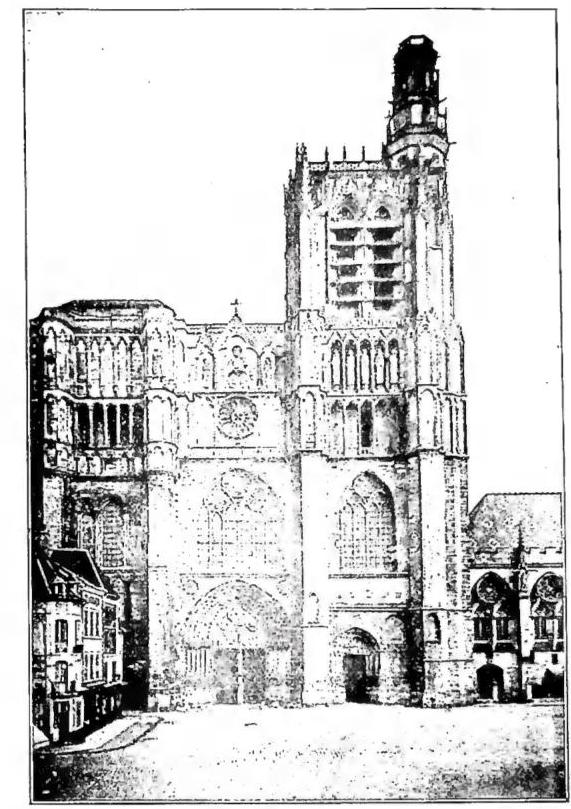
(phot. Combier Macon-Sens)
Illustrious figures of the archdiocese. - The following are remembered: s. Lupo the thaumaturge, made famous by the Legenda aurea, d. 623; Archbishop G. Cornut, d. 1241; Cardinal Duprat, d. 1536, to whom the Concordat of 1516 is owed; Cardinal L. De Bourbon, d. 1557; Cardinal L. of Lorraine, d. 1562; Cardinal de Pellevé, d. 1592; Cardinal J. Du Perron, d. 1618; Cardinal De La Fare, d. 1828.
Renato Fourrey
II. ARCHAEOLOGY AND ART
The Cathedral, dedicated to St Stephen, is a typical example of Gothic art; begun in 1130 by Archbishop Enrico Sanglier, it was altered in the 13th and 14th centuries and completed between 1490 and 1520 with the transept, under Archbishop Tristano Da Salazar. The façade (12th century) presents in the central portal the scene of the wise and foolish virgins; in the tympanum, episodes from the life of St Stephen, whose statue rises on the central pillar; above the great window are statues of Christ and two angels. The 70 small statues of angels and saints decorating the framework were beheaded on 7 November 1793, as were, in the right-hand portal, the 22 small statues of prophets and angels, the four bas-reliefs depicting the death, burial, Assumption and Coronation of the Virgin, and the statue ofPhilippe IV. The tower that rose above the portal collapsed in 1267; it was rebuilt in 1535 and contains 10 statues representing the principal archbishops of S. At the opposite corner, the bell tower rises to a height of 78 m.; the left-hand portal contains bas-reliefs of Prodigality and Avarice, while the tympanum presents episodes from the life of St John the Baptist. The transept portals are the work of M. Chambiges (1490–1513); each small statue bears the name of a personage from the Old and New Testaments. The interior, with three naves, measures 113.50 m. in length and 24.40 m. in height; the central nave is 15.50 m. wide, with alternating paired pillars and columns; the stained-glass windows, dating from the 12th to the 16th century, are of great value. In the transept they depict episodes from the lives of Abraham and Joseph, the patron saints of the diocese, Paradise, legends of St Stephen and St Nicholas, the Tree of Jesse, and the Last Judgment (16th century). In the choir, separated by an artistic grille donated by Cardinal De Luynes (1678), the stained-glass windows represent scenes from the Passion, the life of the Blessed Virgin and the martyrdom of St Stephen (13th century). In the chapel of the apse, the stained-glass windows represent the apostles St Peter, St Paul and St John the Evangelist (13th century). The ambulatory contains 12th-century stained-glass windows depicting the story of St Thomas of Canterbury, the legend of St Eustace, and parables of the Prodigal Son and the Samaritan.
The Cathedral Treasury preserves a precious series of silk textiles, including: fragments of a silk fabric with scenes relating to the story of Joseph, with explanatory inscriptions in Greek (E. Chartrave-M. Prou, Note sur un tissu byzantin à personnages et inscriptions du trésor de la cathédrale de S., in Mémoires de la Société des antiquaires de France, 58 [1897], pp. 258–70); a silk fabric with ducks and griffins, dated ca. 500 (H. Peirce-R. Tylor, L'art byzantin, I, Paris 1932, p. 103, pl. 181); a silk fabric with busts, earlier than the 6th century (ibid., pp. 102–103, pl. 180); a fragment of silk fabric with a buffalo’s head (ibid., pl. 162 b), and another fragment with a maenad, both from the 5th century (ibid., pl. 162 c); the Shroud known as that of St Columba and St Lupus, with seven superimposed bands, each containing four medallions, with confronted lions and, around them, dogs, foxes and trees (E. Chartraire, Les tissus anciens du Trésor de la cathédrale de S., in Revue de l'art chrétien, 61 [1911], pp. 372–76); the Shroud known as that of St Potentiana, removed from reliquaries in 1896 (ibid., p. 378); the Shroud known as that of the Holy Innocents, which is said to have contained relics brought by St Ursicinus; according to E. Chartraire, it dates from the time of Bishop Ansegisus (870–83), who transferred these relics from the church of St Leo to the abbey of St-Pierre-le-Vif (ibid., pp. 376–378, n. 21 and fig. 21). In addition, there is a silk fabric with medallions, confronted horses and birds, a Persian work of the 9th century (L. Duthuit - F. Volbach, L'art byzantin, Paris [1932], p. 74, pl. 89 a); a damask silk fabric with griffins, known as the Shroud of St Viardus, a Byzantine work of the 10th or 11th century (ibid., p. 77, pl. 97); a silk shroud known as that of St Victor, depicting a man grasping two lions by the throat, attributed to the 8th century (ibid., pp. 73–74, pls. 86–87); a silk-and-gold tapestry of the Adoration of the Magi, a work of the second half of the 15th century, donated by Cardinal Carlo di Borbone (1535–57); sacred vestments belonging to Archbishop P. De Charny (13th century), and to St Thomas Becket, who resided from 1166 to 1170 in the monastery of St Columba; a Byzantine chasuble attributed to St Ebo, Archbishop of S. (d. 750); an altar vestment known as «des Trois Couronnements» from the 15th century, representing the Blessed Virgin crowned by the Most Holy Trinity, Bathsheba crowned by Solomon and Esther by Ahasuerus; an ivory casket known as the «Sainte Chasse», with episodes from the lives of Joseph and David; a liturgical comb and an episcopal ring attributed to St Lupus (7th century). Also preserved are a 6th-century ivory pyx, with scenes of lion hunting (H. Peirce - R. Tylor, op. cit., I, Paris 1932, p. 94 and pl. 160 c); and an ivory diptych with scenes of the triumph of Dionysus and Selene, an Oriental work attributed to the middle of the 5th century (ibid., pp. 78–79, pl. 121).
In the chapel of the Madonna is the venerated statue of the Blessed Virgin donated in 1334.
The Archbishop’s Palace was built between 1510 and 1565. In the Synodal Palace, or «Officialité», of the 13th century, restored by Viollet-le-Duc, one may admire a large tapestry depicting the story of Judith and Holofernes, decorated with the arms of Cardinal Wolsey (1515–29); the mausoleum of Cardinal Archbishop Duprat (1525–35); medieval and Renaissance statues; and a series of Roman mosaics. The Municipal Museum is rich in sculptures, stelae, Gallo-Roman inscriptions, and collections of paintings and furniture; it also houses the Municipal Library, containing more than 30,000 volumes and 300 manuscripts, among them the Missal containing the feast of the Circumcision, with a characteristic prose composition attributed to Pietro de Corbeil, Archbishop of S. from 1191 to 1221. The binding incorporates an ivory diptych with the triumph of Diana and Bacchus. The church of St-Pierre-le-Rond dates from the 13th century; the church of St-Savinien (11th–13th centuries) preserves its early-12th-century crypt. The abbey of St Columba was founded by Clotaire II in 620; the church was rebuilt in the 12th century and demolished in 1792. Of the ancient buildings, the 13th-century refectory remains, incorporated into the modern buildings occupied by the Sisters of the Holy Childhood. Two stone reliquaries were found near the altar of the crypt of St Savinian (J. Perrin, Les châsses de pierre antiques des martyrs sénonais dans la crypte de St-Savinien, in Bull. de la Société archéol. de S., 1927–28, p. 734). A mosaic depicting two stags confronting a cantharus was published by Martigny (Mosaïque chrétienne trouvée à S., in Gazette archéologique, 3 [1877], pp. 189–94). In 1909, at the site where the abbey church of St-Pierre-le-Vif had stood, a tomb was discovered containing a Merovingian gold fibula (P. Deschamps, Note sur une fibule d'or trouvée à S., in Bull. archéol. du Comité, 1913, pp. 17–20, pl. 2 and fig. 1). Since 1844, S. has had a «Société archéologique».
Auxerre. — The ancient territory of the diocese of Auxerre corresponded to that of the two dioceses of Auxerre and Nevers before the Revolution. Around the end of the 5th century, following the political divisions between the Frankish Kingdom and the Kingdom of Burgundy, the diocese of Nevers was established from the territory of the latter. Auxerre’s glory is s. Germano, who died at Ravenna in 448. During the Middle Ages, the history of the diocese was repeatedly troubled by feudal bishops too often eager to enlarge their domains. The region was pillaged during the Hundred Years’ War and then by the Wars of Religion. The diocese was reorganized only in the 17th century. Unfortunately, in the following century it was damaged by Jansenism, and the Revolution brought about its suppression. Auxerre had 217 parishes; it was divided into the two diaconates of Auxerre and Puisaye, themselves divided, the former into the archpriesthoods of Auxerre and Vargy, and the latter into those of Puisaye and St-Bris. It had a cathedral chapter composed of 59 canons; the diocese had 9 collegiate churches, one of them in Auxerre itself, Notre Dame de la Cité. At the end of the 6th century, the church of Auxerre possessed a calendar that entered into the compilation of the Martyrologium Hieronymianum. Two canons of Auxerre, Rainogala and Alagus, with the help of Enrico, a monk of S. Germano, composed, in the time of Bishop Wala, around 875, the Liber episcopalis of the diocese up to Cristiano, known under the title Gesta pontificum Antissiodor, (ed. Duru, in Bibliothèque historique de l'Yonne, 1), after the model of the Liber pontificalis of Rome; it was continued later. Manuscript 123 of the Library of Auxerre, from the 12th century, contains biographies first from s. Pellegrino to Ugo abbot of Pontigny (d. in 1151), and then up to Erardo of Lésigne (d. in 1278). The first bishop, s. Pellegrino, is indicated as a martyr in the Martyrologium Hieronymianum on 16 May; his Passio seems to have been inspired by that of the ss. Andoro and Tirso of the diocese of Autun, from the first half of the 6th century; his successor Marcelliano is likewise in the Hieronymianum on 12 May; so too, on 6 May, is Valeriano, attested in 346; Elladio on 8 May; and Amatore (d. in 418) on 1 May. The latter’s life was written by the priest Stefano, of African origin, at the request of Bishop Annacario (Acta SS. Maii, I, p. 53). Then follows s. Germano, who is commemorated in the Sacramentarium Hieronymianum on 31 July; in 429 he was sent to Brittany by Pope Celestine to combat the Pelagians. His life was written by Costanzo, a priest of Lyon and friend of Sidonio Apollinare, at the suggestion of Bishop Paziente (BHL, I, p. 515). Then follow Elladio (in the Hieronymianum on 28 September), Fraterno (in the Hieronymianum on 29 September), Censurio (in the Hieronymianum on 10 June; Sidonio Apollinare wrote to him around 475: Ep., VI, 10), Orso (in the Hieronymianum on 29 July), Teodosio (in the Hieronymianum on 17 July), who was present at the Council of Orléans in 511, Gregorio (in the Hieronymianum on 19 December); Ottato (in the Hieronymianum on 31 August and on 2 May, where his translation is indicated), followed by Droctoaldo, Eleuterio (in the Hieronymianum on 26 August), who attended the Councils of Orléans in 533, 538, 541, and 549; Romano (in the Hieronymianum on 6 October); Eterio (in the Hieronymianum on 27 July). Then Annacario, whose ordination is indicated by the Hieronymianum on 31 July, attended the Councils of Paris in 573; in 581 and 585, those of Micon; Pope Pelagius II wrote to him in 580 and 586 (Jaffé-Wattenbach, 1048, 1057); he convened a diocesan synod and died in 605; his biography was composed in the 9th century (Acta SS. Julii, VII, p. 97). His successor Desiderio attended the Council of Paris in 614; Palladio was at the Council of Clichy in 627 and at that of Chalon-sur-Saône in 650; Vigilio was murdered around 684; Scopilio donated precious vessels to the Cathedral (684–92); Tetrico (from around 692 to 767, the year in which he was murdered); then Floccaldo, Savarico, Ainmaro, Quintiliano, Cilliano, Clemente, Aidolfo, Maurino, Aronne, who accompanied Charlemagne to Rome in 800; Angelelmo, Eribaldo, Abba, Cristiano, Wala in 872, who attended the Council of Ponthion in 876; Vibaldo, Erifrido in 909; then s. Gerano (909–14); s. Betto (933–61); Giovanni (997–98); Umbaldo (1095–1114); Ugo di Montaigu (1116–36), a friend of s. Bernardo; Ugo di Mâcon (1137–51), abbot of Pontigny; Alano (1152–67), author of the life of s. Bernardo; Guglielmo di Tracy (1167–81); Ugo di Noyers (1183–1206); Guglielmo di Seignelay (1207–20), later archbishop of Paris; Bernardo De Sully (1234–44); Guido De Mello (1247–70); Pietro De Mornay (1296–1306), who was chancellor of France; Pietro De Cros (1349–51), cardinal in 1350; Filippo De Lenoncourt (1560–62), later a cardinal; Cardinal Filiberto Babon de la Bourdaisière (1562–70); J. Amot (1571–93), a learned Hellenist; Carlo De Caylus (1704–54); the last bishop (1761) was Mons. J. B. Campion De Cicé. In 1802 the diocese was incorporated into that of Troyes and in 1822 into that of S. The pope Pius VII, in order to preserve the memory of the Church of Auxerre, suppressed by the Concordat, decided by a brief of 3 June 1823 that henceforth the archbishop of S. should bear the title of bishop of Auxerre.
The ancient cathedral of S. Stefano was built over earlier structures, the first of which was attributed to s. Amatore; the present Gothic building was begun in 1215 by Bishop Guglielmo de Seignelay, continued by Mons. Enrico De Villeneuve, and completed between 1520 and 1545. Although the southern tower of the façade remained unfinished, while the northern one rises to a height of 65 m., it too was damaged during the Wars of Religion. In the central portal are the Redeemer among the angels, the Madonna, and s. Giovanni Ev.; the Last Judgment; in the jambs, the wise and foolish virgins; in the medallions, the story of Joseph and the parable of the Prodigal Son. In the portal are scenes relating to s. Giovanni Battista, the Creation, and the Flood; on the right, the story of David and Bathsheba and statuettes of the liberal arts; farther to the right, a high relief depicting the Judgment of Solomon. The interior (98.50 m. × 39) has three naves with side chapels, which preserve remnants of frescoes and an inscription dated 1573 commemorating the restoration carried out by Bishop J. Amyot after the devastations of the Huguenots in 1567. The choir and ambulatory are in the ogival style (1215–45), with superb 13th-century stained-glass windows in medallions containing 353 subjects drawn from Holy Scripture and hagiography (R. Fourrey, Les verrières historiées de la Cathédrale d'Auxerre, Auxerre 1931). In the sacristy are paintings of the stoning of s. Stefano (1543).
The basilica of St-Germain was built in the first half of the 6th century by Queen Clotilde to house the body of s. Germano, bishop of Auxerre; the lower crypts were completed in 859, when, in the presence of Carlo il Calvo, the remains of s. Germano were deposited there.
It was dedicated by Bishop Cristiano on 20 May 865, together with the adjoining oratory of St John the Baptist, which occupied the site of an ancient baptistery whose altar was later clad in silver by Bishop Gualdrico (918–33), who was buried there nearby (Cesta Pontificum Autissidior., 44). The nave was destroyed in 1811; only the bell tower of the twelfth century remains. Beneath the choir is the eleventh-century crypt, a remnant of the Romanesque Cathedral from the time of Ugo di Chalon; it has three naves with an ambulatory. In the vault of the apse chapel is an eleventh-century fresco representing Christ on a white horse, surrounded by four angels, likewise on white horses; another fresco depicts Christ in majesty surrounded by the Evangelists, also from the eleventh century. The Treasury is rich in ivory statuettes (fourteenth–seventeenth centuries), Limoges enamel reliquaries, illuminated manuscripts, diptychs from the fourteenth to the seventeenth century, etc. To the left of the Cathedral is the twelfth-century chapel of SS. Clement and Michael, now used as a patronal chapel. The church of S. Eusebio formed part of an abbey founded around 630 by s. Pallade; it is a twelfth-century church with three naves and a choir dating from 1530, imitating that of the Cathedral, with chapels adorned with stained glass from 1616. The Treasury preserves the so-called « Suaire de st Germain », a Byzantine fabric with which Carlo il Calvo wrapped the body of s. Germano during the translation that took place in 841. The church of S. Pellegrino, rebuilt in the sixteenth century, is now used for Protestant worship; excavations carried out there in 1927–28 by R. Louis revealed beneath the ground the structures of the primitive cathedral of Auxerre. The church of S. Pietro, also called St-Père-en-Vallée (1536–72), has portals sculpted in 1646 and a large square bell tower, 45 m. high (1536–54), reproducing that of the Cathedral; the artistic stained-glass windows were damaged by bombardment. In one chapel is a wooden triptych with the Nativity. The Prefecture occupies the former episcopal palace; in it one may admire a Romanesque gallery with 18 arches resting on monolithic columns and paired colonnettes, built by Ugo di Montaigu between 1115 and 1136 and restored in 1948. The small Gothic building at the centre was erected in 1257 by Bishop Guido de Meldo and contains the former synodal hall. On the site of the castle of the counts of Nevers, in a palace dating from 1622, are located the Library and the Museum. The Library contains more than 60,000 volumes, 200 manuscripts, and incunabula. The Museum houses archaeological and numismatic collections, as well as paintings and sculptures, including a sixteenth-century wooden retable from the church of Vermenton, with a high relief representing the Dormition and Coronation of the Madonna. There is also the Musée d’Eckmühl, devoted to the Napoleonic period. More than 4 km. from Auxerre lies St-Bris-le-Vineux, with a church dedicated to the ss. Prix (whence the present name) and Cot, dating from the thirteenth century and restored in 1926; the tomb of s. Cot is venerated there, and the choir contains a fresco of the Tree of Jesse (ca. 1500). The ancient Benedictine abbey of S. Michele at Tonnerre was founded around 800 and restored around 980 by Count Milo of Tonnerre; it received a privilege from Pope Alexander III, and Cardinal Alano, legate of Pope Callixtus III, counted it among the twelve most distinguished abbeys of Gaul. The church venerated the relics of s. Teodorico, bishop of Orléans, in the first half of the eleventh century; it passed to the Congregation of S. Mauro in 1667. The ruins of the abbey are southeast of the present town (Cottineau, II, col. 3170). The Cistercian abbey of S. Edmond at Pontigny, founded by Tibaldo IV the Great, count of Champagne, around 1114 (its first abbot was Ugo, count of Mâcon, companion of s. Bernardo), received great benefactions from King Luigi VII. Three archbishops of Canterbury took refuge there: s. Tommaso Becket (ca. 1164), Stefano Langton, and s. Edmondo, who was buried there in 1242. Remains of the ancient abbey survive; the twelfth-century church measures 108 x 22 m. (50 at the transept), has three naves, and is preceded by a narthex. The choir is surrounded by 8 columns and a portico. Behind the altar is a large eighteenth-century reliquary containing the remains of s. Edmondo (Cottineau, II, cols. 2331–32). It is a pilgrimage destination on 16 November and on Pentecost Monday. The Revolution damaged the monastic buildings; in 1843 six priests founded the « Société des Pères de St Edme » in the remains of the abbey, but they were expelled in 1901 by the suppression law. The buildings were sold, but in 1947 the Fathers of St Edme returned from America, where they had emigrated, and opened a French-American College there. - Vedi tav. XIX.