
MOULINS, DIOCESE of. — Diocese and prefectural see of the department of Allier, the ancient capital of Bourbonnais. It extends over 7,381 sq. km. with a population of 375,845 inhabitants, of whom approximately 350,000 are Catholics; it comprises 320 parishes, divided into 4 archpriestships and 48 deaneries; it has 275 diocesan priests and 104 religious priests, a major and a minor seminary, 8 male and 22 female religious communities (Ann. Pont., 1951, p. 279).
The first document relating to the city of M. dates from 1147, although remains of villas, fortified sites, and Gallo-Roman necropolises have been found in several places along the Roman road that led from Lyon to Cherbourg. A modest borough in the twelfth century, it took its name from the mills situated along the banks of the Allier and the Brechmbault pond (today the Post Office and Theatre building). Arcimbaldo VI of Bourbon-Dampierre granted M. municipal franchises; between 1269 and 1290, the Hospital of St Julian was built. At that time M. possessed two chapels dedicated to St Peter: the first stood where the Cathedral now rises, while the second, called St-Pierre-de-Bourgogne, was erected in 1250. Duke Louis I of Bourbon began construction of the castle around 1340; it was completed only in 1379 by Louis II. In 1788 Pope Pius VI created the diocese of M., whose first bishop was to have been Msgr. De Gallois de la Tour, then residing in M. as vicar general of the bishop of Autun, but everything was suspended by the Revolution. The see, restored in 1817, received its first incumbent in 1822; it was formed by dismembering the dioceses of Autun, Bourges, and Clermont-Ferrand. The organizer of the diocese was Msgr. A. de la Grange de Pons (1823–49); among his successors are remembered Msgr. P. S. de Dreux-Brezé (1850–93) and E. Dubourg (1893–1906).
CLEMENS PP.XII.
Motu Proprio by Duggs which con{uio a Duro di Scena la Duga di P. P. P. P. P. P. P. P. P. P. P. P. P. P. P. P. P. P. P. P. P. P. P. P. P. P. P. P. P. P. P. P. P. P. P. P. P. P. P. P. P. P. P. P. P. P. P. P. P. P. P. P. P. P. P. P. P. P. P. P. P. P. P. P. P. P. P. P. P. P. P. P. P. P. P. P. P. P. P. P. P. P. P. P. P. P. P. P. P. P. P. P. P. P. P. P. P. P. P. P. P. P. P. P. P. P. P. P. P. P. P. P. P. P. P. P. P. P. P. P. P. P. P. P. P. P. P. P. P. P. P. P. P. P. P. P. P. P. P. P. P. P. P. P. P. P. P. P. P. P. P. P. P. P. P. P. P. P.(from G. Battelli, Escanata scriptoraria, III, Vatican City 1933, tau. 29)
MOTU PROPRIO - M. p. of Clement XII (25 July 1735). The Pope’s autograph portion is noteworthy: « Placet motu proprio (Laurentio) » - Vatican Archives, A. A. Arm. I-XVIII, 557.
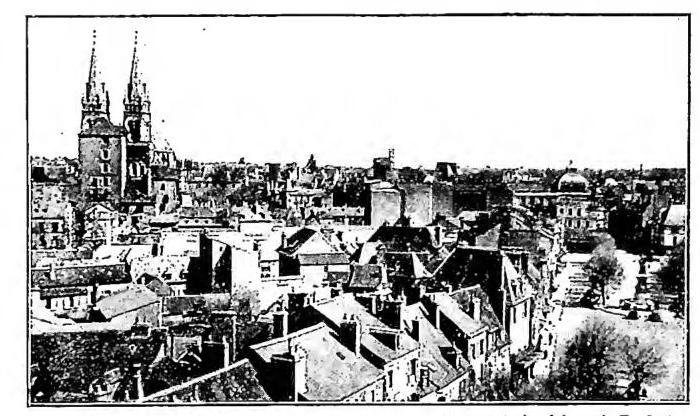
The diocese is suffragan to Sens. The foundation stone of the Cathedral (Notre-Dame) was laid in 1468 by Duchess Agnès of Bourbon to replace the chapel of St Peter, which had become a collegiate church in 1386. The building consists of a Gothic-style choir surrounded by a rectangular ambulatory of the type found at St-Germain-l'Auxerrois in Paris and St-Jean-de-Troyes. Around the middle of the nineteenth century, a three-aisled nave of five bays and a façade flanked by two tall towers were added. The choir windows date from the sixteenth century and depict
episodes from the life of St Catherine, the Crucifixion, the Madonna, the Tree of Jesse, episodes from a crusade, the martyrdom of St Barnabas, the Annunciation and the Assumption of the Blessed Virgin, with portraits of the donors. A wooden statue of the Madonna and Child known as the «Vierge noire», attributed to the twelfth century, is venerated there (E. Mâle, L'art religieux de la fin du moyen âge en France, Paris 1931, p. 288). The sacristy houses the triptych known as that of the «le maître de M.», a panel dated 1498 represent-
Within the territory of the diocese, at Souvigny (Sylviniacum), stands the Abbey of St Peter, founded by Abbot Berno in 916. His successors were St Majolus (d. 994) and St Odilo (d. 1049). The church begun by Odilo was consecrated in 1064 by Peter Damian. It was restored from 1424 to 1444 and then passed in commendam. The church (83 × 38 m) contains the mausoleums of the dukes of Bourbon. An octagonal column is surmounted by a capital with crude scenes relating to the privilege of minting money, obtained by the monks at the end of the eleventh century. The abbey Library, rich in illuminated codices, was transferred in 1790, partly to that of the city of M. and partly to the National Library in Paris. The abbey’s precious Bible, however, is preserved in the Mantis Museum of M., established in 1910 (L. Brehier, La Bible de Souvigny et la Bible de Clermont, in Bulletin de la Société d'émulation Bourbonnaise, 1910, pp. 240-55). The monastery of St-Lieu-Sept-Fonds (septem fontes), near Bourbon-Lancy, was founded by the Carthusians in 1132, suppressed in 1789, and restored by the Trappists in 1836; the abbey church was destroyed during the Revolution (Cottineau, II, cols. 1310-11). Among the venerated shrines are those of Notre-Dame at St-Germain des Fossés and of St-Georges at Bourbon l'Archambault.
sionnaire, 1948-49, Paris 1948, pp. 364, 645-47, 1061-62. For Souvigny: A. Limagne, Souvigny, son histoire, son abbaye, son église, Montluçon 1910; L. Brehier, L'église romane de Souvigny et les dates de sa construction, in Revue Mabillon, 11 (1922), pp. 1-12; 13 (1924), pp. 13-17; id., L'art de la miniature au moyen-âge et la ville de Souvigny, in Bulletin de la Société Bourbonnaise, 1923, pp. 39-52; Cottineau, II, cols. 3073-75. Enrico Josi