
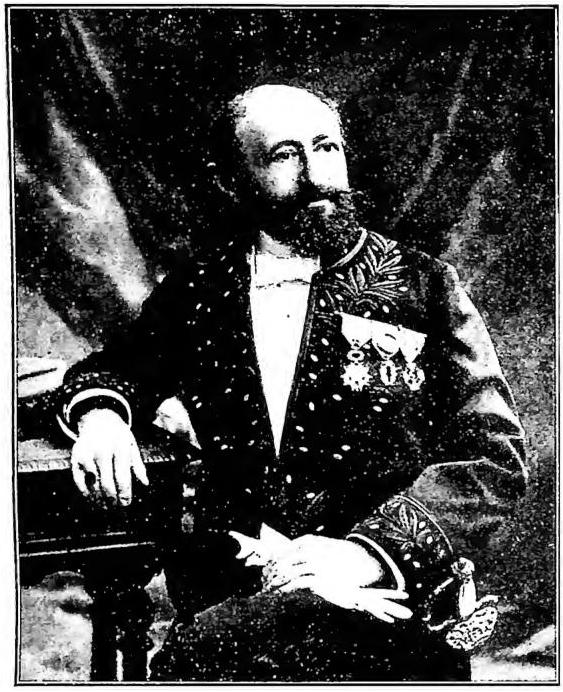
MUNTZ, EUGÈNE. - Archaeologist and art historian, b. 11 June 1845 at Soultz-sous-Förets near Strasbourg, d. 30 Oct. 1902 in Paris. He was a member of the Académie de France and of the « Société nationale des Antiquaires de France »; Italy welcomed him into almost all of its academies and also into some deputations of local history. His publications amount to about 20 volumes and 500 articles.
After completing his classical studies he immediately became a contributor to the Revue de l'Instruction publique and the Gazette des beaux arts. Having moved on to the Ecole des Chartes, he began personal research and travelled in Germany, Switzerland and Austria. When a Roman section of the Ecole française d'Athènes was established in 1873, M. was admitted to it together with Bayet, Bloch, Collignon and Duchesne, remaining there both in 1874, when the section was transformed into the Ecole archéologique de Rome, and in 1875, when it became the Ecole française de Rome.
Following the same path then indicated by G. B. De Rossi for epigraphic studies, M. devoted himself to research on documents for the history of art in library manuscripts and archival papers, places he called « sanctuaries of science » (Florence et la Toscane, pp. 255 and 270). In the Vatican Archives he extracted from the accounting registers of the pontifical court all those notices which he then gathered into three volumes between 1878 and 1882, namely: Les arts à la cour des Papes pendant le XVe et le XVIe siècles. Vol. I (1878) contains the period from the pontificate of Martin V (1417) to that of Pius II (1464); vol. II (1879) is devoted to the pontificate of Paul II (1464); vol. III (1882) runs from Pope Sixtus IV (1471) to Julius II (1513). Also the fruit of personal research are his studies on La bibliothèque du Vatican au XVIe siècle (Paris 1886) and La bibliothèque du Vatican au XVe siècle d'après des documents inédits (in collaboration with Paul Fabre), in Bibliothèque des Ecoles françaises d'Athènes et de Rome, 18 (1887); furthermore La bibliothèque du Vatican pendant la Révolution Française, in Mélanges Julien Havet, Paris 1895, pp. 579-591. In collaboration with A. L. Frothingham: Il tesoro della basilica di S. Pietro in Vaticano dal XIII al XV sec. con una scelta d'inventari inediti, in Archivio della Società romana di storia patria, 6 (1883), pp. 1-137. Of great importance are his Recherches sur l'oeuvre archéologique de Jacques Grimaldi ancien archéoise de la Basilique du Vatican d'après les manuscrits conservés à Rome, à Florence, à Milan, à Turin et à Paris, in Biblioth. Ecoles franç. etc., I, II, Paris 1877, pp. 225-69. Furthermore Les architectes de St-Pierre de Rome d'après des documents nouveaux (1147-1549), in Gazette des beaux-arts, 19 (1879), pp. 353-368; 20 (1880), pp. 506-29; Les tombeaux des papes en Allemagne et en France, in Revue de l'art chrétien, 7 (1896), pp. 347-56; 453-56.
Notable too is the study on La tiare pontificale du VIIIe au XVIe siècle, in Mémoires et l'Acad. des descript. et belles lettres, 36 (1898), pp. 235-324; original is the work on Les roses d'or pontificales, in Revue de l'art chrétien, 5th series, 12 (1901), pp. 1-11. The residence of the popes at Avignon likewise prompted a series of articles on the architects of the Pontifical Palace in the Bulletin des Antiquaires de France between 1882 and 1890, afterwards gathered together; he studied Les peintres d'Avignon pendant le règne de Clément VI, in the Bulletin monumental (1885); in particular the paintings of Simone Martini in the Mémoires des antiquaires de France, 45 (1885), pp. 67-92; and La statue du pape Urbain V au musée d'Avignon, in Gazette archéologique, 9 (1884), pp. 98-104. For Christian archaeology E. M. wrote Les sources de l'archéologie chrétienne dans les bibliothèques de Rome, de Florence et de Milan, in Mélanges d'archéol. et d'histoire, 8 (1888), pp. 81-146. He collected a series of documents relating to the Christian mosaics of Rome, Naples, Siponto, Capua, Vercelli, Olona and Albenga, in twelve articles in the Revue archéologique from 1874 to 1901; three studies on those of Ravenna and Rome appeared in the American Journal of Archaeology (1885, pp. 115-30; 1886, pp. 295-313; 1890, pp. 1-9). In the Mémoires de la Société Antiquaires de France (52 [1891], pp. 238-322), he dealt with the technique of mosaics; in the Mélanges Paul Fabre he gathered the notices on the Premiers historiens des mosaïques romaines (Paris 1902, pp. 478-95). E. M. lived for the glorification of art, of artists and of their patrons; his ideal was above all the Renaissance.
His volume Les précurseurs de la Renaissance is from 1881, followed as an appendix by Les collections des Médicis au XVᵉ siècle, Paris 1888; the two volumes were revised by the author and translated into Italian by Guido Mazzoni (Precursori e propagatori del Rinascimento, Florence 1902). He felt the fascination of Italian art. Then his three great volumes on L'histoire de l'art pendant la Renaissance: L'Italie, Les primitifs, Paris 1889 (Italian ed.: L'arte italiana nel Quattrocento, Milan 1894); II. Italie. L'âge d'or, Paris 1891 (Italian ed., L'età aurea dell'arte italiana, Milan 1895); III. Italie. La fin de la Renaissance, Michel-Ange, Le Corrège, Les Vénitiens (Paris 1895). He brought out the works of Francesco Laurana, importer into France of the art of the Renaissance, the constant collaboration, during the 14th century, of Italian and French artists, the influence of the Italians in France, during the Middle Ages, in the art of the medal, and above all the Italian origin of the French Renaissance. His stay in Florence prompted the volume: Florence et la Toscane; paysages et monuments, moeurs et souvenirs historiques, Paris 1897 and 1901.
He favoured Raphael above all; he wrote in fact: Raphaël, sa vie, son oeuvre et son temps (Paris 1881; 2nd ed. 1886; 3rd ed. 1900; English eds., London 1882, 1888, 1896). Les tapisseries de Raphaël au Vatican et dans les principaux musées ou collections de l'Europe, Paris 1897. After a series of articles on Leonardo da Vinci, his time and his works, he printed the volume Léonard de Vinci, l'artiste, le penseur, le savant, Paris 1899, translated into English in two volumes. He devoted a volume to Donatello, while his work on Botticelli was cut short by death. Furthermore Pétrarque, ses études d'art, son influence sur les artistes, ses portraits, et ceux de Laure, l'illustration des ses écrits, Paris 1902. As early as 1874 E. M. had published documents on the workshops of the Gobelins in the first half of the 17th century in France, in Italy and in Flanders (Revue des Sociétés Savantes, 5th series, 8 [1874], pp. 509-20). His stay in Italy yielded the volume Histoire de la tapisserie, Paris 1878-84, followed by the volume La tapisserie (ibid. 1884, translated into English and Spanish), as well as a series of articles on Les tapisseries d'Arras à la fin du XIVᵉ et au commencement du XVᵉ siècle (Le Courrier de l'art chrétien, 5 [1886]). Furthermore Les tapisseries à l'époque de Louis XII (Les lettres et les arts, Paris 1886) and again on L'inventaire des tapisseries de la Tour de Londres à la mort du roi Henri VIII, 1547 (L'oeuvre d'Art, 1899). He did not neglect miniatures either, as his studies on Matteo de' Pasti (Le Courrier de l'art chrétien, 2 [1883], p. 599 ff.), on Florentine miniature painting in the 15th century (L'art, 1 [1883], p. 157 ff.), French miniatures in Italian libraries (La bibliofilia, 1902) and the volume of Etudes iconographiques et liturgiques sur le moyen-âge, Paris 1887, in which he also treats of Irish and Anglo-Saxon miniature painting of the 9th century, demonstrate. Also in the field of goldsmithing E. M. studied the work of Giovanni Bartolo di Siena orfo della corte di Avignone nel XIV sec., in Archivio storico italiano, 5th series, 2 [1888], pp. 1-20.
In 1876 E. M. was appointed deputy librarian of the the École des Beaux-Arts, of which he became librarian and curator of the archives and collections in 1878. From 1884 to 1893 he replaced Taine in the chair of aesthetics and art history at the same school and at the University of Geneva. The scholar's lofty aims are contained in these golden precepts: art must not serve as an aid to corruption, but must strive to moralize its contemporaries and to leave to posterity models destined in turn to educate future generations; art must serve the education of the masses (L'art et la morale, in Revue bleue, 1898, p. 742).
BIBL.: sources