MURANO, SCHOOL OF ART OF. - In the course of the 15th century, M. gave birth to a considerable number of artists who, although without forming a pictorial school with characteristics of its own, added luster to the name of the island and spread many works on the mainland and along the Adriatic coast.
Among all of them, the most important are the painters of the Vivarini family (v.): ANTONIO, the eldest (b. c. 1415, d. between 1476 and 1484) with works dated from 1441 to 1469; his brother BARTOLOMEO (b. c. 1432, d. c. 1499), and Antonio's son, ALVISE (b. 1445-46, d. 1503-1505). These artists each had a distinct personality and evolution, and without great mutual ties, except for an initial period of collaboration between Antonio and his brother, and Alvise's apprenticeship under his uncle Bartolomeo.
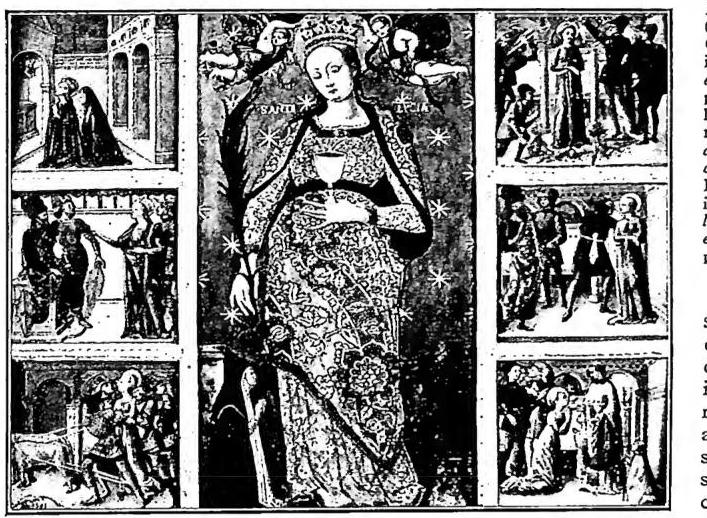
Other painters are: QUIRIZIO DA M., documented from 1401 to 1478, a follower of Antonio Vivarini, whose ingenuous grace and late-Gothic characteristics he preserves, while nevertheless coming under the influence of other artists such as Crivelli and Bellini; his certain works: a triptych: St. Lucy and scenes from her life, at the Accademia dei Concordi in Rovigo, a Redeemer, at the Accademia in Venice, notable for its profound Bellinian landscape, and a Madonna, also at the Accademia. ANDREA DA M., documented from 1462 to 1502, enjoyed considerable fame in earlier times, which recent criticism tends to confirm. A follower of Bartolomeo Vivarini, whose assistant he also was, he has a harsh, broken manner, at times a little coarse but nevertheless frank and effective, which in his best works reveals the influence of Andrea del Castagno, as in the triptych of the Accademia in Venice with the Madonna of Mercy and various saints. Other works are the great altarpiece of Trebaseleghe (begun in 1484), which has passages of great effect, a Crucifix in the Museum of Merano, a St. John the Evangelist in a private collection in the United States, the late and weak altarpiece of Mussolente (1502), etc. Recently the hypothesis has been advanced that Andrea da M. is the author of the parts