
VIVARINI, FAMIGLIA. – Murano painters active in Venice from approximately 1440 to the early 1500s.
ANTONIO. — Son of Michele the glassmaker, he is mentioned in numerous Venetian documents from 1446 to ’66; he died between 1476 and 1484. During his first and most important period, he painted Giovanni d'Alemagna (v.), producing numerous works in Venice and Padua, where he is recorded as enrolled in the painters’ fraglia in 1447: the polyptych of S. Girolamo, formerly in S. Stefano (1441, Vienna Museum); that of S. Monica in the same church (five small scenes from the Saint’s life survive in the Museums of Murano and Detroit, in the Lee Collection in Richmond and the Keester Collection in London, and in the Gall. Carrara in Bergamo); the three altarpieces of the chapel of S. Tarasio at S. Zaccaria (1443–44); the Coronation of the Virgin at S. Pantaleone (1446); the solemn Madonna with Saints of the Scuola della Carità (1446, now in the Accademia); and the polyptych formerly in S. Francesco at Padua, now at Konopište (1447). Scholars have sought to distinguish the two artists’ individual personalities, but so far without convincing results, since works certainly by Alemagna are lacking, nor is the only painting signed solely by Antonio in this
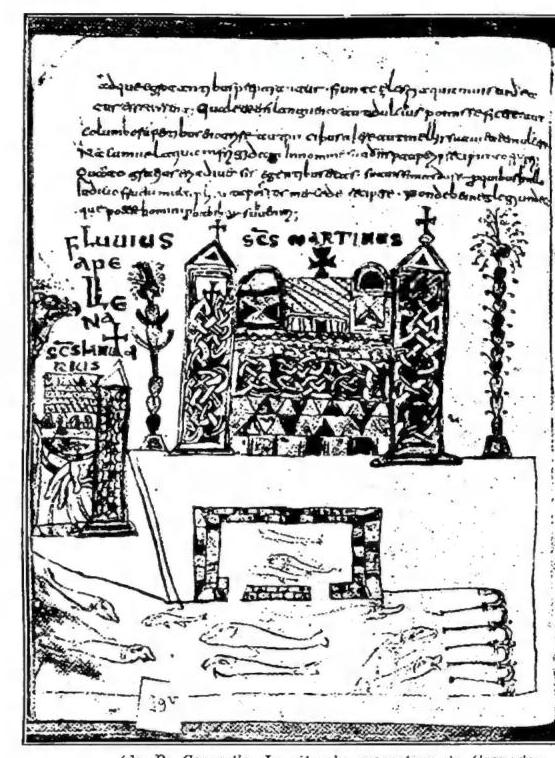
VIVARIUM – Depiction of the monastery of V., with its churches and its vivarium. Eighth-century miniature – Bamberg, Library, cod. Patr. 61, fol. 29r.
period, the polyptych of Parenzo, of modest quality in many of its parts (the reading of the final digit of the date is uncertain: 1440 or 1442). Although the artistic unity of the works signed by the two partners is such as to render this investigation almost superfluous, it is now generally held that Antonio played the predominant role in the collaboration, with the German’s contribution limited to the more distinctly decorative passages. His style, which in these youthful years possesses a very particular charm through the softness of its forms and the enchantment of its colour, reveals the influence of Gentile da Fabriano and, even more strongly, that of Masolino, who may have stopped in Venice on his return from Hungary in 1435–40.
To this period, which concluded with the decoration of the vault of the Ovetari Chapel at the Eremitani in Padua, left unfinished at Giovanni’s death (1450), are also assigned: the Madonna in S. Tommaso in Padua (perhaps from the same altarpiece are two panels with saints in the Gallery in London), the polyptych formerly at Praglia and now in Brera, the Madonna in the Poldi Pezzoli Museum and that of Città di Castello, and the S. Orsola and saints in the Seminary of Brescia. In that same year, 1450, with the important polyptych now in the picture gallery of Bologna, Antonio’s collaboration with his brother Bartolomeo began, as did his approach to the latter’s Mantegnesque-Paduan manner. To this period belong the Cagnola triptych (1452) and the polyptychs of Arbe (1458), Osimo, and Corridonia (ca. 1462). Paduan features are also displayed by Antonio’s late works executed alone, such as the feeble polyptych in the Vatican Pinacoteca (1464) and the saints in the Museum of Bari (1467).
BARTOLOMEO. – Born in Murano around 1432, died around 1499; his works are dated from 1448 to 1491. He was probably a pupil of his brother Antonio, with whom he collaborated for more than a decade (v. SORA), yet from the outset he established himself with a highly personal style, inspired by Mantegna and the Paduans. After the youthful
Madonna of the Lane Collection (1448) and the works produced in collaboration with Antonio, beginning in 1459 (the date of the St. John of Capistrano in the Louvre and of a Madonna in the Museo di Murano), he produced for approximately twenty years numerous works representing the finest period of his activity: the polyptych 615 of the Accademia in Venice (1464), the Madonna enthroned of the Pinacoteca di Napoli (1465), the triptych of S. Maria Formosa (1473), the polyptych of SS. Giovanni e Paolo (1473), of which a S. Agostino and two other Saints remain, to be ranked among his most sober and monumental works, the triptych of S. Marco ai Frari, the polyptych of S. Ambrogio at the Accademia (1477), the Madonna and Saints of S. Giovanni in Bragora (1478), etc. After these years Bartolomeo’s art declined into an often empty and weary repetition of motifs that had become the property of his large workshop, which disseminated his works even in distant centres, especially along the Adriatic coasts and in southern Italy.
ALVISE. — Son of Antonio, born in Venice around 1445–1446, died between 1503 and 1505. Educated in the family’s artistic milieu, he followed above all the Paduan school and his uncle Bartolomeo, whose petrified forms he echoes in the polyptych at Montefiorentino in the Marches (1475, his first dated work) and in the one with the Pentecost and Saints in the Berlin Museum, both constructed according to traditional Gothic schemes, which Alvise later abandoned in favor of a freer composition in the Madonna and Saints in the Gallery of Venice, dated 1480. In this work and in his subsequent paintings (St. Clare and St. Martyr at the Accademia; triptych in the Museum of Naples, 1485; altarpiece with the Madonna and Saints in Berlin), the influence of Antonello da Messina is clear, and Alvise became one of his most faithful interpreters in Venice. Influences of Giambellino can be observed in the Madonna and Sleeping Child in the church of the Redentore and in those in S. Giovanni in Bragora in Venice and in the Museum of Capodistria. In the late works (Resurrected Christ in S. Giovanni in Bragora; altarpiece of S. Ambrogio at the Frari, completed by Marco Basaiti), the harshness of the forms is considerably softened. Also worthy of mention, besides several portraits (one of a Gentleman in the National Gallery in London, dated 1497), are the youthful St. Matthew and the Baptist at the Accademia, the marvelous bust of St. Anthony in the Correr Museum, a St. Jerome in the Kress collection in New York, and a Christ Carrying the Cross at SS. Giovanni e Paolo, recently restored. Alvise’s importance, although considerable, was for a certain period overestimated, as numerous works were attributed to him that were later restored to Giambellino. — Vedi tav. CLIII.